


The Illusory Promise of Fast-Track AI Tech Startups: Lovable Dev Trends 2026

Lovable’s recent report looks incredible at first: 1 million new projects are created on the platform every week.
Is this a revolution in the tech world? Is AI-enabled vibe coding disrupting the software development market? In a world where 100 million people are already paying for subscription-based AI tools and over 2.4 billion users take advantage of free AI chatbots, the answer is yes.
The 4IRE team partnered with Actana Research to clarify what really stands behind the whopping 1 million stat, and what it means for the global tech industry.
Apps and Projects People Build with Lovable
The first point to keep in mind is that 1 million new projects doesn’t mean 1 million new startups. People build prototypes, landing pages, internal business tools, mini-SaaS products, and MVPs using Lovable, but only a tiny portion of these projects will grow into real businesses.
Lovable is an AI app builder that lets users create working software using natural language with the help of vibe coding.
Its recent report shows that people not only experiment with tech but also build real, working software like websites, internal tools, CRMs, inventory systems, e-commerce storefronts, etc. A quick breakdown by project category looks as follows:
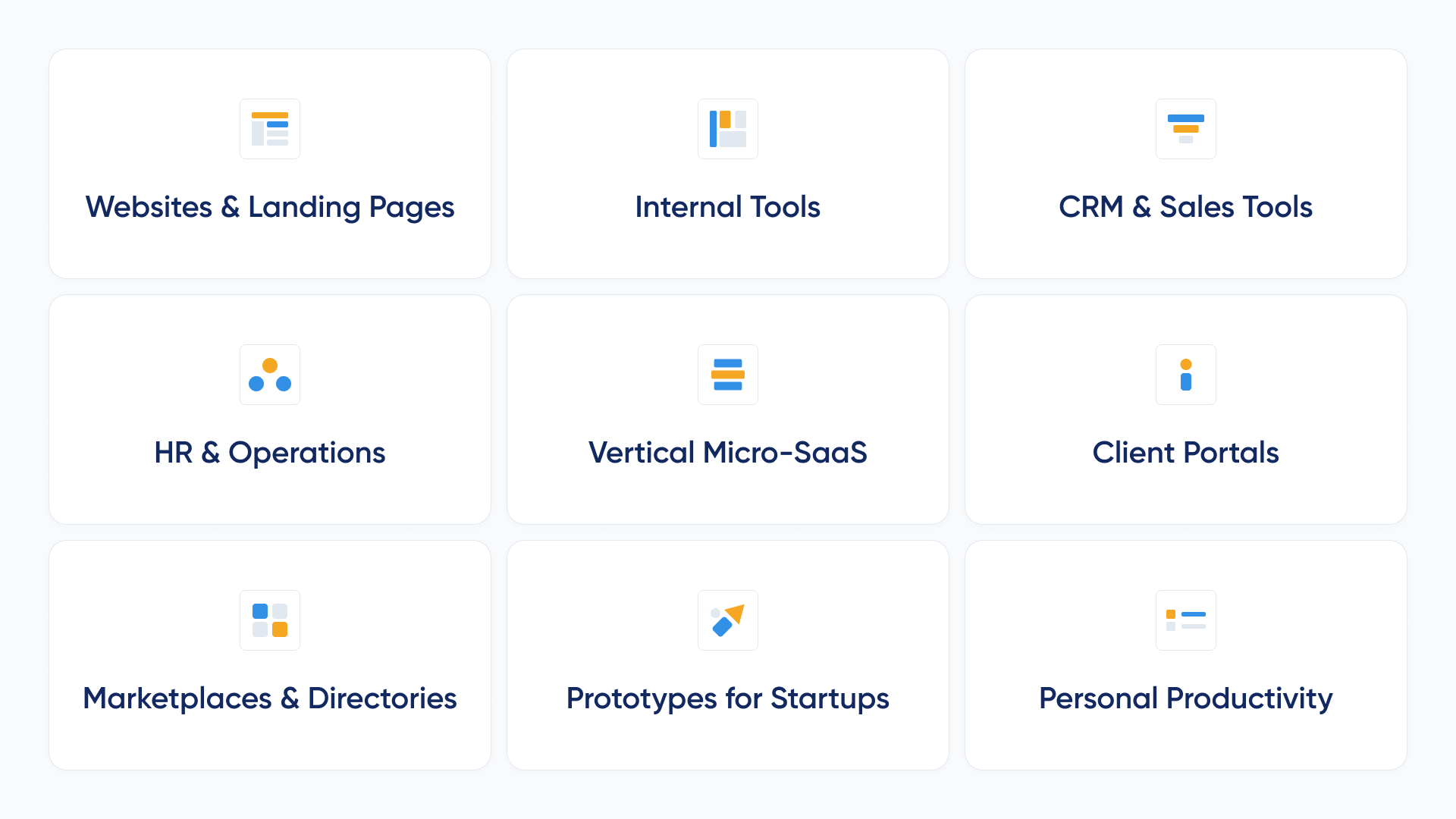
The most important thing in the rise of Lovable-based vibe coding is that 4 out of 5 builders are people without technical expertise. Software development remains the largest represented industry, but almost two-thirds of users come from other niches, including retail, media, finance, healthcare, education, and the like.
1 Million Projects a Week: A Realistic Figure
Following Lovable’s internal report, user activity statistics are more than impressive:
- 50M projects built to date
- 1M new projects built every week
- 720M visits to Lovable-built projects every month
Yet, a closer look at the 1-million figure from Lovable makes it less incredible if you understand that a project may mean:
- One test prototype
- One version of a landing page
- One internal utility tool
- One experiment
- One educational project
- One side-project
- One MVP that will never be launched
- One working tool for internal business use.
This consideration turns 1 million projects into 1 million acts of software creation, with a real project funnel looking this way:
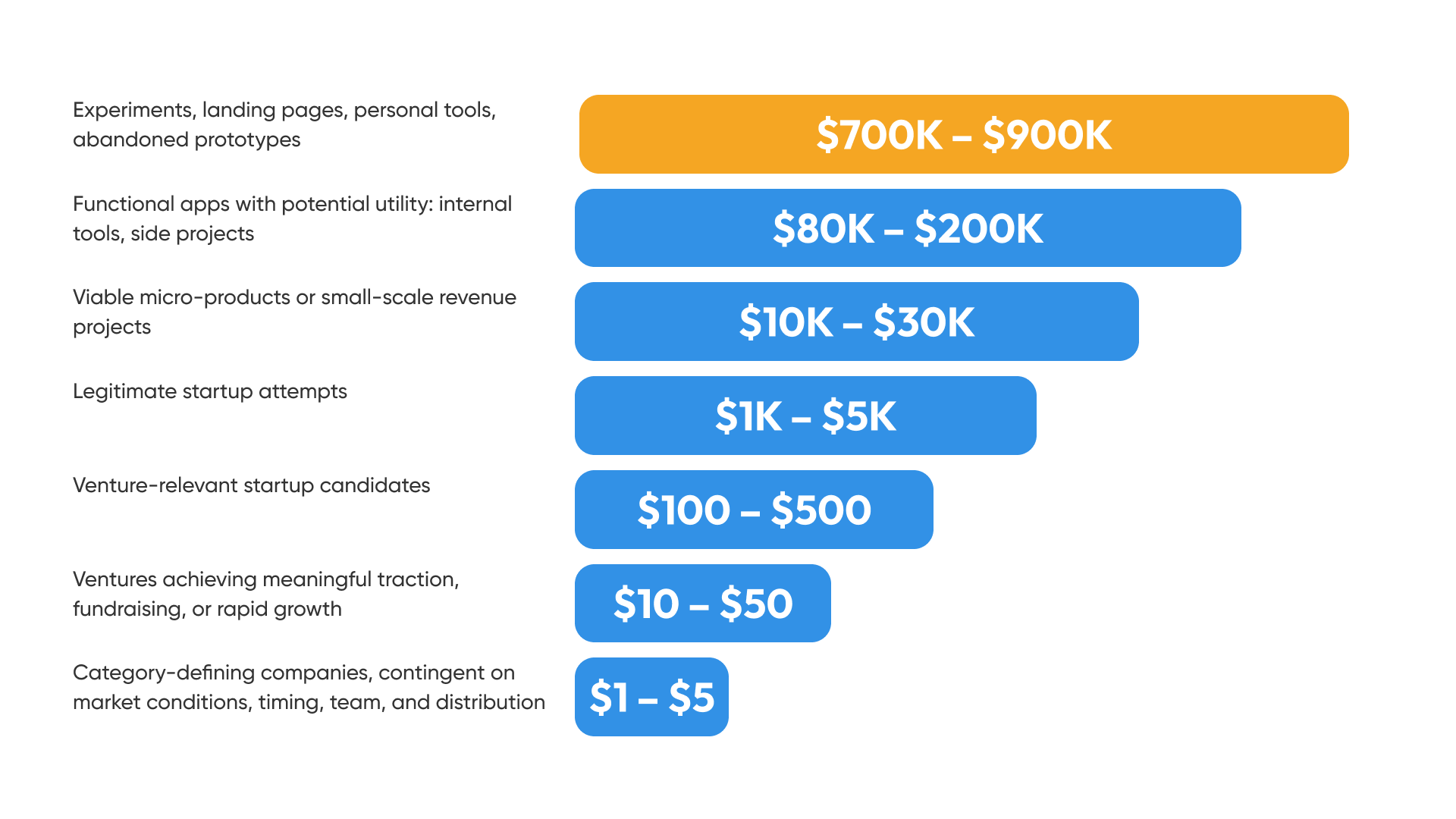
Who Builds with Lovable? Audience Analysis
In-depth analysis of Lovable users also offers valuable insights (four-fifths of solo builders; only a bit more than half of users build a business). The most interesting observation is that 95.5% of users target monetization this or that way, but the real percentage of those who really earn money using Lovable output is significantly smaller.
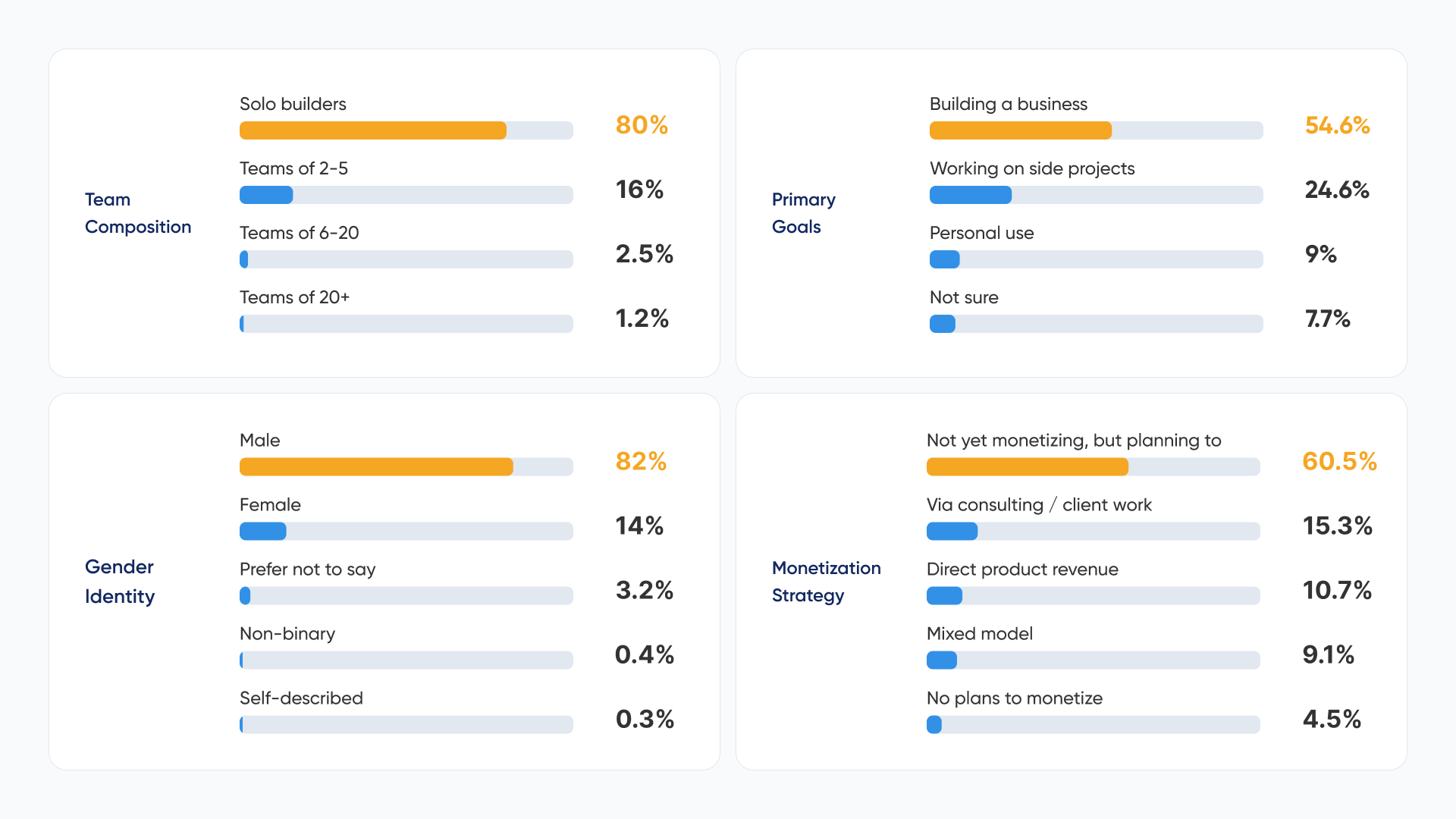
A matter of special interest is the persistence of gender disparities in coding. The presence of 82% of male coders compared to 14% of females in the industry is a compounding outcome of factors:
- Male-heavy AI adoption. Early tech innovation adoption has historically been male-dominated, even when tech products are marketed as “universal.”
- Male founder/indie hacker culture. Lovable intersects with indie hacking, SaaS, startup, crypto & AI communities, where male participation is traditionally higher.
- Self-identification as a builder. Men position their activities as ‘building a business’ more often, while women are more prone to use AI coding tools for internal business tasks.
- Risk profile disparities. Product creation, market launch, monetization, and public testing are socially risky activities to which men are more tolerant.
These disparities point to the fact that while Lovable is a much more democratized and user-friendly coding tool compared to many other tech products, the 5-to-1 gap remains a matter of caution.
True Breakdown of New Tech Startups
To understand how many real tech businesses are entering the market every year, one should draw a distinction between four categories.
#1 New Businesses
This category shows the highest numbers. For instance, based on the US Census Bureau data, over 5.1 million businesses were started in 2025. This means 425,000 businesses per month and over 100,000 businesses per week, only in the USA. Revenue Memo report suggests 50 million new businesses are founded globally every year, which translates into 137,000 new businesses every day.
#2 Startups
Distinguishing startups from new businesses is quite hard, given that they are mixed with microbusinesses, self-employment ventures, and local firms. Still, their number is estimated at roughly tens of millions a year.
#3 Tech Startups
This category is much smaller in size, with 832,000 new businesses started in 2025 alone. In the EU alone, almost 146,000 tech startups emerged in 2024, followed by 134,000 new firms in 2025. Yet, if one focuses only on tech firms and VC-relevant startups worth an investor’s attention, the real number goes down to dozens of thousands a year.
#4 VC-Backable Startups
This group is the smallest, with global VC funding exhibiting a downward trend after the 2020-2022 boom. Based on the GSA Ventures report, global VC funding in Q1 2025 surpassed $126 million, but the number of funded startups fell to 7,551. This trend is eloquent: VCs are ready to fund only sustainable projects with real value, so they are far pickier today.
Will AI & Vibe Coding Increase the Number of VC Startups in 2026 and Beyond?
The answer is yes, and it already does. On the broader market scale, software creation becomes abundant, while user attention, trust, and differentiation grow scarce. These trends erode real demand, so AI and vibe coding only increase the number of VC startups and X-tech projects entering the market without guaranteeing their success. Its real impact is the rise of weak, generic, poorly researched, and prematurely launched products, with significant financial implications for founders.
Yet, vibe coding is not as transformative as it seems, with some market aspects beyond its reach.
| AI Impacts | Spheres Beyond AI Impact |
|---|---|
| ✔ Prototypes | ✘ Market selection |
| ✔ Solo founders | ✘ Target audience research to address real pain points |
| ✔ Vertical SaaS/micro-SaaS products | ✘ Distribution techniques and channels |
| ✔ X-tech projects | ✘ User trust |
| ✔ Customer discovery speed | |
| ✔ Business-first founders |
This breakdown clearly shows that the serious aspects of business planning, from product discovery to distribution and customer retention, are largely beyond the scope of vibe-coding capacity. Besides, security flaws in vibe-coded digital products are the plague of the industry, with experts cautioning that 30 – 60%+ code is vulnerable to hacking and exploit.
While everybody’s raving about the AI revolution, the trend has a dark reverse side as well, which many prefer not to highlight. Advanced AI tools introduce new security risks, which a recent exploit of Hugging Face by OpenAI’s new GPT-5.6 model excellently illustrates. These and other cybersecurity implications of fast AI progress are driving security tool development, like an Open Secure AI Alliance announced by NVIDIA, Microsoft, IBM, SpaceX, CrowdStrike, and other AI market actors.
These cases show that security turns into a real bottleneck not only for vibe-coding projects created by non-tech builders but also for serious tech enterprises. 4IRE, as a company with over a decade of professional experience in digital product design and launch, helps clients with these aspects of business development, ensuring their digital products launch smoothly regardless of their creation mode and comply with the highest cybersecurity standards. We can deliver end-to-end assistance in:
- Security and compliance checks and architecture setup.
- AI development and integration from scratch.
- Optimization of existing business processes with AI-powered tools.
These services are invaluable for teams behind vibe-coded products that lack tech expertise, explore new niches, and struggle with making sense of tech regulation.
The Rise of the Prototype Economy: the 2026 Mega-Trend
The new reality of vibe coding has acquired the name of prototype economy, which has given rise to five broad categories of tech projects.
- Prompt Projects. These prototypes are typically built in under 30 minutes. 99% of them will lead to nowhere as intermediary tools, drafts, and experiments.
- Personal Tools. Useful personal instruments for business and non-business goals.
- Internal Business Tools. The strongest short-term use case for Lovable. Companies and tech experts build CRM, dashboards, calculators, and portals for their projects, deriving real value from the speed and convenience of vibe coding.
- Micro-SaaS/Indie Projects. Small subscription-based products with $100-$10,000 MRR. This category grows really fast.
- VC-Backable Startups. The smallest segment represented by real companies with a large target market, qualified teams, retention techniques, scalable GTM, and moat. Their number will also grow, but not as fast as the number of prototypes.
Key Takeaways
Our joint study with Actana Research shows that Lovable does more than simply encourage vibe coding. It gives rise to the Build Economy, a new reality in which millions of people turn their ideas into working software in a couple of clicks.
Based on these insights, you should keep the following in mind:
- Lovable creates millions of projects.
- The market selects thousands of tech startups at launch.
- VCs fund hundreds of these startups.
- Only a handful of VC-funded projects will grow into large enterprises.
Our conclusion is that AI indeed speeds up building, but the market still rewards depth of capturing the audience’s pain points and the quality of execution. A lack of product-market fit is the top reason for tech startup failures, while trust, user retention capacity, and distribution expertise make a difference, giving speed a secondary role in tech firm success.
Similar articles
More articles

