

 DeFi

A DeFi product is only as trustworthy as the code behind it. Smart contracts hold user funds directly, bugs cannot be patched silently after launch, and every protocol is exposed to attackers from day one. That makes the choice of DeFi development company one of the most consequential decisions you will make, more than for a typical software project.
This guide explains what to check before you hire a DeFi team and profiles seven companies worth evaluating in 2026. Each was re-checked on its own website in September 2026, with a dated sign that it is still active; we only repeat claims the companies make about themselves.
What DeFi Products Can a Development Partner Build?
- Decentralized exchanges and AMMs, plus aggregators that route trades across them
- Lending and borrowing protocols
- Staking and liquid staking platforms
- Yield and vault products, including tokenized real-world assets
- Non-custodial DeFi wallets and wallet integrations
- Cross-chain bridges and derivatives platforms
Each category has its own risk profile. A lending protocol lives or dies on its liquidation logic and oracle design; a DEX on its pricing curve and liquidity incentives. Ask candidates which of these they have actually shipped, not just which they list.
How to Choose a DeFi Development Company
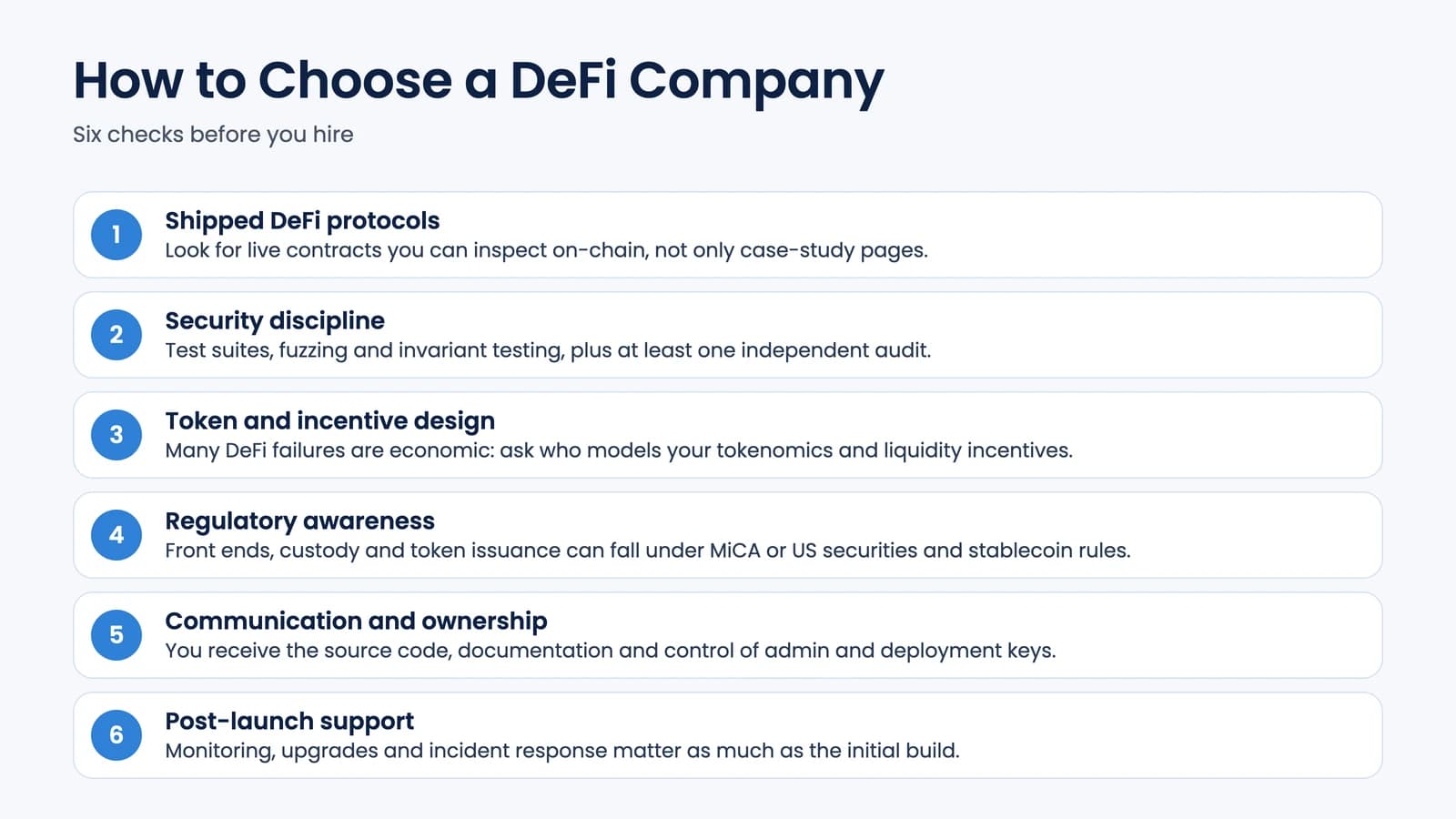
- Shipped DeFi protocols. Look for live contracts you can inspect on-chain, not only case-study pages.
- Security discipline. The team should use test suites, fuzzing and invariant testing, and plan for at least one independent audit. Our guide on how to audit smart contracts explains what a good audit covers.
- Token and incentive design. Many DeFi failures are economic, not technical. Ask who will model your tokenomics and liquidity incentives.
- Regulatory awareness. Front ends, custody and token issuance can fall under MiCA in the EU, whose transitional period for crypto-asset service providers ended on 1 July 2026, or under US securities and stablecoin rules.
- Communication and ownership. You should receive the source code, documentation and control of admin and deployment keys, not a black box.
- Post-launch support. Monitoring, upgrades and incident response matter as much as the initial build.
Top 7 DeFi Development Companies in 2026
1. 4IRE
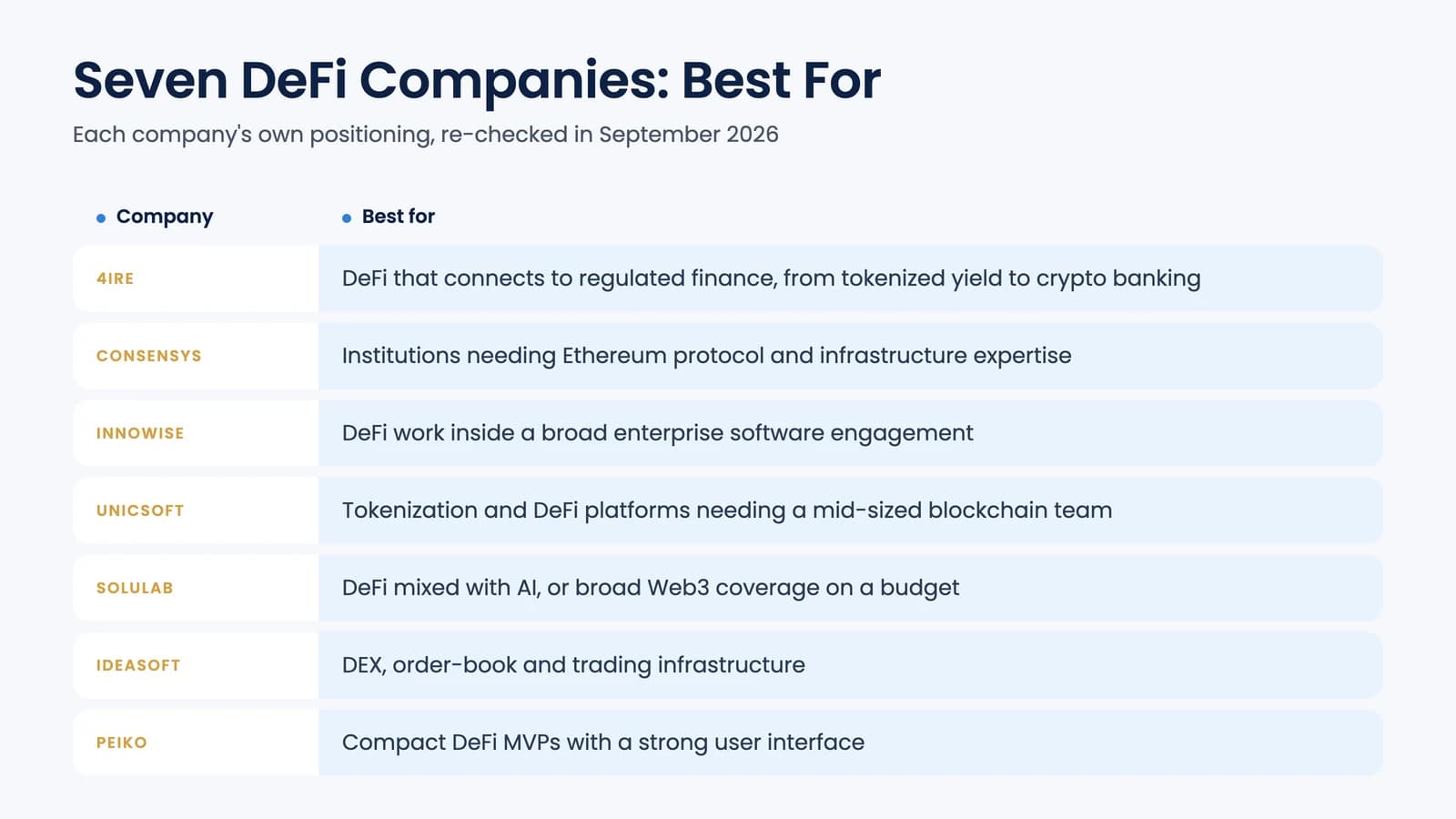
4IRE is a DeFi development company that has built fintech and blockchain software since 2010 and has delivered more than 250 projects. Its DeFi services cover smart contracts and tokens, DEX and aggregator development, lending and staking platforms, DeFi wallets, bridges and smart contract audits. Its DeFi track record includes the front end and core smart contracts for Ondo Finance's first DeFi vault product and development work on Aurora, the NEAR-based Ethereum scaling solution. 4IRE is a member of the Substrate Delivery Partners Program and the NEAR Protocol program, and it also works with banks such as Danske Bank and First Abu Dhabi Bank, which is useful when a DeFi product has to meet bank-grade compliance. Best for: DeFi products that need to connect to regulated finance, from tokenized yield to crypto banking.
2. Consensys
Consensys is an Ethereum infrastructure company behind MetaMask, Infura, the Linea network and the Besu and Teku Ethereum clients. It is not a build-anything agency, but it offers advisory and technical services, tailored engineering and managed operations for institutions building on Ethereum. On 9 September 2026 it announced plans to split into two independent companies, MetaMask and Consensys, with the separation expected by the end of 2026. Best for: institutions that need Ethereum protocol and infrastructure expertise rather than a full product team.
3. Innowise
Innowise is a Warsaw-headquartered software company established in 2007, reporting more than 3,500 IT professionals and around 1,600 completed projects. Its DeFi services include DeFi smart contracts, platforms, tokens, liquidity pools, yield farming and DeFi banking features, delivered through outsourcing or dedicated teams, with ISO 9001 and ISO/IEC 27001 certifications. Best for: larger organisations that want DeFi work inside a broad enterprise software engagement.
4. Unicsoft
Unicsoft has been in software engineering since 2005 and says it has focused on blockchain for the last ten years. It builds tokenization platforms, DeFi software, smart contracts and crypto wallets, reports more than 250 completed projects and names MakerDAO and AlphaWallet among its clients. It has offices in Lexington (US), Limassol and Singapore and holds ISO 27001 and ISO 9001 certifications. Best for: tokenization and DeFi platforms that need an experienced, mid-sized blockchain team.
5. SoluLab
SoluLab combines blockchain and Web3 development with generative AI, with client-facing operations in the US and delivery centres in India. It reports 250+ developers and more than 11 years in business, and displays ISO 27001, SOC and CMMI Level 3 credentials on its site. Its blog was still publishing in late September 2026, including posts on blockchain vendor selection and AI agents. Best for: projects that mix DeFi features with AI or need broad Web3 coverage on a budget.
6. IdeaSoft
IdeaSoft has around ten years in the market and 250+ completed projects, working from Tallinn, Lisbon and Abu Dhabi. It offers blockchain, decentralized exchange, crypto exchange and wallet development and lists itself as a co-founder of Orderly Network, a DeFi trading infrastructure project. Best for: DEX, order-book and trading infrastructure.
7. Peiko
Peiko has operated since 2017 and builds Web3 products including decentralized exchanges, P2P crypto exchanges, smart contracts and wallets, alongside web and mobile development. Its recent content covers tokenomics design and Telegram Mini Apps. Best for: compact DeFi MVPs with a strong user interface.
Red Flags When Evaluating a DeFi Vendor
- No live contracts or verified deployments you can inspect on a block explorer.
- An audit is treated as optional, or the vendor offers to audit its own code as the only review. An internal review is useful, but an independent smart contract audit should come from a separate team.
- Fixed-price quotes for novel protocol mechanics before any discovery or economic modelling.
- Vague answers on who holds admin keys, how upgrades work and what happens in an incident.
- Promises of guaranteed yields or token prices. A development partner builds the product; it cannot promise market outcomes.
Custom Build, Fork or White-Label?
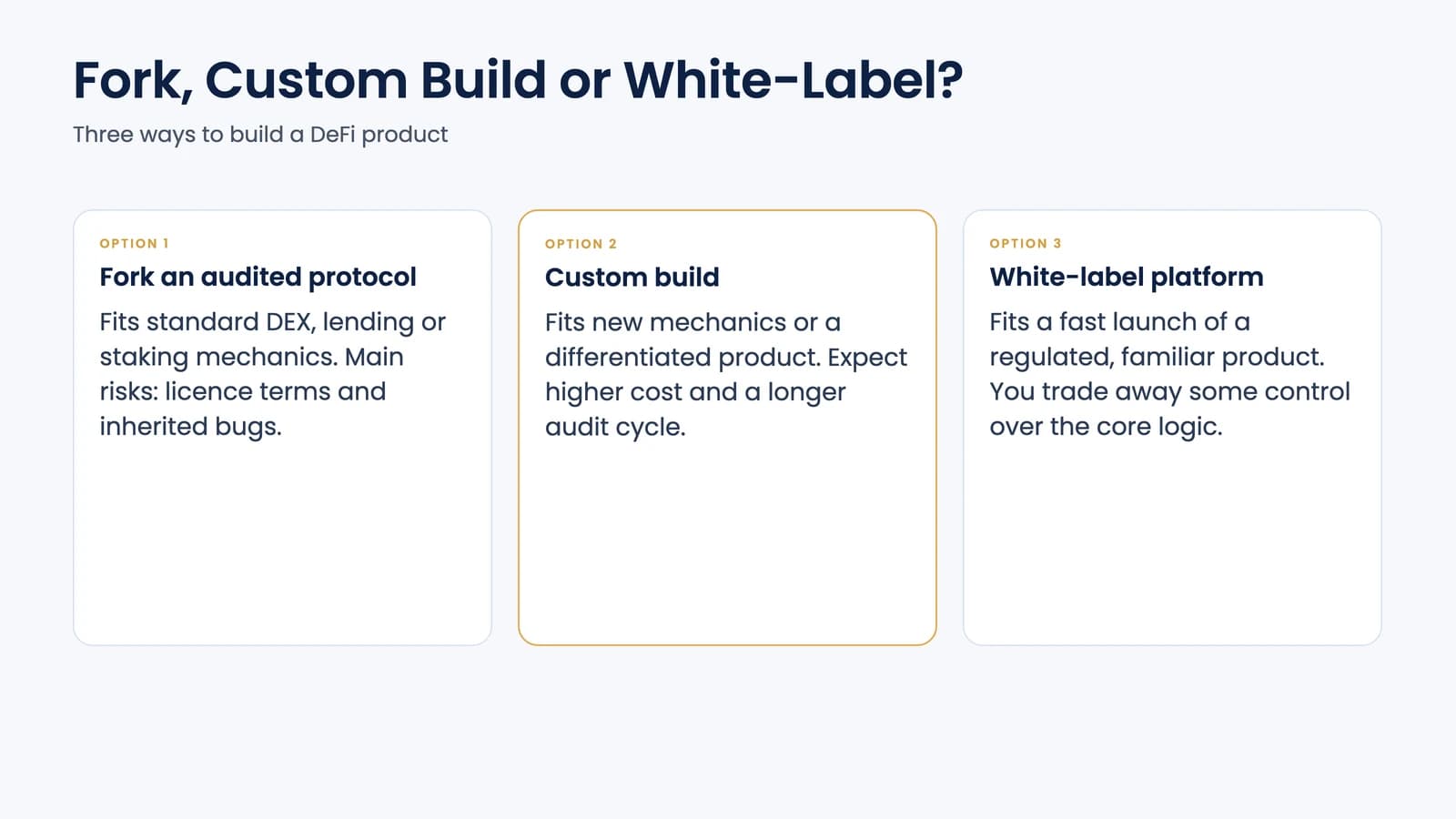
- Fork an audited protocol: fits standard DEX, lending or staking mechanics; the main risks are licence terms and inherited bugs.
- Custom build: fits new mechanics or a differentiated product; expect higher cost and a longer audit cycle.
- White-label platform: fits a fast launch of a regulated, familiar product; you trade away some control over the core logic.
Budget follows that choice. As a reference point from 4IRE's own estimates, a custom DEX or AMM typically costs $120,000 to $250,000, and a full audit of a complex DeFi protocol can run $40,000 to $90,000. Our breakdown of DEX development cost shows where that money goes.
Hire a Company or Build Your Own Team?
A development company brings a ready team, established security practice and experience from previous protocols, which usually gets a first product to mainnet faster. An in-house team gives you long-term control once the protocol is proven. If you are weighing both options, see our guide on where to hire DeFi developers, and for a wider view of vendors beyond DeFi, our list of top blockchain development companies.
Conclusion
The best DeFi development company for you is the one whose shipped protocols, security process and regulatory experience match your product. Shortlist two or three teams, inspect their live contracts, ask how they would handle audits and incentives, and start with a paid discovery before committing to the full build. 4IRE's DeFi team is happy to be one of the teams you compare.
Building a DeFi Protocol?
Tell us about your product, and our team will scope the contracts, audit plan, timeline and budget. Schedule a free consultation with our DeFi experts.
FAQ on Top DeFi development companies in 2026
Check that the team has shipped live DeFi protocols similar to yours, review their security process and audit plan, ask who designs the token economics, confirm they understand the rules in your target markets, and speak to past clients. A short paid discovery is the best test before a full contract.
It depends on the product. On 4IRE's own estimates, a custom DEX or AMM typically costs $120,000 to $250,000. An independent smart contract audit starts around $5,000 to $15,000 for simple contracts and can reach $40,000 to $90,000 for complex DeFi protocols.
Forking an audited protocol is faster and cheaper when standard mechanics are enough, but you inherit its licence terms and any hidden flaws, and you still need your own audit. A custom build makes sense when your mechanics are genuinely new or when the product is your core differentiator.
4IRE has built fintech and blockchain software since 2010 and has delivered more than 250 projects. Its DeFi work includes smart contracts for Ondo Finance's first vault product and development for Aurora, and it combines DeFi engineering with experience building for banks and regulated fintechs.