

The Complete Guide to Real World Asset Tokenization in 2026 | RWA
Imagine trading luxury real estate, fine art, or carbon credits as easily as Bitcoin or stocks.
This is the reality with real-world asset (RWA) tokenization: a financial innovation that is changing how we create, manage, and exchange value.
Major institutions are already taking the lead. J.P. Morgan issued the first tokenized asset-backed securities. DAMAC launched a $1 billion project for real estate tokenization. BlackRock’s BUIDL fund crossed $2.4 billion in assets and entered DeFi rails in early 2026. As of Q1 2026, the total value of tokenized real-world assets on public blockchains reached $29 billion, representing a 263% increase year-over-year from 2024. With stablecoins included, the total tokenized market exceeds $240 billion.
The GENIUS Act in the U.S. and the EU’s MiCA regulation have now provided legal clarity for tokenized assets, encouraging wider institutional adoption.
The lines between traditional finance and decentralized finance are blurring, reshaping opportunities for asset owners, financial institutions, and investors. If you have not started exploring this shift, now is the time. Our Asset Tokenization Platform Development service is built to help enterprises move from decision to deployment quickly and compliantly.
RWA Tokenization Market Size in 2026
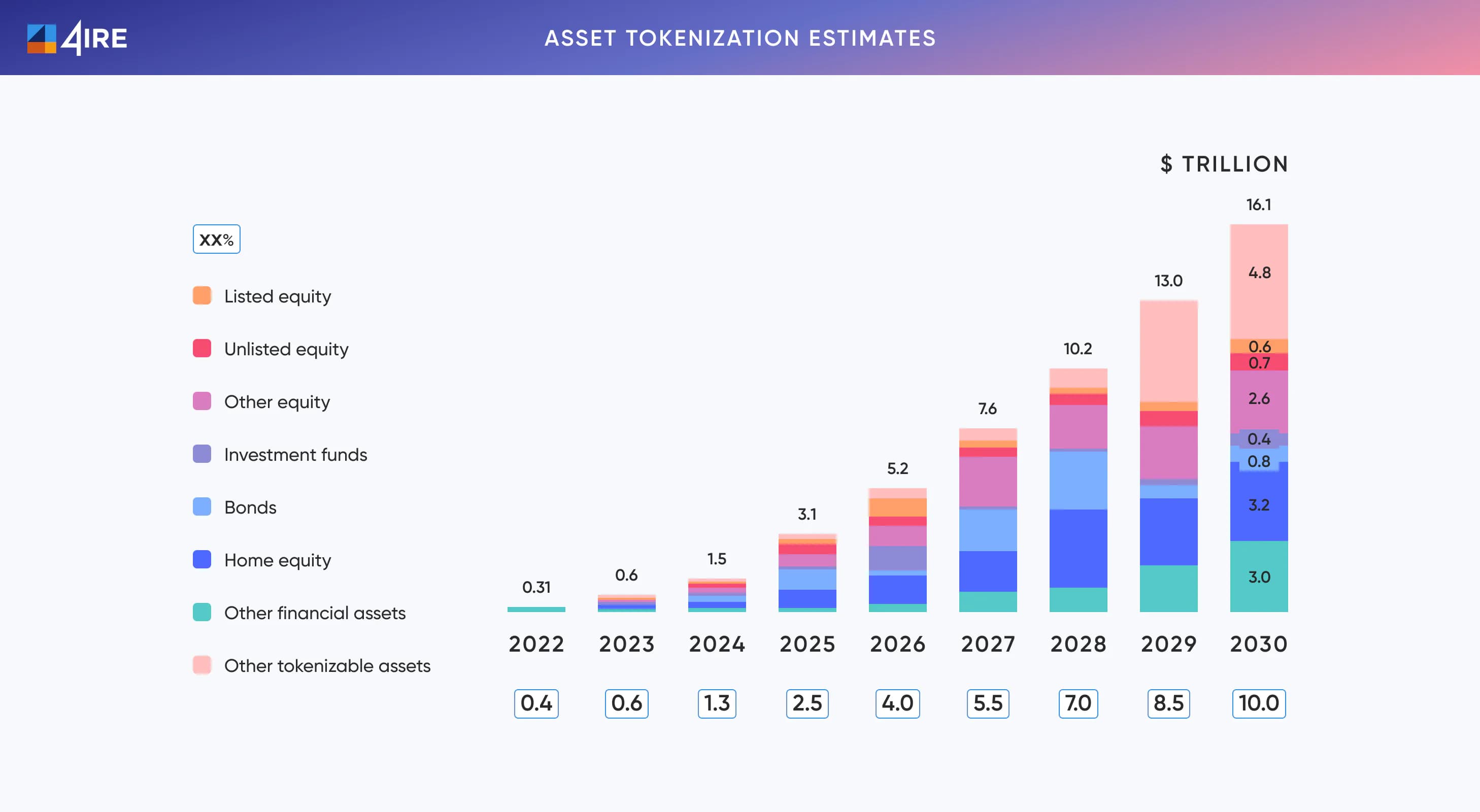
As of Q1 2026, the RWA tokenization market has reached industrial scale. The total value of tokenized assets on public blockchains grew from $21 billion at the start of January 2026 to $29 billion by April 2026, reflecting 30% expansion in a single quarter.
Boston Consulting Group and Standard Chartered project the market could reach $16 trillion by 2030, representing nearly 10% of global GDP. Only a tiny fraction of the $28 trillion U.S. Treasury market has been tokenized to date, which illustrates the enormous runway remaining.
Thus, it is time for all early adopters and forward-looking investors to take a closer look at RWA tokenization. In this article, I will walk you through the tokenization process, the regulatory landscape as it stands in mid-2026, and the institutional moves that are reshaping global finance.
What Is Tokenization of Real World Assets?
Real-world asset tokenization is the process of converting ownership rights of physical or intangible assets, such as property, shares, bonds, commodities, or carbon credits, into digital tokens on a blockchain. These tokens can be divided, traded, or held far more efficiently than their traditional equivalents. The core advantages include liquidity, transparency, lower transaction costs, access to a larger pool of investors, automated asset management through smart contracts, and broader financial inclusion.
Think: tokenization of bonds and stocks, tokenized carbon credits, or digitized private equity shares—all tradeable 24/7, globally.
Real World Asset Tokenization Explained
The first widely recognized case of real-world asset tokenization was USDT, a stablecoin pegged to the U.S. Dollar. It introduced the concept of fungible asset tokenization at scale. When it comes to non-fungible assets, the process typically involves dividing the asset into fractional shares and offering each at a fraction of its market value.
For example, you could tokenize an office building worth $25 million and divide it into 2,500,000 tokens, each priced at $10. Any investor can then enter the real estate market with as little as $10.
This accessibility is enabled by blockchain technology, which works as follows:
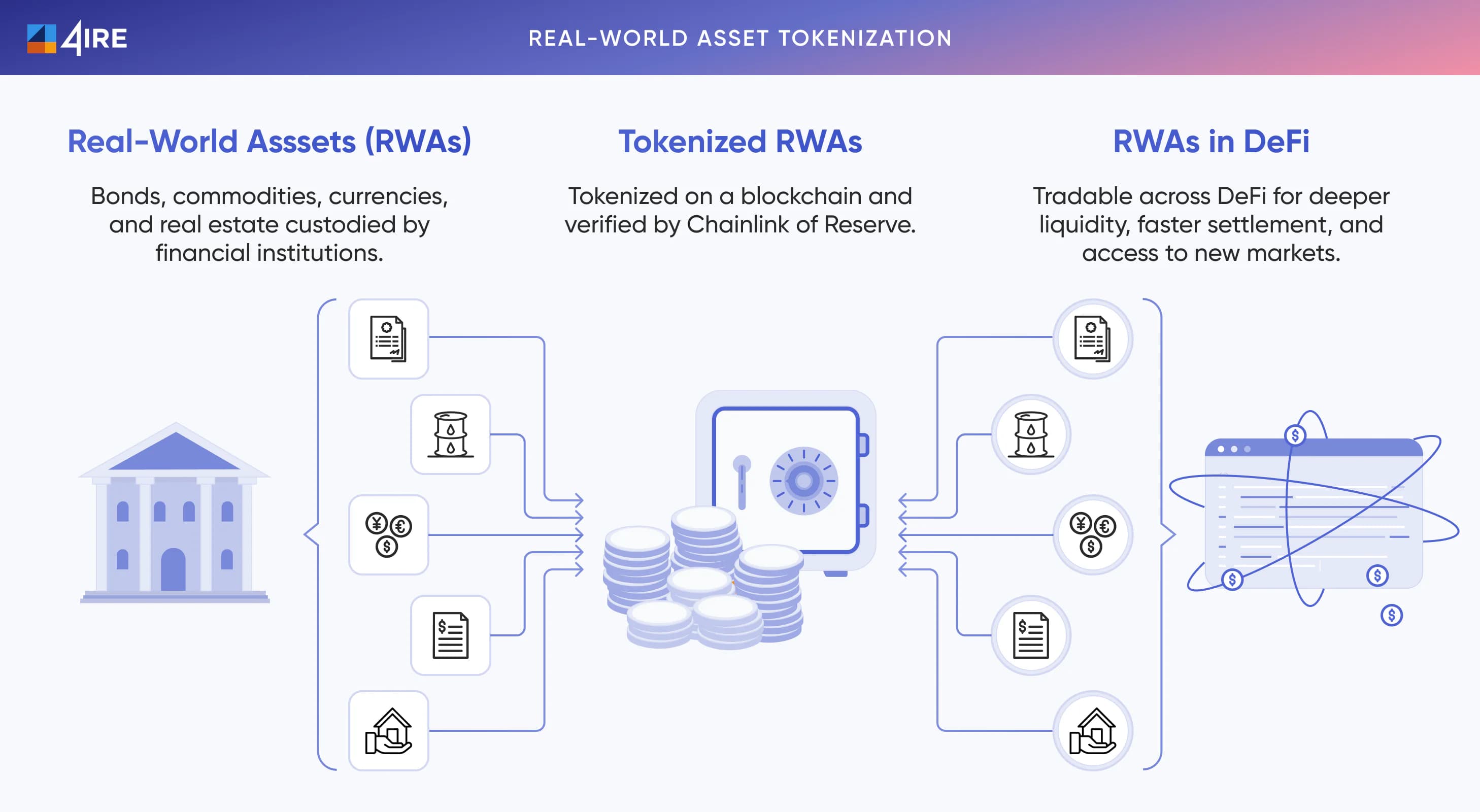
Division of real-world assets into fractions. A specific type of RWA (gold, real estate, fine art) is divided into a defined number of fractional shares.
Conversion of asset fractions into digital tokens. The asset is tokenized on a blockchain platform by minting tokens after ownership verification, for example through Chainlink’s Proof of Reserve. This stage refers to collateralization, which ensures that the issuer holds the stated asset quantity.
Launch of RWA tokens into the DeFi space for circulation. The tokenized assets are deployed to crypto exchanges and DeFi platforms, where they serve as utility tokens or investment instruments.
When it comes to non-fungible assets, the process of RWA tokenization usually involves the asset’s division into a particular number of fractions and their sale at the fractional cost of the present-day market value of the asset. For example, you may tokenize an office building worth $25 million and divide it into 2,500,000 tokens, each of which will cost $10. This way, any investor interested in holding a share of real estate property as an investment may start with only $10 in their pocket.
This unprecedented accessibility of serious investment is enabled by blockchain technology, which works as follows:
- Division of real-world assets into fractions. A certain type of RWA (gold, real estate, fine art, etc.) is divided into a particular number of fractional shares.
- Conversion of asset fractions into digital tokens. The asset is tokenized on one of the popular blockchain platforms by minting the specified number of tokens after the owner’s property verification (e.g., Chainlink’s Proof of Reserve). This stage refers to collateralization – ensuring that the owner has the tokenized asset in the stated quantity.
- Launch of RWA tokens to the DeFi space for circulation. The successfully tokenized real-world assets are deployed to crypto exchanges and DeFi platforms, where they can perform the role of utility tokens or investment tools.
Types of Real-World Assets Suitable for Tokenization
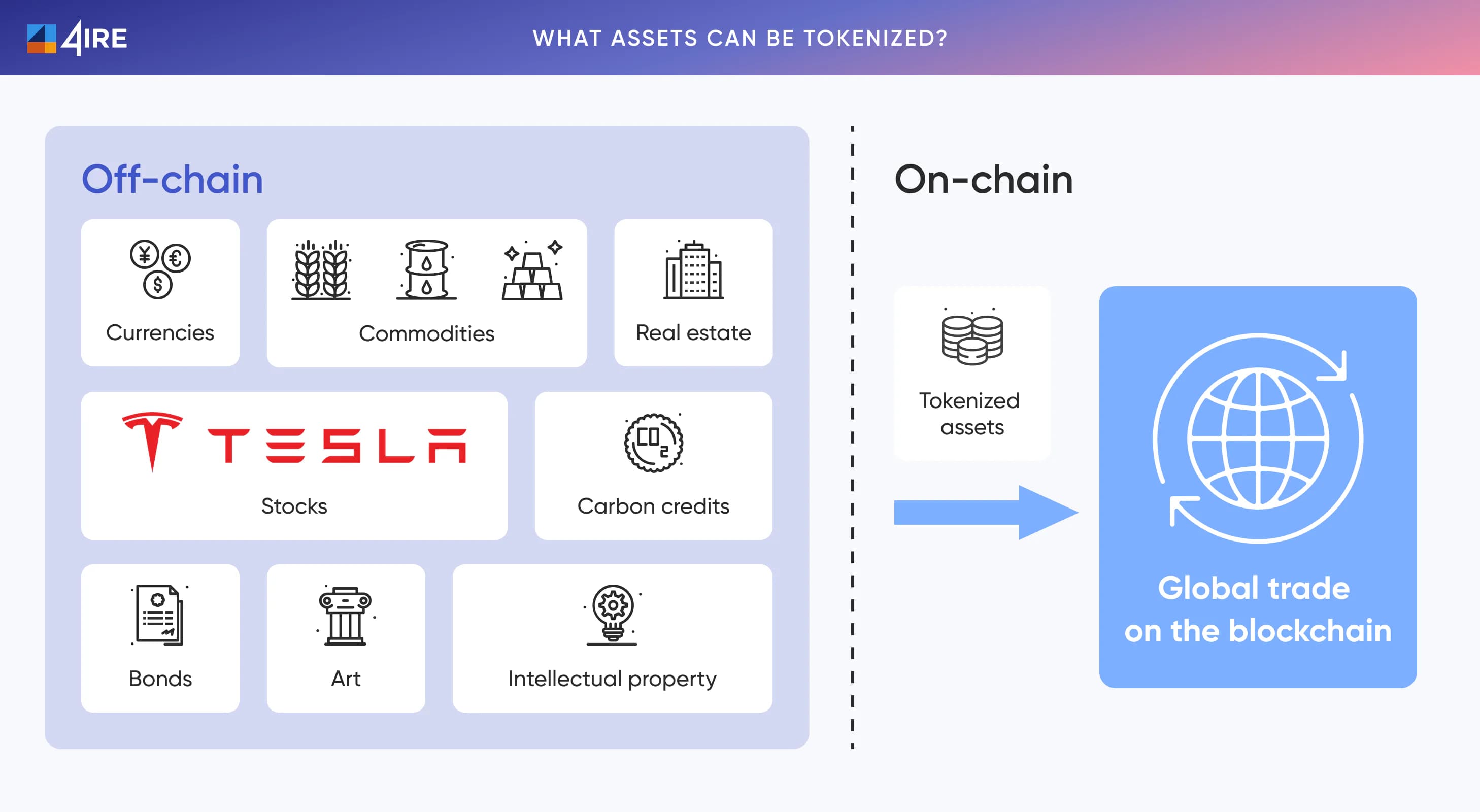
Tokenization works with both fungible and non-fungible assets. Here are the primary categories:
- Commodities. Gold tokenization is gaining popularity as a way to combine the stability and steady price growth of gold with the liquidity of digital assets. As of April 2026, tokenized commodities reached $7.3 billion in total market value, driven by a 289% growth rate during 2025.
- Currencies. Stablecoins were the first example of currency tokenization. Central bank digital currencies (CBDCs) represent the next frontier, with multiple governments currently in advanced exploration stages.
- Real estate. The greatest benefit of RWA tokenization is felt here, where buying property has historically meant freezing a large capital sum. Tokenization enables fractional ownership and dramatically improves liquidity for property owners. Read our complete guide to real estate tokenization in 2026.
- Art and collectibles. Tokenized artwork is easier to buy and sell, belongs to a community of holders rather than a single owner, and its authenticity is straightforwardly traceable and provable using blockchain records.
- IP objects. Intellectual property remains one of the most vulnerable asset classes. IP tokenization enables easier ownership tracing and authentication for copyrights, trademarks, and patents.
Stocks, bonds, and securities. Tokenized financial instruments are a game-changer for global market access. In a world where approximately 1.7 billion people lack access to financial services, digital assets have the potential to democratize participation.
The Four Leading Asset Classes in 2026
As of Q1 2026, the RWA market is no longer a single category but a diversified ecosystem. Here is how the four dominant segments break down.
Tokenized U.S. Treasuries and Fixed Income
Tokenized Treasuries have become the risk-free rate benchmark of the digital asset world, reaching $13.4 billion by early April 2026. The sector crossed the $10 billion milestone in late February 2026 and continues to climb.
BlackRock’s BUIDL fund ($2.4B), Circle’s USYC ($2.7B), Ondo’s product suite ($2.6B), and Franklin Templeton’s BENJI fund ($1.0B) lead the segment. A significant milestone occurred in early 2026 when BlackRock’s BUIDL entered DeFi rails via Uniswap, allowing a regulated fund to serve as collateral in decentralized lending protocols for the first time.
Private Credit and Structured Finance
Private credit has solidified its position as the second-largest tokenized asset class at $16.8 billion. This segment addresses the chronic illiquidity of small and medium-sized enterprise (SME) lending and revenue-based financing. Over 60% of tokenized RWA value globally is now concentrated here.
Platforms like Centrifuge and Maple Finance have enabled businesses to unlock liquidity from assets that were traditionally locked for years. Smart contracts automate income distribution, eliminating manual paperwork and reducing administrative overhead by up to 70%.
Tokenized Gold and Commodities
Tokenized commodities reached $7.3 billion in market capitalization by April 2026, following a 289% growth rate in 2025. Gold accounts for roughly 70% of this figure, with Tether’s XAUT and Paxos’ PAXG dominating nearly 90% of the segment.
Spot trading volumes for tokenized gold hit $90.7 billion in Q1 2026 alone, already exceeding the entire 2025 full-year volume of $84.6 billion. Gold-backed tokens have transitioned from passive holdings to active trading instruments on both centralized and decentralized exchanges.
Tokenized Equities and ETFs
Tokenized equities reached approximately $960 million by March 2026, more than doubling from mid-2025 levels. Ondo Finance holds a dominant 60% market share through its Global Markets platform. Monthly spot trading volumes for tokenized blue-chip stocks consistently exceeded $4 billion throughout early 2026.
NYSE and Nasdaq are developing 24/7 tokenized securities infrastructure, which will allow public markets to settle as blockchain tokens alongside traditional rails by late 2026 or 2027.
Benefits of Asset Tokenization
Throughout my RWA tokenization experience at 4IRE, I have seen the following advantages delivered consistently across projects:
- Liquidity. Asset owners no longer need to freeze capital in large-scale assets. Tokenization lets them return a portion to active circulation and reinvestment.
- Fractional ownership. Investors can access real estate, gold, fine art, and other assets they would otherwise be unable to afford with limited capital.
- Immutability and transparency. Blockchain technology ensures full transparency of all operations and eliminates the risk of fraud or manipulation.
- 24/7 access. RWA token holders can buy and sell their assets around the clock, without being tied to traditional exchange hours.
- Financial inclusion. These digital assets are available to all individuals across the globe, including unbanked and underbanked populations.
- Cost efficiency. Smart contracts eliminate intermediaries, lowering transaction costs significantly.
Regulatory Landscape: What Changed in 2026
One of the most important developments of the past 18 months is the arrival of real regulatory clarity. For institutional investors, this has been the single biggest accelerator of adoption.
EU: MiCA and the July 2026 Deadline
The EU’s Markets in Crypto-Assets (MiCA) regulation became fully applicable on December 30, 2024. A critical grandfathering period ends on July 1, 2026. After that date, any crypto-asset service provider operating in the EU must hold full MiCA authorization or cease operations.
By April 2026, over 185 market operators had obtained MiCA licenses, allowing them to passport their services across all 27 EU member states. MiCA distinguishes between Asset-Referenced Tokens (ARTs), which stabilize value relative to a basket of assets, and E-Money Tokens (EMTs), which are backed 1:1 by a single fiat currency.
USA: The GENIUS Act and SEC Action
The U.S. regulatory environment shifted fundamentally with the passage of the GENIUS Act (Guiding and Establishing National Innovation for U.S. Stablecoins) in July 2025. The Act established clear rules for payment stablecoins, requiring 1:1 backing with highly liquid assets like U.S. dollars and Treasuries.
In March 2026, the SEC and CFTC released joint guidance on digital asset taxonomy, clarifying the classification of digital commodities and securities. The SEC also approved intraday trading for WisdomTree’s tokenized money market fund (WTGXX), marking the first time a tokenized mutual fund was approved for T-instant settlement in the U.S. The Digital Asset Market Clarity Act is expected to remove additional barriers by late 2026.
Asia-Pacific: Singapore and Hong Kong
Singapore’s Project Guardian, led by the Monetary Authority of Singapore (MAS), has moved from pilot phase to an operational roadmap for tokenized funds and government bills settled via wholesale CBDC.
In Hong Kong, the Securities and Futures Commission (SFC) granted the first stablecoin licenses to Standard Chartered and HSBC in April 2026. Japan is preparing to reclassify crypto assets as financial products by late 2026, potentially lowering the tax rate on crypto gains from 55% to a flat 20%, which is expected to unlock billions in dormant capital.
Who Is Deploying in 2026: Major Institutional Moves
The narrative has shifted from “big banks exploring blockchain” to “big banks deploying products.”
BlackRock BUIDL reached $2.4 billion in assets and entered DeFi rails via Uniswap in early 2026, allowing a regulated fund to be used as collateral in decentralized lending protocols. This was a landmark moment for institutional DeFi.
Morgan Stanley identified RWA tokenization as a top global business focus in April 2026. The firm plans to launch an institutional digital wallet in the second half of 2026, designed to hold tokenized traditional investments alongside Bitcoin, Ethereum, and Solana. By late 2026, Morgan Stanley intends to allow institutional clients to trade tokenized versions of select U.S. blue-chip stocks and ETFs on its internal alternative trading system.
J.P. Morgan’s Onyx platform is enabling Treasuries to settle like crypto, facilitating tokenized collateral transactions that reduce the capital requirements and counterparty risks associated with traditional multi-day settlement cycles.
Sovereign wealth funds have become major catalysts. Abu Dhabi’s Mubadala Investment Company ($380B AUM) and the Saudi Public Investment Fund ($2.2T AUM) are actively using tokenization to unlock liquidity in real estate and infrastructure assets. GIC and Temasek ($700B+ combined) are participating in Singapore’s Project Guardian for tokenized funds.
What Is the Role of Blockchain in RWA Tokenization?
Tokenization would be impossible without blockchain. The most widely used platforms in 2026 are:
- Ethereum. The leading network for smart contract execution. The ERC20 and ERC-3643 protocols remain the primary standards for institutional tokenization.
- Hyperledger Besu. A corporate-grade solution based on Ethereum, supporting both permissioned and permissionless networks with a modular architecture.
- Quorum. Developed by J.P. Morgan, Quorum is an open-source permissioned blockchain focused on privacy and fully compatible with Ethereum.
- Corda. Optimal for enterprise-level solutions requiring robust regulatory compliance, particularly for IP and real estate tokenization.
- Tezos. Known for strong on-chain governance, solid verification capabilities, and self-amending features.
Layer 2 and Layer 3 Scaling
While Ethereum remains the primary settlement layer, transaction execution has increasingly shifted to Layer 2 and Layer 3 solutions. Layer 2 networks such as Arbitrum and Optimism provide the speed and lower fees needed for high-frequency trading. Layer 3 application-specific environments, such as Nautilus Chain or zkStack by zkSync, offer greater customization for enterprise-grade privacy and compliance requirements.
Chainlink CCIP and Cross-Chain Interoperability
The interoperability problem, where tokens on one blockchain cannot interact with those on another, is being solved by the Cross-Chain Interoperability Protocol (CCIP). CCIP acts as the connective tissue of the multi-chain ecosystem. It uses a Burn and Mint mechanism rather than simple bridging, ensuring that total supply remains constant across chains and that the asset on the destination chain is a native issuance. Swift has partnered with Chainlink to connect over 11,000 financial institutions to multiple blockchain networks.
Zero-Knowledge Proofs and Privacy
A major hurdle for institutional adoption has been the tension between blockchain transparency and proprietary data confidentiality. Zero-knowledge proofs (ZKPs) have emerged as the solution, allowing transactions to be verified without revealing the underlying sensitive data. This enables businesses to protect trade secrets while remaining fully compliant with regulatory reporting requirements.
Use Cases and Real-World Examples
Let’s also recollect several real-world examples of applying RWA tokenization for business transformation.
- USDT. As I’ve mentioned above, USDT was the first and, so far, the most successful case of currency tokenization. This project of Tether is used as a global currency standard in the crypto world.
- Lofty. The company tokenizes residential real estate, including houses and condos, to give investors easier access to real estate investment.
- Carbon credit tokenization platform. This is our company’s successful carbon credit tokenization case. The 4IRE team designed a carbon credit marketplace and created the native token for efficient and standardized carbon credit trading.
- Agrotoken. The project enables farmers to tokenize their harvest (e.g., grains) and exchange those digital assets for money, services, and other goods on digital exchanges. Tokenized grain is also accepted as loan collateral.
Challenges and Risks in Asset Tokenization
RWA tokenization is not a universally frictionless solution. In my experience, the most significant risk categories in 2026 are:
- Custody and storage risks. For commodity-backed tokens, the secure vaulting of physical gold or oil involves high costs and geopolitical risks that must be accounted for in the project structure.
- Liquidity fragmentation. Tokens on Ethereum cannot natively interact with those on Stellar or Polygon, creating liquidity silos. Chainlink CCIP is the primary solution to this challenge, but cross-chain fragmentation remains an active issue.
- Price volatility sync. Fluctuations in the price of underlying assets such as oil or silver can challenge the peg of commodity-backed tokens, requiring robust redemption mechanisms to maintain 1:1 backing.
- Legal uncertainty. While MiCA and the GENIUS Act have created frameworks in the EU and U.S., many jurisdictions still do not fully recognize digital ownership rights, which can complicate enforcement of claims.
- Security risks. Smart contracts remain vulnerable to exploits. A thorough manual and automated audit is non-negotiable before any token issuance.
Key Trends in RWA Tokenization in 2026
The following eight trends define where the market stands as of mid-2026:
- Tokenized Treasuries as the on-chain risk-free rate. At $13.4 billion and growing, tokenized U.S. government bonds have become the foundational instrument of institutional on-chain finance.
- Private credit dominance. Over 60% of all tokenized RWA value sits in private credit instruments. Centrifuge and Maple Finance lead the space.
- Gold as the on-chain collateral layer. Q1 2026 spot volumes for tokenized gold ($90.7B) have already surpassed all of 2025, signaling a shift from passive holding to active trading.
- MiCA enforcement. The July 2026 deadline is driving rapid compliance activity across the EU. This is creating a more stable environment for institutional participation.
- AI agents as market participants. Platforms like IXS have launched regulated investment layers purpose-built for AI agents that hold, manage, and transact tokenized assets autonomously.
- Tokenized equities and ETF infrastructure. NYSE and Nasdaq are building 24/7 tokenized securities infrastructure, moving public markets toward blockchain settlement.
- Sovereign wealth fund participation at scale. Mubadala, Saudi PIF, and GIC/Temasek are actively using tokenization to unlock liquidity in real estate and infrastructure portfolios.
- CBDC integration moving from pilot to production. MAS’s Project Guardian has moved from trials to an operational roadmap, and several central banks are preparing for live CBDC settlement of tokenized assets.
How to Tokenize an Asset: Your Step-by-Step Guide for 2026
The tokenization process has been standardized around a five-step lifecycle. Here is how it works in practice:
Step 1: Asset Selection and Legal Structuring. Choose the real-world asset to tokenize and form a Special Purpose Vehicle (SPV) that takes formal ownership. The SPV is the legal wrapper linking the physical asset to its digital representation.
Step 2: Smart Contract Creation. Developers write contracts on networks such as Ethereum or Polygon that define the token’s rights (income distribution, voting, governance) and compliance rules. A thorough manual and automated smart contract audit is required before deployment.
Step 3: Token Issuance and KYC/AML. Tokens are minted after going through a Proof of Reserve verification. They are then distributed only to investors who pass rigorous Know Your Customer (KYC) and Anti-Money Laundering (AML) checks.
Step 4: Secondary Market Trading. Issued tokens are listed on regulated exchanges such as Securitize Markets to provide ongoing liquidity for investors.
Step 5: Automated Income Distribution. Smart contracts automatically distribute rent, interest, or dividends directly to token holders’ wallets, eliminating manual paperwork. This step alone can reduce administrative overhead by up to 70%.
Blockchain partner selection sits between steps 1 and 2. Vet your provider’s credentials, portfolio, and track record with similar projects before committing to a platform and protocol stack.
How to Make Profits from RWA Tokenization?
The real-world asset tokenization industry is quickly gaining momentum because of the unique benefits and opportunities it gives to expensive non-fungible asset owners. They gain profits from the liquidity of their non-fungible belongings; by tokenizing assets, they may allocate the money to investment projects and earn a decent ROI instead of freezing funds in one purchase. Thus, by partnering with a reliable asset tokenization company like 4IRE, any RWA owner can reap added profits from their unique assets of value in the DeFi space using our white-label tokenization solution.
RWA tokens’ buyers also enjoy a wide range of earning opportunities, such as:
- Appreciating RWA value. If you invest in RWA tokens of real estate, gold, or fine art, you may expect to reap sound profits from this purchase in several years. These assets are enjoying a stably rising demand and grow in value year by year, thus offering good passive income for their fractional owners.
- Rental income. If you buy RWA tokens for rental property, you receive the right to a portion of rental income the building’s owner derives from rental contracts.
- Token trading. Trading is a source of income for many crypto enthusiasts, and the same relates to RWA tokens. You can earn money from the volatile prices of tokens by executing timely trades on various exchange platforms.
- Crowdfunding projects. While your financial limitations may not allow you to buy a house or an exclusive work of art, RWA tokens enable crowdfunding of such purchases. This way, you get as many tokens as you can afford to buy and participate in a lucrative deal.
- Staking and yield farming options. Some RWA assets are accepted to liquidity pools in exchange for an attractive APY, enabling you to get a stable passive income from your investment.
- Fractional ownership of high-value assets. Finally, investors in RWA assets may get a unique opportunity to diversify their portfolios with real estate, precious metals, and other unique property assets at a reasonable price. Imagine how self-indulging it is to own a fraction of a Mona Lisa painting or the Empire State Building!
This way, owning RWA tokens represents a tangible earning opportunity. It’s a great chance to diversify your portfolio and tap into the niches with a traditionally high entry threshold, typically inaccessible to retail investors on small budgets.
Conclusion
The world is ready for blockchain innovation, and one of the notable gains this technology gives to investors is fractional ownership. By introducing RWA tokens, large asset owners have given people access to previously unattainable investment industries and have received greater liquidity of their funds. I firmly believe that real world asset tokenization has a bright future and will develop in leaps as blockchain adoption continues to grow. Thus, the time to invest in RWA tokenization is now, especially with our white-label tokenization solution simplifying the process.
FAQ on RWA tokenization in 2026
The process starts with valuing the asset and creating a legal framework to define ownership. Next, a blockchain platform is used to issue digital tokens representing shares of that asset. These tokens are then secured via smart contracts, enabling secure trading or transfer while ensuring compliance with regulations.
Real world asset tokenization involves converting ownership rights of tangible or intangible assets—like real estate, art, or intellectual property into digital tokens on a blockchain. This process allows these assets to be divided, traded, or invested in more efficiently, often unlocking liquidity that was previously hard to access.
It is possible to tokenize anything, from real estate property to trademarks, patents, and fine art. The use of tokenization in finance is also growing, with stocks, bonds, and treasuries also being tokenized to allow greater access to financial instruments among underbanked and unbanked populations.
Begin by assessing your asset’s value with a professional appraiser. Then, select a suitable blockchain platform Ethereum or Polygon are popular choices – and engage a legal team to ensure compliance. Develop a smart contract with a developer, issue the tokens, and list them on a compliant exchange or platform.
On average, RWA tokenization projects range from $100,000 to $300,000 or more, depending on asset class, regulatory complexity, and technology stack. Legal and licensing costs typically represent the largest share of the total.
Yet, the RWA tokenization technology is fully legal, as it involves the digitalization of the asset’s real-life value and its fractional circulation. If the owner goes through the process of proof ownership/reserve, they have the right to issue tokens into circulation.
The ERC20 standard is highly secure and can give a certain degree of asset reliability. Yet, tokenized assets are still vulnerable to the security risks typical for other crypto coins, such as high volatility, low interoperability, and cybersecurity threats.
Digital assets are a digital blueprint of a physical asset, while tokenized assets are fungible (regardless of the fungibility features of their RWA analog) and can be used as financial instruments.
The most popular RWA trends are the expanding usage of stablecoins and tokenized treasuries. Users are also exploring private credit tokenization and non-fungible assets like art, books, trademarks, and the like. Tokenization is also gaining momentum in GreenFi and regenerative finance.
4IRE has been at the grassroots of blockchain technology adoption and has a huge experience in the field of tokenization. Our team is behind many DeFi projects that we’ve implemented from start to finish. So, we’re ready to offer hands-on experience and a diverse tech stack to make your project a success.
Elevate Your Vision with Web3 Pioneers
Join the ranks of industry leaders by leveraging our Blockchain and Web3 expertise. From concept to execution, our dedicated team is here to turn your ideas into reality. Take the first step – book a meeting with our senior expert today!