

 AI

Crypto exchanges, DAOs and launchpads run on repetitive, data-heavy work: watching transactions for fraud, answering the same onboarding questions, and adjusting liquidity as markets move. AI agents (software that can plan a sequence of actions and execute them with limited human input) are increasingly doing that work. Below, the 4IRE team walks through where AI agents are actually being used across crypto platforms in 2026, what they need to work reliably, and how to plan a pilot.
What an AI agent is, and what it isn't
An AI agent combines a large language model with tools, memory and a goal. Unlike a chatbot that only answers a prompt, an agent can call an API, read the result, and decide the next step on its own, repeating that loop until the task is done or it hits a guardrail. In crypto specifically, agents increasingly need to move value, not just information, which is why payment standards built for agents matter. x402, an open protocol backed by Coinbase, Cloudflare and the x402 Foundation, lets an agent pay for an API call or a data feed in stablecoins over HTTP, without a human approving each transaction; by late September 2026 the network was processing tens of millions of dollars in monthly volume, mostly between developer tools and data services.
It's worth being precise about the boundary: agents plan and act, but the actions that touch funds or governance still run through smart contracts, multisig approvals or rate limits set by the platform. An agent that can move money without any of those checks is a security incident waiting to happen, not a feature.
Where AI agents are used on crypto platforms today
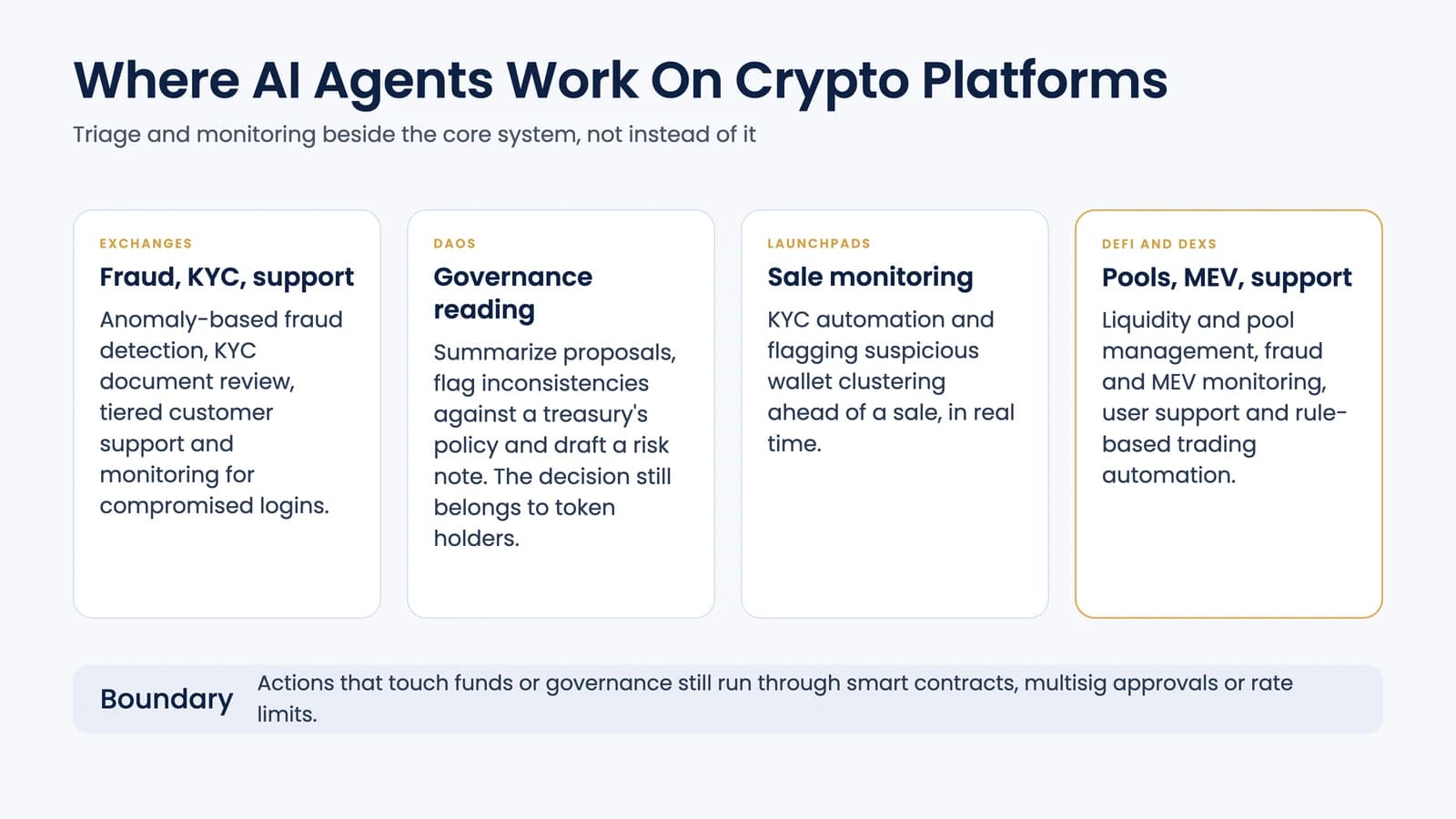
Exchanges
On centralized and hybrid exchanges, agents are used for anomaly-based fraud detection, KYC document review, tiered customer support, and monitoring accounts for behaviour that suggests a compromised login. None of this replaces the exchange's core risk engine. It sits alongside it, triaging cases so human reviewers see the ones that actually need judgment. The underlying language models are the same ones reshaping other parts of crypto product work. See our piece on ChatGPT use cases in crypto for the broader picture.
DAOs and governance
Reading and summarizing every governance proposal doesn't scale once a DAO has dozens of active proposals. Agents built into forums like Discourse or DAO tooling can summarize a proposal, flag inconsistencies against a treasury's stated policy, or draft a first-pass risk note for delegates to check. The decision still belongs to token holders, but the reading load drops.
Launchpads and token sales
Launchpads use agents for KYC automation and for flagging suspicious wallet clustering ahead of a sale, a pattern that historically preceded bot-driven sniping or wash trading. Because launch windows are short and adversarial, this is one of the few places where agent-driven monitoring genuinely needs to run in real time rather than on a daily batch.
DeFi and DEXs
- Liquidity and pool management. Agents can rebalance AMM pool parameters or move liquidity between venues faster than a human operator, though this only helps if the underlying strategy is sound: a fast agent executing a bad strategy just loses money faster. See our guide to building an AMM for the mechanics a pool actually runs on.
- Fraud and MEV monitoring. Wash trading, flash-loan attacks and front-running leave patterns an agent can be trained to flag; this is a complement to a proper smart contract audit, not a substitute for one.
- User support and onboarding. DEX interfaces are still confusing to newcomers: failed swaps, slippage, wrong network. An agent-driven support layer that can explain a specific failed transaction cuts a real support load.
- Trading automation. Agents are a natural fit for rule-based execution once a trader has a defined strategy; see our guide on building a crypto trading bot for what that involves technically.
What it takes to run agents reliably
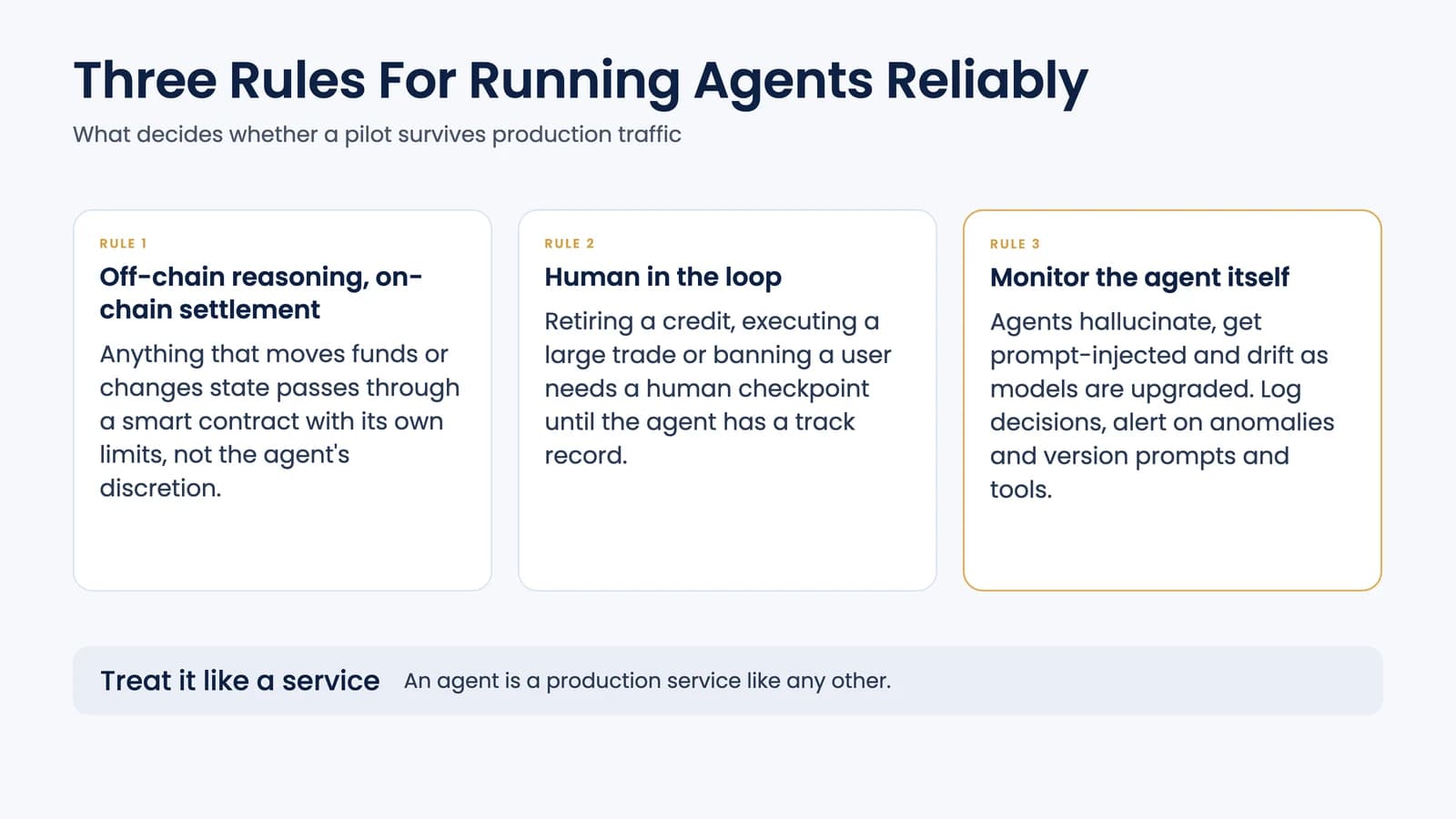
Three things determine whether an agent pilot survives contact with production traffic:
- Off-chain reasoning, on-chain settlement. An agent's judgment happens off-chain; anything that moves funds or changes state should still pass through a smart contract with its own limits, not the agent's own discretion.
- Human-in-the-loop for anything irreversible. Retiring a credit, executing a large trade, or banning a user should have a human checkpoint until the agent has a track record.
- Monitoring the agent itself. Agents hallucinate, get prompt-injected through user input, and drift as models are upgraded. Treat an agent like any other production service: log its decisions, alert on anomalies, and version its prompts and tools.
Where teams get stuck
- No in-house AI team. Few crypto teams have engineers who have shipped an agent to production; this is what an AI developer engagement or an outside partner solves.
- Fitting agents to blockchain's constraints. On-chain calls are slow and cost gas; an agent that wants to react in milliseconds usually needs to reason off-chain and only touch the chain for the parts that must be trustless.
- Compliance and data handling. An agent that reads user KYC data or wallet history has to respect the same data-protection rules the platform already follows; adding AI doesn't create an exemption.
A practical rollout sequence
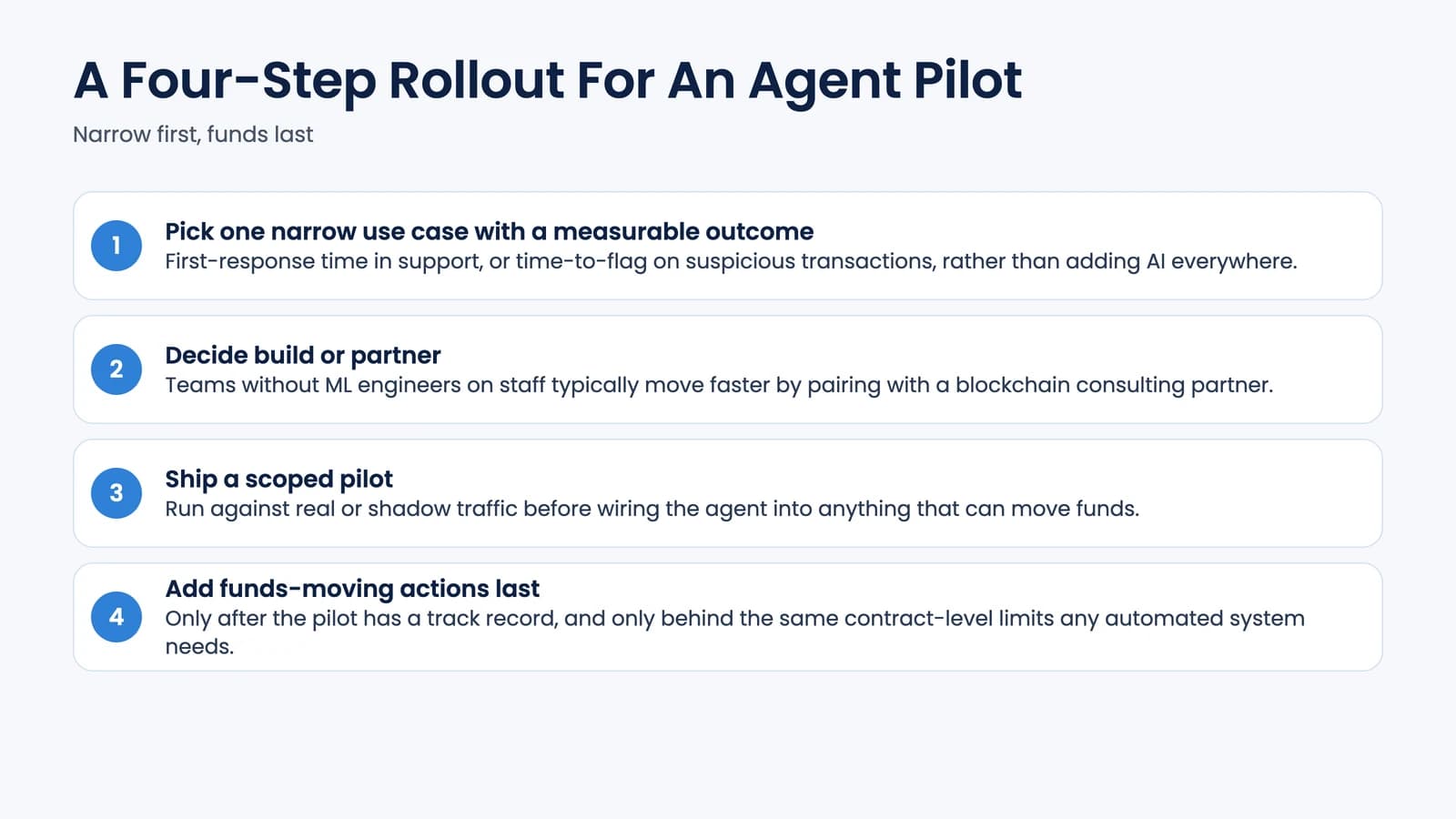
- Pick one narrow use case with a measurable outcome (first-response time in support, or time-to-flag on suspicious transactions) rather than "add AI everywhere."
- Decide build vs. partner. Teams without ML engineers on staff typically move faster by pairing with a blockchain consulting partner for the first project.
- Ship a scoped pilot against real (or shadow) traffic before wiring the agent into anything that can move funds.
- Add funds-moving actions only after the pilot has a track record, and only behind the same contract-level limits any other automated system would need.
Conclusion
AI agents are past the demo stage in crypto: exchanges, DAOs and DEXs are running them for support, monitoring and governance triage today, and standards like x402 are starting to let agents pay for what they use without a human in the loop for every transaction. The platforms getting real value keep the agent's judgment off-chain and its actions bounded by the same contracts and limits that already govern the rest of the system. If you're scoping an agent pilot for a crypto or fintech product, 4IRE's smart contract development and AI teams can help you define the guardrails before you wire anything to production.
Plan Your AI Agent Pilot
Thinking about where AI agents fit in your exchange, DAO or DeFi platform? Our team can help you scope a pilot with the right guardrails from day one.
FAQ on AI agents in crypto
In production today, mostly monitoring and support: fraud and anomaly detection, KYC document review, customer support, governance-proposal summarization, and liquidity or pool-parameter adjustments within limits a human has already set. Actions that move funds still route through smart contracts or multisig approvals.
Only within limits. The safer pattern is: the agent reasons and recommends, and a smart contract, rate limit or human approval enforces the boundary on anything irreversible. An agent with unrestricted signing authority is a risk, not a feature.
A scoped pilot (one use case, shadow or limited traffic) typically takes a few weeks to a couple of months depending on integration complexity; production rollout with monitoring and guardrails takes longer. Timelines depend heavily on whether the team already has ML engineers or is starting from zero.
x402 is an open protocol that lets software agents pay for API calls and data in stablecoins over standard HTTP, without a human approving each transaction. It's one of the first widely adopted standards built specifically for machine-to-machine payments, and it's a sign that agentic infrastructure in crypto is maturing beyond chatbots.
It depends on whether you already have ML engineers who have shipped agents to production. Teams without that in place usually move faster and avoid costly rework by partnering with a development team that has done it before, then building in-house capacity once the first use case is live.