


Top Loan Origination Software Products to Consider in 2026

Artificial intelligence continues to redefine lending workflow solutions at a fast pace. What recently started as a move towards loan processing automation quickly transformed into something bigger than that. The advent of generative AI redefined many well-known technologies in digital finance, including loan origination. Thus, the enterprise LOS solutions are now expected to offer unprecedented personalization, efficiency, and intelligence across the entire pipeline of lending operations.
Having a cloud-based LOS is not an innovation anymore; it’s the new normal with many critical success factors that shape the market of functional, safe, and competitive financial services software. Naturally, every business owner wants to find the best loan origination software product to address their goals, drive costs downward, and elevate performance at all levels. Thus, we’re walking you through the 2026 LOS landscape to show the critical trends and tangible benefits of secure, competitive software options.
This article presents a user-friendly loan origination software comparison to let you make informed decisions and enjoy the best balance of price and quality in the LOS market.
Key Factors to Consider When Choosing LOS
The choice of loan origination solutions is a meticulous process that requires your due diligence and attention to detail. A wrongly chosen, flawed, or overpriced LOP product can hinder your growth and automation strategy and fail to deliver upon the promise of loan automation. Here are a couple of criteria that may guide your choice:
- Functionality. Your chosen LOS software should cover all stages of the loan lifecycle. It should minimize the likelihood of human error, remove process bottlenecks, and speed up the underwriting process.
- Scalability. A high-quality loan servicing platform should be supportive of business growth without bottlenecks and downtime.
- UI/UX. The best loan origination software comes with an intuitive, interactive interface on the user and admin sides.
- Cost. A superior borrower portal software product should offer a solid balance of upfront and ongoing expenses to make budgeting transparent and predictable.
- Support. The team behind your chosen loan application software should be available 24/7 to troubleshoot technical issues, help staff and customers, and introduce timely updates.
The presence of these features makes the chosen option indeed the best loan origination software, which can give you the expected efficiency, compliance, and customer satisfaction combined with automated and error-free AI-powered underwriting.
Top 10 LOS Products You Should Choose From
Here, we share the list of top loan origination systems you should consider when looking for a LOS solution for your business.
1. ABLE Platform™
ABLE Platform™ is a provider of feature-rich, safe, and scalable loan origination software that will add a competitive edge to any lending business. What makes it the best loan origination software? It may be the prioritization of rapid loan processing, with pipeline times cut to less than 15 minutes. It may also be the impressive efficiency of the loan origination process and the predictive accuracy of credit risk assessment software.
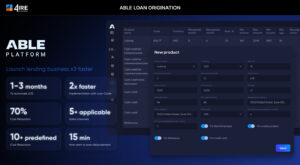
Users also point out the convenient multichannel onboarding that factors in the interests of diverse borrower categories and enables ABLE clients to create easily configurable loan products with an intuitive low-code toolkit. The AI-powered decision engine facilitates quick credit scoring and informs personalized offers suited to the client’s versatile credit data and many other fuzzy variables. ABLE developers understand the importance of regulatory compliance in lending software; thus, the ABLE Platform™ solution also comes with integrated compliance safeguards and tools. All of these features make ABLE one of the top loan origination solutions currently available on the market.
Key Features: automated loan processing, multichannel user onboarding, AI decision and credit risk evaluation engine, configurable lending products, integrated compliance measures, automated document management, real-time data analytics, handy analytical dashboards.
Pros:
- Fast launch on the client’s platform.
- Fully automated loan servicing.
- Scalability of modular design.
- Low-code tools for workflow and product customization.
- Cost-effectiveness.
Cons:
- Sophisticated loan offer calculations and matrices.
A steep learning curve.
2. HES FinTech
HES FinTech’s cutting-edge loan origination software streamlines lending from application to approval via advanced automation, secure data management, and seamless integrations. HES LoanBox boosts efficiency, compliance, and user experience for lenders and borrowers.
Key Features: End-to-end automation, robust security, customizable workflows, real-time
analytics.
Pros: Accelerates processing, lowers costs, improves security.
Cons: High initial setup costs for smaller institutions.
Year founded: 2012
Employees: 70+
Location: Vilnius, Lithuania
Key clients: Alraedah, ID Finance, ALM Securities
3. Encompass (ICE Mortgage Technology)
Encompass is the LOS product by ICE Mortgage Technology, a US-based company focusing on the integration of genAI in its solutions. The company’s digital mortgage platform streamlines all stages of mortgage servicing and offers robust compliance management and customer experience benefits.
Key Features: impressive automation, omnichannel borrower service portals, advanced analytics, e-document management tools, access to secondary loan sales markets.
Pros:
- Impressive efficiency gains upon implementation.
- Scalability achieved with 100+ APIs.
- Built-in compliance monitoring and reporting tools.
Cons:
- Expensive setup.
- Complicated administration and interface.
- Expiring SDK support with costly API transitions.
4. Factoring Software
ProfitStars, a Jack Henry division, is a provider of tech-savvy solutions for factoring companies and lenders in the accounts receivable niche. The company’s branded FactorSoft product uses genAI tools for automated invoice factoring, streamlined funding, and AI-powered portfolio management.
Key Features: AI-powered, automated invoice processing, portfolio management, funding status updates for clients, analytics, and ongoing compliance tools.
Pros:
- Effective automation.
- Integration with the broader Jack Henry ecosystem and third-party services.
Cons:
- High setup and ownership costs.
- Limited focus on factoring.
5. Finlux by M2P
The Finlux cloud-native LOS solution is currently used by 60+ M2P clients with a cumulative loan portfolio exceeding $3.2 billion. The product is tailored to the needs of banks, NBFCs, and FinTechs. It offers a scalable, API-driven architecture that enables automation and digital transformation.
Key Features: automation of the entire loan lifecycle, mobile app, workflow customization, AI-powered credit decisioning, data analytics, and detailed reporting.
Pros:
- Configurable workflows enable quick deployment.
- Scalable and flexible solution.
- End-to-end automation of all stages of loan servicing.
- Robust compliance across 15+ jurisdictions.
Cons:
- High setup costs.
- API integration dependency.
6. E-Wallet Software by SDK.Finance
SDK.Finance offers its branded, white-label E-Wallet software to simplify business entry into financial services provision. The software promises significant cost savings and process acceleration across the entire service spectrum, including loan origination. The solution’s scalable, cloud-native architecture simplifies deployment, and genAI tools automate lending and payments.
Key Features: integration of e-wallet and loan functionality for a unified user experience, genAI risk assessment and decision engine, mobile-first design, scalable APIs with banking, KYC, and payment providers, automated compliance solutions.
Pros:
- Quick setup and deployment.
- AI-powered functionality.
- Integrated payments.
- Operational cost savings.
Cons:
- Limited customization.
- Functionality dependent on API integrations.
- Lack of historical use data because of the product’s novelty.
7. Mortgage Automator
Mortgage Automator is a software solution for private, non-bank lending businesses in North America. It automates the entire lending lifecycle of residential, commercial, and construction loan types, from origination to servicing and reporting. The platform offers a holistic user experience with a suite of e-document generation and processing, compliance reporting, payments, and investor reporting tools.
Key Features: automated document generation, loan origination and servicing, integrated CRM, investor management tools, compliance and reporting tools, an all-in-one borrower and investor portal, and also versatile APIs.
Pros:
- Significant time savings on task automation.
- Workflow customization opportunities.
- Robust, versatile integrations.
- High-quality support.
Cons:
- High subscription costs.
- Lack of QuickBooks integration.
- Rollout delays in regard to advanced features.
8. Floify
Floify is a cloud-based mortgage automation and point-of-sale (PoS) platform established in 2012 and acquired by Porch Group in 2021. The software is suited to the needs of brokers and banks because of its extensive toolkit for document collection, verification, and mortgage management. Its AI-powered decision engine and analytical tools improve the borrower experience and streamline the complex mortgage pipeline.
Key Features: digital 1003 loan application for fast and easy submissions, eSignature, real-time loan status tracking, workflow customization, mobile-optimized platform, compliance management, report generation tools, and extensive analytics.
Pros:
- Scalability and variety of integrations.
- Transparent pricing model.
- Fast loan processing (up to 10 days).
Cons:
- Customization restrictions.
- Irritating email notifications.
9. Newgen Loan Origination
Newgen Loan Origination is a product by Newgen Software, an India-based company founded in 1992. The software solution represents an AI-powered LOS that suits the needs of banks, NBFCs, and Fintech companies. It uses AI tools for process automation and acceleration and ensures cutting-edge compliance.
Key Features: comprehensive process automation, intuitive and feature-rich customer portal, real-time analytical reports, genAI decision engine, and advanced document management.
Pros:
- Quick solution deployment.
- Efficient, AI-powered processes.
- Scalable and flexible software with 100+ integrations.
- Robust compliance in 50+ jurisdictions.
Cons:
- The steep learning curve for AI and low-code feature utilization.
- High setup costs.
- Limited customization potential.
10. ARIVE
ARIVE is a California-based LOS solution provider targeting independent mortgage brokers and non-delegated correspondents as its target audience. The company was created in 2018 and was bought by LendWize in 2021. It represents an all-in-one software product that combines LOS, PoS features, and the Products and Pricing Engine (PPE), integrated with a proprietary lender marketplace. The solution employs generative AI to automate workflows and achieve competitive productivity gains.
Key Features: integrated ecosystem of financial and lending services, borrower portal, real-time price updates, efficient support from contract processors, and automated compliance features.
Pros:
- A single-point resource for LOS, POS, and PPE operations.
- A user-friendly lender marketplace.
- High speed and automation.
- Community-driven development and updates.
Cons:
- Complex initial setup.
- Expensive upscaling.
- Lack of reliable user reviews and the product’s track record in the LOS market.
Automate the Digital Lending Process with Superior Loan Origination Solutions
All of these software options showcase the fast pace of innovation in the digital lending sector. What seemed like a futuristic, sci-fi concept a couple of years ago is the new norm among competitive businesses. Thus, the emergence of generative artificial intelligence in 2026 marks a watershed moment that opens a new page of AI in lending. In this business context, your task is to choose a safe, feature-rich, and compliant LOS solution that will move you fast forward in this market.
FAQ on top loan origination software in 2026
Automation is only one part of the benefits of using generative AI in your lending business. Smart AI tools reduce human error at all stages of the process, improve credit risk assessment, introduce accurate predictive modeling, and ensure ongoing compliance monitoring and reporting.
Robust architectural and governance frameworks are important to all enterprises using generative AI to streamline their loan origination processes. Relevant frameworks include modular and explainable AI architecture, bias detection and mitigation measures, and solid data governance and validation pipelines. The recommended governance frameworks are AI ethics and fairness protocols, model risk management (MRM) tools, transparency and disclosure protocols, and instruments for continuous monitoring and feedback provision (preferably including humans).
Beyond features, business owners should consider the strategic, operational, and regulatory dimensions of the selected software. The loan origination system should be compliant, aligned with the business architecture and tech stack, and customization-ready. It should also have robust security and data privacy safeguards put in place, with continuous learning and feedback loop integration features for real-time feedback and model retraining based on the changing business needs.
The main foreseeable trends of disruptive and unforeseen nature in the field of generative AI in loan origination include the emergence of dynamic, AI-generated lending products and advanced-level psychographic and behavioral risk profiling within AI-powered systems. Another step forward in digital lending may be the advent of synthetic personas for stress testing and bias audits of AI algorithms. The rise of decentralized Web3/DAO lending ecosystems also looks like a not-too-distant reality.
Advanced cybersecurity and data governance measures are vital for sensitive loan data protection and long-term customer trust. The list of recommended remedies includes zero trust architecture (ZTA) of loan processing software, minimization of sensitive data processing, and an encryption-by-design approach to loan automation software development. Access controls, secure prompt engineering, and continuous threat modeling are also potentially valuable tools for keeping customer and business data intact.
Similar articles
More articles

