

 Bank

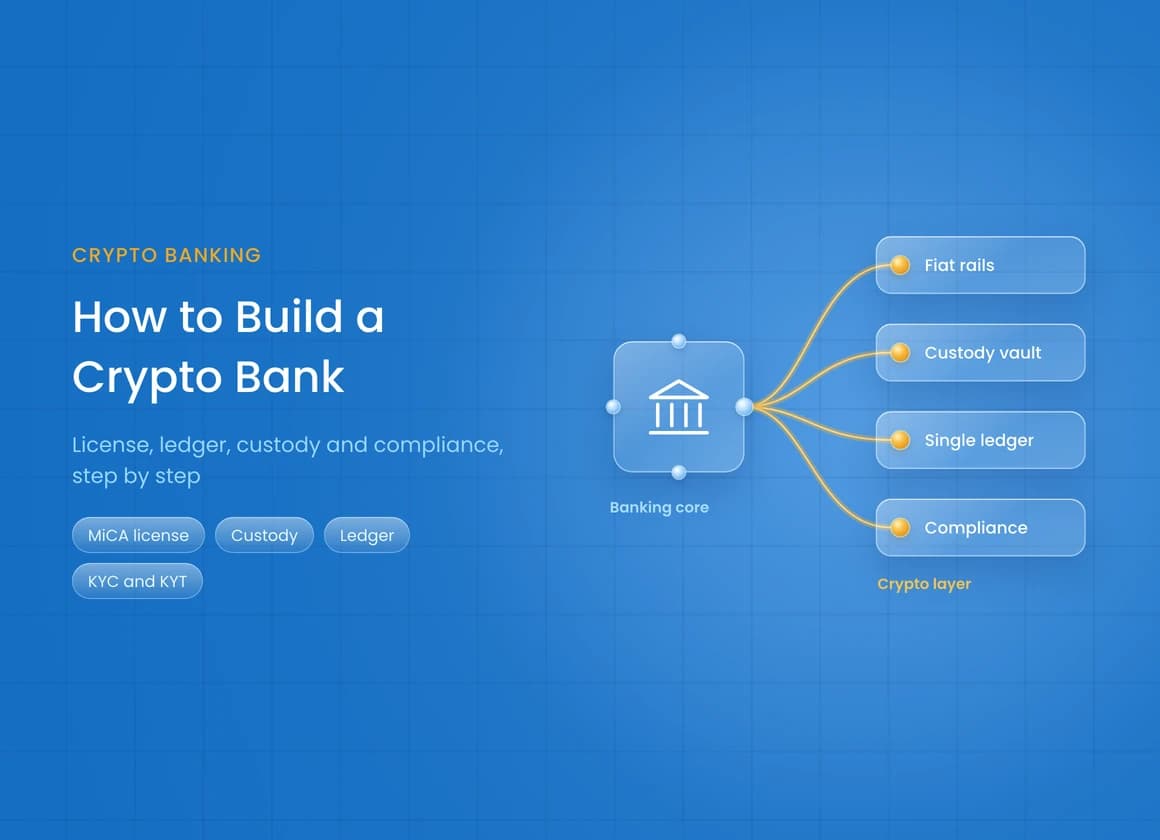
To build a crypto bank in 2026, you need four things working together: a license (or a licensed partner) that covers both fiat and crypto, a ledger that keeps customer money and digital assets reconciled to the cent, custody you can defend in front of an auditor, and compliance built into every flow. The app is the easy part. The regulatory and operational design decides whether you can launch.
The timing is better than it was two years ago. The EU’s MiCA regime now fully applies, US regulators have opened federal charters to crypto firms, and the UK has published final rules for its new crypto regime. This guide walks through the build in the order the 4IRE team usually works through it with clients. If you need the basics first, read our explainer on what crypto banks are and how they work.
Choose Your Crypto Bank Model
“Crypto bank” covers several business models. Pick yours first, because it sets your license, your partners and your budget:
- A licensed bank adding crypto. An existing bank offers custody, trading or stablecoin payments inside its current app. Our article on why banks adopt crypto modules covers this route.
- A crypto-native bank. A company obtains a banking or trust charter built around digital assets. Switzerland’s AMINA Bank (formerly SEBA) received a FINMA banking license in 2019; in the US, Anchorage Digital received conditional OCC approval in January 2021 to become a national trust bank.
- A neobank with crypto features. A digital bank or e-money institution adds a crypto service provider license for trading and custody.
- A crypto platform with banking features. An exchange or wallet adds IBANs, cards and payments through licensed banking partners.
Most startups choose one of the last two, because they do not require a full banking license on day one.
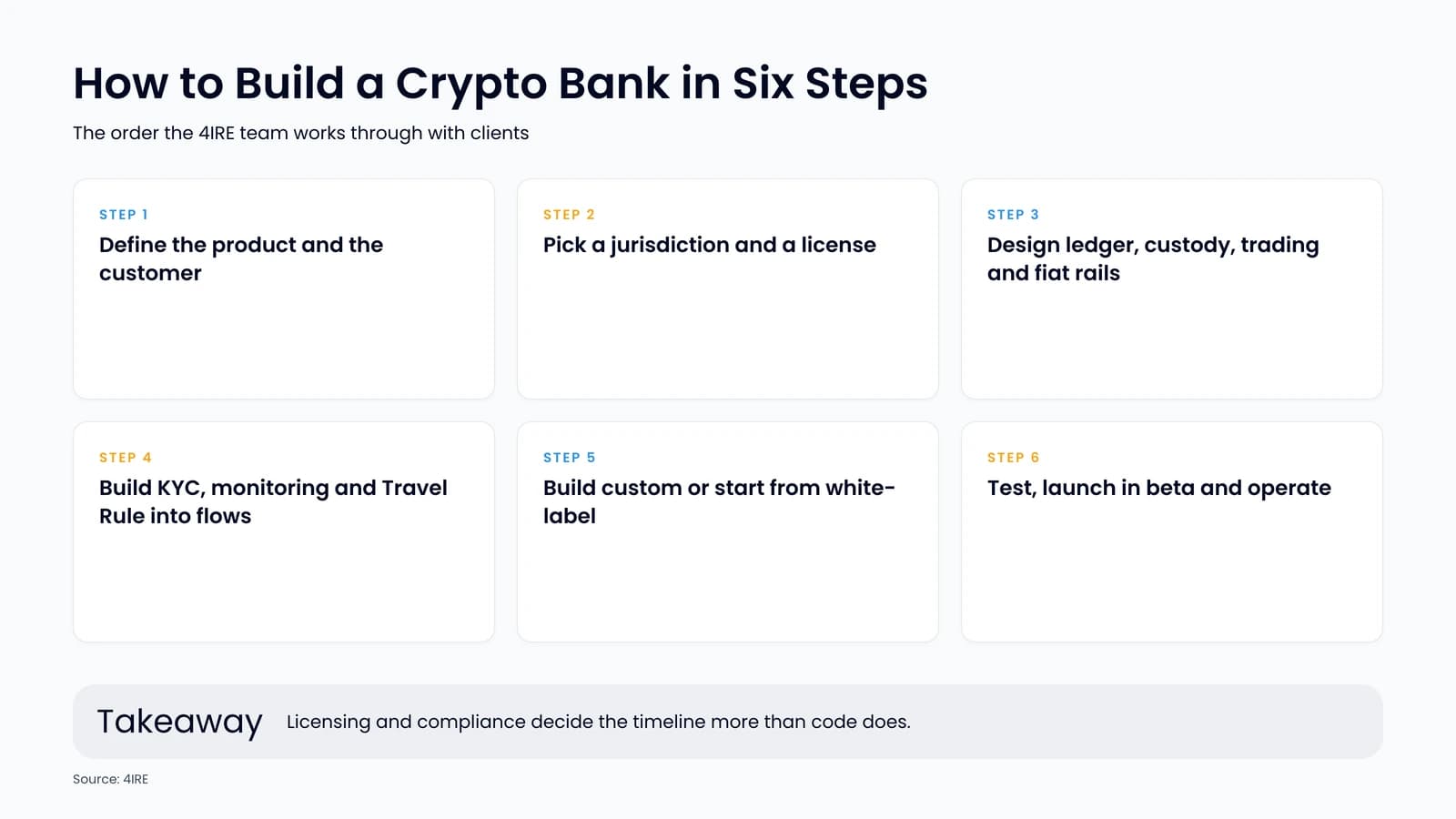
Step 1. Define the Product and the Customer
Decide who you serve and what they do first. A crypto bank for freelancers paid in stablecoins needs fast off-ramps and invoicing. One for high-net-worth clients needs institutional-grade custody and reporting. One for SMEs needs multi-user accounts and approval flows.
Write down the first release: which assets, which fiat currencies, which countries, which cards and which payment rails. Every item on that list has a licensing and integration cost.
Step 2. Pick a Jurisdiction and a License
Licensing drives cost and time to market more than any technical choice. Our overview of fintech and crypto license types goes deeper; the current picture in the main markets:
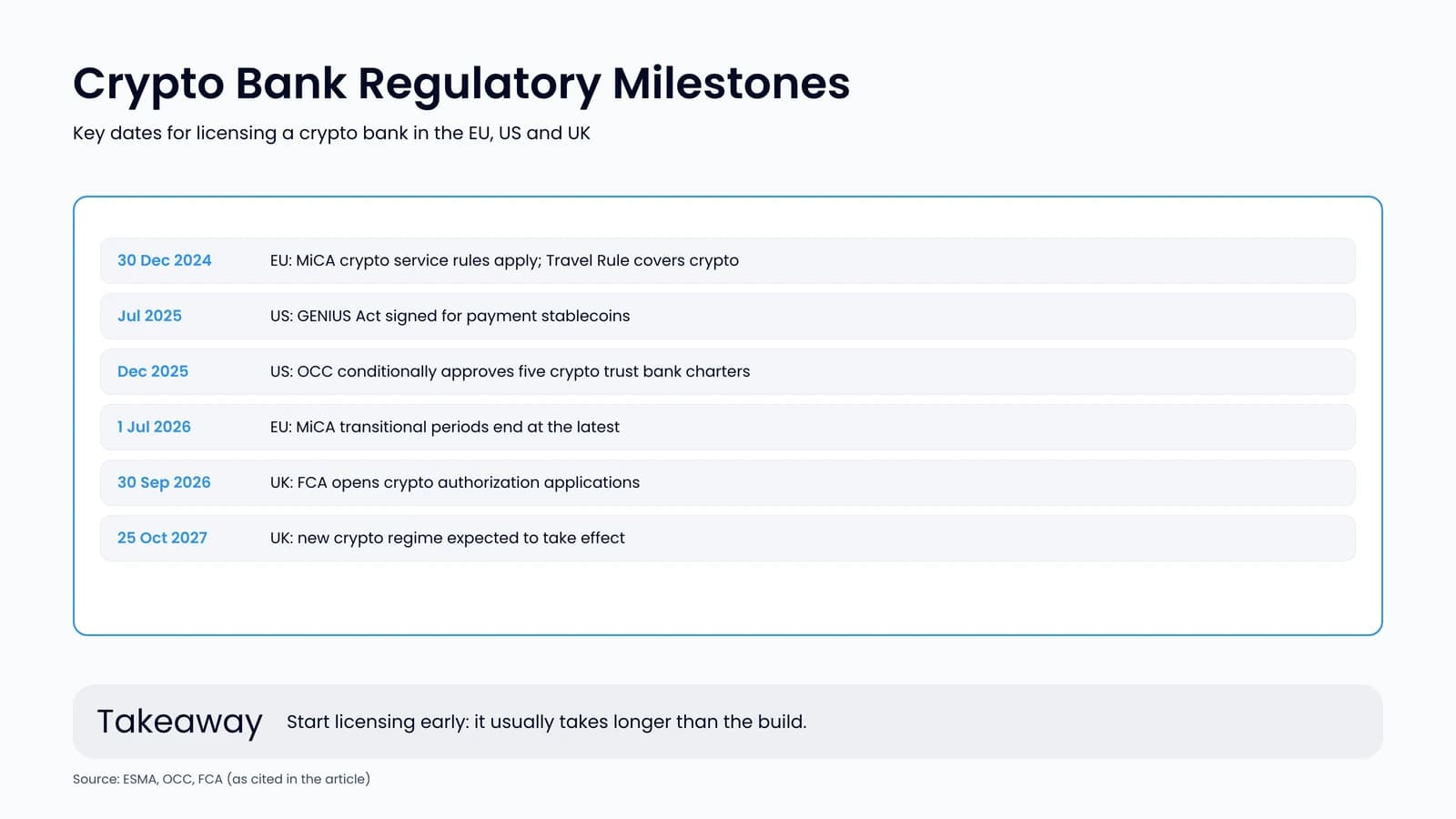
- European Union. Since 30 December 2024, crypto services require authorization as a crypto-asset service provider (CASP) under MiCA, which can be passported across the EEA. Transitional periods for firms operating under old national regimes ended by 1 July 2026 at the latest. Credit institutions can offer crypto services after notifying their regulator at least 40 working days in advance.
- United States. In December 2025, the OCC conditionally approved five national trust bank charters for Circle, Ripple, BitGo, Fidelity Digital Assets and Paxos: two new charters and three conversions of state trust companies. Trust charters cover custody and settlement, not insured deposits. Stablecoin issuance falls under the GENIUS Act, signed in July 2025, whose implementing rules were still being finalized as of September 2026.
- United Kingdom. The FCA’s new crypto regime opened for applications on 30 September 2026 (firms should apply by 28 February 2027) and is expected to take effect on 25 October 2027.
- United Arab Emirates. In Dubai, VARA regulates virtual asset providers everywhere except the DIFC, which has its own regulator.
For fiat accounts and cards, you will also need an e-money or payment license, or a partner bank that holds one.
Step 3. Design the Architecture
A crypto bank is two systems that must agree with each other: a banking core for fiat and a digital asset stack for crypto. The core components are:
- Ledger and core banking. One source of truth for balances in every currency and asset, with double-entry accounting and daily reconciliation against banks and blockchains.
- Custody. Hot, warm and cold wallets with MPC or HSM key management, withdrawal limits and approval policies. This is where most losses happen, so it deserves the most design time. Our crypto wallet development team builds custodial and MPC wallets for this layer.
- Trading and liquidity. Connections to exchanges or OTC desks for conversions, with price protection and slippage limits.
- Fiat rails. SEPA, SWIFT, card issuing and local payment schemes through licensed partners.
- Stablecoin rails. Increasingly the bridge between the two worlds; see our guide to stablecoins for the regulatory status of the main coins.
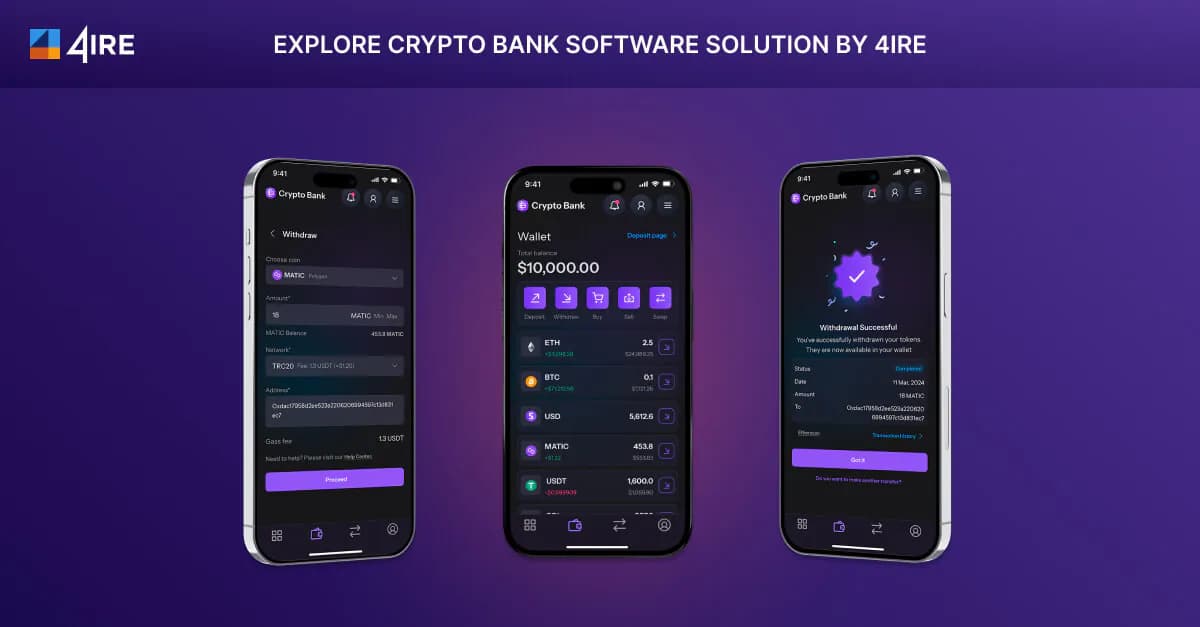
- Apps and back office. Customer web and mobile apps plus an admin panel for operations, support, fees and reporting.
Step 4. Build Compliance into the Flows
Regulators and banking partners judge your controls, not your policy documents. Plan for:
- KYC and KYB at onboarding, with document and liveness checks.
- Sanctions and PEP screening at onboarding and on an ongoing basis.
- Transaction monitoring for fiat and blockchain analytics (KYT) for crypto.
- Travel Rule data on crypto transfers; in the EU, the Transfer of Funds Regulation has applied to crypto transfers since 30 December 2024.
- Segregation of client assets and reports that come straight from the ledger.
Step 5. Build Custom or Start from White-Label
A fully custom build gives you complete control, but it is the slowest route; by 4IRE’s estimate, custom crypto bank development takes 8–10 months. A white-label base with ready-made accounts, wallets, KYC and admin modules shortens that considerably. 4IRE’s white-label crypto banking software includes a custodial wallet, virtual cards, KYC integrations, and IP rights with a source-code license, and is designed for launch in about two months.
Many teams combine both: a white-label core for standard banking functions, plus custom crypto banking software development where the product differentiates.
Step 6. Test, Launch and Operate
Before launch, run functional and load tests, a penetration test of apps and APIs, a review of key management, and an audit of any smart contracts you deploy. Start with a closed beta, conservative transaction limits and a small asset list.
After launch, the work shifts to operations: customer support, fraud handling, regulatory reporting, liquidity management and regular security reviews.
Pitfalls to Avoid
- One banking partner. When Silvergate announced its wind-down and Signature Bank was closed in March 2023, crypto companies lost their main US fiat rails within days. Plan for at least two partners.
- Weak key management. Custody failures are rarely recoverable. Treat key ceremonies, access policies and withdrawal approvals as core product features.
- Commingled funds. Keep client assets separate from company funds and make that visible in reporting.
- Thin liquidity. Without reliable liquidity providers, conversions become slow and expensive for customers.
- Compliance added late. Retrofitting KYC and monitoring usually means rebuilding onboarding.
How a Crypto Bank Makes Money
The main revenue streams are trading and conversion fees, FX spreads, card interchange, subscription plans, custody fees for business clients, and fees from partner products. Lending and yield products can add margin, but they carry the heaviest licensing and risk requirements, so most teams add them later.
How Much Does It Cost and How Long Does It Take?
Cost depends on the model, the number of jurisdictions, the assets and payment rails you support, and how much you build from scratch. Licensing often takes longer than development. A white-label base can cut the build to a couple of months; a fully custom platform takes most of a year. A scoped discovery phase gives the most reliable estimate.
How 4IRE Can Help
The 4IRE team builds crypto banks, neobank platforms, wallets and payment systems for fintechs and banks. We start from proven white-label modules, integrate your KYC, custody and banking partners, and hand over IP rights with a source-code license.
FAQ on Building a Crypto Bank
A traditional bank takes deposits in fiat and lends them out. A crypto bank combines fiat accounts with services for digital assets, such as custody, trading and stablecoin payments. Many crypto banks are not banks in the legal sense: they operate under e-money, payment or crypto licenses, or through licensed partners.
It depends on the market and the services. In the EU, crypto services need MiCA authorization as a crypto-asset service provider, and fiat accounts need an e-money, payment or banking license. In the US, firms combine state licenses, trust charters or partner banks. In Dubai, virtual asset providers are licensed by VARA.
By 4IRE’s estimates, a custom crypto bank takes 8–10 months to develop, while a white-label solution can launch in about two months. Licensing and partner onboarding often take longer than development, so start them in parallel.
Secure onboarding with KYC, multi-currency fiat and crypto accounts, custodial wallets, deposits and withdrawals, conversions, cards, transaction monitoring, and an admin panel for operations, fees and reporting.
Yes. Many teams add custody, trading or stablecoin payments as a module on top of their current core and app, once they hold or partner for the right crypto license.