


In March 2023, 4IRE published crypto banking research built with ProcessMIX, Aurum's legal team and Actana Research, the result of three months of joint analysis across the crypto and digital banking sectors. This article revisits that report's key calls against what has actually happened by October 2026, and lays out where crypto bank licensing, regulation and product strategy stand now.
If you need the basics first, our guide on what crypto banks are covers the definitions and models. This piece focuses on the trend record since 2023 and the decision to enter the market today.
The original report also included a blueprint for crypto bank projects: a licence-first, custody-second sequence for turning a concept into a working product. That order held up too. Every provider we reference below, from Revolut to the OCC's newest trust-chartered firms, settled its licence route before it shipped a feature, not after.
What the 2023 Report Predicted
- Banks would grow more crypto-friendly, folding custody and crypto payments into existing services without treating crypto as a separate product.
- Superapps bundling fiat, crypto and other financial services would come to dominate digital and crypto banking.
- Distributed ledger technology would see rising institutional acceptance, despite scepticism from established banking players.
- AI, IoT and machine learning would shape the next wave of digital banking products.
- Regulatory ambiguity, not technology, was the main brake on crypto banking growth, and rules were expected to tighten.
- Cybersecurity, user privacy and fund safety would remain the top concern for providers and users alike.
- Stablecoins and central bank digital currencies had the best odds of institutional adoption among crypto assets, held back mainly by immature regulation.
What Actually Happened by 2026
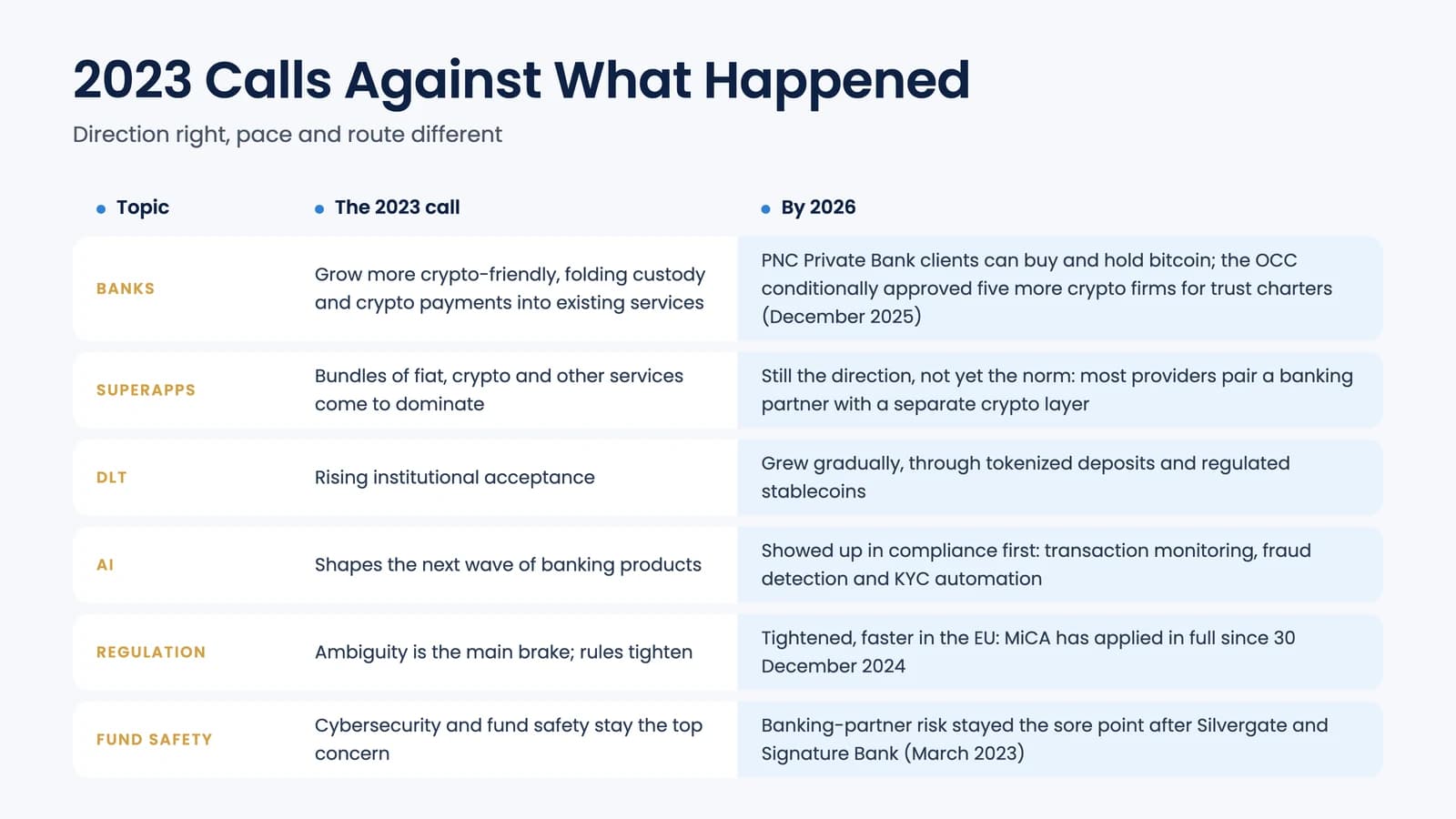
Measured against events through 2026, the report's direction was right more often than it was wrong, though the pace and shape of each shift differed from what the 2023 take implied. Of the seven findings above, none turned out to be false; a couple took longer than three years to play out, and a couple arrived through a different route than the one the report pointed to.
- Banks did turn crypto-friendly. In December 2025, PNC let PNC Private Bank clients buy and hold bitcoin directly, built on Coinbase's infrastructure, and the OCC conditionally approved five more crypto firms, including Circle, Ripple, Paxos, BitGo and Fidelity Digital Assets, for national trust bank charters that same month. Our article on why banks adopt crypto modules tracks this shift.
- Superapps are still the direction, not yet the norm. The fiat/crypto line keeps blurring: Revolut won a MiCA licence in Cyprus in October 2025 to run crypto services across the European Economic Area. But most providers still pair a banking partner with a separate crypto layer rather than running both under one roof, as our guide to launching a neobank describes.
- Regulation tightened, faster in the EU than elsewhere. MiCA has applied in full across the EU since 30 December 2024, and transitional national regimes ended by 1 July 2026 at the latest. The UK's FCA opened its own crypto authorisation window on 30 September 2026, taking full effect on 25 October 2027. The US initially moved the other way, withdrawing restrictive 2022-2023 banking guidance in 2025 before building a federal framework for payment stablecoins through the GENIUS Act. Our overview of fintech and crypto licence types covers the current routes.
Custody, DLT and AI Since 2023
- Custody and banking-partner risk stayed the sore point. The wind-down of Silvergate and the closure of Signature Bank in March 2023 cut many crypto firms off from their US fiat rails within days, and the episode remains the reference case for treating banking-partner risk, not only hacking risk, as part of a crypto bank's risk model.
- DLT adoption grew gradually, through tokenized deposits and regulated stablecoins, not a wholesale shift. Bank interest has concentrated on tokenized deposits and stablecoins as settlement rails, ahead of decentralised finance generally, a trend our comparison of stablecoins and deposit tokens looks at directly.
- AI showed up in compliance before it showed up in the app. The clearest 2026 use cases are transaction monitoring, fraud detection and KYC automation, ahead of the consumer-facing AI features the 2023 report anticipated.
Licensing Routes for a Crypto Bank in 2026
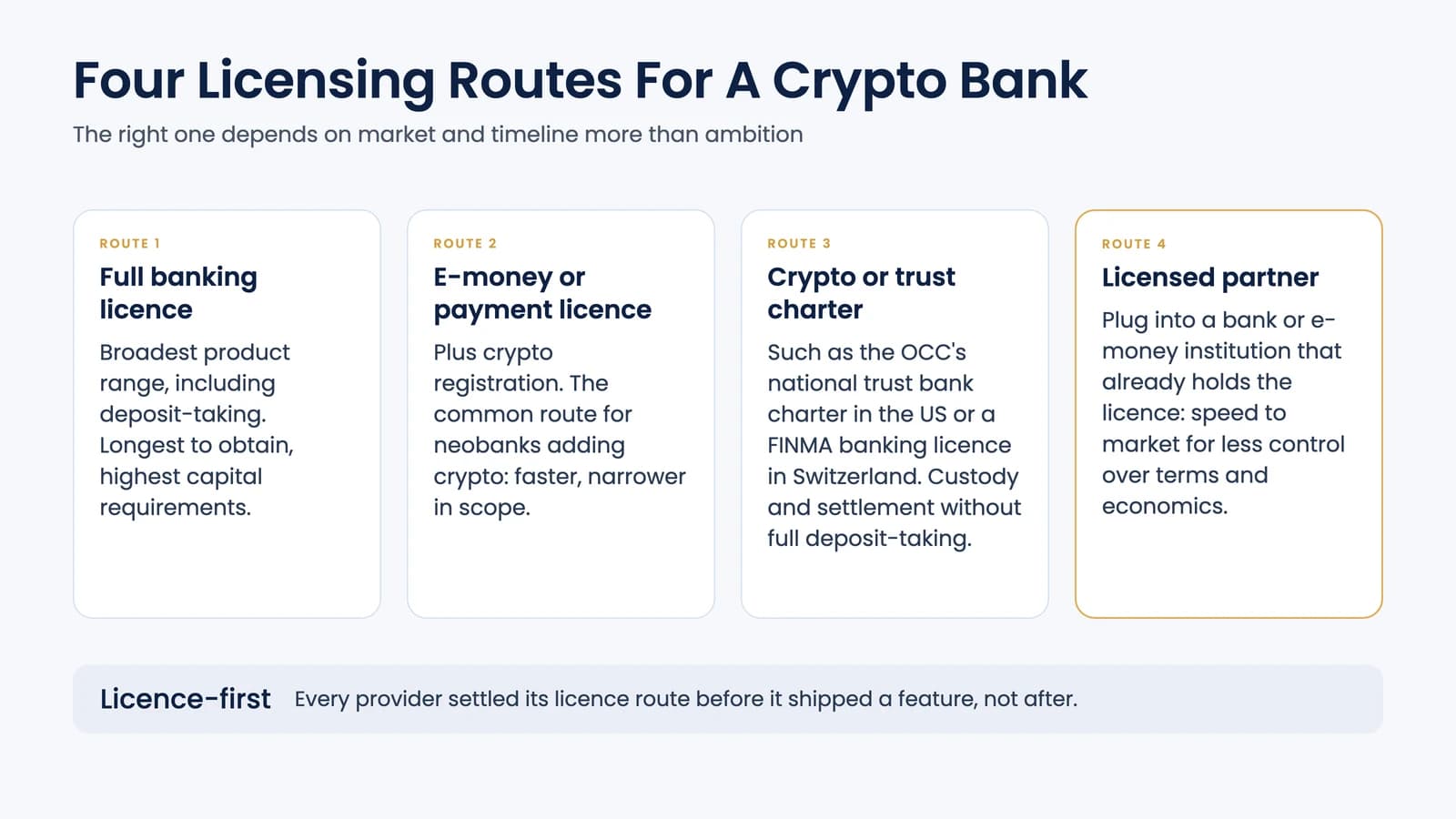
Four routes cover most new crypto banking projects today, and the right one depends on market and timeline more than ambition.
- Full banking licence. Gives the broadest product range, including deposit-taking, but takes the longest and carries the highest capital requirements; few crypto-native projects pursue it directly.
- E-money or payment licence plus crypto registration. The common route for neobanks adding crypto: faster to obtain, narrower in scope, and what most “crypto-friendly” apps run on.
- A dedicated crypto or trust charter, such as the OCC's national trust bank charter in the US or a FINMA banking licence in Switzerland. It legitimises custody and settlement without full deposit-taking powers.
- A licensed partner. Plugging into a bank or e-money institution that already holds the licence, trading speed to market for less control over terms and economics.
Is It Still a Good Time to Build a Crypto Bank?
The 2023 report's central bet, that crypto and digital banking would converge rather than one replacing the other, has held up. What has changed is the entry cost: the licensing bar is higher, and compliance by design is now a baseline expectation, not a differentiator. A few questions decide whether now is the right moment for a specific project:
- Which licence route matches the timeline, not just the market? A partner-led launch can ship in months; a dedicated charter can take years.
- Who carries custody risk, and how is it demonstrated to users and regulators? Audits, asset segregation and the custody technology all need an answer before launch, not after.
- Does the product need its own token or treasury economics, or does it work on stablecoins and tokenized deposits already live in the market?
- Is the target market one where the licence regime is settled, such as the EU, or still forming, such as the UK until October 2027?
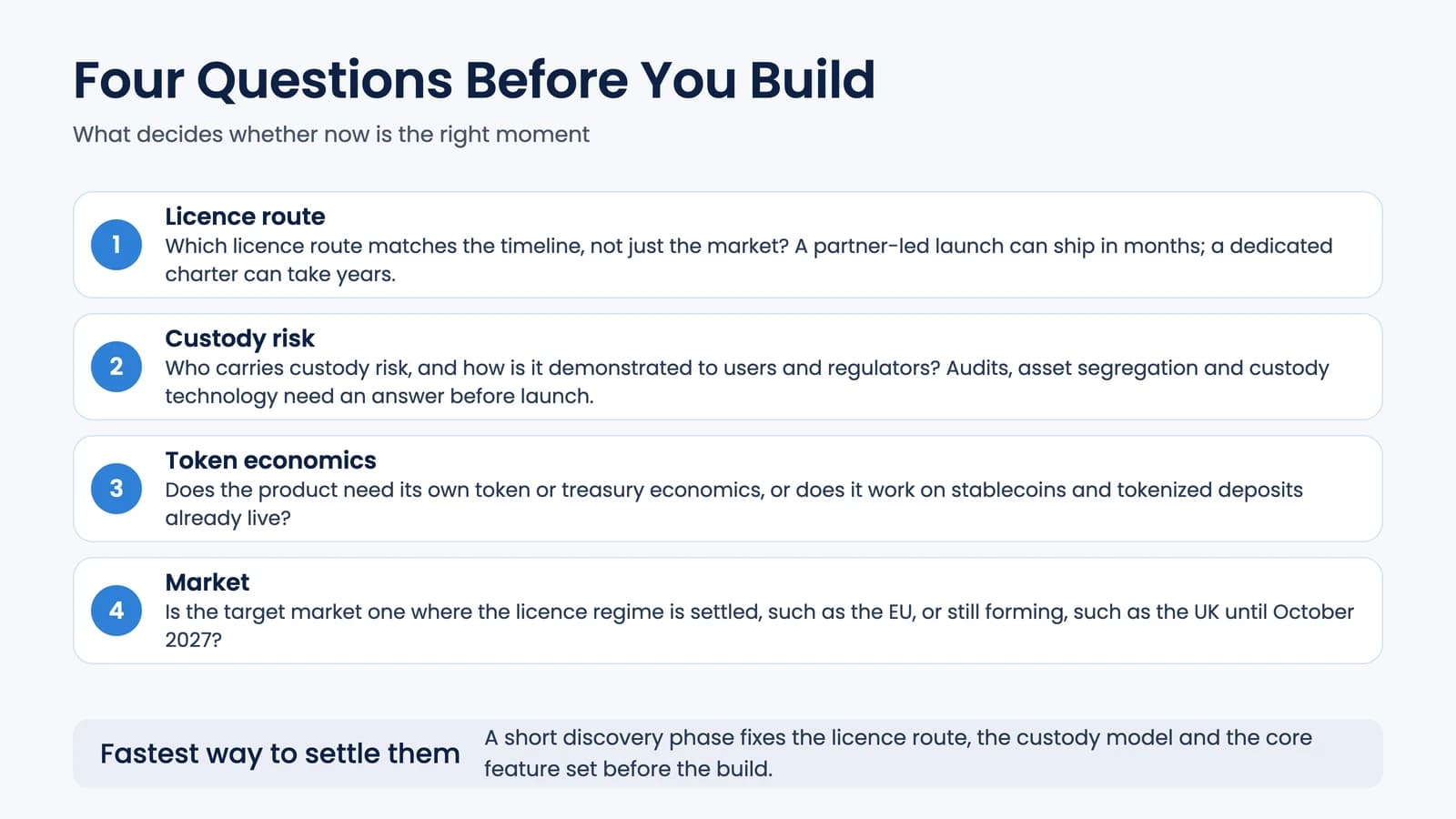
A short discovery phase is still the fastest way to settle the licence route, the custody model and the core feature set before committing to a build. It is also the cheapest point at which to change course: reworking a licence application after development has started costs far more than reworking a slide deck before it.
Plan Your Crypto Bank with 4IRE
4IRE builds white-label crypto banking software for fintechs and banks, and helps new projects choose the licence route and architecture that fit their market.
FAQ
It has moved from a trend into a licensing and infrastructure problem. Combining fiat and crypto in one account is now widely copied; what separates providers in 2026 is which licence they hold and how they handle custody, not whether they offer crypto at all.
It depends on the market and the services offered. The EU requires MiCA authorisation for crypto-asset services; the US route increasingly runs through an OCC trust charter or a state money transmitter licence; a licensed partner bank or e-money institution is the fastest route in most markets. Our licence overview covers each in detail.
Custody and banking-partner risk, not the blockchain itself. The 2023 US banking crisis that took down Silvergate and Signature Bank cut crypto firms off from fiat rails within days; a new project should plan for a banking-partner failure, not only a smart-contract bug.