

Quality Assurance in Web3: How to Mitigate Risks in Software Development
The present-day era of Internet development is characterized by greater decentralization, transparency, and distributed ownership – this is what Web 3.0 stands for. Powered by blockchain technology, the world of Web 3.0 offers diverse, decentralized apps (dApps) and software, which revolutionizes the users’ and developers’ perceptions of digital products and services.
The Web3 world features innovative technologies, such as IoT systems, NFTs, decentralized identity, and blockchain-based applications of all types and business purposes. It used to be valued at around $2.18 billion in 2023, and its size is expected to exceed $65 billion by 2032, exhibiting a CAGR of 46%.
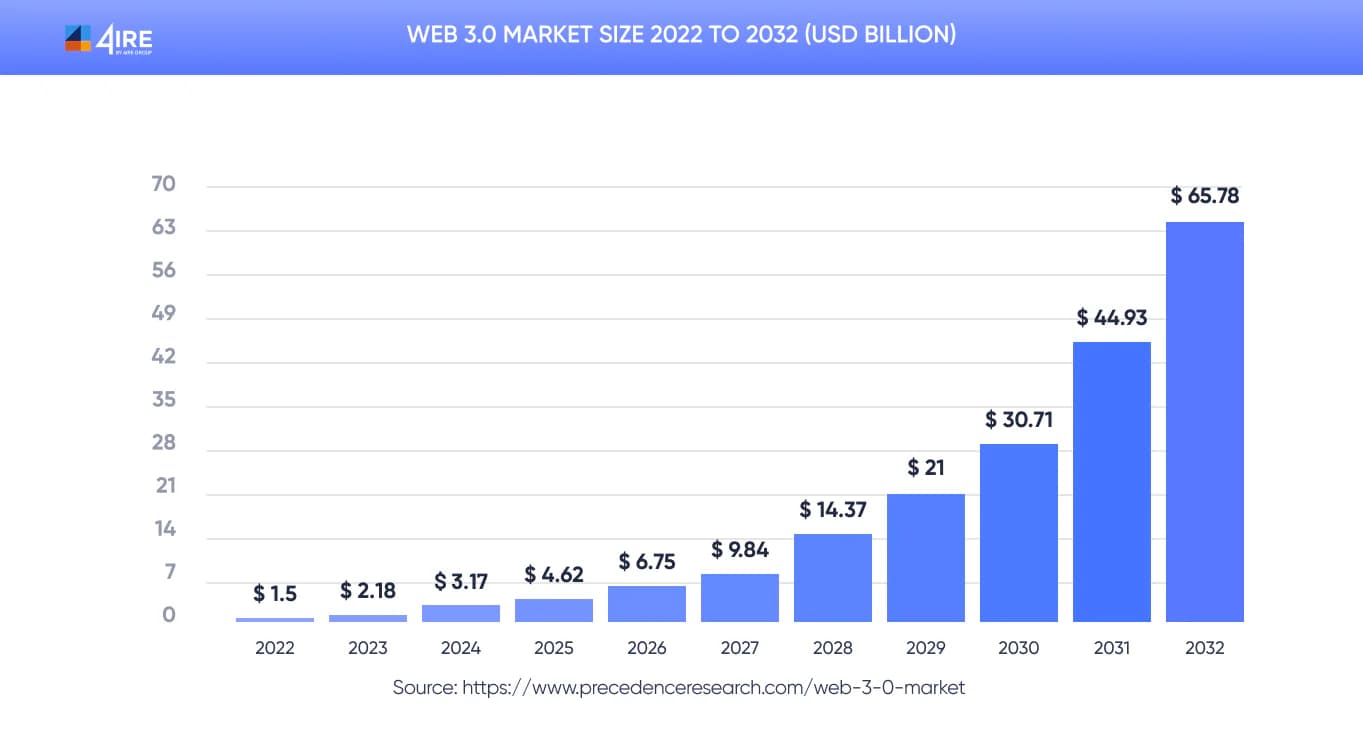
This massive growth is partly attributed to the quick rise in the popularity of metaverses and other virtual environments, which offer brand-new spaces for service use and interactions. It is also geared for growth with the rapid increase in cryptocurrency and NFT use cases and adoption, as well as the deployment of 6G and 5G technologies.
Yet, together with the massive rise in the Web 3.0 infrastructure, the cybersecurity risks also increase manifold. Since the Web3 technology is relatively new and unexplored, with many new projects launched with experimental features, developers face unprecedented challenges in anticipating and offsetting hazards. Just look at the following figures supplied by Hacken experts:
- Almost $513 million was stolen in Q2.
- Projects also lost over $397 million because of losing access or control of their dApps.
- Only a bit more than $347 million was recovered due to cybersecurity interventions.
These stats point to the immense significance of ensuring comprehensive dApp security at the development stage and throughout its operations. Therefore, quality assurance (QA) in Web3 is a new, dynamically developing cybersecurity niche that requires close attention and stands no guesswork or reliance on chance in the digital space. This article explores all nuances of QA for Web 3.0 and guides you on choosing a reliable quality assurance company for your Web3 project’s needs.
Web 3.0 Testing vs. Traditional Testing
The main difference that a QA tester for blockchain applications has to deal with is the decentralized nature of such software. Unlike traditional apps and platforms hosted on a specific server, dApps are usually hosted on distributed ledgers. As a result of decentralization, QA specialists may not have access to all nodes and have limited data manipulation capacity on the mainnet.
This way, QA testing of dApps usually occurs in simulated blockchain environments or testnets, with the testers facing the need to replicate real-world conditions without full control over the network.
It is also critical to note that all Web3 apps operate based on smart contracts, and the tester’s key task is to perform in-depth smart contract security testing. Thus, QA specialists have to be well-versed in the smart contract audit process and understand the code logic and potential vulnerabilities of smart contracts inside out.
Why Is QA Testing Crucial for Your Web3 Project?
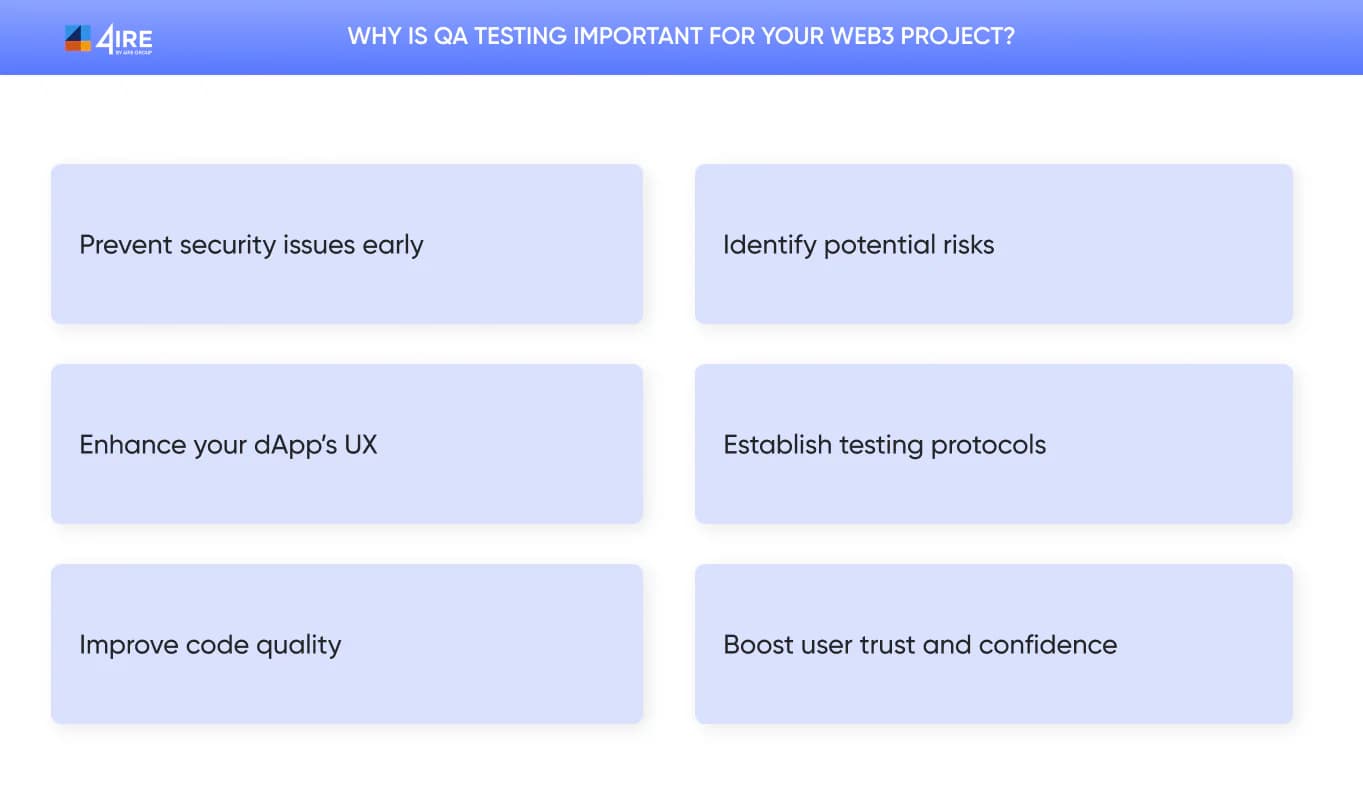
The importance of Web3 application testing can hardly be overestimated today. By investing time, effort, and money into a comprehensive QA procedure, you can:
- Prevent security issues early. It’s much cheaper to detect and eliminate errors and code issues at the early stages of development than to intervene in the late stages when the bugs and defects are already entrenched in the project’s core codebase. Thus, early blockchain bug tracking can help you avoid the escalation of problems with the code logic and quality.
- Enhance your dApp’s UX. End-user QA testing may help you create a user-friendly interface with simple logic to facilitate the dApp’s adoption. By means of running UX tests, you can ensure that your software meets the usability and functionality expectations, thus avoiding costly revisions after deployment.
- Improve code quality. A crypto QA automation engineer can offer invaluable insights into how your code quality can be enhanced for the sake of smooth and secure automation. They can perform a comprehensive code review in line with the best practices and coding standards, thus helping you create more maintainable and less error-prone code.
- Identify potential risks. QA engineers possess the needed expertise to identify the full range of looming blockchain security risks your project may face upon deployment. They can also develop customized mitigation strategies to prevent the emergence of critical security issues upon the launch of your dApp.
- Boost user trust and confidence. Rigorous blockchain testing before the project’s full-scale launch is a great investment in building user confidence and trust in your software product. A dApp with a safety seal is more likely to attract investors, senior management support, and customer buy-in.
- Establish testing protocols. You can attain much better testing coverage and automation of testing procedures by setting up all processes at the beginning. A tried and tested QA process and framework will contribute to quick feedback loops, smooth and continuous testing, and faster development.
With all these benefits in mind, you’re sure to grow more positive about the role of QA in blockchain development. Now, it’s time to consider the scope of your QA efforts and the key Web3 functionalities you will have to cover in the QA process.
Common Risks in Web3 Software Development
As an innovative, decentralized space for digital transactions, Web3 comes with unique risks and cybersecurity issues you need to know before joining the industry with your product.
- Smart contract vulnerabilities. Smart contracts are self-executing, automated algorithms responsible for your dApp’s performance of the predetermined tasks for users. Since they operate without human intrusion or validation, they have to be fully correct and immune to third-party manipulation. That’s why the main advice is that you don’t skip the smart contract audit, as the correctness of smart contract logic can make or break your entire dApp’s functionality.
- Scalability issues. dApp operations may become unstable under changing network conditions or increased transaction volumes. Therefore, comprehensive dApp testing can help you anticipate and prevent those problems, preparing your project for smooth performance and unrestrained scaling.
- Interoperability concerns. With so many blockchain networks and protocols co-existing in the Web3 space, interoperability is key for the smooth operation of your dApp. Besides, bridges and oracles are the most vulnerable aspects in the Web 3.0 space; they are the most frequent objects of hacker attacks and exploits. Thus, by testing and securing your dApp’s cross-platform interactions, you guarantee user trust and safety.
- Regulatory compliance. Though Web3 is a more democratic space with a less rigid regulatory framework, your dApp should still follow the core jurisdictional laws and rules. As you are planning to process and store sensitive user data and enable financial transactions, your project will have to meet compliance requirements; otherwise, it may be fined or blocked.
- User experience (UX) challenges. Web 3.0 is a highly popular and quickly rising niche in the digital services market. Yet, many blockchain-based apps are criticized for cumbersome interfaces and complex learning curves. That’s why one of the top-priority tasks for you is to ensure a stellar UX so that your product stands out as an intuitive and user-friendly option in the competitive market.
All these risks should be adequately covered in the process of DeFi application testing to maximize the chances for the dApp’s smooth market entry and absence of critical issues during its operations.
Key Web3 Functionalities to Test
To guarantee that your quality assurance services cover all key Web3 functionalities, use the following checklist for organizing the QA process.
- Core functionality. As your dApp is typically meant to perform a certain function and serve specific user purposes, the task of your decentralized app testing is to double-check whether it indeed performs its functions. It should also be able to meet business objectives; for example, a crypto investing app should allow safe and instant transactions with crypto assets and offer a secure wallet for asset storage.
- Front-end (interface) issues. Front-end quality is the decisive factor for apps’ adoption, as the quality of user experience determines whether users like the app or not. That’s why it is imperative to make UIs visually attractive, intuitive, and easy to navigate.
- Smart contract quality. Even a tiny smart contract vulnerability can cause devastating consequences for your dApp, from user data breaches to large-scale asset losses on the user and company side. For this reason, it’s critically important to hire a qualified blockchain technology consulting partner who will perform a comprehensive smart contract QA audit and guarantee your dApp’s correct operations.
- Data management. Your dApp will have to process and store personal and financial user data, crypto assets, and wallet addresses. These aspects should be comprehensively protected without undermining user privacy and hindering functionality.
- Chain integrations and compatibility. While your dApp may be operating on one blockchain, it may be compatible with other networks via oracles and bridges. Your top priority is to guarantee those links’ security and guarantee the dApp’s effective communication with other blockchain environments.
- Ethical and regulatory compliance. The regulatory and ethical landscape of Web3 is continually evolving. Thus, it is vital to keep pace with all regulatory changes and ensure compliance at all levels.
Main Types of QA Practices in Web3
What types of tests can your QA engineer perform to guarantee your dApp’s smooth functioning and safety for users? Here is the most common list of testing approaches a QA audit includes.
- Network testing. This type of test determines whether your dApp can function correctly on a variety of Ethereum networks. It is meant to evaluate the selected network’s resilience and performance.
- Security testing. These tests serve to identify and mitigate potential risks and vulnerabilities in the dApp’s smart contracts. They also cover the issues of confidentiality, service non-denial, availability, and other critical security parameters of the Web3 space.
- Penetration testing. This type of test is meant to check how vulnerable the dApp is to unauthorized penetration, such as a hacker exploit or sensitive data interception.
- Unit testing. These tests approach the dApp’s separate functions unit by unit and test them in an isolated manner to identify code problems more precisely.
- Performance testing. Performance tests are meant to measure the dApp’s scalability and speed of transactions it can perform in the blockchain network.
- API testing. It is meant to validate API functionality and assess its ability to interact with other services.
- Smart contract audit and code review. Testers should ensure the accuracy and security of smart contracts, as well as their logic and ability to perform the designated functions.
Web3 Quality Assurance Process
This is how the QA assurance process usually takes place.
- Requirement analysis. Every provider of QA services needs to understand the scope of required QA work and your expectations from the audit. Thus, the initial stage presupposes the discussion of requirements that will lay the foundation for the QA plan.
- Test case design. The QA service provider analyzes your dApp and determines its functionality, smart contract logic, and blockchain network requirements to develop the right testing environment.
- Test execution. This stage is the actual QA procedure. Your QA engineer will perform various types of tests, including dApp penetration testing, unit testing, etc., to identify all vulnerabilities and make the final evaluation of your dApp’s security.
- Reporting. Based on the test’s outcomes, you will receive an issue report with all identified code flaws, bugs, and potential weaknesses that have to be addressed before the launch.
- Test automation.
- Updating the test case. The new round of tests is performed after the bugs are addressed, and the code flaws are corrected. The resulting evaluation signals about whether the app is ready for launch.
- Deployment and monitoring. Now that you have rectified all cybersecurity issues based on the QA report, it’s time to launch your dApp to the Web3 space. Yet, you should integrate continuous QA tracking processes into your operations to detect emerging bugs early and eliminate them before the problem escalates and hinders the dApp’s performance.
Best Practices for Web3 Testing
The output of your QA efforts will be much better if you employ the following best practices adopted as a golden standard in the Web3 QA testing industry.
- Make testing a part of your development process. Don’t think of the QA audit as a separate stage for finalizing your software development efforts. By integrating QA processes at the initial stages, you can avoid costly errors and eliminate bugs early.
- Use several testing methods and tools. By combining several software tools or using manual and automated QA procedures jointly, you will receive a much fuller image of the code’s quality.
- Prioritize smart contract QA. Your smart contracts should be fully secure before the dApp’s launch, which is a critical safety precondition.
- Use Web3-specialized tools. Web 3.0 is a unique space with nuances in architecture and design, so one-size-fits-all testing techniques will hardly cover all aspects of dApp quality.
- Include threat modeling and exploratory testing in your QA processes. These methods will uncover a broader range of risks your standard toolkit may fail to anticipate.
- Partner with your community. Users and developers can also become a valuable source of bug reports and insights. Listen to their feedback and take early measures to restore the dApp’s functionality.
- Keep pace with the changing cybersecurity landscape. Cybercriminals are quickly evolving in Web3, finding new ways to steal user data and money. Thus, your Web3 project should always be one step ahead in cybersecurity measures.
Popular Tools and Frameworks for Web3 QA
If you’re new to the field of QA testing for crypto and blockchain projects, here are a couple of handy automated testing tools to try out.
- Truffle Suite. This resource offers a rigorous testing framework for blockchain applications. It may guarantee a smooth and simple process of dApp testing and troubleshooting. Its automated smart contract testing framework enables comprehensive and accurate smart contract audits.
- Hardhat. The Hardhat framework enables Ethereum-based smart contract development and testing. It has a Mocha testing library and the Chai assertion library for built-in smart contract testing.
- Ganache. Ganache 7 Ethereum Simulator is a handy tool for forking and resting smart contracts in their local environments. It provides rigorous control of the chain, thus giving the QA tester better control over command execution and state inspection.
- MythX. This EVM-focused smart contract security service has many features for Solidity dApp testing and security vulnerability detection. It is also compatible with the Truffle Suite for security pipeline enhancement.
- Ethers.js and Web3.js. These two JS-based blockchain libraries can assist you with QA procedures. They are lightweight and user-friendly, offering numerous features for advanced debugging and testing.
How to Choose Your Web3 QA Partner?
If you’re thinking seriously about cybersecurity and approaching the stage of QA in your project development, it’s time to turn to 4IRE for a comprehensive smart contract audit. 4IRE can become your dedicated Web3 partner, as we’re a decentralized exchange development company with extensive expertise in all aspects of the Web 3.0 industry. Our Web3 QA experts can perform all kinds of automated and manual QA procedures for your project, spotting all code vulnerabilities and anticipating any security risks subject to early mitigation.
As you can see, DeFi security testing is a task that can’t be skipped or ignored in the Web3 space. The market is experiencing fast growth, and so are the sophisticated and inventive hacker tactics. That’s why a successful launch of a safe Web3 project is impossible without rigorous blockchain QA services from a qualified, reliable QA provider.
FAQ on blockchain quality assurance
Web3 apps operate in the decentralized blockchain space and don’t have a central storage or server where the QA engineer can perform comprehensive testing. That’s why the dApp testing process is undertaken on the testnet with limited control over the environment.
4IRE currently performs in-depth smart contract audits for Web3 projects with manual and automated QA tools. We provide a detailed bug report and an improvement plan for mitigating the identified risks and code vulnerabilities.
You can hire QA engineers from the 4IRE team using the team augmentation model. This way, our specialists will integrate seamlessly into your Web3 development team and provide valuable insights and assistance with the identification and elimination of cryptocurrency security issues.
The cost estimate depends on your project’s type and complexity. Typically, you will have to pay from $5,000 to $15,000+ for a comprehensive smart contract audit, but the price may go up if you need to test other functionalities and aspects.
4IRE is a highly experienced vendor of Web3 development and crypto vulnerability assessment services in the international market. We have a large team of top-level blockchain engineers with a keen eye for code vulnerabilities and potential risks. Our team has a versatile blockchain tech stack and is well-versed with most blockchain technologies and networks.
Elevate Your Vision with Web3 Pioneers
Join the ranks of industry leaders by leveraging our Blockchain and Web3 expertise. From concept to execution, our dedicated team is here to turn your ideas into reality. Take the first step – book a meeting with our senior expert today!