

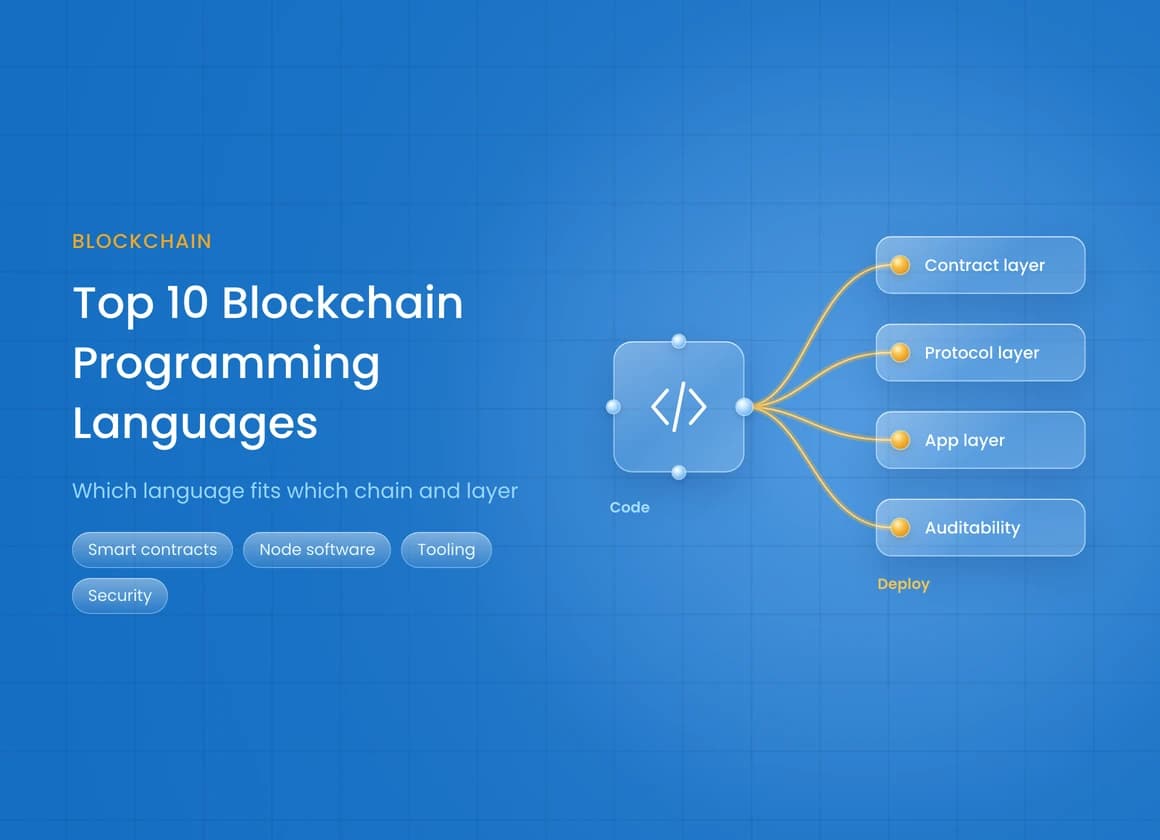

There is no single best blockchain programming language. The right choice depends on which chain you build on and which layer of the system you are writing: on-chain smart contracts, the node software that runs the network, or the back end and front end that connect users to it. Picking the language first and the chain second is one of the most common, and most expensive, mistakes in blockchain projects.
This guide covers the ten languages that matter most for blockchain development in 2026, where each is used, and how to choose between them for your project.
Three Layers, Different Languages
- Smart contracts run on the blockchain itself and hold assets. Languages here are designed around determinism and safety: Solidity, Vyper, Rust, Move and Cairo.
- Protocol and node software runs the network: consensus, networking and storage. It is written in systems languages such as Go, Rust, C++ and Java.
- Application and tooling code connects users and services to the chain: wallets, back ends, indexers and scripts, usually in TypeScript, JavaScript or Python.
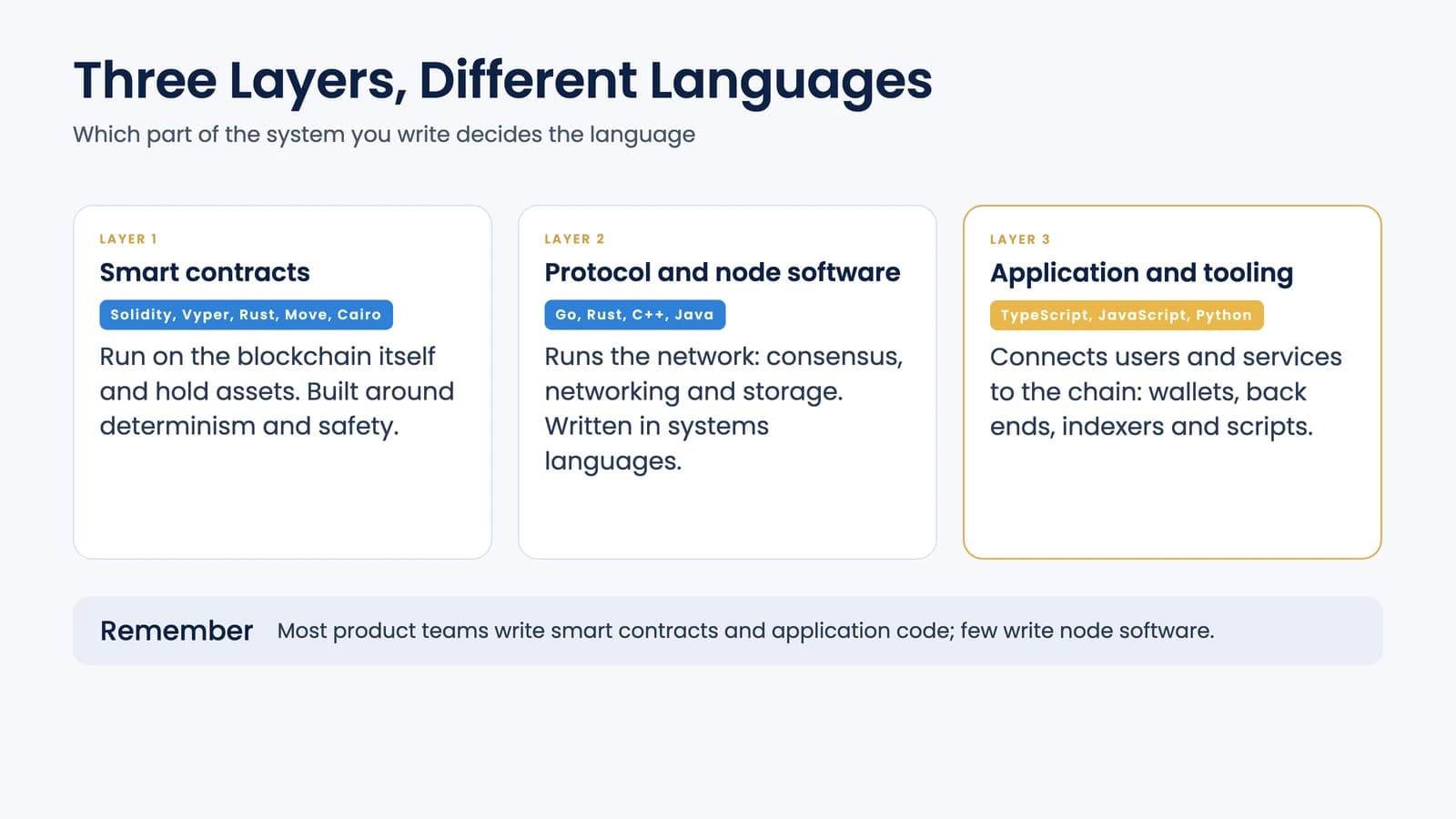
Most product teams write smart contracts and application code; few write node software. Keep that split in mind when you read about "popular" languages.
How to Choose a Blockchain Programming Language
- Start from the chain. Each platform supports a small set of contract languages, so the platform decision usually makes the language decision for you. Our guide on how to choose the right blockchain covers that first step.
- Weigh safety features. Languages that restrict risky patterns reduce the attack surface of code that holds funds.
- Check the tooling and audit market. Mature testing frameworks, libraries and auditors familiar with the language lower both risk and cost.
- Consider hiring. A language with a larger developer pool is easier to staff; see our guide on where to hire DeFi developers.
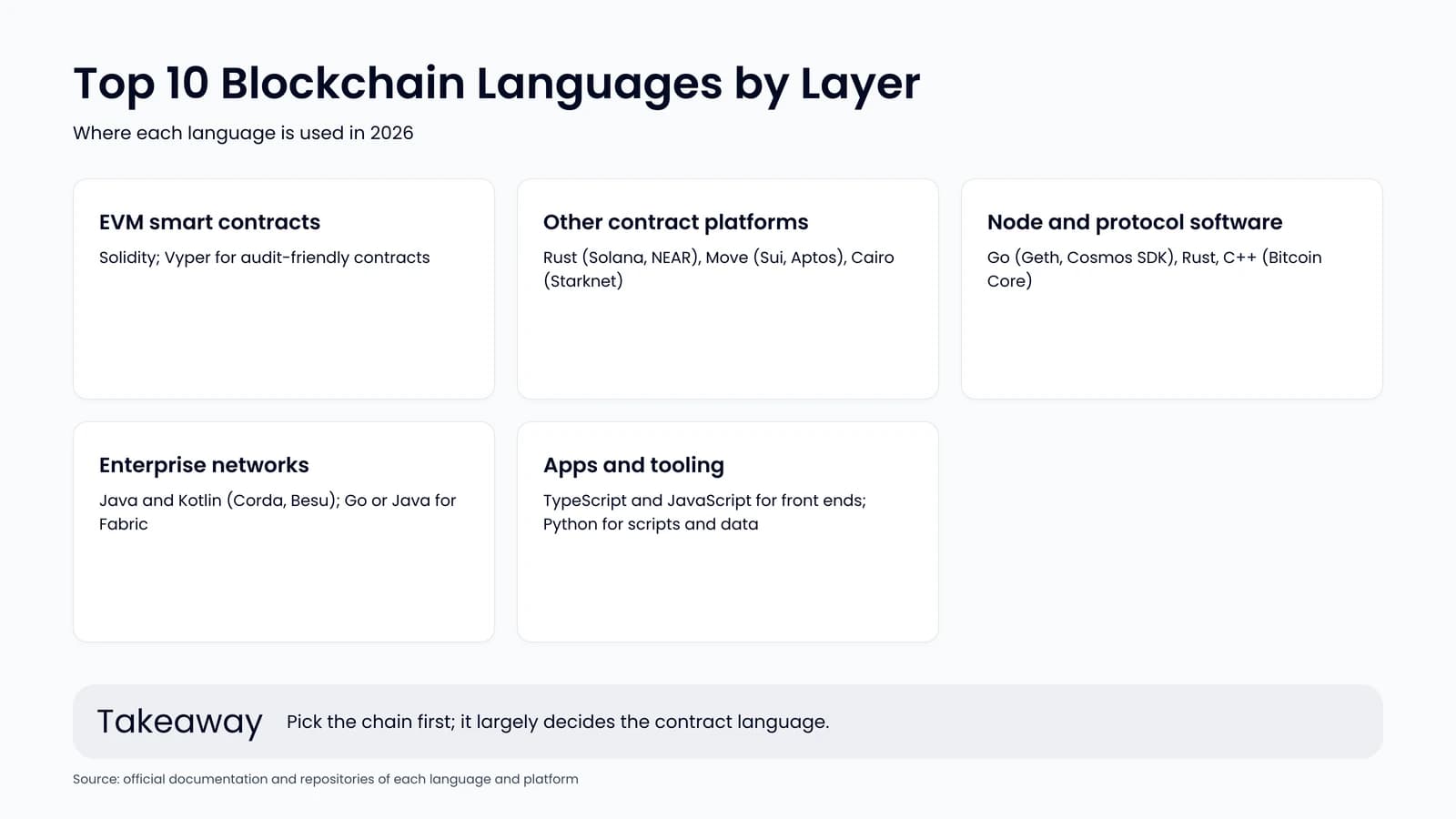
Top 10 Blockchain Programming Languages in 2026
1. Solidity
Solidity is the main language for smart contracts on Ethereum and every EVM-compatible network, including major layer-2s and many other layer-1 chains. Its documentation describes it as an object-oriented, statically typed, curly-bracket language influenced by C++, Python and JavaScript, with support for inheritance, libraries and user-defined types. It is actively maintained, with version 0.8.37 released in September 2026. Solidity has the largest body of audited libraries, tools and auditors, which is why most DeFi protocols use it. If you need a team, you can hire Solidity developers with production DeFi experience.
2. Rust
Rust combines C-level performance with memory safety enforced at compile time, which makes it a favourite for both contracts and infrastructure. Solana programs are written in Rust, either natively or with the Anchor framework, and NEAR recommends Rust for production smart contracts. The Polkadot SDK, the Sui and Aptos node software and Agave, a Solana validator client, are also written in Rust. It suits teams building high-throughput Solana or NEAR products, or custom chains with Substrate. The trade-off is a steep learning curve.
3. Vyper
Vyper is a Pythonic contract language for the EVM that deliberately leaves out features that make code hard to audit: there are no modifiers, no class inheritance, no inline assembly, no function or operator overloading, no recursion and no infinite loops. The result is smaller, more readable contracts. Curve Finance, for example, writes its core contracts in Vyper. It is a good fit when auditability matters more than flexibility.
4. Move
Move was created for Meta's Diem project and now powers Sui and Aptos, each with its own variant. Sui describes it as an open-source language for writing safe packages that manipulate on-chain objects. Move treats assets as resources that cannot be copied or accidentally destroyed, which removes whole classes of bugs common in other languages. The community is younger than Solidity's, so libraries and experienced auditors are scarcer.
5. Cairo
Cairo is the language of Starknet, an Ethereum layer-2 based on validity proofs. It is designed for writing provable programs: code whose correct execution can be verified with a cryptographic proof. It shares many similarities with Rust, so Rust developers find it familiar, and it is under active development, with new releases through September 2026. Choose it when you are building on Starknet or need verifiable computation.
6. Go
Go is a core infrastructure language. Geth, a long-running Ethereum execution client, is written in Go, as are the Cosmos SDK and Hyperledger Fabric, which also accepts smart contracts (chaincode) in Go. Its simple concurrency model and fast compilation suit node software, indexers and back-end services.
7. TypeScript and JavaScript
Almost every blockchain application has a TypeScript or JavaScript layer. Libraries such as viem and ethers.js connect wallets and front ends to contracts, and development frameworks such as Hardhat are built on TypeScript. NEAR offers a JavaScript and TypeScript SDK for contracts, and Hyperledger Fabric chaincode can be written in Node.js. For most teams, this is the second language after the contract language.
8. Python
Python is widely used for blockchain scripting, testing, data analysis and back-end services. The web3.py library connects Python applications to Ethereum, and Vyper borrows its syntax from Python. It is rarely used for contracts directly, but it is a practical choice for analytics, automation and research on on-chain data.
9. C++
C++ is the language of Bitcoin Core, the reference implementation of Bitcoin, and of several other established networks. It offers fine-grained control over memory and performance, which matters for node software, but it is unforgiving: manual memory management makes it a poor choice for teams without deep systems experience. New projects increasingly choose Rust for the same role.
10. Java and Kotlin
Java and Kotlin dominate enterprise blockchain. Corda, the permissioned platform used by banks and financial institutions, is written in Kotlin and supports contracts in Java and other JVM languages, while Hyperledger Besu, an enterprise Ethereum client, is written in Java, and Fabric chaincode can also be written in Java. If you are building for a bank or a consortium, see why teams choose Corda.
Language Choice and Security
No language makes a contract safe on its own. Vyper and Move remove some dangerous patterns by design, and Rust prevents many memory errors, but logic bugs, flawed access control and economic exploits are possible in any of them. What a language changes is how easy mistakes are to make and to spot. Whatever you choose, budget for automated testing, fuzzing, peer review and an independent audit before any contract holds real value, and prefer audited libraries over custom code for standard components such as tokens and access control.
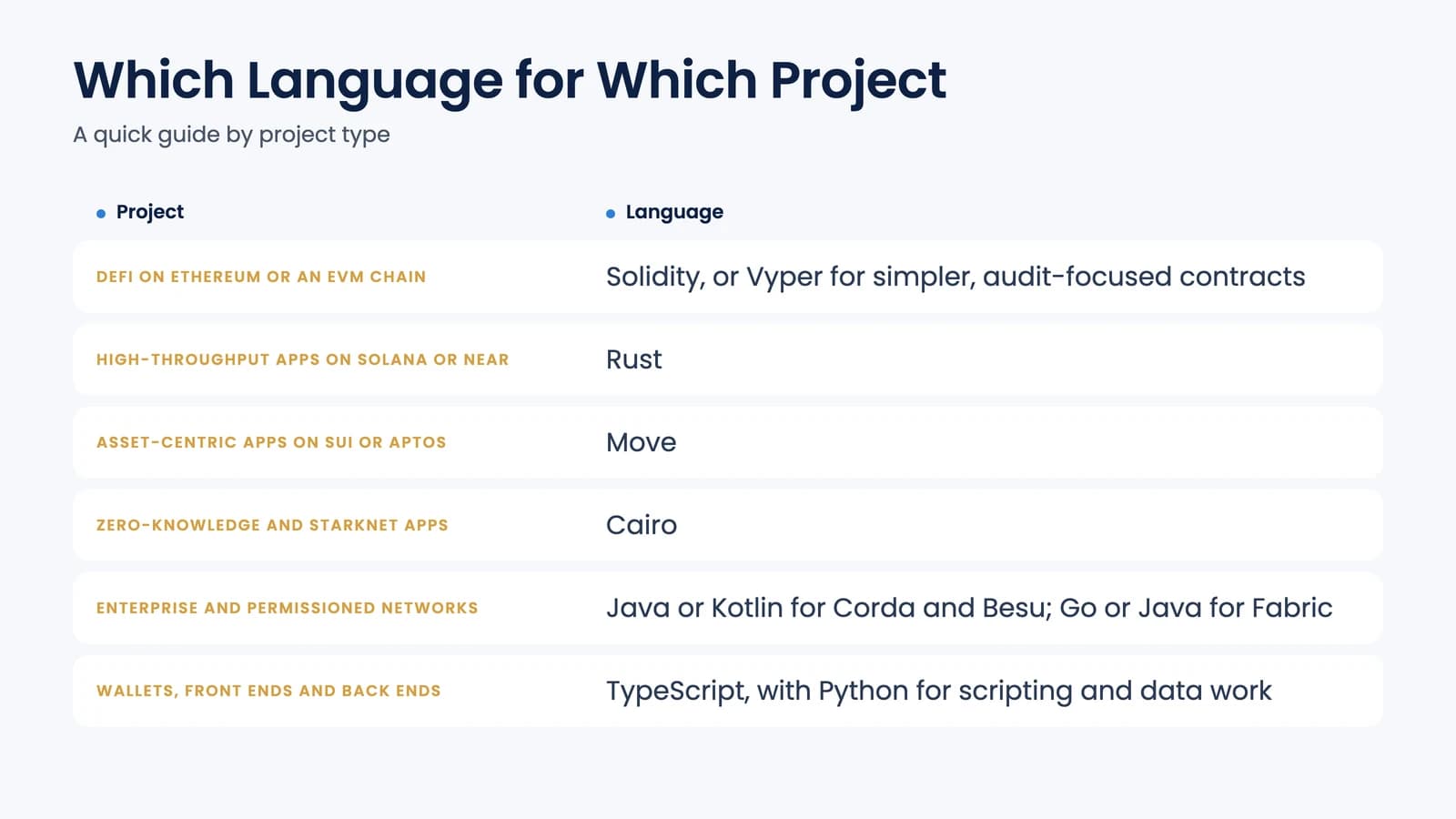
Quick Guide: Which Language for Which Project?
- DeFi on Ethereum or an EVM chain: Solidity, or Vyper for simpler, audit-focused contracts.
- High-throughput consumer apps on Solana or NEAR: Rust.
- Asset-centric apps on Sui or Aptos: Move.
- Zero-knowledge and Starknet apps: Cairo.
- Enterprise and permissioned networks: Java or Kotlin for Corda and Besu, Go or Java for Fabric.
- Wallets, front ends and back ends: TypeScript, with Python for scripting and data work.
Conclusion
Choose the chain first, then the language it supports best, then check that you can hire and audit for that language. Solidity and Rust cover most new projects, Move and Cairo are strong choices on their own platforms, and Go, C++, Java and Kotlin remain essential for infrastructure and enterprise work. If you are unsure which combination fits your product, our blockchain consulting team can help you compare platforms, languages and delivery risks before you commit.
Learn more from us
 Blockchain news28 Sept 2026
Crypto Wallet Development Cost in 2026: A Full Breakdown
How much does crypto wallet development cost in 2026? 4IRE's estimates by tier, platform and feature, plus running costs and what drives the budget.
Olena Petrashchuk
 Blockchain news28 Sept 2026
Real World Asset Tokenization in 2026: A Practical Guide to RWA
Real world asset tokenization explained: asset classes, how the stack works, 2026 RWA market data, US, EU, Singapore and UAE rules, and how to launch.
Olena Petrashchuk
 Understanding Blockchain06 Oct 2026
Web3 Quality Assurance: How to Test Smart Contracts and dApps
How Web3 QA differs from normal testing: unit, fuzz and invariant tests, mainnet forks, audits and monitoring, plus the tools still current in 2026.
Olena Petrashchuk
Not Sure Which Stack to Choose?
Our blockchain consultants can compare chains, languages and delivery risks for your product. Schedule a free consultation to get a clear recommendation.
FAQ
It depends on the chain and the layer you are building. For smart contracts, Solidity dominates Ethereum and EVM chains, Rust is used on Solana and NEAR, Move on Sui and Aptos, and Cairo on Starknet. For node software, Go, Rust and C++ are common, and TypeScript is the usual choice for wallets and front ends.
Solidity is the most widely used, with the largest body of libraries and auditors. Vyper is a simpler, audit-friendly alternative on the EVM. Rust is standard on Solana and NEAR, Move is designed around safe asset handling on Sui and Aptos, and Cairo is used for provable programs on Starknet.
Choose the chain first, based on where your users and liquidity are, then use its primary contract language: Solidity or Vyper for EVM chains, Rust for Solana, Move for Sui or Aptos. Also check the maturity of testing tools, the availability of experienced auditors and how easily you can hire developers for that language.
Yes, but mostly around the chain rather than on it. Python is common for scripts, testing, data analysis and back-end services, through libraries such as web3.py. Vyper, an EVM contract language, uses Python-like syntax.
Specialist Web3 job boards, vetted talent networks and development companies are the main options. 4IRE provides blockchain engineers across Solidity, Rust and other stacks, and can help you decide which skills your project actually needs.