

 GreenFi

Every industrial facility that burns fuel or runs heavy machinery emits CO2, and a growing share of the world now caps how much of that any single business can emit for free. When a company exceeds its cap, it has two options: cut emissions, or buy credits from a business that has room to spare. That redistribution is what a carbon trading platform exists to facilitate, and building one well means understanding both the regulatory mechanics and the technical stack behind it. For the market's current size and growth trends, see our companion piece on carbon trading market size and trends. Here's the 4IRE team's guide to doing it in 2026.
Why carbon trading exists
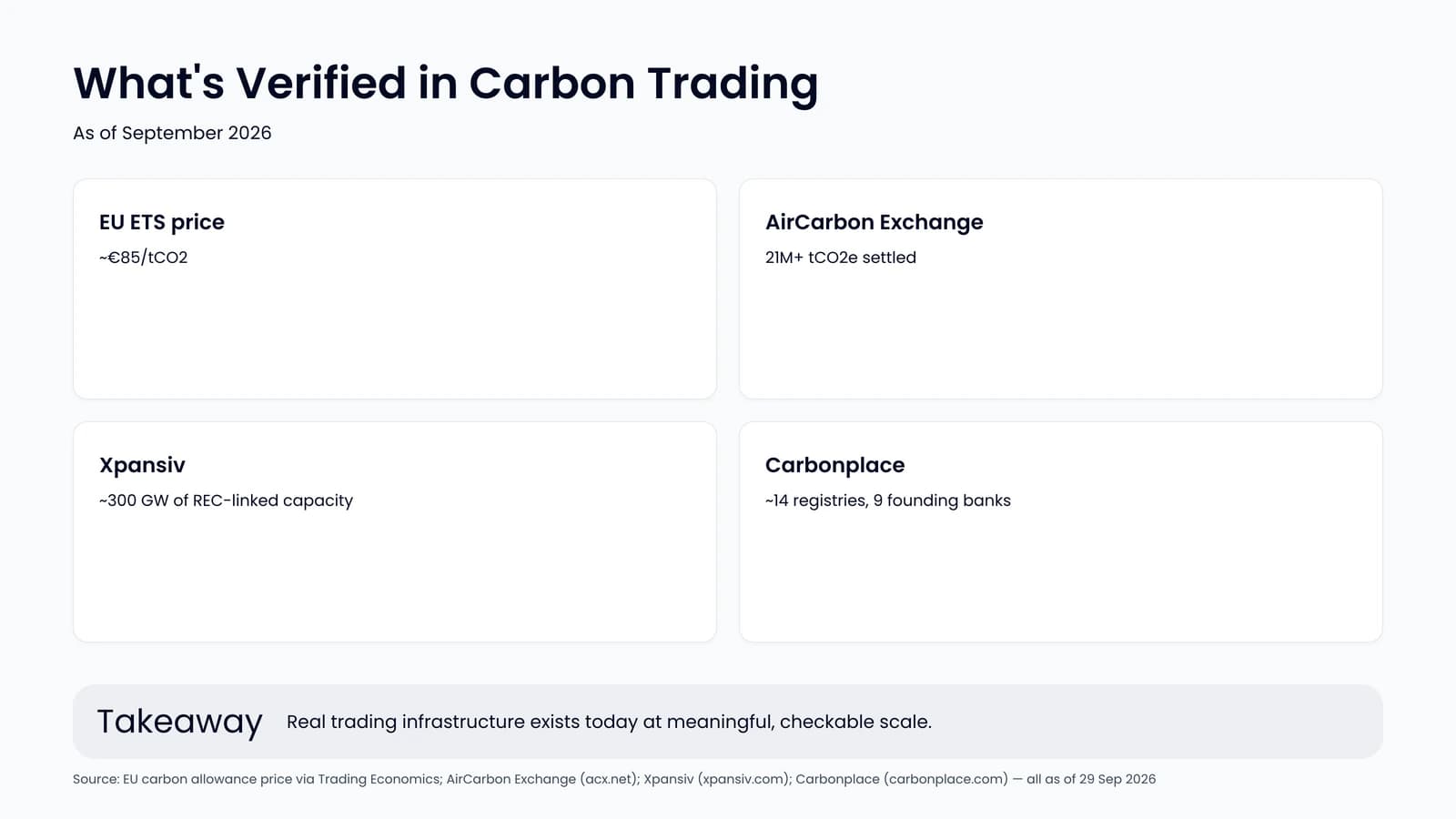
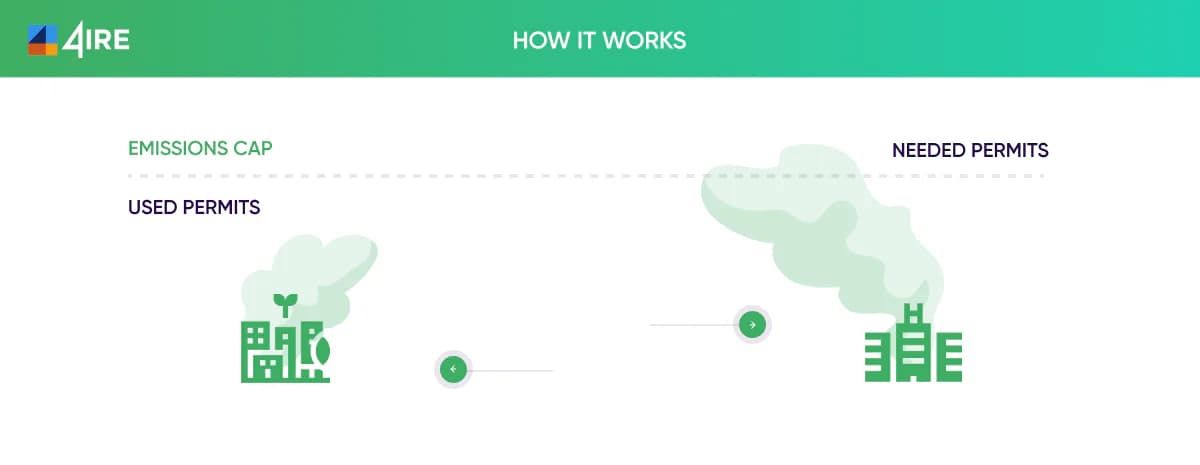
Regulators set an emissions cap for covered industries and issue a matching number of allowances. A company that stays under its cap can sell the unused portion; a company that exceeds it must either buy more allowances or pay a penalty. The total volume of allowed emissions doesn't change. It's redistributed toward whoever needs it most, which is the core mechanism behind cap-and-trade schemes like the EU Emissions Trading System (EU ETS), currently the largest and most liquid carbon market, trading at roughly €85 per tonne of CO2 as of late September 2026.
Carbon credits vs. carbon offsets
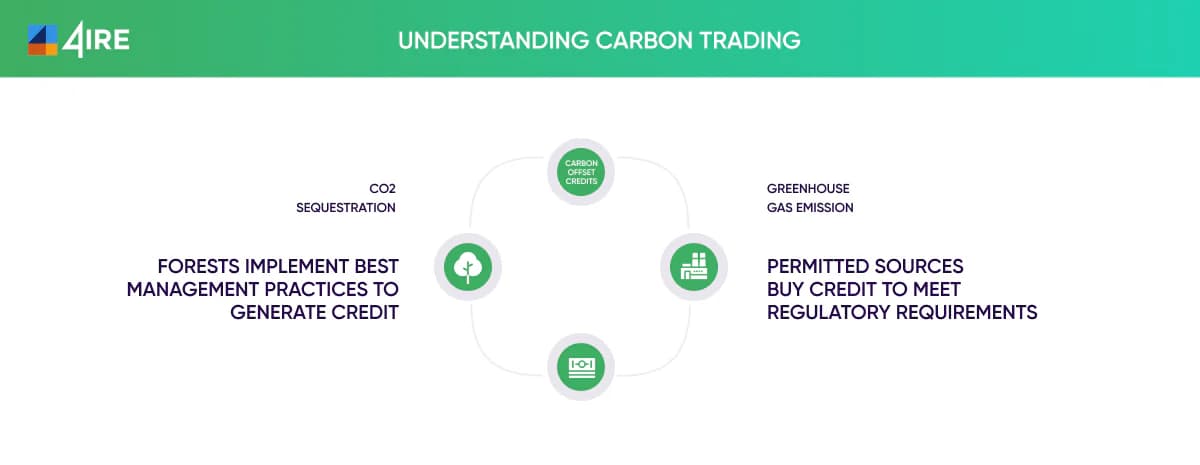
- Carbon credits are compliance instruments: a certificate letting the holder emit a defined amount of CO2 under a regulator's cap.
- Carbon offsets work in the opposite direction: a company or project that actively reduces or removes CO2 (reforestation, methane capture, renewable energy) earns credits it can sell to others.
Both trade on carbon trading platforms: specialized marketplaces where buyers, sellers and brokers meet under (ideally) transparent pricing and verified supply.
Key components of a carbon trading platform
- Registration and authentication, with two-factor or biometric verification and, in most jurisdictions, mandatory KYC/AML.
- Data management and security that meets whichever regime applies (GDPR in the EU, and equivalent rules elsewhere), since the platform handles both financial and personal data.
- Registry and emission-tracking integrations, so every credit entering the platform has a verifiable, traceable origin rather than a self-reported one. See why carbon credit registries are entering blockchain for how this is evolving.
- Trading and transactional functionality, covering spot trades at minimum, with futures/derivatives support for more mature platforms, and smart-contract-backed settlement if the platform is blockchain-based.
- Reporting and analytics, including a carbon footprint calculator that helps buyers estimate how many credits they actually need.
- Regulatory compliance tooling: credit verification, audit trails, and jurisdiction-specific reporting.
- Third-party integrations (APIs) for payment rails, wallets, and market data feeds.
- Scalable architecture that can absorb traffic spikes around compliance deadlines without downtime.
Step-by-step: building the platform
- Research. Study existing carbon trading platforms (what they do well, where users complain) before writing a single requirement.
- Market analysis. Decide which market you're serving (compliance, voluntary, or both) and which credit types and registries that implies.
- Strategic partnerships. Line up a development partner, plus relationships with registries, offset project developers, and (if relevant) local environmental organizations.
- Technical specification. Turn your business model into a concrete requirements document that a development team can scope and estimate against.
- UI/UX design. Carbon trading is unfamiliar territory for many users; a confusing interface is a bigger churn risk here than in mainstream trading products.
- Backend development. Build the registry integrations, matching engine, and (if applicable) smart contracts before layering on secondary features.
- Regulatory compliance. Confirm KYC/AML and reporting requirements are actually built in, not bolted on at the end.
- QA and audit. Run full security and functional testing; if smart contracts are involved, get an independent smart contract audit before launch.
- Marketing. Start building audience awareness weeks or months ahead of launch, not the day of.
- Launch.
- Maintenance and support. A live trading platform needs ongoing monitoring, registry-sync upkeep, and feature updates as the regulatory environment shifts.
Platforms with real, verifiable traction
A few carbon trading platforms have genuine, checkable scale as of late September 2026:
- AirCarbon Exchange (ACX): a licensed digital exchange with 190+ trading members across 30+ countries and more than 21 million tonnes of CO2e settled, trading both carbon credits (including its own Carbon Emission Tokens) and renewable energy certificates.
- Xpansiv: operates CBL and related exchanges for carbon credits, RECs and other environmental commodities, alongside registry infrastructure covering roughly 300 GW of renewable capacity.
- Carbonplace: a carbon credit management and trading platform founded by nine global banks, giving institutional users access to roughly 14 registries through one account with unified reporting.
Where current players fall short
The market's biggest structural weakness is still fragmentation: dozens of registries, inconsistent credit-quality standards across them, and legacy platforms that are slow and non-transparent by comparison to a modern exchange. That's the gap blockchain-based platforms are built to close. 4IRE has over a decade of GreenFi delivery experience, including our own white-label carbon credit marketplace, and can help you scope a platform against your specific target market and registries. See our companion piece on carbon credit market overview for how the compliance and voluntary markets differ, and our cost breakdown for what to budget.
Conclusion
Building a carbon trading platform means combining trading-platform fundamentals (authentication, matching, compliance) with carbon-specific requirements most generalist dev teams haven't dealt with: registry integrations, credit verification, and the compliance-vs-voluntary split. Get that foundation right and you're positioned to serve a market that keeps growing as caps tighten and corporate offsetting demand rises.
Build Your Carbon Trading Platform
We'll scope the registry integrations, compliance requirements and tech stack for your carbon trading platform, whether custom-built or white-label.
FAQ on building a carbon trading platform in 2026
Secure registration and authentication (often with KYC/AML), integration with carbon registries and emission-tracking systems, trading and settlement functionality, reporting and analytics tools, regulatory compliance features, and API connectivity for payments and market data.
Partnerships with registries and offset-project developers give your platform a source of verified, tradeable credits from day one, rather than starting with an empty marketplace. Partnerships with credit buyers (companies facing compliance deadlines) give you demand-side liquidity.
4IRE's own project ranges run from roughly $20,000-$40,000 for a focused MVP up to $250,000+ for a full-feature platform, depending on the feature set, blockchain architecture, and integration complexity. See our detailed cost breakdown for the factors that move the estimate.
4IRE has over a decade of hands-on GreenFi and blockchain delivery, including our own white-label carbon credit marketplace covering issuance, tokenization and role-based trading. That domain-specific track record (registry integrations, compliance requirements, credit tokenization) is the part generalist blockchain teams usually have to learn from scratch.