The Cost to Develop an Emissions Trading Platform in 2026

The world is heading towards sustainability, with many voluntary and legally binding measures taken to reduce the human carbon footprint and restore the global ecosystem. That’s why the cap-and-trade schemes are rising in popularity, enabling various participants of the global market to redistribute the global CO2 cap in line with their needs.
Carbon offset credits help energy-intensive businesses avoid legal penalties by purchasing unused CO2 credits from more sustainable enterprises. This way, the global industrial community manages to keep the total CO2 emissions under control and avoid excess CO2 emissions. The environmental benefits of carbon credits in recycling are also well-acknowledged, giving a strong rationale for forward-looking businesses to consider entry to the GreenFi market.
Our observation is that emissions trading systems (ETS) development is one of the most popular sustainable finance trends for 2025 and beyond. Thus, it’s time to include the ETS project in your business plan for the next year and tap into the fast-growing, promising area with immense potential. Here is a detailed guide to emission trading platforms, the required feature set, the cost factors that will shape your development costs, and a manual for choosing the best tech partner for this project.
How Do Emission Trading Platforms Work?
Like any other trading resource, every ETS platform allows real-time trading of emissions in line with the continuously changing dynamics of supply and demand. These platforms are places where interested parties can buy or sell emission allowances, tradable emissions permits, and other GreenFi instruments.

Emission Trading Platform – Carbon Credits 101
Carbon credits are the basic asset circulating in the emissions trading market and helping businesses redistribute and manage their carbon footprint. There are two markets for carbon trading:
- Compliance carbon market. This market is government-regulated, with state agencies setting cap-and-trade programs for businesses and industrial enterprises to ensure the CO2 cap is not exceeded on the national level. State-set caps are mandatory for everyone, so companies that don’t spend their CO2 caps or engage in CO2 sequestration can sell their unspent carbon credits to less eco-friendly businesses in the form of compliance credits.
- Voluntary carbon market. This market is not regulated and operates on the market principles of supply and demand. Therefore, every eco-friendly business targeting carbon neutrality and wishing to improve its CO2 footprint can purchase carbon credits here, sold by carbon offset projects and eco-initiatives.
Depending on the project type, carbon credits may also come in the form of:
- Renewable energy certificates (RECs). One REC equals one megawatt-hour (MWh) of electricity generated using renewable energy means. These credits are primary contributors to the development of renewable energy industries.
- Avoided emissions credits. Such credits are awarded to companies that avoid CO2 emissions by shifting to eco-friendly alternatives and reducing their general CO2 output on a consistent basis.
- Methane capture credits. Companies that prevent the release of methane into the atmosphere generate this type of credit to compensate for other businesses’ methane-intensive activities.
- Carbon sequestration credits. CO2 sequestration stands for the physical removal of CO2 from the atmosphere by means of reforestation and carbon capture and storage (CCS) activities.
How Large Is the Emission Trading Market?
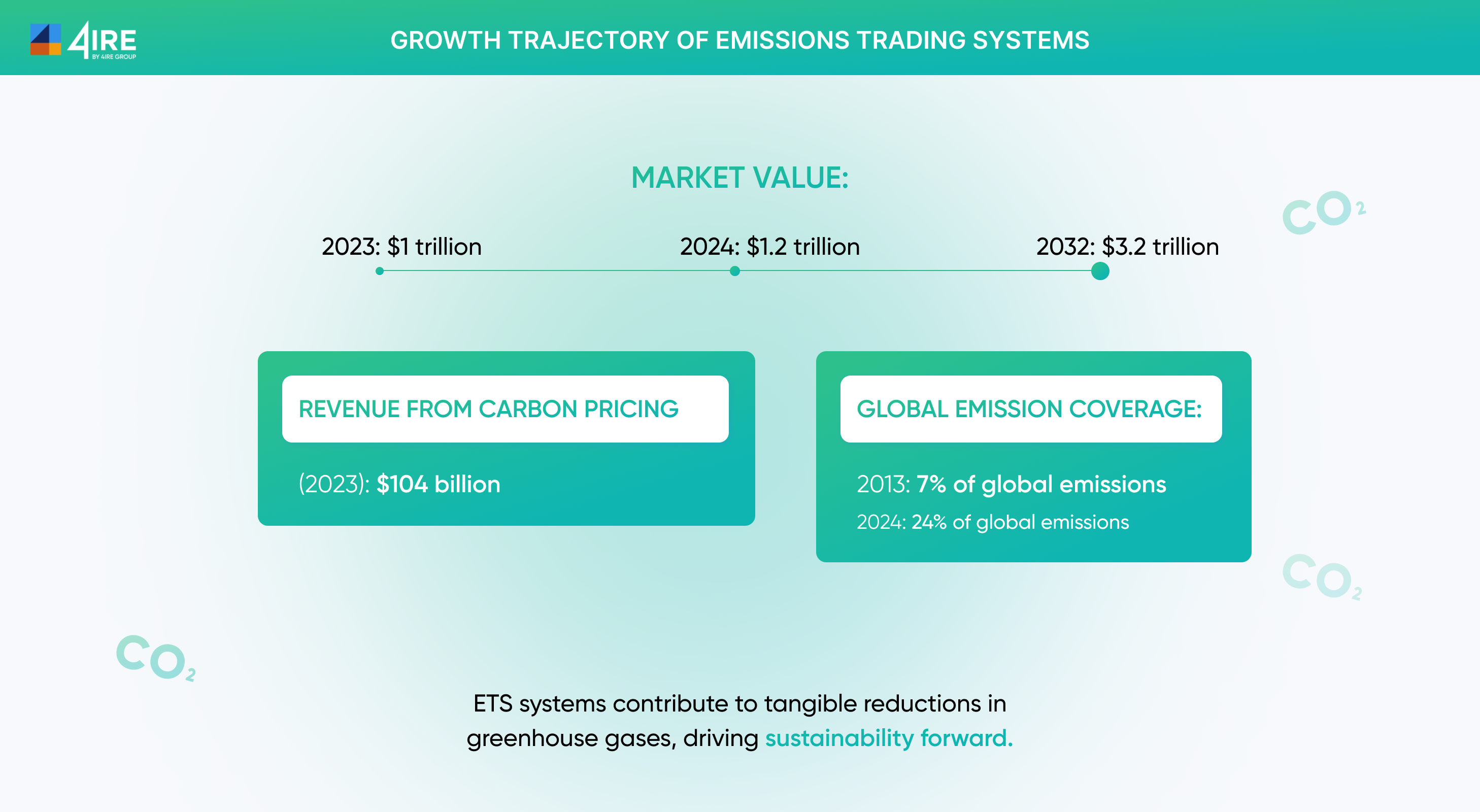
A quick glance at the emissions trading volume and the associated market is enough to see the GreenFi industry growth is in full swing. The global carbon trading market size exceeded $1 trillion in 2023 and moved on to reach $1.2 trillion in 2024 only. The 2032 forecast stands at $3.2+ trillion, which is a healthy trend for growth and expansion of the voluntary carbon market and associated spheres.
The World Bank’s report suggests that the revenue from carbon pricing systems exceeded $104 billion in 2023. At present, international market players have 75 carbon pricing strategies and instruments, which produce combined economic effects ranging from business revenue to funding of climate and nature-related programs.
The trend for the outreach of global emissions with ETS systems is also positive. Around a decade ago, the carbon trading market covered only 7% of global emissions, while in 2024, the ratio exceeded 24%. This trend suggests the real-world impact of market-based environmental policies and their ability to cause tangible greenhouse gas reduction.
Key Components of the Emission Trading Platform
ETS platforms may include innovative, fancy features to attract users and set new trends in the carbon trading market. Yet, every project should include a mandatory set of features to fulfill its purpose and meet the clients’ needs.
Signup and Login (Authentication)
Users need to have a clear, intuitive channel for registering on your platform with a minimum input required at the account setup stage. The login and user authentication steps should be protected with two-step verification or biometric authentication to minimize the risk of unauthorized access. Some jurisdictions also require a mandatory KYC/AML procedure for user registration.
Data Privacy and Security
As trading platforms deal with clients’ money and sensitive information, cybersecurity is a top-priority issue in the development process. Your resource should be thoroughly encrypted, with robust shields covering data transactions and financial operations.
UI/UX Design
User interface and overall platform usability are part and parcel of attracting and keeping new clients. Therefore, you need to invest time and effort in the UI/UX design to make sure your platform offers quick and intuitive onboarding, has a visually clear layout, and enables users to perform the needed operations without friction.
Integration with Carbon Registries and Emission Tracking Systems
Registry compatibility is one of the key considerations in the process of ETS platform design. Your trading platform needs to link to relevant carbon registries and emission tracking systems to avoid fraud or double credit selling.
Trading and Transactional Functionality
Your blockchain-powered platform will need smart contracts for trading carbon credit instruments to ensure transaction transparency and traceability. Thus, you need to find a tech partner ready to create safe, functional, smart contracts for your project. Another element that powers the trading system and enables the participants to exchange carbon credits for money is the order matching algorithm, which allows P2P trading without intermediary involvement.
Reporting and Analytics Tools
The trading platform’s registered users should have access to insightful, accurate analytics of their activities and trading performance. This data will help them make sense of the carbon market trends in terms of price-setting, supply, and demand, thus shaping more informed CO2 credit buying and selling strategies for the future. It is also necessary to equip the buyers with smart carbon footprint calculators that help them estimate the number of credits needed to meet their caps.
Regulatory Compliance
Every carbon trading marketplace needs to ensure compliance with the national and international CO2 regulations. You should double-check the monitoring and reporting standards of the target jurisdiction where your platform will operate and turn to legal experts for putting all compliance measures in place (e.g., carbon credit verification, accurate accounting, etc.).
Third-Party Integrations
The GreenFi niche is a quickly expanding ecosystem, so your project will always benefit from an advanced level of connectivity and openness to related projects and services.
Scalable Architecture
As any project is created with growth in mind, your development team should take proper care of the horizontal and vertical scalability of your platform’s architecture, as it’s the only way to ensure proper load balancing for high traffic without security and functionality compromises.
How Much Time Does It Take to Develop an Emission Trading Platform?
The duration of the ETS platform’s development depends on the type of software you’ve chosen. Custom software development is sure to take 9-12 months, exceeding 18 months for enterprise-level projects. However, the customization and fine-tuning of a white-label software solution may reduce the time-to-market of your ETS platform to 2-3 months.
Emission Marketplace Development Cost Factors
On average, the budget you will need to build an emission trading platform will range from $40,000 to $250,000. Where your project sits on this price continuum will depend on a number of cost factors discussed below.
Custom vs. Off-the-shelf Solutions
The pre-built software comparison with the tailored solutions’ cost will always show a greater price tag for custom software development. An ETS platform built from scratch will always take more time, a large number of tech specialists, and a more considerable sum of money, while a white-label product usually involves only licensing fees and a bit of extra cost for customization.
However, it’s also noteworthy that custom ETS software comes with stellar security measures, custom code logic that is less likely to be hacked, and a fully original design and feature set. That’s why the ROI on custom solutions is way higher in the long run, while a preconfigured, white-label software solution may be more financially viable for startups.
Technological Infrastructure
Your platform should be equipped with robust, scalable tech elements, such as secure payment gateways and scalable database systems. The tech stack also includes robust cybersecurity measures, reliable smart contracts for on-platform transactions, and a comprehensive user verification and carbon credit validation system. It makes sense to consider cloud-based platform solutions because they offer a healthy balance of security, scalability, and technical superiority.
Set of Features
A safe path to follow in the carbon credit marketplace’s creation is initial product validation by building a cost-effective MVP (Minimum Viable Product). The affordable and fast MVP development gives you a glimpse into the practical side of the carbon credit marketplace’s operations because of the core functionalities focus. It also allows a pocket-friendly adjustment of design and functionality at the early stages. This software type may cost you from $20,000 to $40,000 on average.
Once you opt for a full-feature platform, the costs may rise further, as you get not an MVP but a software product fully ready for deployment. It will involve more development hours, a larger team of tech specialists, and a more extended period. If we include consultation costs, R&D, design, development, QA testing, launch, and maintenance, the platform’s costs will rise to $40,000 – $100,000+. If you need additional marketing help, you should be ready to add $5,000-$10,000+ to the cost estimate.
The most expensive and technically demanding type of product is an enterprise-grade platform powered by a private blockchain. This resource promises the highest level of security and customization, but it also involves extensive R&D, design, and development costs, as well as the overall price of the blockchain architecture. Thus, such projects are priced at $100,000+ and can reach several hundreds of thousands of dollars in the final price estimate.
In-House vs. Outsourcing Development Team
The cost to develop emission trading platform projects also depends on the team you’re engaging with. Let’s first look at the internal team’s pros and cons. Building an in-house team is a long-term investment in the tech expertise you can bank on at all times. Besides, it’s a guarantee of confidential data protection and continuous tech support. Yet, there are also many outsourcing benefits: when you hire offshore development teams, you get access to the global tech stack and talent pool without geographical limitations. In addition, by comparing the cost differences in hiring, you can see that in-house staff recruitment and employment are much more expensive, especially for one-time software projects like this.
How to Choose the Best Emission Trading Platform Provider?
When embarking on carbon offset platform development, you need to make sure you’re working with the best tech partner. Regardless of whether you’re using a pre-built software product or targeting a fully customized, modular platform design, the reliability of your dev team makes a real difference. Here are the main factors you should consider before signing a contract to develop an emission trading platform.
- Experience. The provider of ETS development services should be a well-established market player known in the international software industry. It’s better to work with experienced businesses that have 5+ years of market presence and a long list of positive reviews and completed projects.
- Expertise. You should partner with a company that possesses domain-specific expertise in GreenFi, blockchain, and ETS software development. Check the provider’s portfolio to see whether it dealt with such projects before.
- Customization.
- Security. Apart from robust cybersecurity measures for your digital product, the chosen tech team should be able to provide end-to-end software quality assurance before its deployment to the blockchain space.
- Support. Your software developer should be able to provide support and administration services for the carbon trading platform it’s building for you. Otherwise, its team should train your in-house staff or an outsourcing firm on the basics of technical support and troubleshooting.
- Cost. The cost-benefit ratio should be balanced, meeting your financial capacity and delivering a solid ROI for whatever solution you opt for.
Why Consider 4IRE for Your Emission Trading Platform Project?
4IRE is a GreenFi software developer with a solid reputation and a wide variety of technically superior, groundbreaking projects in this industry. We have lots of benefits to offer to every business considering an entry into the carbon trading market with blockchain-powered software products.
- Team strength. Our dedicated software development team of 250+ software engineers and blockchain architects is ready to build a carbon trading platform in full compliance with your specifications and technology needs. We have senior-level experts on board and offer professional technology consulting services to set your project in the right direction.
- Technical expertise. Our company is experienced in blockchain development and GreenFi, ready to offer solid support at all stages of the project, from the discovery phase to deployment.
- On-time project delivery. The combination of lean product development methodology with a strong tech stack of the 4IRE team enables us to submit all major project deliverables within the estimated deadlines. All work takes place under the thorough control of Project Managers and the company’s CTO to avoid delays.
- Advanced tech stacks. Our team possesses advanced skills and knowledge to ensure
- Blockchain integration. 4IRE is well-versed in all aspects surrounding the use of blockchain in carbon credit trading. We can develop a state-of-the-art tech stack and set of features for your platform and supercharge it with the most robust blockchain solutions.
- Affordable prices. We can help you cut the environmental trading platform cost by offering robust, safe, and feature-rich white-label solutions.
- 24/7 customer support and post-launch maintenance. Get 24/7 technical support from the competent 4IRE team and regular upgrades of your white label carbon trading software after its safe and timely launch.
The Time to Enter GreenFi Is Now
As you can see, the cost of building carbon trading marketplaces varies widely and depends on many factors. You need to contact a development partner early at the stage of project planning to get a more accurate quote and go on with budgeting. The choice between a public and private blockchain, the variety and complexity of features you want to see in your platform, and the tech stack needed all play a role in the final cost estimation.
Thus, it’s impossible to come to grips with the final price tag of your GreenFi project without consultation with experts. Welcome to 4IRE for a detailed discussion of your business idea; our CTO will explain all software options and help you navigate the complicated pricing landscape of this software niche.
FAQ on cost to develop an emission trading platform in 2026
A carbon credit marketplace is a blockchain-based platform where buyers and sellers of carbon credits and other GreenFi instruments meet to meet their CO2 caps, sponsor eco-friendly funds and initiatives, and redistribute the available CO2 volumes.
As the regulatory landscape for CO2 emissions gets stricter and more demanding, businesses are continually pressured to meet the rising sustainability goals and standards. Thus, ETS platforms are great meeting places for buyers and sellers of carbon credits, which allows eco-friendly firms to monetize their CO2 sequestration and capture efforts, and resource-intensive businesses – to avoid fines for a high CO2 footprint.
Our rich expertise in blockchain, DeFi, and GreenFi can aid any ETS project at any stage. From discovery and idea validation to end-to-end software development, we offer in-depth insights and knowledge of the industry to make your projects a success.
-

 Verified Expert in Blockchain
 - 16 Years of Experience


Similar articles
More articles