

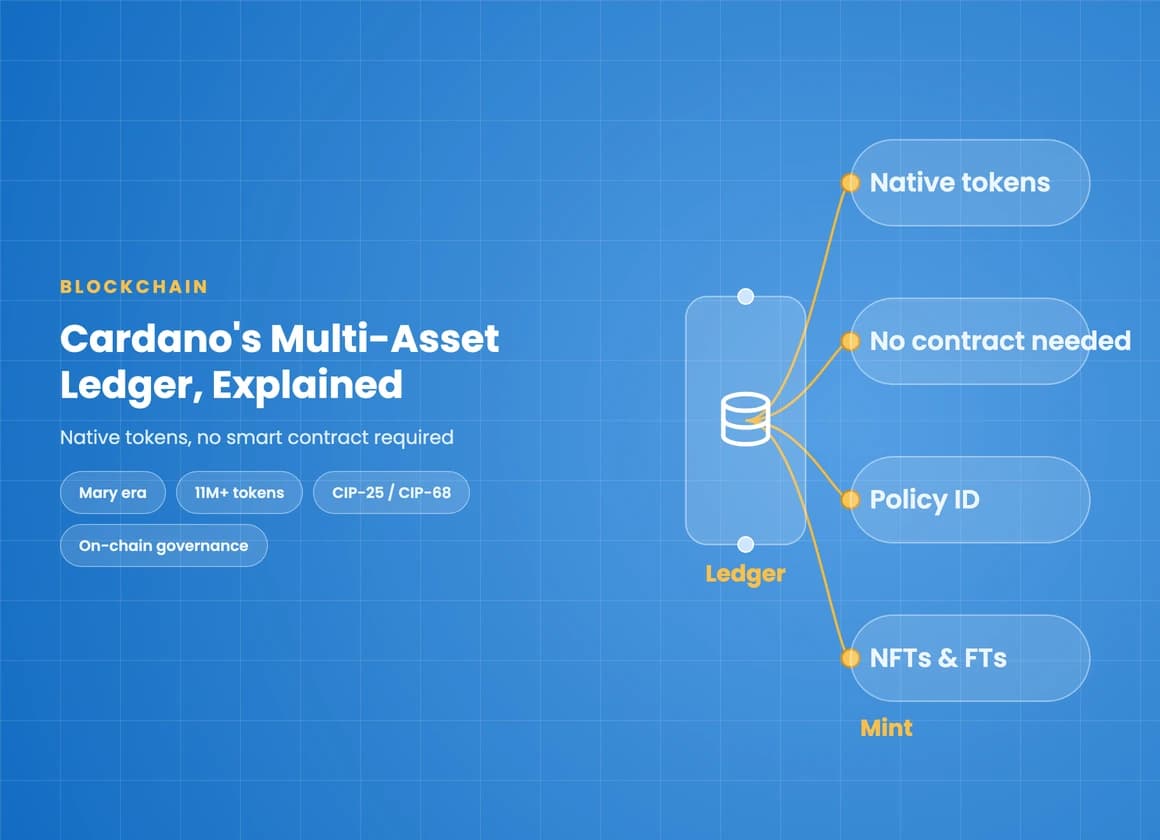

Most blockchains treat anything that is not their base coin as an afterthought: on Ethereum, a token is a smart contract that happens to track balances. Cardano took a different route from the start. Since the Mary hard fork of March 2021, Cardano's ledger itself understands multiple asset types, so ADA and any number of custom tokens can move in the same transaction without a single line of contract code. This guide explains how that native multi-asset model works and what it changes for a team building on Cardano in 2026.
What Makes Cardano a Multi-Asset Blockchain?
Cardano's ledger extends the same accounting logic used for ADA to any user-defined token. According to Cardano's developer documentation, native tokens are tracked and accounted for by the ledger itself, not by a smart contract: there is no equivalent of an ERC-20 contract to deploy, audit and pay gas to execute on every transfer. A single transaction output can hold ADA and several other token types at once, each type carrying its own policy and rules.
This is not a minor convenience. On an account-based chain, every new fungible token is a new piece of software with its own attack surface. On Cardano, a token's behavior is defined once, at minting time, and the ledger enforces it the same way it enforces ADA balances: no reentrancy bugs, no custom transfer function to get wrong, and no per-token gas logic to audit.
Native Tokens vs. ERC-20 Tokens
| Cardano native tokens | ERC-20 tokens | |
|---|---|---|
| Where logic lives | Ledger itself | A deployed smart contract |
| Transfer mechanism | Same transaction type as ADA | Contract call, separate gas cost |
| Security surface | Ledger-level, shared with ADA | Per-contract, audited individually |
| Multiple assets per transaction | Yes, natively | Requires batching or a router contract |
Minting and Policy IDs
Every native token is tied to a policy ID, a hash of the minting policy script that controls it. According to Cardano's docs, that policy can be a simple signature requirement, a time lock that forbids minting after a set slot, or a more complex script, and a token's policy ID can never change once it exists. This is what gives a Cardano token a verifiable, fixed supply story: a buyer can check the policy script directly, not just trust a team's word that minting has stopped.
NFTs on Cardano: CIP-25 and CIP-68
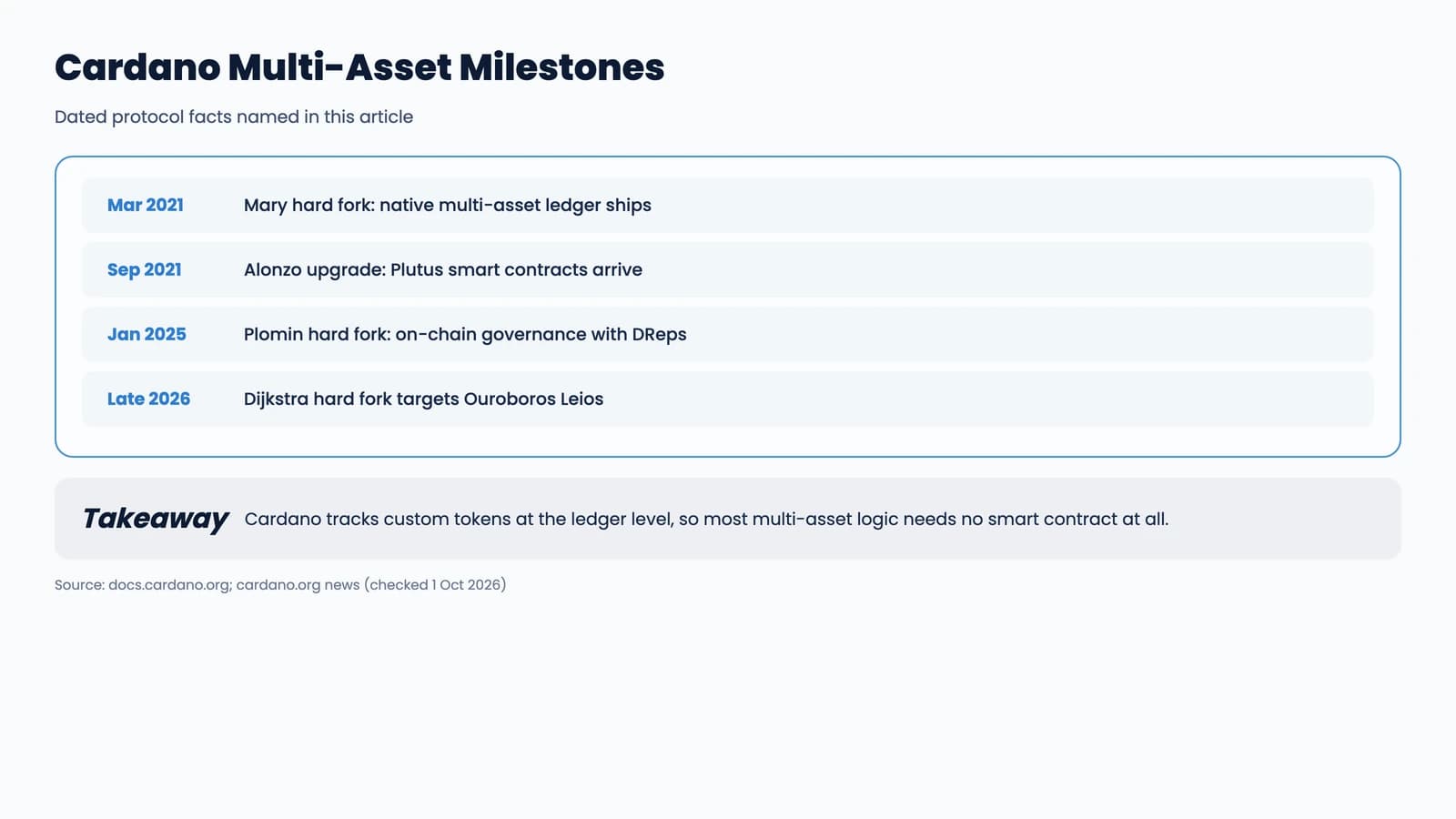
Cardano's first NFT metadata standard, CIP-25, arrived in April 2021, weeks after the Mary hard fork made native tokens possible, and attaches a name, image and description as transaction metadata on the minting transaction. That metadata can technically be revised through a later mint under the same label, but it is invisible to Plutus smart contracts and most tooling treats the original mint as final. CIP-68 is the newer standard: it stores metadata in a separate reference token locked at a script address instead of in transaction metadata, which makes it directly readable by smart contracts and lets an issuer update it on-chain under rules it defines. CIP-68 also extends the same pattern to fungible and "rich-fungible" tokens, not only NFTs. Cardano passed eleven million native tokens minted on the network in January 2026 (CardanoScan), spanning both standards, and the count has only grown since.
Cardano Today: Governance, Scaling and Market Size
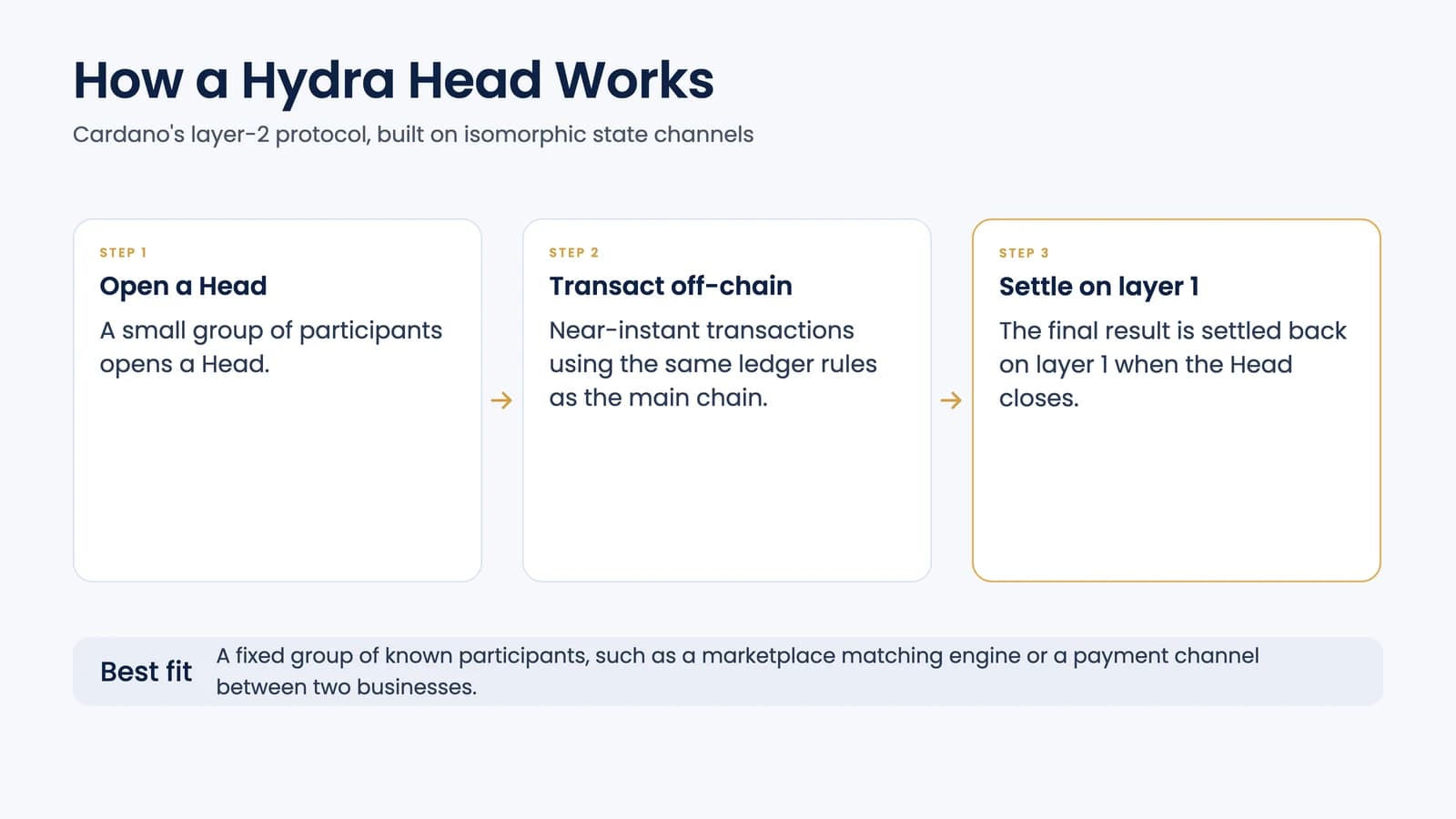
Cardano has supported smart contracts, written in Plutus or Aiken, since the Alonzo upgrade in September 2021, and the Hydra layer-2 protocol handles high-volume, low-latency interactions off the main ledger. Hydra works through "isomorphic state channels": a small group of participants opens a Head, transacts off-chain near-instantly using the same ledger rules as the main chain, and settles the final result back on layer 1 when the Head closes. That design fits a fixed group of known participants, such as a marketplace matching engine or a payment channel between two businesses, better than open, permissionless trading. Since the Plomin hard fork of January 2025, Cardano has run on-chain governance: ADA holders vote directly or through delegated representatives (DReps) on treasury spending and protocol changes, alongside stake pool operators and a Constitutional Committee, under the Cardano Constitution. The next scaling step, Ouroboros Leios, is targeted for the Dijkstra hard fork in late 2026.
As of 1 October 2026, CoinGecko ranks ADA 17th by market capitalization, at roughly $9.3 billion, out of a 45-billion hard-capped supply. For how this compares to other layer-1 designs, see our Cardano vs Ethereum and Cardano vs Polkadot breakdowns.
Building Multi-Asset Apps on Cardano
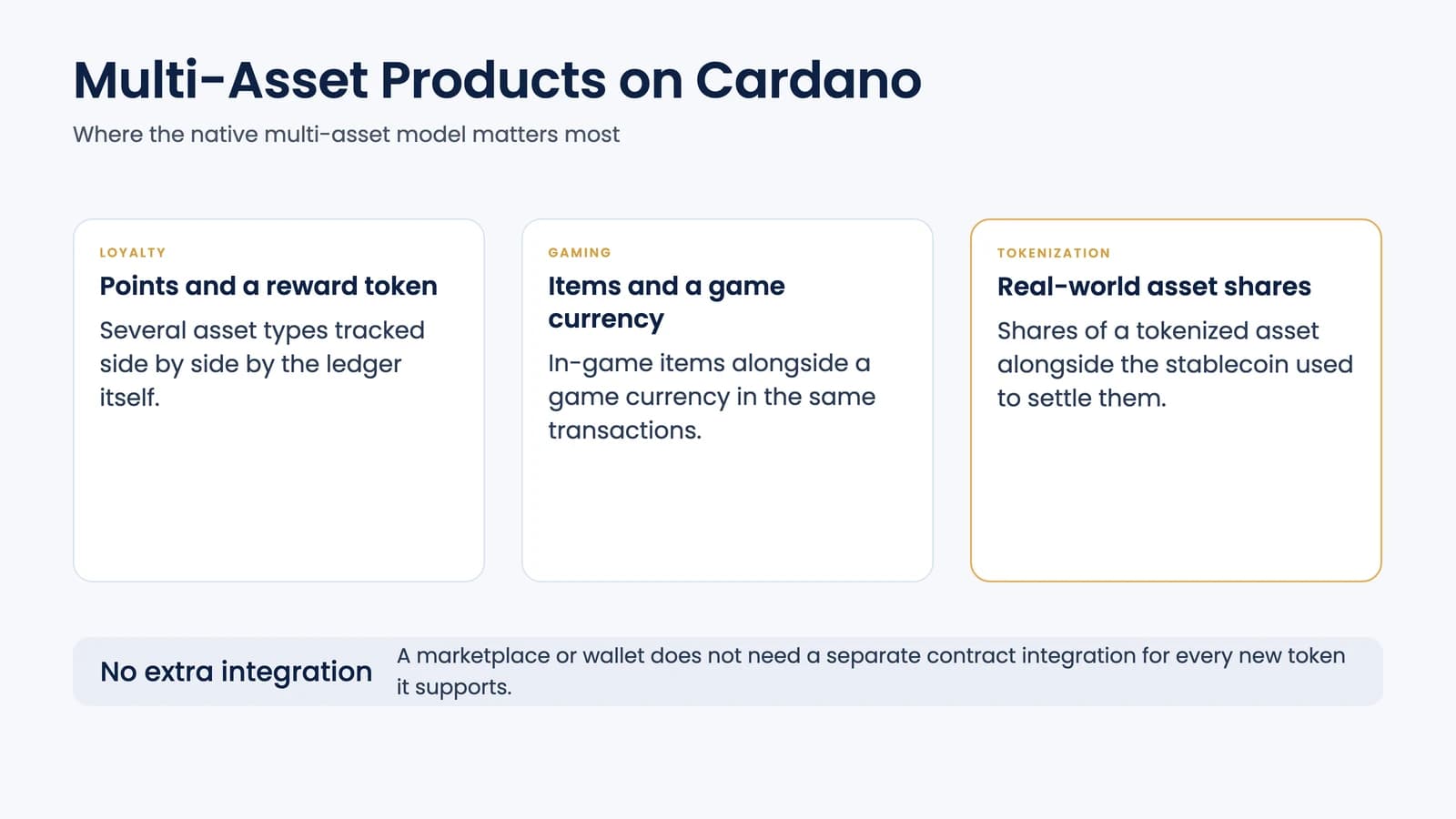
The native multi-asset model matters most for products that need to represent many distinct assets cheaply and safely: loyalty points alongside a reward token, in-game items alongside a game currency, or shares of a tokenized real-world asset alongside a stablecoin used to settle them. Because the ledger itself tracks each asset type, a marketplace or wallet does not need a separate contract integration for every new token it wants to support. This is also why Cardano comes up regularly in real-world asset tokenization work, where a single transaction moving a tokenized asset and its payment token benefits from the ledger's native handling of both. Any contract logic layered on top, whether for trading, lending or vesting, still needs an independent smart contract audit, since Plutus and Aiken carry their own risks distinct from the ledger's.
Conclusion
Cardano's multi-asset ledger removes an entire category of bugs by making token accounting a ledger-level feature rather than a smart contract exercise, and CIP-68 now lets that metadata be read and updated by contracts when a project needs it. Whether that fits your product depends on whether you need Cardano's EUTXO contract model for the logic sitting on top of those tokens.
If you are weighing Cardano's native tokens against an ERC-20 or a custom chain, 4IRE's Cardano development team can map your token design to the right standard before you build.
Building with Cardano Native Tokens?
4IRE's Cardano team can map your token design to the right standard before you build.
Frequently asked questions
No. Native tokens are minted and transferred using the ledger's own transaction format, governed by a minting policy script. A smart contract is only needed for logic layered on top, such as trading or lending.
A policy ID is the hash of a token's minting policy script. It never changes, so anyone can verify a token's supply rules directly from the policy rather than trusting an issuer's claims.
CIP-25 attaches fixed, immutable metadata to the minting transaction. CIP-68 stores metadata in a separate reference token that smart contracts can read and that an issuer can update under rules it defines, and it also covers fungible and rich-fungible tokens, not only NFTs.
Yes. Cardano moved to on-chain governance with the Plomin hard fork in January 2025, and its next scaling upgrade, Ouroboros Leios, is targeted for the Dijkstra hard fork in late 2026.