


Cardano and Ethereum are both proof-of-stake smart contract platforms, and both are often shortlisted by teams launching a token, a DeFi product or a tokenized asset. Beyond that, they differ in almost every design decision: how they record balances, how they scale, how they are governed and how large their networks have become.
This comparison covers where each network stands as of September 2026, the technical differences that matter to builders, and how to decide which one fits your project. It is not investment advice; if you are weighing ADA or ETH as an asset, treat the size figures below as context, not a forecast.
Cardano and Ethereum at a Glance
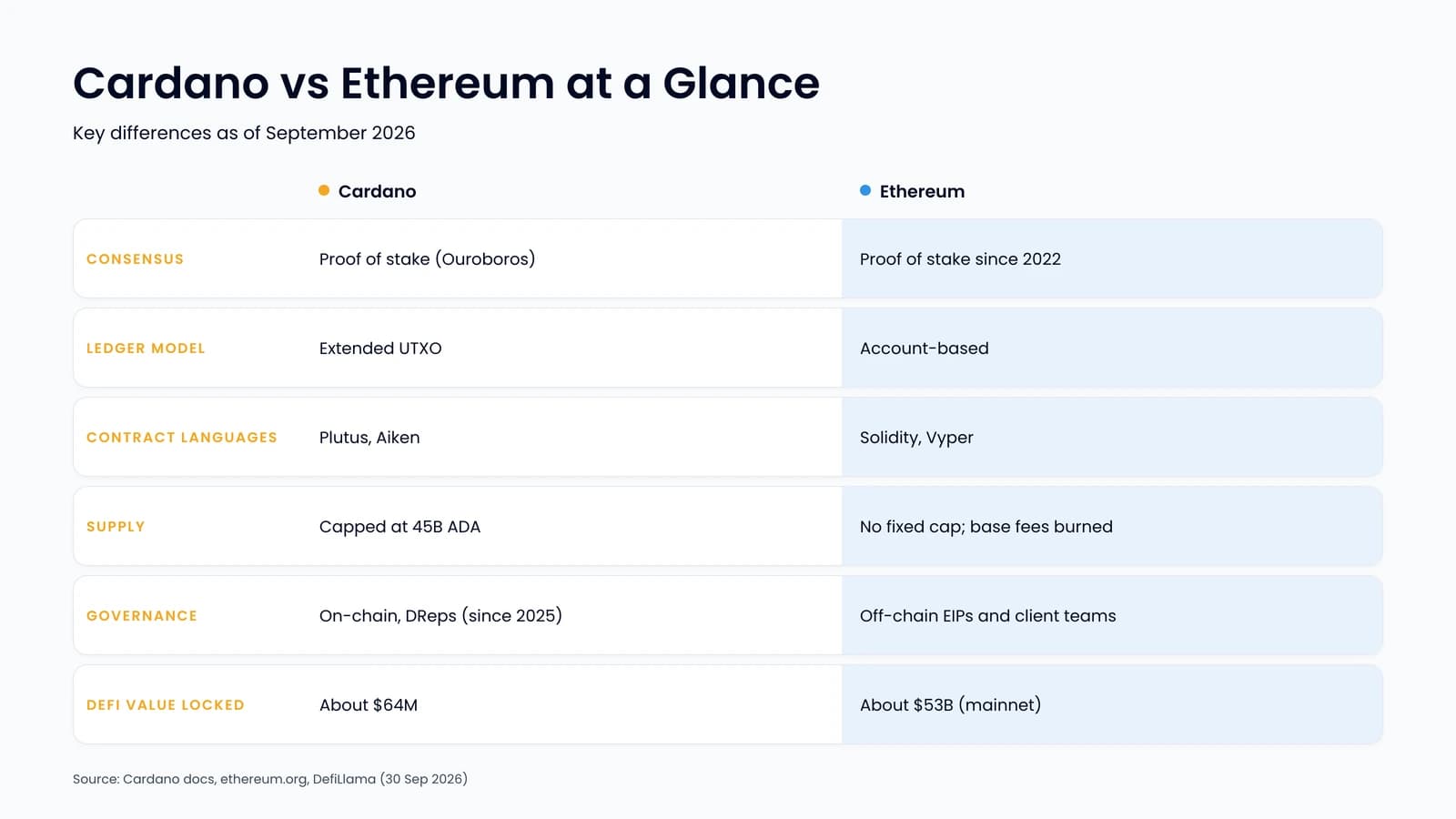
- Launch. Ethereum went live on 30 July 2015; Cardano's mainnet started in September 2017 and gained smart contracts with the Alonzo upgrade in September 2021.
- Consensus. Both use proof of stake: Ethereum since the Merge on 15 September 2022, Cardano through its Ouroboros protocol family.
- Ledger model. Ethereum is account-based; Cardano uses an extended UTXO (EUTXO) model.
- Contract languages. Solidity and Vyper on the Ethereum Virtual Machine; Plutus and Aiken on Cardano.
- Supply. ETH has no fixed maximum supply; ADA is capped at 45 billion.
- Governance. Ethereum upgrades are coordinated off-chain through improvement proposals and client teams; Cardano has run fully on-chain governance since January 2025.
What Is Ethereum?
Ethereum is a general-purpose blockchain whose virtual machine executes smart contracts. It holds the largest share of DeFi, stablecoin and tokenization activity, and its EVM has become a de facto standard copied by dozens of other networks, which is why Solidity skills and audit tooling transfer so easily between chains.
The network has changed substantially since the “Ethereum 2.0” era. The Merge replaced mining with staking and, according to ethereum.org, cut the network's energy use by about 99.95%; the old “Eth1/Eth2” labels have been retired in favor of the execution and consensus layers. Blocks are proposed in fixed 12-second slots. Since the London upgrade in 2021, the base fee of every transaction is burned.
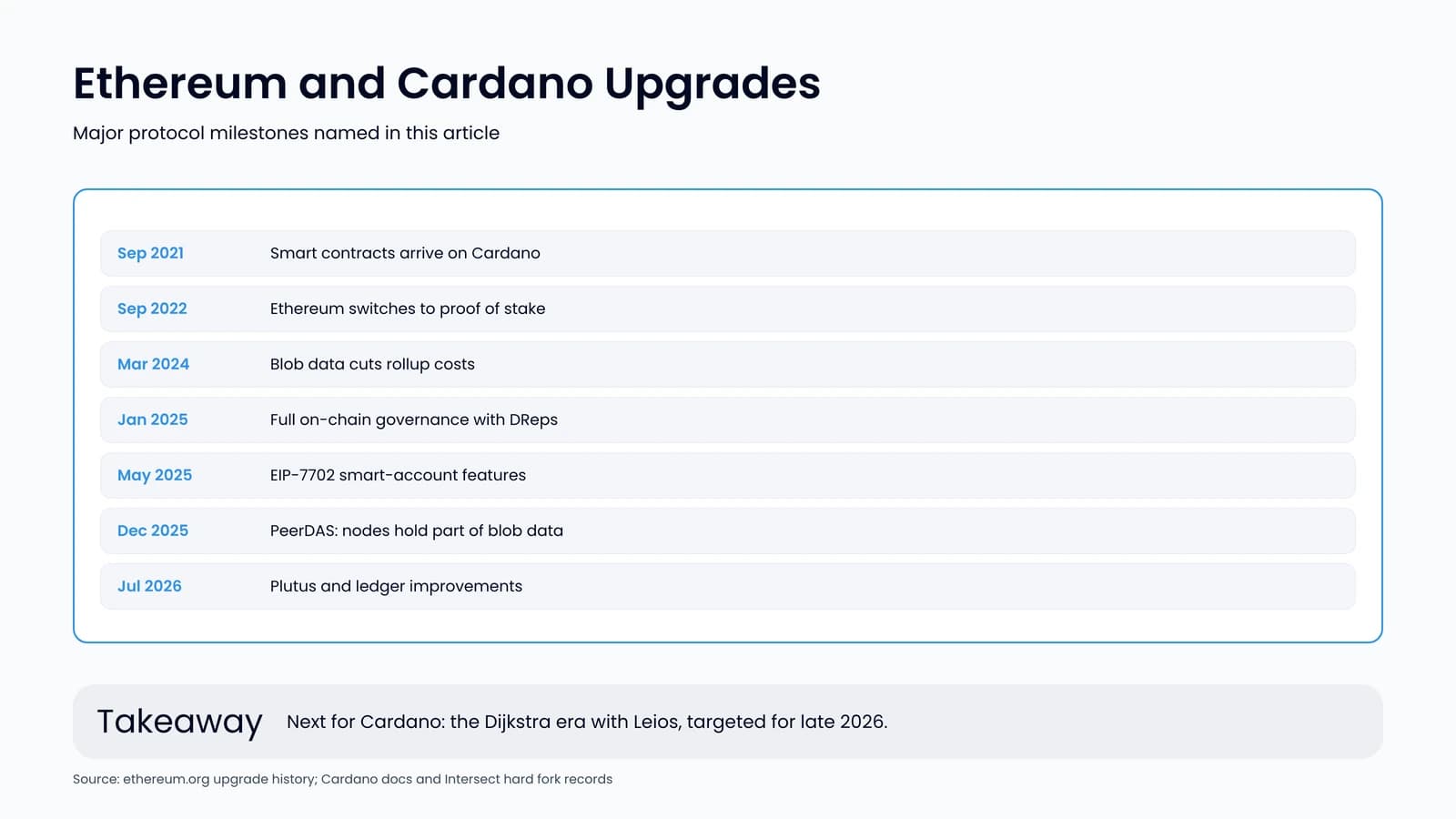
Most of Ethereum's scaling now happens on layer-2 rollups, and recent upgrades target them directly. As listed in Ethereum's official upgrade history, Dencun (13 March 2024) added cheap “blob” data for rollups, Pectra (7 May 2025) let ordinary accounts execute smart-contract logic through EIP-7702, and Fusaka (3 December 2025) introduced PeerDAS so nodes only hold part of the blob data. For teams planning Ethereum app development, the practical question is usually which rollup to deploy on, not whether to use mainnet.
What Is Cardano?
Cardano is a proof-of-stake layer 1 built around peer-reviewed research. Its Ouroboros consensus divides time into one-second slots, and with the current protocol settings a block is produced on average every 20 seconds; stake is delegated to pools in five-day epochs. Smart contracts use the EUTXO model, in which a transaction's result and fee can be calculated off-chain before it is submitted, so a script cannot fail unexpectedly and still charge the user a surprise fee.
Developers write on-chain code mainly in Plutus (Haskell-based) or Aiken, a newer language designed specifically for Cardano. Hydra, a layer-2 “head” protocol, handles high-throughput interactions between a set of participants off the main chain. If you are comparing languages across blockchains, our overview of blockchain programming languages covers Haskell, Rust and Solidity side by side.
Governance is where Cardano moved furthest in recent years. The Chang hard fork on 1 September 2024 introduced the CIP-1694 governance framework, and the Plomin hard fork on 29 January 2025 completed it: ADA holders now vote on treasury withdrawals, protocol parameters and hard forks directly or through delegated representatives (DReps), as the Cardano announcement describes. The van Rossem hard fork followed on 18 July 2026, and the Dijkstra era, which introduces the Ouroboros Linear Leios throughput upgrade, is targeted for late 2026.
Key Differences Between Cardano and Ethereum
Accounting model and developer experience
Ethereum's account model feels familiar: each contract holds its own state, and developers write code the way they would for a shared database. Cardano's EUTXO model treats state as outputs that are consumed and recreated. It gives predictable fees and makes parallel processing easier, but it requires different application design, especially for DeFi protocols where many users touch the same pool at once. Expect a learning curve if your team comes from Solidity.
Scaling strategy
Ethereum scales outward through rollups that post data back to the main chain. Cardano focuses on increasing base-layer throughput, with Leios as the next step, and uses Hydra for specific high-volume cases. Neither publishes a single throughput figure that holds up under real load, so benchmark the transactions your product actually needs instead of relying on marketing TPS numbers.
Governance and upgrades
On Ethereum, upgrades are agreed by core developers and client teams through Ethereum Improvement Proposals and then adopted by node operators. On Cardano, every hard fork now needs approval on-chain from stake pool operators, DReps and a Constitutional Committee. The Cardano route is more formal and transparent; the Ethereum route has delivered a faster sequence of major upgrades.
Adoption and Market Size
The gap in adoption is large. As of 30 September 2026, CoinGecko ranks ETH second by market capitalization at about $327 billion and ADA 17th at about $9.2 billion, while DefiLlama shows roughly $53 billion of value locked in DeFi on Ethereum mainnet against about $64 million on Cardano. For a product that depends on liquidity, stablecoins or existing users, that difference usually outweighs technical elegance.
Which One Should You Build On?
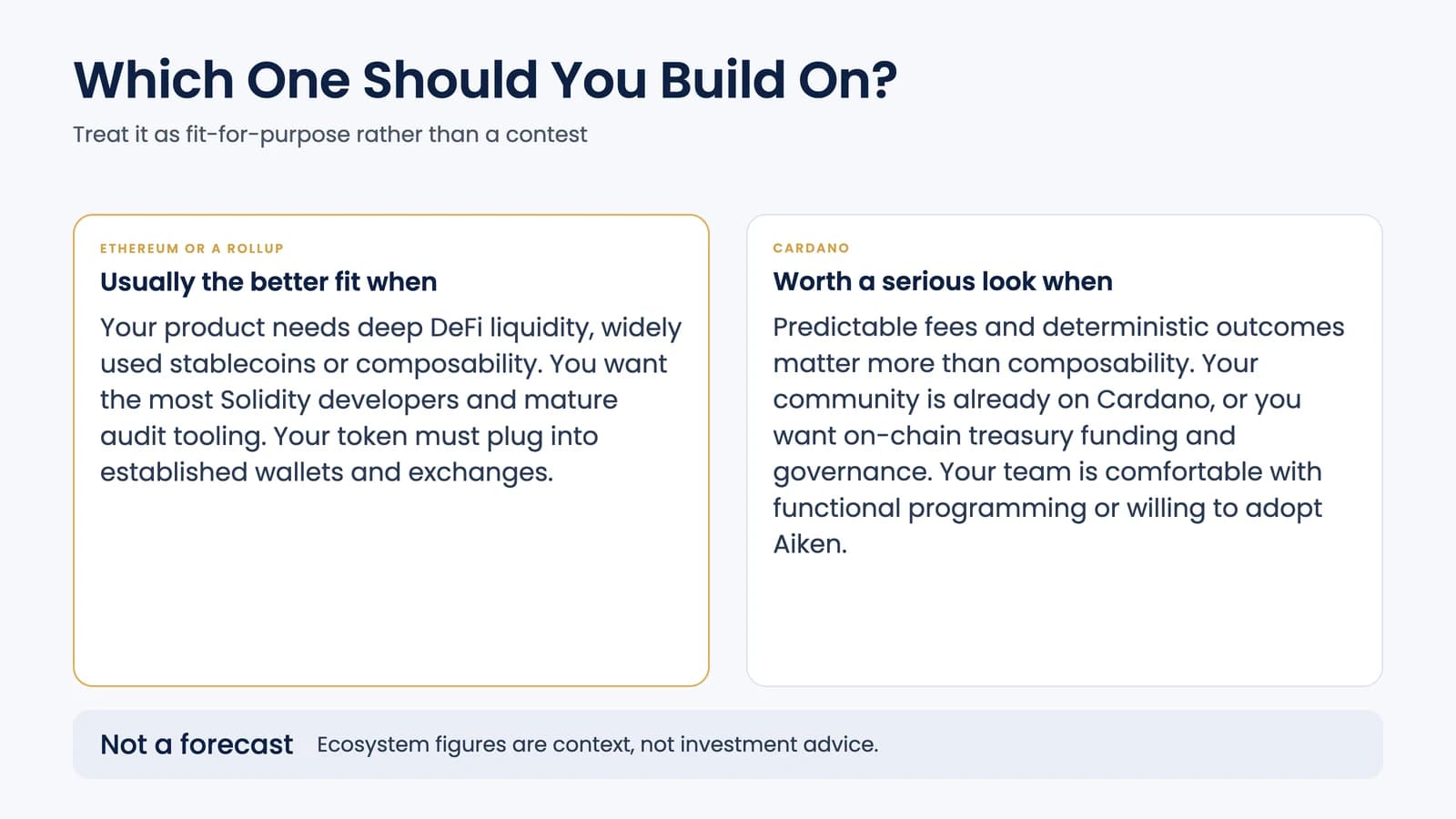
Treat the choice as fit-for-purpose rather than a contest. Ethereum, or one of its rollups, is usually the better fit when:
- Your product needs deep DeFi liquidity, widely used stablecoins or composability with existing protocols.
- You want the largest pool of Solidity developers and the most mature smart contract audit tooling.
- You plan a token, stablecoin or tokenized asset that must plug into established wallets and exchanges; our guide on creating a stablecoin on Ethereum shows what that involves.
Cardano is worth a serious look when:
- Predictable fees and deterministic transaction outcomes matter more than composability.
- Your community or partners are already on Cardano, or you want on-chain treasury funding and governance built into the network.
- Your team is comfortable with functional programming, or willing to adopt Aiken.
If neither fits cleanly, it is worth widening the shortlist. Our comparisons of Cardano and Polkadot and of three leading public blockchains cover other options, and the guide on how to choose the right blockchain walks through the criteria in more detail.
A Note on ADA and ETH as Assets
The original version of this article asked which coin was the better investment. We no longer make that kind of call. Both assets are volatile, and past price moves say little about future ones. What you can compare objectively are supply rules (ETH's issuance offset by fee burning versus ADA's fixed cap, with about 37.5 billion ADA circulating), staking mechanics, governance rights and the depth of each network. Anyone making investment decisions should rely on their own research and, where appropriate, licensed advice.
Conclusion
Ethereum remains the default for products that need liquidity, tooling and reach, now mostly through its rollups. Cardano offers a more formal, research-driven design with on-chain governance and predictable execution, but far less adoption. The right answer depends on your users, your team's skills and the assets your product has to touch.
4IRE builds on both networks. If you are weighing them for a new product, our Cardano development team can help you test the choice against your requirements before you commit.
Learn more from us
 01 Oct 2026
Cardano vs. Polkadot: Architecture, Governance and Use Cases
Cardano vs Polkadot in 2026: single chain vs network of chains, smart contracts, scaling, governance, token supply and which one fits your project.
Olena Petrashchuk
 01 Oct 2026
How to Choose the Right Blockchain for Your dApp Development
Compare Ethereum, Solana, NEAR, Polygon and Avalanche for dApp development, and the criteria that decide which blockchain actually fits your project.
Olena Petrashchuk
 Ethereum news28 Sept 2026
How to Create a Stablecoin on Ethereum: A Step-by-Step Guide
How to create a stablecoin on Ethereum: pick a collateral model, meet licensing rules, design the ERC-20 contract, build redemption, audit and launch.
Olena Petrashchuk
Choosing Between Cardano and Ethereum?
Our architects have shipped products on both networks. Book a call to test the choice against your users, assets and budget before you build.
FAQ on Cardano vs Ethereum
No. Cardano is a separate layer-1 blockchain with its own consensus protocol (Ouroboros), its own ledger model (extended UTXO) and its own smart contract languages. It does not run on Ethereum or use the EVM.
Not in a simple sense. Ethereum proposes a block every 12 seconds and pushes most activity to rollups; Cardano produces a block roughly every 20 seconds on average and is working on Leios to raise base-layer throughput. Real-world speed depends on where your app runs and how it is designed.
Cardano fees are predictable and calculated before submission. Ethereum mainnet fees vary with demand, but most users now transact on layer-2 rollups, where fees are typically a small fraction of mainnet costs. Compare the fees for your actual transaction types.
Not directly. Cardano does not run the EVM, so contracts need to be redesigned for the EUTXO model and rewritten in Plutus or Aiken. Budget for a new audit as well.