


Food passes through more hands than almost any other product. A salad bag or a fish fillet can move from a farm or boat through packers, processors, cold stores, distributors and a restaurant kitchen in a few days, and each company keeps its own records. When a batch is contaminated or a label is false, tracing it back can take days, and in the meantime shops and restaurants throw away far more food than they need to.
Blockchain helps by giving everyone in that chain one shared, tamper-evident record of where each lot came from and what happened to it. This article explains where that makes a measurable difference for food producers, retailers and restaurants, where it does not, and what to plan for if you build one.

Why Traceability Is Now a Requirement
For years, food traceability was mostly a matter of good practice. In the United States it is becoming a legal obligation. The FDA's Food Traceability Rule (FSMA section 204) requires companies that handle foods on the FDA's Food Traceability List to keep Key Data Elements for Critical Tracking Events such as harvesting, cooling, initial packing, shipping, receiving and transformation. They must produce those records within 24 hours of an FDA request and, during an outbreak or recall, an electronic sortable spreadsheet with the relevant data.
The compliance date was originally 20 January 2026. Congress has since directed the FDA not to enforce the rule before 20 July 2028, which gives companies time to build proper systems. The rule does not require any specific technology: paper, spreadsheets, databases and blockchains are all allowed, as long as the records are complete and fast to retrieve. The real question is which system lets dozens of trading partners share those records reliably.
How Blockchain Food Traceability Works
Each company in the chain records the events it is responsible for, signs them and links them to a lot or batch ID. The farm logs the harvest, the packer logs packing and cooling, the carrier logs pickup and temperature, and the store or restaurant logs receipt. Because the records sit on a shared ledger, any authorised party can follow a lot from farm to fork without chasing emails, and no party can rewrite an entry after the fact.
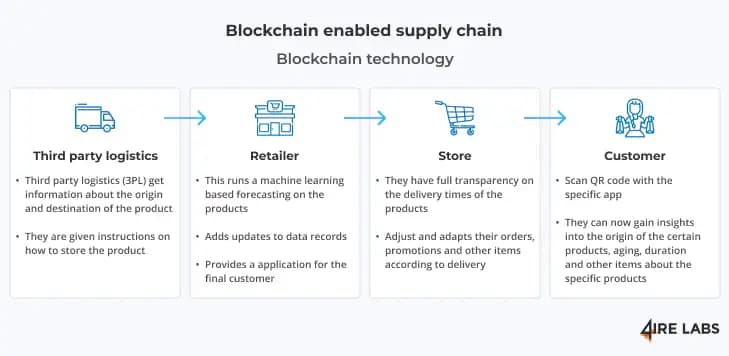
The best-known result comes from Walmart. In its pilot with IBM on Hyperledger Fabric, tracing the origin of a package of mangoes took 7 days with the old process and 2.2 seconds on the blockchain system, according to the Linux Foundation Decentralized Trust case study. In September 2018, Walmart went on to require its fresh leafy greens suppliers to trace their products using the system. The same principles apply outside food; see our overview of blockchain use cases in supply chain management.
What Goes on the Record
A useful traceability record is short and consistent. For each lot, the parties typically write:
- Identity: a traceability lot code, product description and quantity.
- Location and time: where and when the event happened, and who performed it.
- Links: the lot it came from and the lot or shipment it went into, so the chain can be followed in both directions.
- Evidence: hashes of certificates, inspection results or temperature logs, with the documents themselves kept off-chain.
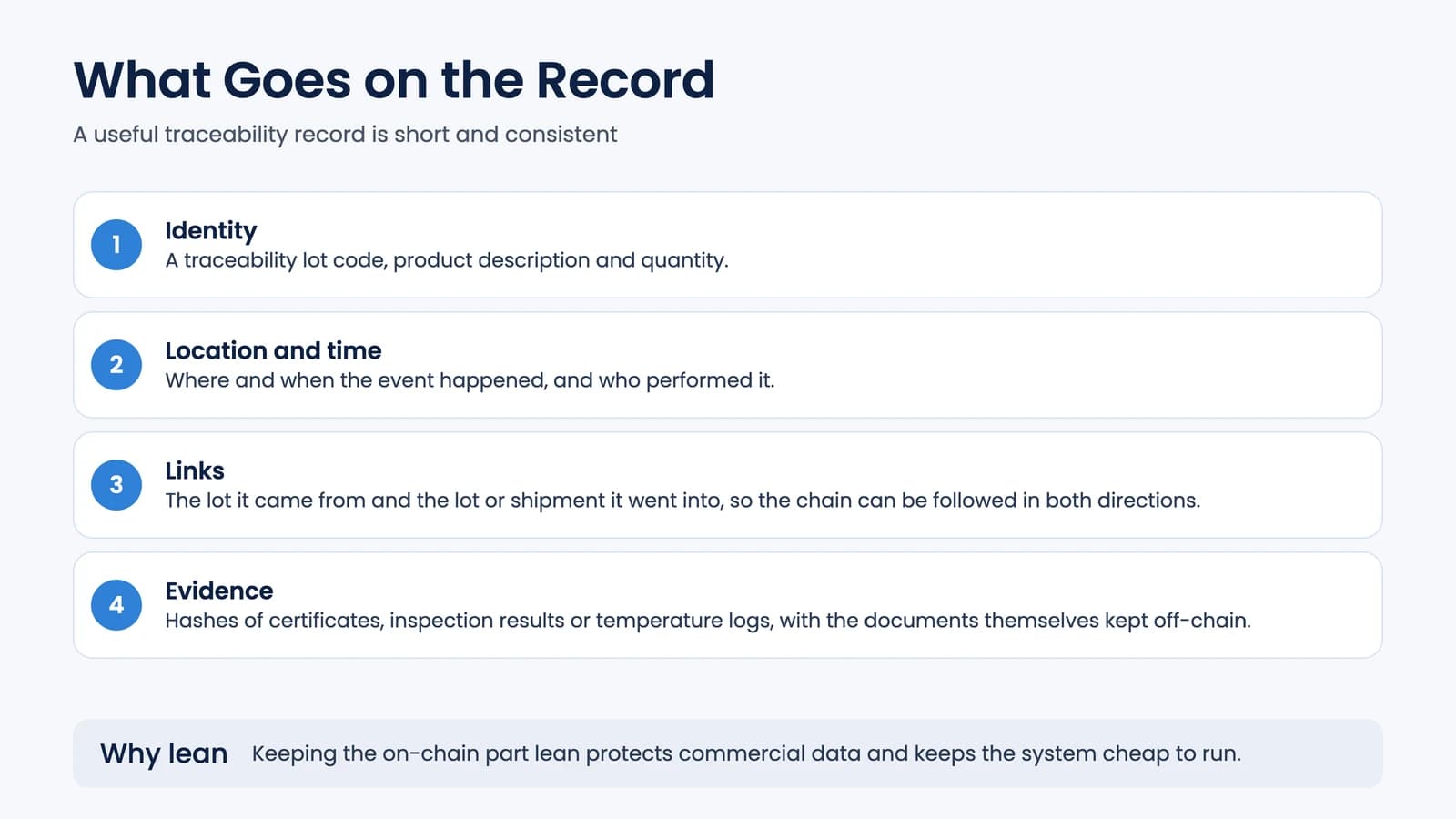
Keeping the on-chain part this lean protects commercial data such as prices and volumes and keeps the system cheap to run, while still letting any authorised party prove that a record has not been changed.
Blockchain Use Cases in the Food Industry
- Targeted recalls. When you can see exactly which lots went to which stores, you can pull those lots instead of a whole product line.
- Cold chain monitoring. Temperature sensors in trucks and cold rooms write readings to the record, so a break in the cold chain is visible to the buyer, not just the carrier.
- Certification and origin claims. Organic, halal, fair-trade or protected-origin certificates can be attached to lots, so a claim on a menu or pack can be traced to the certificate behind it.
- Food fraud. Fraud often happens at the hand-offs: a cheaper fish sold as a premium one, diluted oil, a relabelled origin. A signed chain of custody makes those substitutions harder to hide.
- Supplier payments. Smart contracts can pay a supplier automatically when a delivery is received and passes inspection, which matters for small farms with tight cash flow.
What It Means for Restaurants
Restaurants sit at the end of the chain and carry the reputational risk. A traceability record lets a restaurant group answer an allergy or contamination question quickly and back up menu claims such as "locally sourced" or "line-caught" with data from its suppliers. For groups with many sites, the same record shows which kitchens received an affected lot, so a supplier recall does not have to close every location.
Loyalty is the other area where restaurants have tried blockchain, with mixed results. Starbucks launched Odyssey, an NFT-based extension of its rewards programme, as a beta in 2022, then closed it on 31 March 2024 after 15 months, as Nation's Restaurant News reported. The lesson is not that tokens cannot work, but that customers do not care about the technology. A tokenized reward makes sense when points need to be shared across several brands or redeemed by partners; for a single chain, a conventional app is usually enough. If you do go down that route, design the rewards economics first; our guides to crypto cashback and tokenomics design cover the traps.
Limits to Plan For
- Data at the source. A ledger keeps records honest after entry, not before. Scanners, sensors and audits still decide whether the first entry is true.
- Supplier onboarding. Small farms and fishers need simple tools, often a mobile app or a portal run by their buyer, not a node of their own.
- Choice of network. Known trading partners usually point to a permissioned ledger; our guide to choosing a distributed ledger technology explains the trade-offs.
- Standards. Data should follow the fields regulators and partners already ask for, such as the FSMA 204 Key Data Elements, so the same record serves compliance and business needs.
- Business case. If one company owns every step, a normal database with audit logs may be cheaper and just as useful.
Where to Start
Choose one product line where traceability has a clear value, such as a high-risk food on the FDA list, a premium origin claim or a costly recall history. Record the minimum set of events your partners can realistically capture, and measure how long a trace takes before and after. Our blockchain consulting team can help you test whether a shared ledger is worth it for your chain.
4IRE has also built consumer-facing food tech, including a restaurant booking and bill payment app for Swedish client Maitres, with card fraud detection built in. You can see our work on the food tech industry page, and more cross-industry examples in our overview of blockchain use cases in business.
FAQ
Mainly for farm-to-fork traceability: each company in the chain records harvest, packing, shipping and receiving events for a lot on a shared ledger. That supports faster, narrower recalls, cold chain monitoring, proof of certifications and origin claims, and automatic payments to suppliers on delivery.
No. FSMA 204 requires companies handling foods on the Food Traceability List to keep specific Key Data Elements and produce them within 24 hours of an FDA request, but any system that meets that standard is allowed. The FDA will not enforce the rule before 20 July 2028.
In Walmart's pilot with IBM, tracing a package of mangoes to its source took 2.2 seconds on the blockchain system, compared with 7 days using the previous process.
Only in specific cases, such as points shared across several brands or partners. Customers value simple rewards more than the technology; Starbucks closed its NFT-based Odyssey programme in March 2024 after a 15-month beta.