


DeFi developers are some of the hardest engineers to hire. The work combines smart contract programming, financial logic and adversarial security thinking, and mistakes are expensive: code that holds user funds is attacked from the moment it goes live. A strong full-stack developer without on-chain experience is not a substitute.
This guide covers the skills to look for, what DeFi developers cost in 2026, where to find them, and a practical hiring process, whether you want to hire individuals or bring in a ready team to build your dApp.
What Makes DeFi Development Different
A DeFi application replaces an intermediary with smart contracts. Users interact with those contracts directly to trade, lend, stake or borrow, and every transaction is public and final. That brings three requirements most software teams never face: contracts are hard to change after deployment, the code is open to anyone looking for an exploit, and the product's economics (fees, incentives, liquidations) are part of its security.
Most DeFi still runs on Ethereum and EVM-compatible networks, but Solana, NEAR and Move-based chains such as Sui and Aptos have their own ecosystems and languages. Decide on your platform before you hire; our guide on how to choose the right blockchain covers the trade-offs.
Skills to Look For in a DeFi Developer
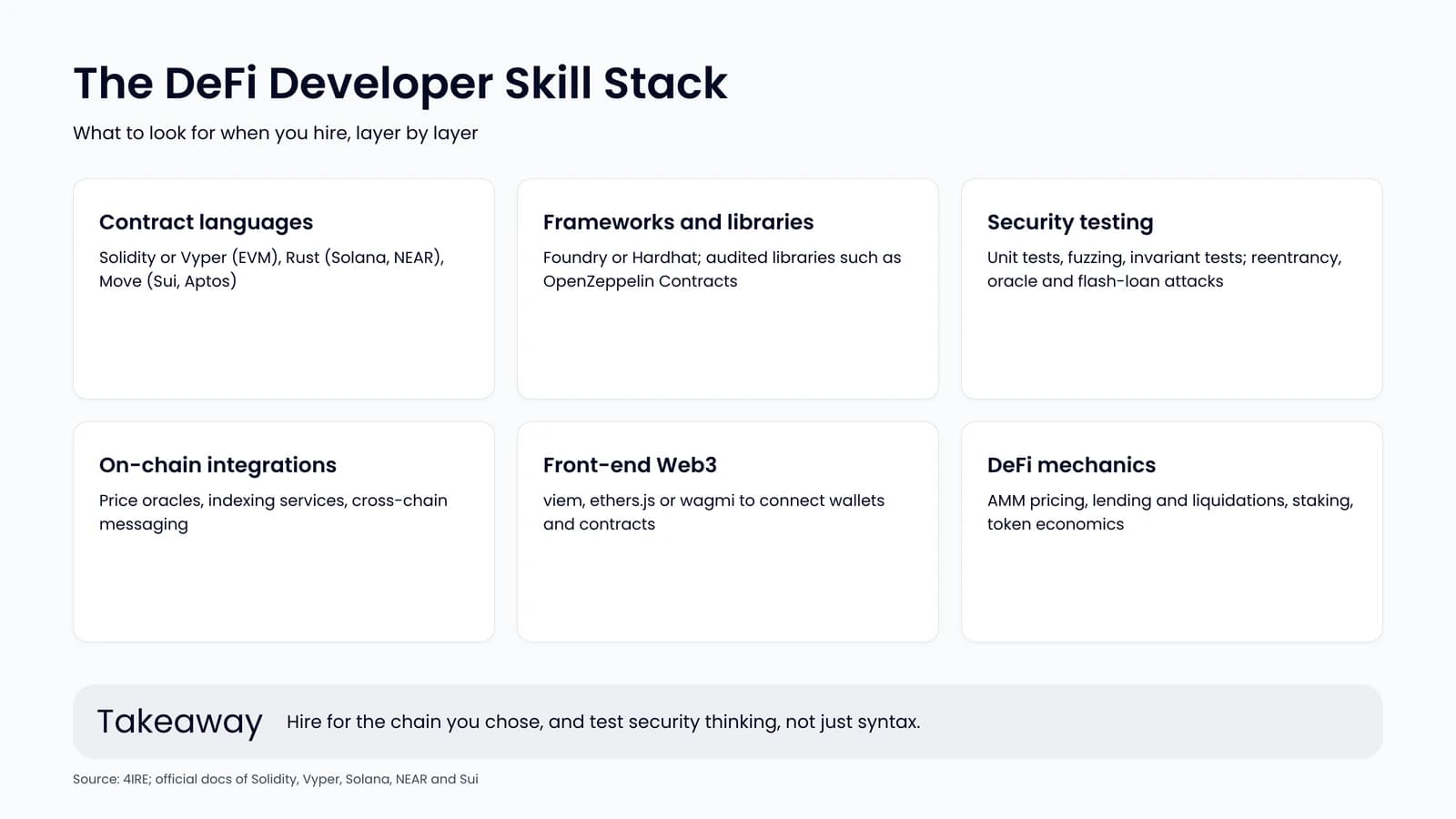
- Contract languages: Solidity or Vyper for EVM chains, Rust for Solana (usually with the Anchor framework) and NEAR, Move for Sui and Aptos.
- Development frameworks and libraries: Foundry or Hardhat for building and testing, and audited libraries such as OpenZeppelin Contracts rather than hand-rolled token or access-control code.
- Security testing: unit tests, fuzzing and invariant testing, plus working knowledge of common attack classes such as reentrancy, oracle manipulation and flash-loan exploits.
- On-chain integrations: price oracles, indexing services and cross-chain messaging, and an understanding of how each can fail.
- Front-end Web3 libraries: viem, ethers.js or wagmi to connect wallets and contracts to the user interface.
- DeFi mechanics: AMM pricing, lending and liquidation logic, staking rewards and token economics.
For a step-by-step view of how these pieces fit together in a real build, see our DeFi dApp development guide.
How Much Does It Cost to Hire a DeFi Developer?
Rates vary widely by seniority, location and chain. Two reference points, measured in different ways:
- Salaries in job postings. Web3.career's blockchain developer salary data, as published in September 2026, shows an average of about $150,000 a year, ranging from about $78,000 to $262,000, and an average hourly rate of $78 ($41 to $136). These figures come from job listings on the platform, not a survey of all developers.
- Contract rates. On 4IRE's own estimates, senior blockchain developers typically cost $130 to $160 an hour in the US and $55 to $75 an hour in Eastern Europe, the same range we use in our crypto wallet development cost breakdown.
Salary is only part of the cost. Budget for recruiting time, an independent security audit, and the risk of a bad hire, which in DeFi can mean an exploit rather than a missed deadline.
Where to Find DeFi Developers
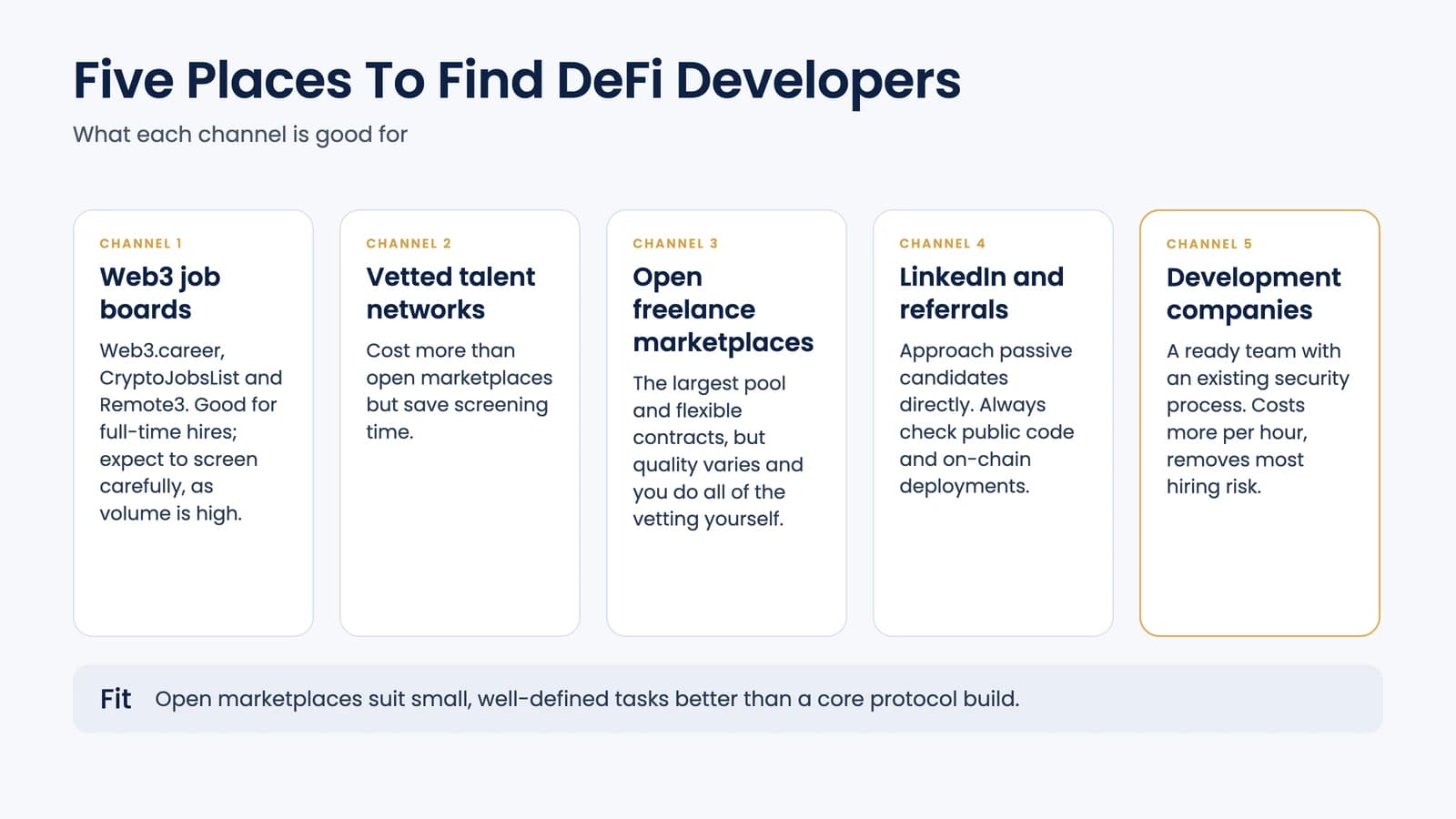
Specialist Web3 job boards
Web3.career, CryptoJobsList and Remote3 are job boards focused on crypto and Web3 roles, all showing active listings in September 2026. They work well for full-time hires: candidates there already want to work in the industry, and you can filter by skills such as Solidity or Rust. Expect to screen carefully, as volume is high.
Vetted talent networks
Toptal markets itself as the top 3% of freelance talent, offers a trial period in which you pay only if satisfied and says its average time to match is under 24 hours. It lists blockchain, Ethereum and Solidity developers. Vetted networks cost more than open marketplaces but save screening time.
Open freelance marketplaces
Upwork gives you the largest pool of freelancers and flexible contracts, but quality varies greatly and you do all of the vetting yourself. It suits small, well-defined tasks better than a core protocol build.
LinkedIn and referrals
LinkedIn search and recruiter tools help you approach passive candidates directly, and referrals from other founders remain one of the most reliable channels. Always check a candidate's public code and on-chain deployments, not only the profile.
Development companies and dedicated teams
A DeFi development company gives you a ready team of smart contract, front-end and QA engineers who have already worked together, with an existing security process. It costs more per hour than a single freelancer but removes most of the hiring risk. Our list of top DeFi development companies compares several options.
In-House, Freelance or Outsourced?
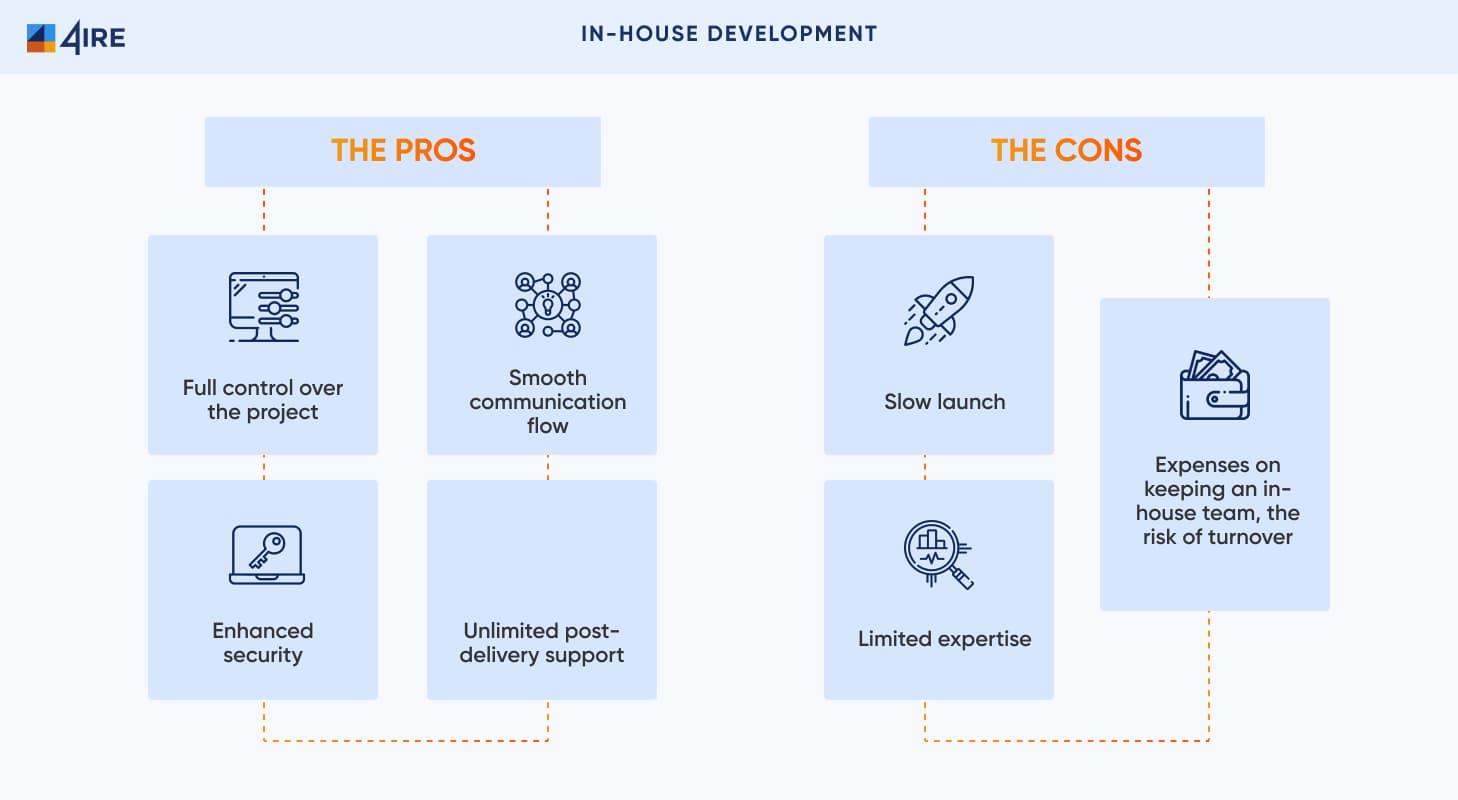
An in-house team gives you full control and keeps knowledge in the company, but it is slow to assemble and expensive to keep. Freelancers are flexible and quick to start but risky for core contracts. An outsourced team is usually the fastest route to a first mainnet launch, after which many companies hire in-house and take over gradually.
How to Hire a DeFi Developer, Step by Step
- Choose the chain and architecture first. It determines the language and tooling you hire for.
- Define the role. Protocol engineer, integration developer and front-end Web3 developer are different jobs.
- Write a specific job description that names the chain, the frameworks and the type of protocol.
- Screen with real code. Review public repositories and deployed contracts, then set a small paid task.
- Test security thinking. Ask the candidate to review a vulnerable contract and explain the attack.
- Onboard with guardrails. Code review, test coverage requirements and an audit plan from the first sprint.
The same principles apply to any technical hire; our broader guide to hiring software engineers covers interviews and onboarding in more depth.
Interview Questions That Reveal Real DeFi Experience
- Walk me through a contract you deployed to mainnet. What would you change today?
- How would you protect this protocol against price-oracle manipulation?
- When is an upgradeable contract the right choice, and who should control the upgrade keys?
- How do you write invariant tests for a lending pool or an AMM?
- What did the last audit of your code find, and how did you fix it?
Strong candidates answer with specifics: the chain, the tools, the bug they missed and how they caught it. Vague answers about "best practices" are a warning sign.
What a Typical DeFi MVP Team Looks Like
A first DeFi product rarely needs a large team, but it needs the right mix. A common setup is one or two smart contract engineers, a front-end developer with Web3 experience, a QA engineer who can write on-chain tests, and part-time input from a product manager and a token-economics specialist. Plan the external audit into the schedule from the start rather than booking it after the code is finished, because good auditors are often booked weeks ahead. If you are building a specific product such as a lending and borrowing platform, size the team around its riskiest component: in lending, that is the liquidation and oracle logic.
How to Hire DeFi Developers with 4IRE
If you would rather not recruit on your own, 4IRE can assemble a dedicated DeFi team around your stack, budget and timeline. Our dApp developers and Solidity developers work on smart contracts, DEXs, lending and staking platforms and wallets, with project managers handling the organisational side. We can usually share matching CVs within 24 hours of receiving your requirements and start work within one to two weeks.
Learn more from us
 Blockchain news28 Sept 2026
Crypto Wallet Development Cost in 2026: A Full Breakdown
How much does crypto wallet development cost in 2026? 4IRE's estimates by tier, platform and feature, plus running costs and what drives the budget.
Olena Petrashchuk
 Blockchain news28 Sept 2026
Real World Asset Tokenization in 2026: A Practical Guide to RWA
Real world asset tokenization explained: asset classes, how the stack works, 2026 RWA market data, US, EU, Singapore and UAE rules, and how to launch.
Olena Petrashchuk
 Blockchain news28 Sept 2026
Real Estate Tokenization in 2026: A Guide to Fractional Ownership
How real estate tokenization works: SPVs, token standards, fractional ownership, current market data, Deloitte's 2035 forecast, rules and real projects.
Olena Petrashchuk
Need a DeFi Team?
Tell us about your dApp, and we will propose a team, stack and timeline that fit your budget. Schedule a free consultation with our experts.
FAQ
Specialist Web3 job boards such as Web3.career, CryptoJobsList and Remote3 are good for full-time hires. Vetted networks such as Toptal save screening time, open marketplaces such as Upwork suit small tasks, and LinkedIn and referrals help you reach passive candidates. A DeFi development company is the fastest option when you need a complete team.
Web3.career's job-listing data, as published in September 2026, puts the average blockchain developer salary at about $150,000 a year and the average hourly rate at $78. On 4IRE's own estimates, senior blockchain developers cost $130 to $160 an hour in the US and $55 to $75 in Eastern Europe.
Fluency in the contract language of your chain (Solidity, Vyper, Rust or Move), experience with frameworks such as Foundry or Hardhat, strong security testing habits, an understanding of oracles and DeFi mechanics such as AMMs and liquidations, and ideally live contracts you can review on-chain.
Recruiting on your own typically takes weeks to months, depending on seniority and location. Vetted networks and agencies are faster. With 4IRE, you can usually review matching CVs within 24 hours and start work within one to two weeks.
Freelancers suit small, well-defined tasks. For a protocol that holds user funds, a team with shared security practices, code review and an audit plan is safer, whether you build it in-house or bring in a development company.