

 Cryptocurrency

Tokenomics is the economic design of a crypto project's token: supply, distribution, utility, incentives and governance. It shapes a token sale's success, its early price, and, above all, whether the project still has a working economy a year after launch. Weak tokenomics is one of the most common reasons a technically sound project fails.
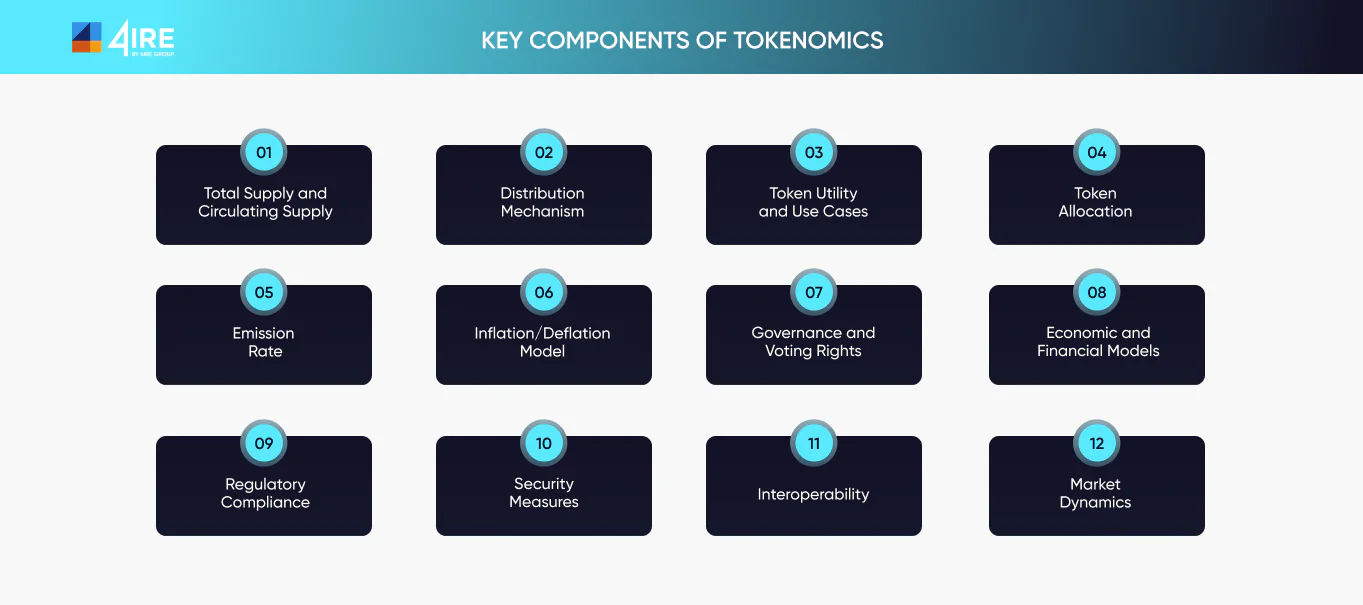
Key Elements of Tokenomics
- Total and circulating supply. Total supply is every token that will ever exist; circulating supply is what is actually in the market. A high circulating share generally signals less overhang risk from future unlocks.
- Distribution mechanism. How tokens reach holders initially (sale, airdrop, grants) and on an ongoing basis (vesting, staking rewards, liquidity mining). See our token vesting guide for the mechanics.
- Utility. What a token actually lets a holder do: pay fees, access a service, stake, or vote. A token without a real use case is a liability, not an asset, for the project.
- Allocation. How the initial supply splits between founders, investors, the team, and the community/treasury, and how those percentages are locked and released.
- Emission and burn mechanics. The rules for minting new supply and, where relevant, permanently removing tokens from circulation to offset inflation.
- Inflation vs. deflation. Whether supply grows or shrinks over time, and what that implies for long-term holder incentives.
- Governance rights. Whether and how token holders influence the project's direction. See our DAO development guide if governance is central to your design.
- Regulatory classification. Whether the token functions as a utility, security or payment instrument shapes which rules apply: in the EU, MiCA has applied to most crypto-asset issuers since December 2024, and a token structured as a transferable security still falls outside MiCA into securities law instead.
Token Types
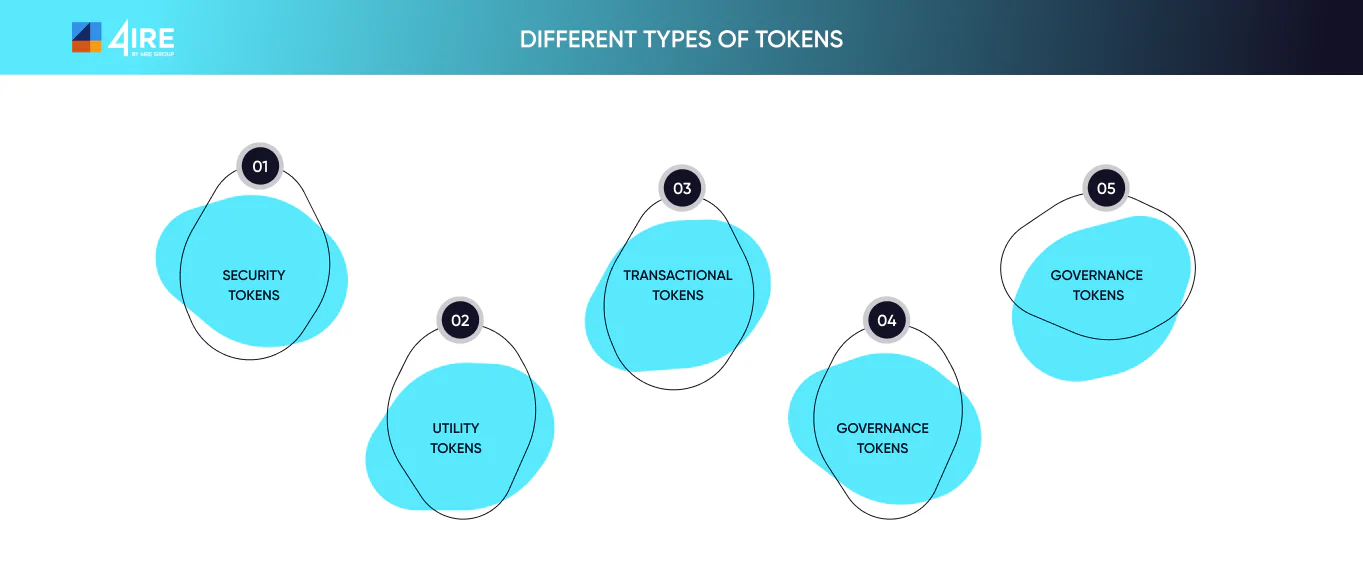
Tokens split along two independent axes. By transferability: fungible tokens (interchangeable, divisible, which is what most people mean by "coin") vs. non-fungible tokens (unique, indivisible). By function: utility tokens (pay for access to a service), governance tokens (voting rights), and security tokens (represent a claim on a real asset or cash flow, and are regulated as securities in most jurisdictions). Most projects combine more than one function in a single token rather than issuing separate tokens for each, which is itself a design decision with trade-offs.
Signs of Poorly Designed Tokenomics
- No clear utility: users have no reason to hold or use the token beyond speculation.
- Vague or missing emission schedule, so nobody can model future supply.
- Oversized allocations to founders, team and early investors relative to the community and treasury.
- No hard cap on emission with no other mechanism (burns, staking lockups) to offset ongoing dilution.
- Unrealistic promised returns, which is both a red flag for investors and, in many jurisdictions, a securities-law problem.
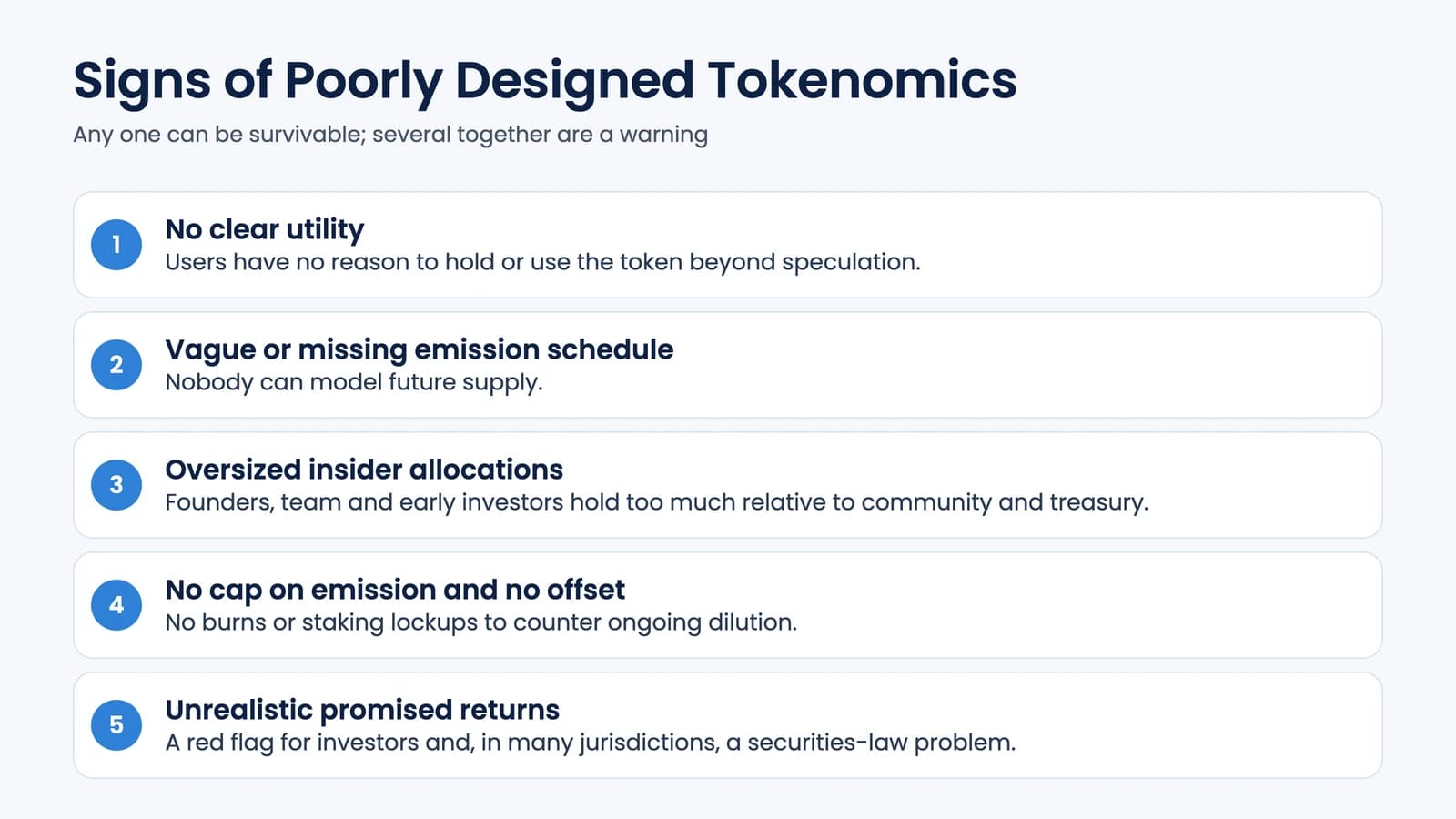
Any one of these can be survivable; several together are usually a preview of the project's failure mode, well before the token itself does anything.
Core Principles for Sustainable Tokenomics
- Design the project's economy first, the token second: a token bolted onto a product that does not need one rarely works.
- Build real value creation into the reward structure, not just distribution for its own sake.
- Model and test for adversarial conditions (a honeypot, a governance attack, a bank run on a lending pool) before launch, not after.
- Balance supply against genuine, sustained demand rather than engineering short-term scarcity.
- Match the model to the project's actual goals: a stablecoin, a play-to-earn token and a governance token need different designs.
Real-World Examples
Sky (the protocol formerly known as MakerDAO, which completed its MKR-to-SKY governance token migration in 2024) runs a multi-token model: its stablecoin is issued against collateral, while its governance token (now SKY) carries voting weight and plays a backstop role in the system's risk management. The project has repeatedly adjusted supply and parameters in response to demand rather than fixing them at launch, and its token has stayed genuinely useful, not just tradable, throughout multiple market cycles.
BNB, the token behind the Binance exchange, is a clear case of utility compounding over time: lower trading fees, launchpad access, and use across BNB Chain all layer onto the same token, with periodic burns used to manage supply. The lesson from both examples is the same: utility that grows with the project outperforms utility fixed at launch.
How to Design Tokenomics: A Practical Sequence
- Research. Pick your chain and technical stack: this shapes what tokenomics patterns are even available to you.
- Choose the token type(s). Fungible or non-fungible, utility, governance, or a hybrid, driven by the project's actual goals, not by what looks impressive in a pitch deck.
- Design the economic model. Inflationary or deflationary, supply schedule, and the mechanisms (staking, burns, buybacks) that regulate it.
- Build in real utility. Define concretely what a holder can do with the token from day one, not just what they might be able to do eventually.
- Stress-test for risk. Model manipulation, governance attacks and extreme market conditions before launch: smart contract audit the mechanism, not just the marketing copy.
- Plan for the long term. Tokenomics is not a launch-day artifact; the model needs to keep working as the project scales.
Testing tools like cadCAD let you simulate a proposed model against a range of market scenarios before it goes live: cheap insurance against a design flaw that only shows up under real market stress.
Pre-Launch Checklist
- Does the project need a new token at all, or does an existing one already serve the purpose?
- Is the token's utility concrete enough to explain in one sentence?
- Is the distribution and vesting schedule fair, clear, and published?
- What happens to the model under a governance attack or a liquidity crunch?
- Is the token's regulatory classification understood for every market you plan to launch in?
How 4IRE Can Help
4IRE designs tokenomics as part of our dApp development and smart contract work, from the initial economic model through token vesting and audited implementation. If you're planning a token launch, talk to us before you finalize the whitepaper, not after.
Designing Your Token Economy?
Our team can help model, stress-test and implement your tokenomics before launch. Schedule a free consultation with our experts.
FAQ on Tokenomics
Tokenomics determines whether a token has a real reason to be held and used beyond speculation. A project can have excellent technology and still fail if the token's supply, distribution and incentives are not designed to sustain demand over time.
No clear token utility, a vague or missing emission schedule, oversized allocations to founders and early investors, no mechanism to offset ongoing dilution, and unrealistic promised returns. Any of these alone is a concern; several together are a strong warning sign.
Discovery work uses stakeholder mapping and market analysis; design work uses mathematical modelling of incentive structures; and simulation tools such as cadCAD let teams test a proposed model against a range of market scenarios before launch.
Yes. 4IRE designs token economics alongside smart contract development and audit, so the model, the vesting logic and the implementation stay consistent from whitepaper to mainnet.