

 Cryptocurrency

After our cryptocurrency development guide, the question we get most is the specific one: what does it actually cost? Below is 4IRE's own breakdown. These are our commercial estimates from real engagements, not a universal market average, and they vary with scope, team location and how much you build versus buy.
Coin vs. Token: Where the Cost Really Diverges
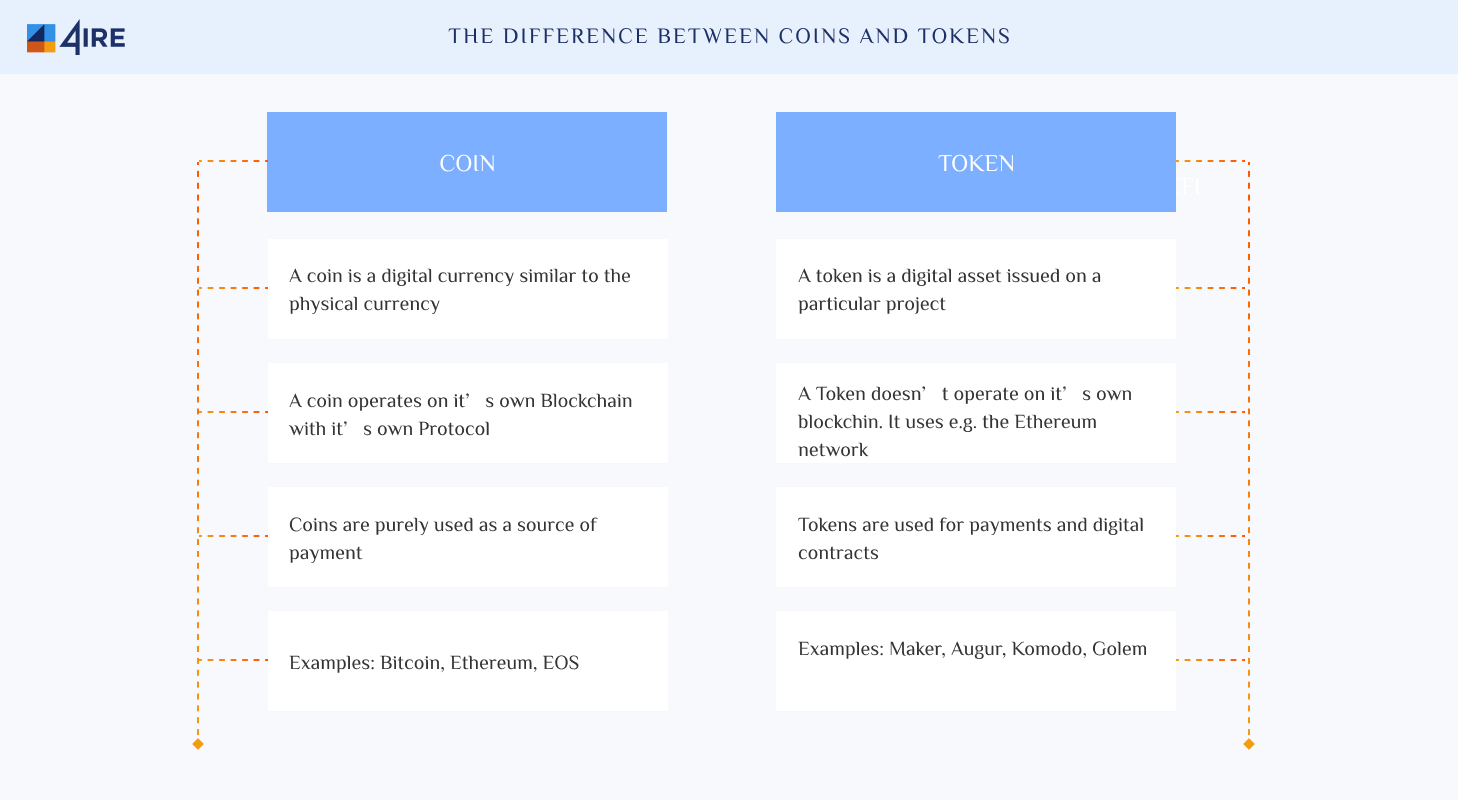
A token, built on an existing chain, comes down mostly to smart contract development, audit, and everything around it (front end, marketing, legal). A coin needs its own consensus mechanism, node network, and security model on top of all of that. See our cryptocurrency development guide for the technical difference. For most founders, a token is the more realistic starting point, and the numbers below reflect that route unless noted otherwise.
Smart contract development for a standard ERC-20-style token typically runs from a few thousand dollars for a simple, unaudited proof of concept to $30,000-$40,000+ for a token with custom logic (vesting, staking, fee mechanics) that needs to hold real value from day one. The contract itself is rarely the largest line item: the audit, front end and legal work around it usually cost more.
Budget Breakdown by Category
| Category | Typical share of a token launch budget |
|---|---|
| Consulting | 5% |
| Design | 10-15% |
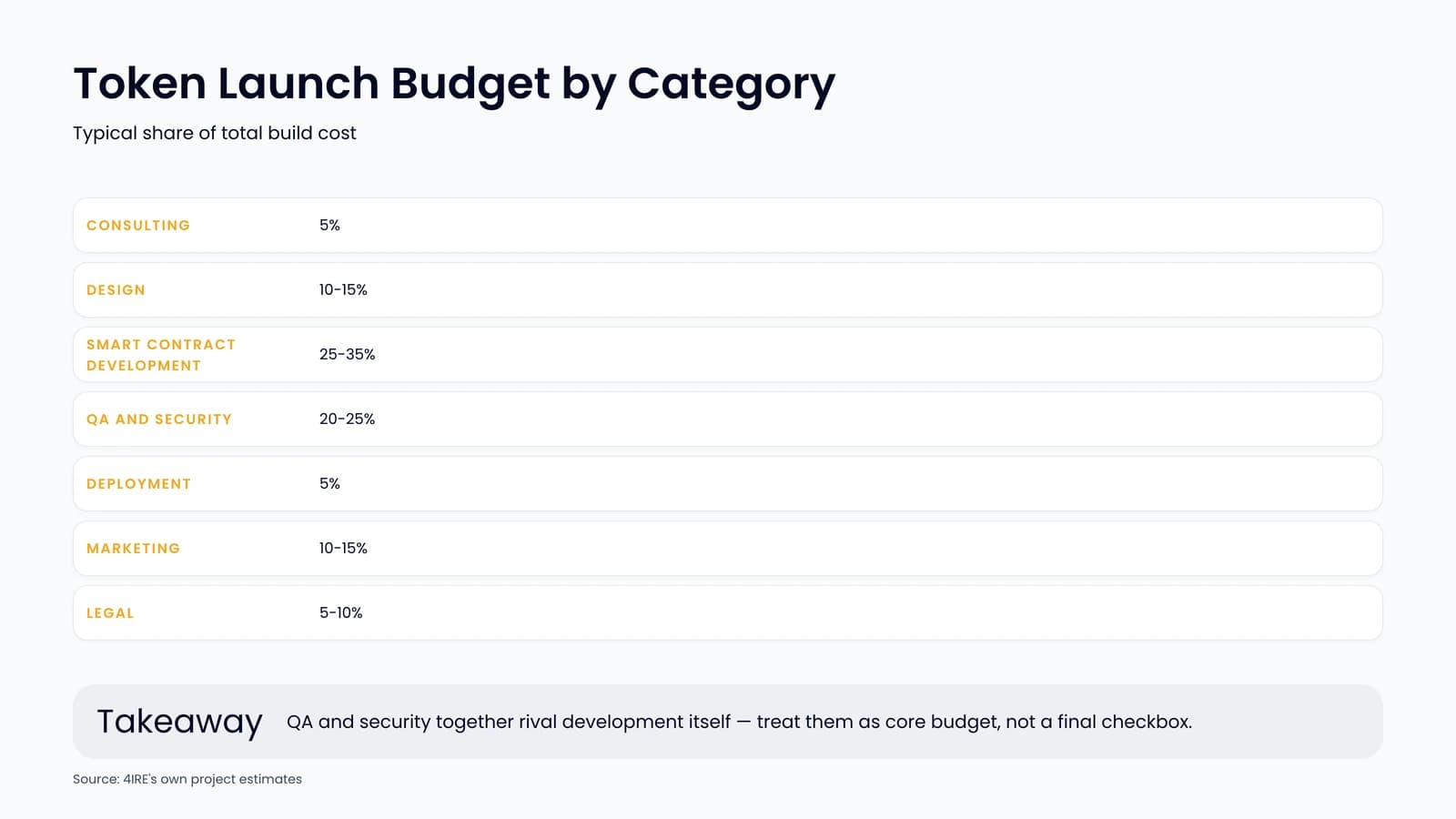
| Smart contract development | 25-35% |
| QA and security | 20-25% |
| Deployment | 5% |
| Marketing | 10-15% |
| Legal | 5-10% |
| Ongoing maintenance (post-launch, annual) | 15-20% of the total build cost |
What Development Talent Actually Costs
Rates vary by seniority, chain and location more than anything else. 4IRE's own crypto wallet development cost breakdown put senior blockchain developer rates at $130-$160/hour in the US and $55-$75/hour in Eastern Europe, and the same range applies to smart contract and Solidity developers for a cryptocurrency build. This is the single number we use consistently across our cost articles rather than a separate figure per project type.
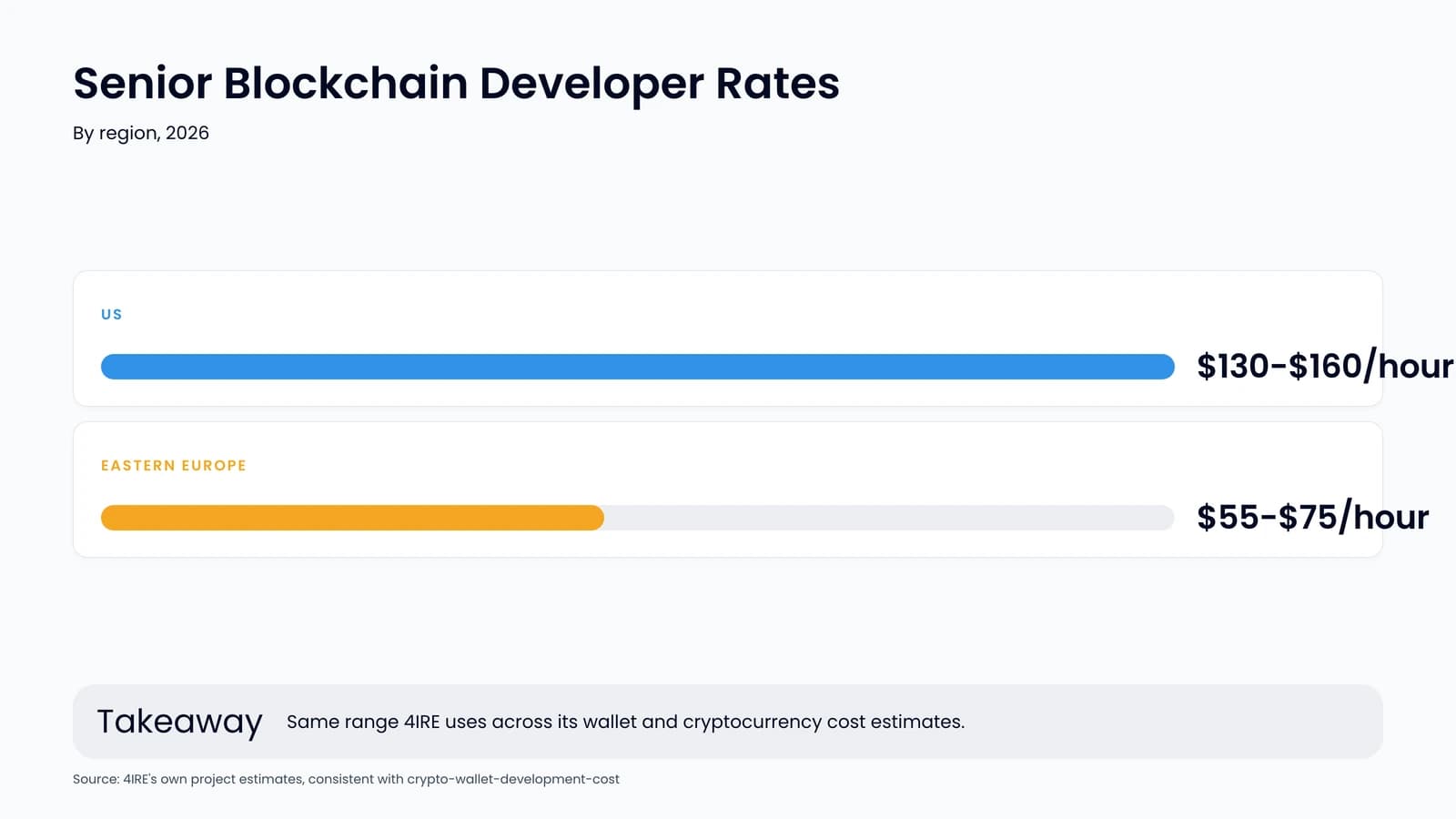
- Blockchain/smart contract developer: $130-$160/hour (US) or $55-$75/hour (Eastern Europe) for senior talent; junior or offshore-budget rates run lower but carry more rework risk.
- UX/UI and product designer: roughly $40-$70/hour, since design directly shapes whether users trust a new token enough to actually hold it.
- Project manager: roughly $50-$80/hour, worth budgeting for on anything beyond a solo build, given how many moving pieces a token launch has.
QA and Legal
QA is not optional for anything holding real value. Plan for it to take up close to a quarter of your development budget, same order of magnitude as a smart contract audit itself, which for a standard token typically runs $5,000-$15,000 and scales higher for more complex mechanics.
Legal counsel is not optional either, and it is one of the most-skipped line items by underfunded teams. Ongoing in-house counsel is a real salary commitment; most early-stage teams instead retain outside counsel for the securities-law review a token sale needs, plus jurisdiction-specific advice for wherever they plan to sell. Budget a meaningful five-figure sum here rather than treating legal as an afterthought. The cost of getting it wrong is far higher than the cost of doing it right.
Marketing and Launch Costs
- A dedicated project website: roughly $1,000-$5,000 for a focused, well-translated single-purpose site.
- Whitepaper: $1,500-$6,000 depending on depth and whether it needs independent economic modelling.
- Social presence and influencer partnerships: largely variable, from near-zero to a meaningful ongoing spend depending on your growth strategy.
- Exchange listings: usually a percentage of raised funds or a flat fee, and varies enormously by exchange tier.
Design the Economics Before You Cost the Build
The biggest cost overruns we see are not engineering surprises; they are teams that started building before deciding what the token actually does. A tokenomics design pass and a vesting schedule for team and investor allocations both belong before development starts, not after: changing supply mechanics or allocation logic mid-build usually means re-auditing the contract, which is the expensive way to learn this lesson.
Total Cost of Creating a New Cryptocurrency
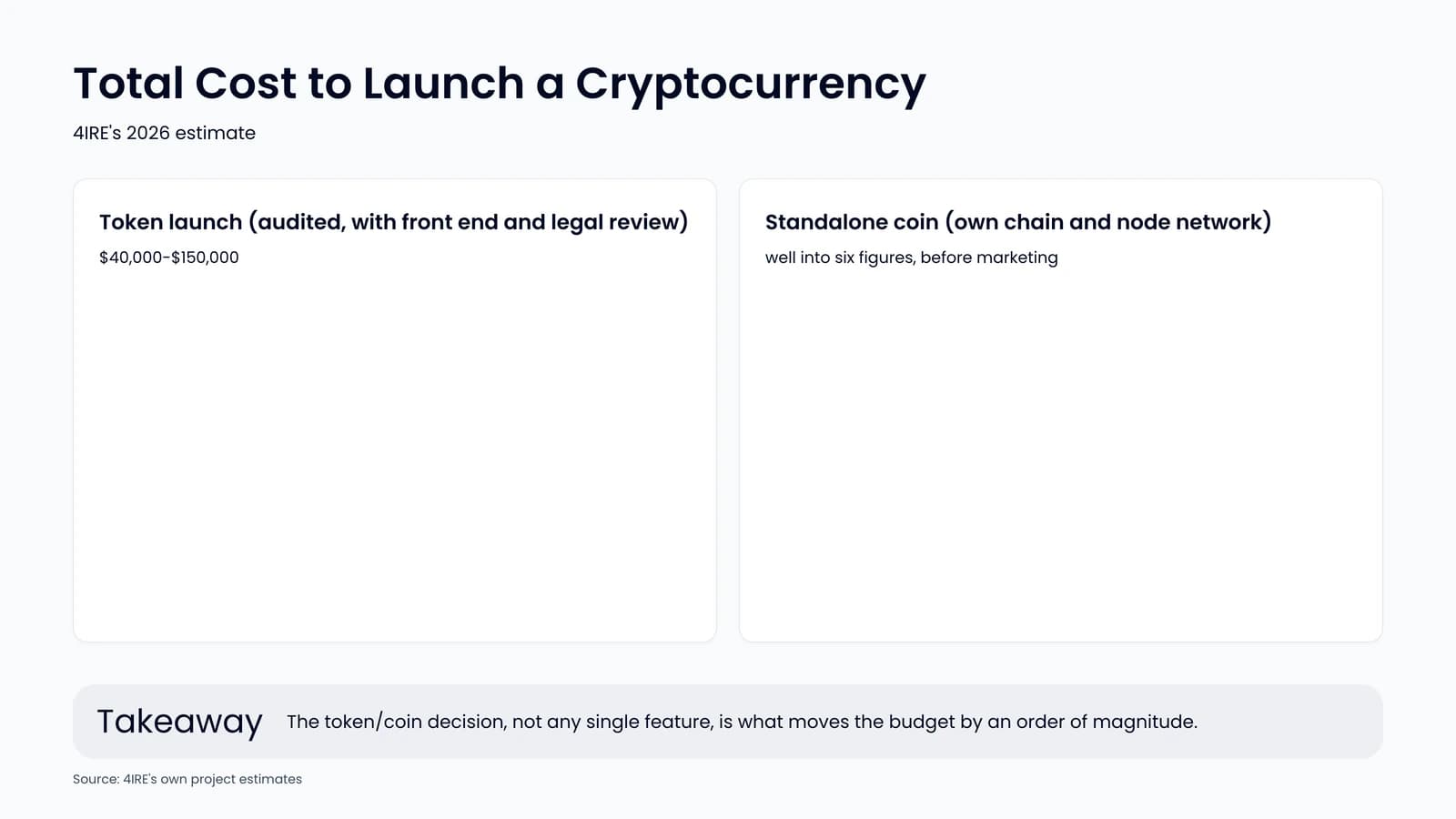
Putting the categories above together, 4IRE's estimate for a properly built, audited token launch (smart contract, audit, front end, whitepaper, legal review and initial marketing) runs roughly $40,000–$150,000. The low end fits a simple, standard-logic token; a token with the custom vesting, staking or fee logic described above (a $30,000–$40,000+ contract on its own) sits toward the middle and upper end of this range once QA, audit, legal and marketing are added around it. A standalone coin with its own chain and node network is a different order of magnitude entirely, typically well into six figures before any marketing spend, because it carries the full cost of a blockchain build rather than a contract on top of one.
Can You Save?
The most reliable way to control cost without cutting corners on security is to work with an experienced team that has already solved the same problems on other projects. Rework from an inexperienced team almost always costs more than paying for expertise up front. If you're weighing a coin against a token, or want a scoped estimate for your specific project, talk to our blockchain consulting team before committing to an architecture.
Want a Real Cost Estimate?
Tell us about your token or coin idea, and we'll scope a realistic budget and timeline. Schedule a free consultation with our experts.
FAQ
4IRE's estimate for a properly built, audited token launch is roughly $40,000-$150,000, covering smart contract development, audit, front end, whitepaper, legal review and initial marketing. A standalone coin with its own blockchain is typically well into six figures, since it carries the full cost of building and securing a chain rather than a contract on top of one.
A token is dramatically cheaper, because it runs on an existing blockchain's smart contract standard instead of needing its own consensus mechanism, node network and security model. For most founders, a token is the realistic starting point.
4IRE's standard smart contract audits run $5,000-$15,000, scaling higher for more complex token mechanics such as custom vesting, staking or fee logic.
Yes, mainly by scoping tightly (token over coin, standard mechanics over heavily custom ones) and working with an experienced team rather than the cheapest available one, since rework from an inexperienced team typically costs more in the end than paying for expertise up front.