

Token Vesting: Keep Investors Engaged, Prevent Price Drops, and Scale Securely
Every blockchain project thrives on fundraising, which is possible if people have trust and confidence in it. The good news is that you can increase your chances for success by introducing transparent token release mechanisms and offering solid tokenomics.
In this guide, we’ll walk you through the fundamentals of token vesting and burning and clarify the main vesting schedule types. We’ll also provide tips on choosing a reliable smart contract development company for a flawless token launch.
What Is Token Vesting and How Does It Work?
Let’s first clarify the main aspects of tokenomics to guide you to the nuances of vesting schedule design. Here are the basic terms you need to get the big picture:
- Tokenomics. Tokenomics denotes the economic structure of a specific Web3 project; it lays out the token’s utility and distribution modes and sets the specific token supply cap. The tokenomics model should also cover the principles of governance and incentive mechanisms in the form of token rewards. Read our tokenomics design guide to learn about the practical side of this project development phase.
- Vesting period. Vesting implies gradual access to tokens over time in line with the initially determined schedule and method.
- Lockup period. Token owners can’t transfer, sell, or exchange their tokens during the lockup term. This period is needed to prevent a large token influx into circulation, which can cause price volatility and negatively impact the project and its community.
- Token burning. Burning is a mechanism used to counter-balance token releases during the vesting period. At the stage of burning, a predetermined number of tokens get permanently removed from circulation, thus reducing supply and contributing to price and value stabilization over time.
With this terminology at our fingertips, we can now define vesting as a process of gradual release of locked tokens held in the project owners’ and early investors’ wallets in line with the vesting schedule stipulated in the project’s whitepaper. As the vesting event occurs, tokens become available for withdrawal, exchange, or DeFi staking on the project’s platform for further wealth generation.
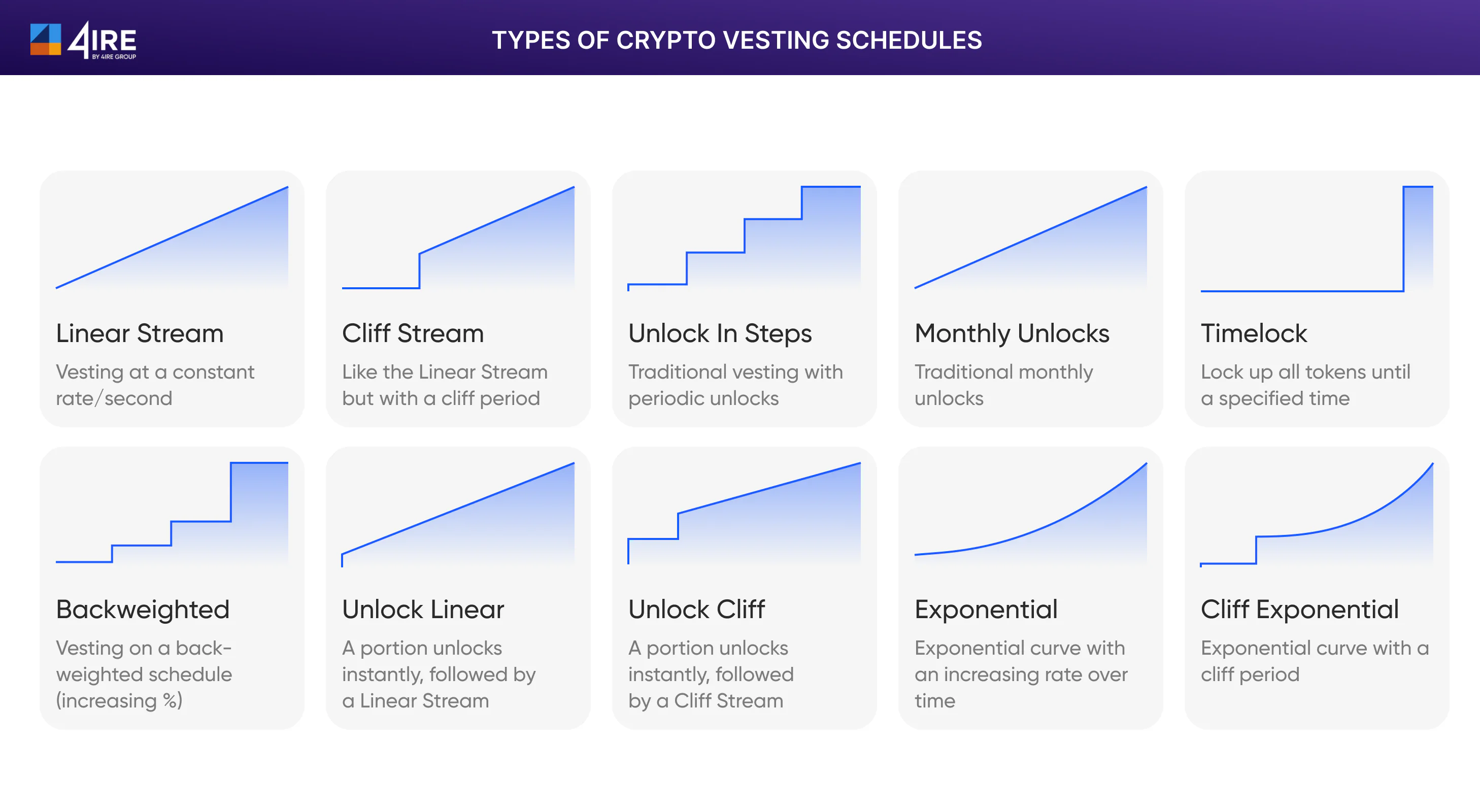
Types of Crypto Vesting Schedules You can plan your token unlocks in several ways, depending on the project’s goals and roadmap. Here are the main popular options to create custom token vesting schedules for your project:
- Linear stream. This type of vesting schedule presupposes a steady stream of token releases over time. Holders receive a small portion of their assets unlocked during a specific time frame (e.g., every day, week, month, etc.) ensuring an even supply of tokens into circulation.
- Cliff stream. A ‘cliff’ means a certain waiting period during which the owner receives no tokens, followed by a one-time release of a lump portion of the owned assets. This way, the cliff vesting schedule works as an incentive for team members to stay on the project for an extended period, waiting for their first sizable remuneration. After the cliff, the vesting scheme usually shifts to a linear stream.
- Unlock in steps. This token release schedule presupposes several rounds of token releases, typically pegged to the project’s milestones or time intervals. For instance, a project may unlock 10% of tokens every month or 25% of tokens every quarter.
- Monthly unlocks. This schedule is pretty straightforward, as it presupposes a release of equal portions of held tokens every month.
- Timelock. This approach is about keeping all tokens locked until a certain moment when 100% of the assets become available to holders. For example, investors may need to wait for 12 months of the token lockup period to have their assets unlocked in full.
- Backweighted. This vesting schedule allows owners to get increasing portions of their assets unlocked at each consecutive unlocking stage (kind of snowball effect). The scheme works well as an incentive for long-term holders, thus enabling the community to receive more and more tokens with each unlocking round.
- Unlock linear. The token distribution timeline is similar to the linear stream method, with the only difference in the upfront unlocking of an initial portion of tokens. This way, early investors get immediate access to a part of their assets and then follow a predictable, steady process of further unlocking.
- Unlock cliff. This method combines the upfront unlocked sum, the cliff payment within a certain period, and the gradual release scheme that follows.
- Exponential. The number of released tokens increases over time by following the exponential curve. This way, investors get increased access to tokens in exchange for minimal access at the initial period of the project’s launch.
Cliff exponential. This vesting schedule includes a cliff period with no unlocked tokens, after which the release begins at an exponential curve.
| Vesting Schedule | Description | Best For |
|---|---|---|
| Linear Stream | Constant, continuous token release | Gradual, predictable releases |
| Cliff Stream | Linear release after an initial cliff period | Ensuring long-term commitment before unlock |
| Unlock In Steps | Tokens unlock in set intervals or milestones | Milestone-based vesting |
| Monthly Unlocks | Tokens unlock at monthly intervals | Predictable monthly releases |
| Timelock | All tokens locked until a specified date | Projects requiring full lock-up before access |
| Backweighted | Larger token unlocks towards the end of vesting | Rewarding long-term commitment |
| Unlock Linear | Partial unlock upfront, followed by a Linear Stream | Immediate incentive with predictable stream |
| Unlock Cliff | Partial unlock upfront, followed by a Cliff Stream | Initial access, with long-term commitment incentive |
| Exponential | Release accelerates over time | Rewarding patient, long-term holders |
| Cliff Exponential | Cliff period followed by an accelerating exponential release | Delayed access with increasing rate over time |
You can also tie your token unlocks to their holders’ activities and performance on the project, thus practicing performance-based vesting. Some projects also adopt hybrid vesting to give their token holders the best of the two (or more) unlock schedule types. It’s also worth mentioning the accelerated vesting schedule, which is also popular. It may be implemented as an incentive for high-value employees or key investors who represent strategic value for the project or be pegged to key performance milestones.
Burning Mechanisms with Staking Rewards
Just like token vesting, the mechanism of token burning also plays a vital role in Web3 project’s tokenomics. Burnt tokens are permanently removed from circulation, thus reducing the total supply and creating artificial scarcity for the token in the crypto market. This way, the burn function is in achieving a persistent increase in the token’s value over time.
Let’s have a look at some examples of token burning mechanisms:
- Binance burns $10 million worth of its tokens every quarter by sending them to the “burn address” — a wallet from which the tokens can never be retrieved or sent elsewhere.
- The Entangle project has launched a “Burn to Build” program, which involves daily burning of its tokens in the treasury.
- Ethereum also has a token burning program — EIP-1559 mechanism — that burns a part of transaction fees. Since its launch in 2021, over 3 million ETH tokens have been burnt with the help of London Hard Fork.
Thus, it makes sense to incorporate a burning mechanism in your tokenomics to ensure the project’s longevity and health. You can choose one of the three burning options:
- Manual burning. The project’s team accumulates tokens in treasury and sends them at the estimated time intervals to the burn address (e.g., Binance).
- Automated burning. The burning function is included in the project’s smart contract logic, with a certain portion of the token burnt at every transaction (e.g., Ethereum, SafeMoon projects).
- Buyback and burning. Projects purchase their own tokens to remove them from circulation and then burn them.
Purposes of Vesting Schedules
In a nutshell, token unlocks via vesting are a great way to keep investors and team members on board for a longer period. The world of Web3 technology is so fast-paced that many investors chase quick profits and aren’t ready to exhibit loyalty to projects too long. Hence, vesting serves the following goals:
- Long-term project commitment. As tokens get unlocked over an extended period, the project’s team and early investors have an incentive to remain on the project longer to get their guaranteed remuneration.
- Anti-dumping measures. Vested tokens reach the market more evenly, so they don’t create negative price and supply pressure.
- Fair and equitable token distribution. Token distribution takes place uniformly and fairly among the entire community of project owners and early adopters, thus giving nobody a disproportionate advantage.
- Trust and credibility. A transparent vesting schedule adds to the project’s reputation and encourages user buy-in.
- Stakeholder alignment. Token holders are committed to the project’s long-term success, especially if their vesting periods are pegged to the project’s milestones, not specific dates.
You can address all these goals by partnering with best token vesting platforms and developing your own vesting strategy.
Benefits of Vesting Schedules
By implementing a vesting principle of token release for your project, you can reap the following advantages:
- Avoid the token’s price volatility associated with lump token releases.
- Keep stakeholders committed to project success over an extended period.
- Demonstrate financial discipline and long-term perspective to investors and adopters.
- Retain the project’s founders and tech contributors on board.
- Attract more investors from the crypto community.
- Give transparent and predictable performance incentives to project users.
- Exhibit your commitment to DeFi regulatory compliance.
- Avoid the concentration of tokens in a few hands, which comes with the risk of manipulation.
Role of Smart Contracts in Token Vesting
If you want to implement vesting in your project launch, you need to focus on the quality of vesting smart contract mechanisms first. Your vesting contract will contain the logic of token release, the terms under which the release takes place, the portion of vested tokens, and other essential aspects. For instance, the smart contract provides you with the following benefits:
- Automated token release. Smart contract automation makes it possible to schedule vesting and set all conditions without the need for manual unlocks in the future.
- Rule enforcement. Your vesting smart contract will guarantee that all tokens are unlocked precisely in line with your tokenomics logic and schedule without the risk of manipulation or fraud.
- Security. Smart contracts are immutable, so they guarantee your vesting schedule’s transparency and accuracy from day one.
- Precision. There are minimal to no risks associated with token vesting contracts because of their automatic execution in line with the logic you set during their development.
Thus, it’s important to hire smart contract developers with relevant expertise so that they can create solid vesting smart contract logic for you and test it for accuracy and security.
How to Choose a Token Vesting Service Provider?
You will surely need a trustworthy, experienced blockchain development company to come up with well-designed tokenomics. So, which features to look for in a token vesting provider? Here are the main parameters to simplify your selection process and spot high-quality, affordable crypto vesting services.
- Availability of customized vesting schemes. You should enjoy the flexibility of service provision, with the right to adjust and customize the vesting scheme to your unique business needs and project vision.
- Respect for security and QA. The chosen provider should incorporate robust security measures at every step of smart contract development and execute both manual and automated QA checks to remove potential security loopholes.
- Blockchain compatibility. Look for providers whose teams are well-versed in the Solidity programming language and can build ERC20-compliant solutions — the golden standard in the Web3 world.
- Integrations. Another aspect of token vesting software comparison is the ease and versatility of supported integrations. The chosen company should provide solutions that match your project’s architecture, with clear documentation and effective API support available.
- Transparency. The smart contracts built by your chosen provider should be publicly verifiable and open-source to nurture investor and stakeholder trust.
- Cost and pricing model. Pricing for token vesting services may differ widely among providers. Thus, you should find a company with a transparent and clear pricing structure without hidden fees. Some providers want to receive a certain portion of tokens as remuneration, while others charge a flat fee for their service.
- Reputation and expertise. Read reviews of top token vesting solutions and contact the previous clients of your chosen company to inquire about their first-hand experiences. This way, you will be able to get a better idea of the provider’s market reputation, publicity, and domain-specific expertise in the vesting niche.
- Post-deployment support. A reliable tech vendor provides post-deployment support, in-house staff training, and maintenance with tech upgrades on demand.
- Compliance. No blockchain project can survive regulatory scrutiny without proper compliance instruments put in place. Make sure your blockchain partner can design vesting smart contracts that comply with local and international regulations for your platform type.
4IRE’s Custom Smart Contract Development Services for Token Vesting
4IRE is an international blockchain development company with 14+ years of experience in this niche. Our experts have a nuanced understanding of blockchain programming languages and can create state-of-the-art Web3 projects of any complexity. If you choose us as a vesting smart contract developer, you can count on the end-to-end service package that walks you from an idea to the final vesting contract deployment.
We approach every client’s vesting needs in an individualized manner. The scope of our service includes the following stages:
- Look into your business needs. We hold consultations with key decision-makers to develop a concise list of tech specifications.
- Propose a suitable smart contract architecture. We develop a customized proposal by choosing the appropriate blockchain and designing custom-tailored smart contract logic.
- Develop smart contracts. We engage a team of qualified Solidity developers to create ERC20-compatible smart contracts for smooth, secure, and accurate token vesting.
- Test smart contracts for bugs and loopholes. 4IRE also provides comprehensive smart contract audit services to ensure that your smart contracts follow accurate logic and are free from security flaws.
Conduct final optimization. The smart contracts get polished and prepared for launch based on the QA and audit results.
The Bottom Line
Token vesting is part and parcel of a healthy, sustainable Web3 project’s launch. It guarantees a long-term commitment of major stakeholders and gives a fair, transparent mechanism of token unlocking and burning without the risks of dilution and manipulation. Therefore, it makes sense to do your research on reputable token vesting service providers and find a firm that can build a strong tokenomic model for your project.
We at 4IRE are ready to support your token vesting needs at any stage, from blockchain consultancy to vesting schedule customization and smart contract design. By working with us, you get tried and tested solutions from seasoned tech pros and can move on with your crypto project, whether it’s an initial DEX offering or a crypto exchange, with confidence.
Learn more from us
 Blockchain news23 Apr 2026
Real Estate Tokenization 2026: Fractional Ownership for Global Investors
Real estate tokenization is gaining traction as a tech-enabled option for fractional ownership of high-value assets. Learn more about it here
Helen Petraschuk
 Bank21 Apr 2026
What are Crypto Banks? Everything You Need to Know About
April 22, 2026 Learn what crypto banks are and how they differ from traditional banks. Read to know if a crypto bank is a substitution for the fiat banks, and if they will merge or…
Helen Petraschuk
 Cryptocurrency13 Apr 2026
How to Build a Cryptocurrency Exchange Platform in 2026
Learn how to create a cryptocurrency exchange platform from A to Z. We share development steps, business tips, and an expert look at the process.
Yaroslav Tumanov
FAQ
Vesting is the scheme of gradual unlocking of a Web3 project’s tokens held by early-round investors. These are usually team members, early adopters, and seed round buyers. They receive tokens at heavily discounted prices, so a quick supply of all their assets to the market can cause unfavorable volatility in the token’s value.
Tokenomics is the term used to define a specific crypto project’s economy — the policies and rules the project’s creators have set for token creation, distribution, and management. Tokenomics serves the complex aim of balancing the token’s supply to maintain its value, a vital component of sustainable project growth.
There are over a dozen crypto vesting schedules, such as cliff and linear stream, exponential, timelock, backweighted, and unlock in steps, among others. Some projects also adopt performance-based or hybrid vesting schedules to incentivize token owners.
Vesting encourages investors to hold tokens for a longer period, prevents token dumping, and promotes fairness in token distribution. Transparent and reasonable vesting schedules also build community trust and enhance the project’s credibility by ensuring that the majority of token holders are committed to the project’s success.
Token vesting comes with numerous pros, such as a more stable Web3 market, more confident investors, and community trust. Projects built on vesting principles avoid token accumulation in a pair of hands, which improves their regulatory compliance. Besides, vesting adds a long-term perspective to a project by keeping the tech team and early adopters on board.
Smart contracts are the bloodstream of Web3 projects. They enable automatic token distribution, enforce rules, and guarantee the security, transparency, and accuracy of the vesting process.
Your chosen provider should offer flexible services, focus on security, be well-versed in all major blockchain technologies, and guarantee seamless third-party integrations. We also recommend taking a closer look at the pricing structure and service cost, the provider’s reputation and domain-specific expertise, and competence in guaranteeing compliance.
4IRE can become your dedicated provider of token vesting services due to our extensive blockchain and Web3 expertise, custom contract development, and comprehensive QA testing. We can walk you through the entire process of token vesting design and implementation to guarantee a good standing for your project in the Web3 space.