

 Cryptocurrency

Binance is the reference point for anyone planning a centralised exchange (CEX). Launched in July 2017, it reported more than 323 million registered users across over 100 countries at its ninth anniversary in July 2026. Few teams set out to match that scale on day one. What they want is a platform built the same way: a fast matching engine, secure custody, deep liquidity and a product range that keeps users trading.
This article breaks down what a cryptocurrency exchange like Binance consists of: the product scope, the architecture, liquidity, compliance and the drivers behind the cost. For the step-by-step build process and the choice between CEX, DEX and hybrid models, see our companion guide on how to build a cryptocurrency exchange platform.
How Binance Works
Binance is a custodial exchange. Users register, pass identity verification, deposit crypto or fiat, and trade against balances the exchange holds for them. Trades are matched in Binance's own systems, not on a blockchain; only deposits and withdrawals touch the chain. Traders who pay fees in the exchange's own token, BNB, get a discount.
The product scope of a Binance-like exchange
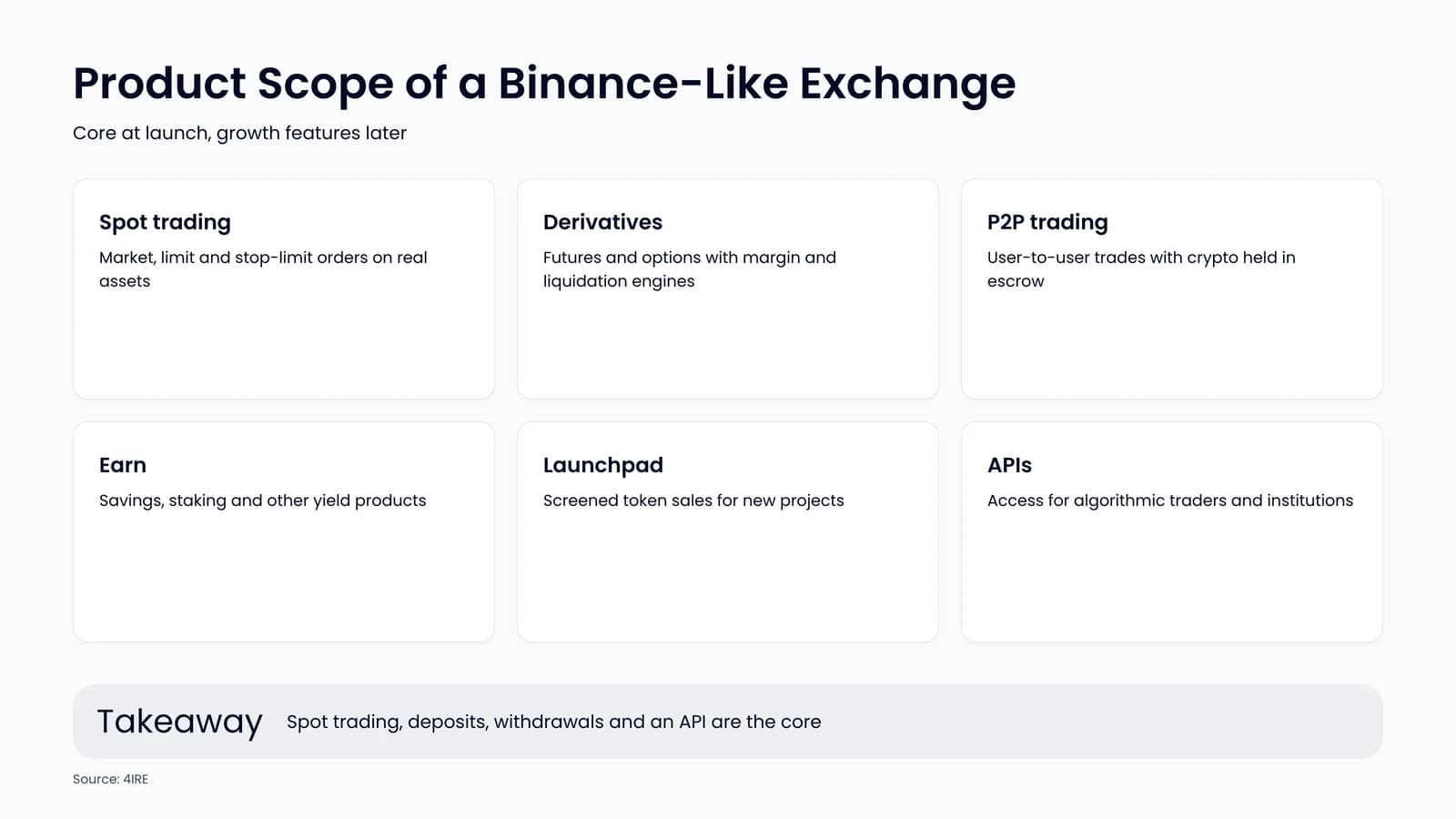
- Spot trading with market, limit and stop-limit orders on real assets.
- Derivatives: futures and options, which need margin, risk and liquidation engines.
- P2P trading, where users buy and sell crypto with each other using local payment methods, with the exchange holding the crypto in escrow.
- Earn products: savings, staking and other yield products.
- Launchpad: token sales for new projects, screened by the exchange.
- APIs for algorithmic traders and institutions.
- A native token and blockchain: BNB and BNB Chain extend Binance's reach beyond the exchange.
No new exchange needs all of this at launch. Spot trading, deposits and withdrawals, and a solid API are the core; the rest are growth features.
White-Label or Custom Development?
The first build decision is whether to start from a white-label platform or build from scratch.
| White-label platform | Custom development | |
|---|---|---|
| Time to market | Weeks to a few months | Usually six months or more |
| Control | Limited to what the vendor supports | Full control of features and roadmap |
| Ownership | Licence to use the code, terms vary | Full IP ownership |
| Cost profile | Lower upfront, ongoing licence fees | Higher upfront, lower dependency |
| Best for | Testing a market or launching fast | Differentiated or high-volume platforms |
Many teams combine the two: a white-label core for trading, wallets and admin, with custom work on the features that set them apart. 4IRE's white-label crypto exchange follows this approach, with spot and leveraged trading, staking, wallets and an admin portal out of the box.
Cryptocurrency Exchange Architecture
A Binance-like exchange is a set of services that must stay fast, consistent and secure under heavy load.
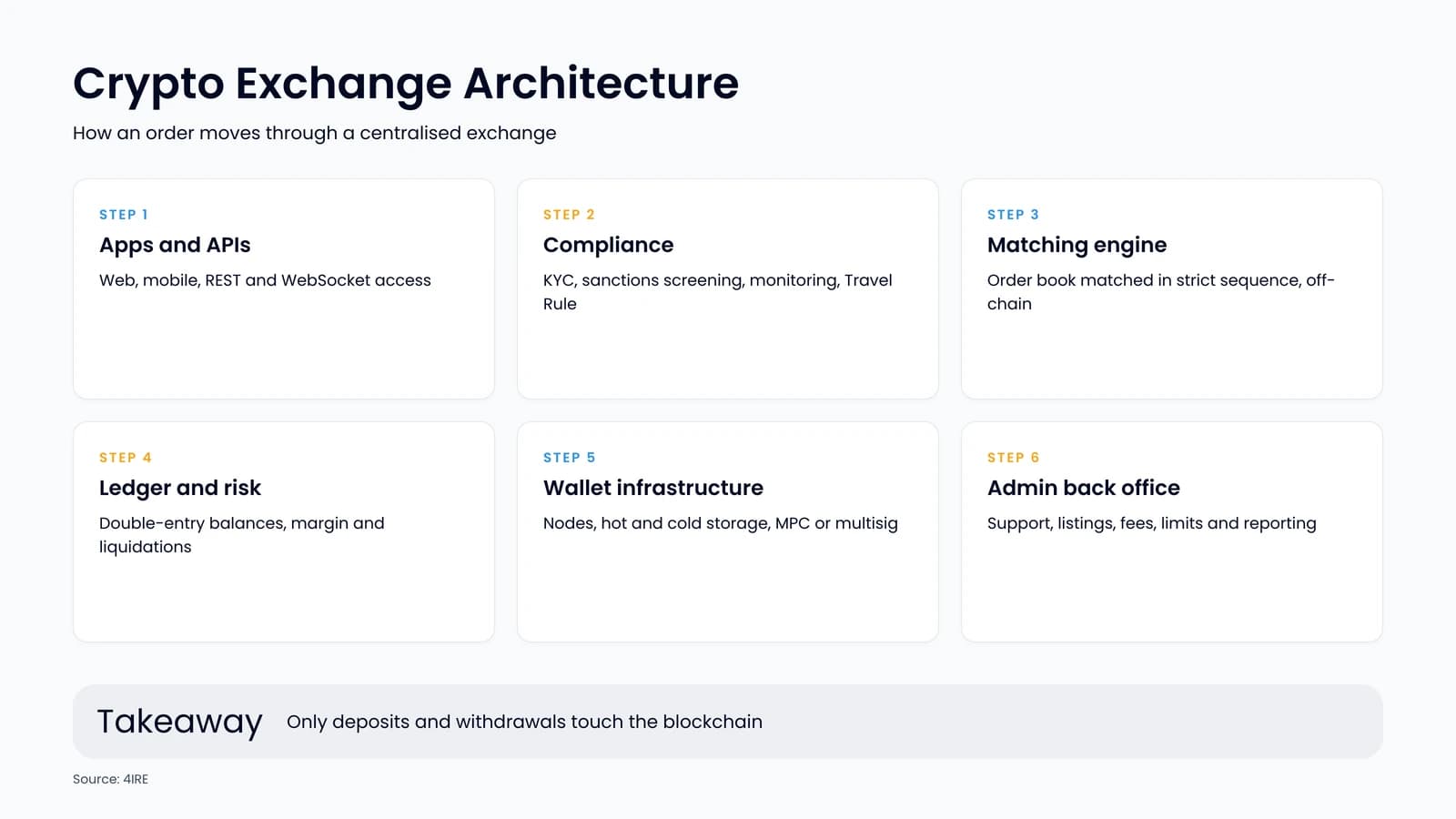
- Matching engine and order book. The core of the exchange. It must process orders in strict sequence with very low latency and never lose or duplicate a trade.
- Ledger and accounts. A double-entry ledger that records every balance change and reconciles it with on-chain holdings.
- Wallet infrastructure. Deposit address generation, blockchain nodes, withdrawal processing and a split between hot and cold storage, increasingly with MPC or multi-signature controls. This is the part attackers target; our crypto wallet development team builds custody infrastructure of this kind.
- Risk engine for margin, liquidations and position limits, if you offer derivatives.
- Market data and APIs: REST and WebSocket feeds for the web and mobile apps, traders and market makers.
- Compliance services: KYC, sanctions screening, transaction monitoring and Travel Rule messaging.
- Admin back office for support, listings, fees, limits and reporting.
Key Crypto Exchange Platform Features
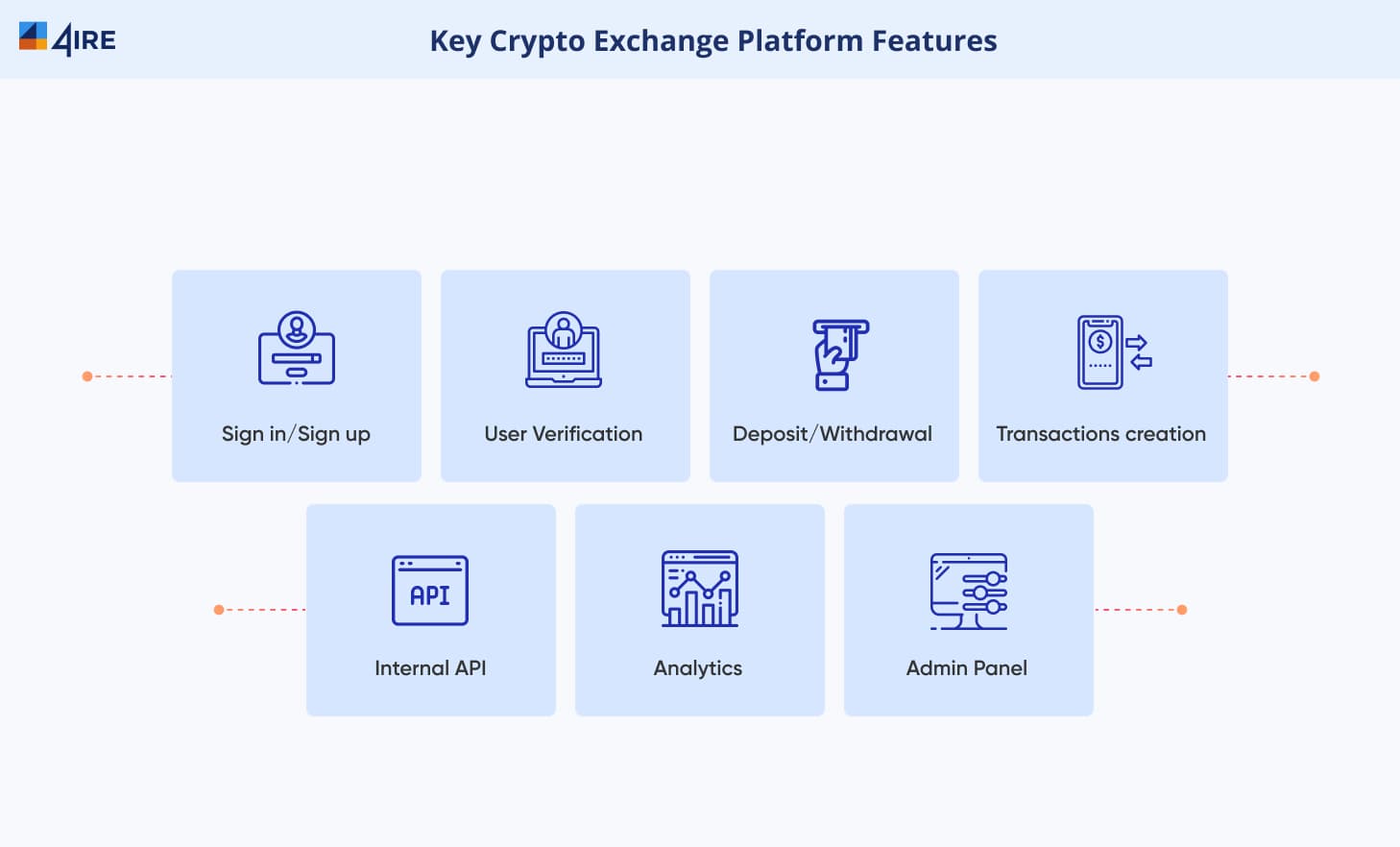
Users judge an exchange by a few basics: fast sign-up with two-factor authentication, smooth identity verification, quick deposits and withdrawals, reliable order types, charts with standard indicators, and responsive support. Institutions and active traders add a stable API with clear rate limits. An admin panel with full audit logs gives your own team the same control.
Liquidity: The Hardest Part
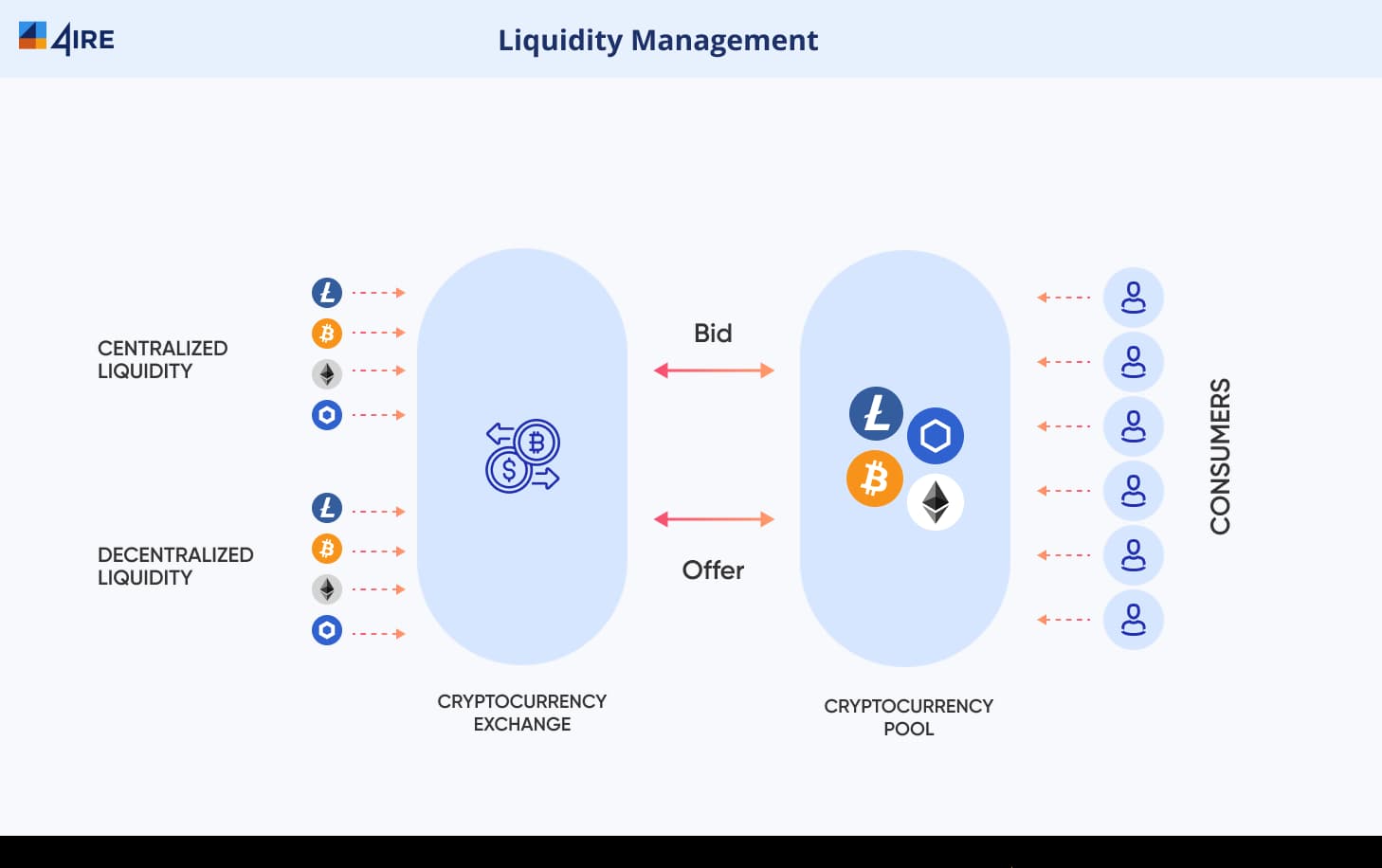
A new exchange starts with empty order books, and traders will not stay where spreads are wide and orders move the price. Binance's advantage is a volume no newcomer can copy, so a new CEX has to source liquidity from outside:
- Market makers under agreements that commit them to quoting tight spreads.
- Liquidity aggregation from other exchanges through connectors, so users' orders are filled against external books.
- Incentives: fee rebates for makers and rewards for early traders.
Start with a limited set of trading pairs, such as major coins against stablecoins, where external liquidity is easiest to source.
Security
Custodial exchanges are prime targets. In February 2025, attackers the FBI attributed to North Korea stole about $1.5 billion in crypto from the exchange Bybit. The lessons apply to any CEX:
- Keep most funds in cold storage, with multi-signature or MPC approvals and independent verification of what signers approve.
- Separate duties, whitelist withdrawal addresses and rate-limit large withdrawals.
- Run penetration tests and code reviews, and a smart contract audit for any on-chain components such as tokens or staking contracts.
- Hold an insurance or reserve fund. Binance runs its SAFU fund and publishes proof of reserves that lets users check their balances are backed 1:1 using Merkle trees and zero-knowledge proofs.
Compliance and Licensing
Binance's own history shows the cost of getting this wrong. In November 2023, it settled with the US Department of Justice and Treasury, agreeing to pay more than $4.3 billion for anti-money-laundering and sanctions violations, including years of weak KYC and no suspicious activity reports.
Today, a CEX needs a licence in every market it serves. In the EU, crypto-asset service providers need MiCA authorisation, and the transitional period for unlicensed firms ended on 1 July 2026. Other hubs, such as the UAE, Singapore and Hong Kong, run their own licensing regimes. Build KYC, transaction monitoring and Travel Rule support into the architecture, and choose your first jurisdiction before you design the product. Our overview of fintech and crypto licences is a starting point.
What Drives the Cost of an Exchange Like Binance
There is no honest single figure: a spot-only white-label launch and a full Binance-style platform differ by an order of magnitude. The main drivers are:
| Cost driver | Why it matters |
|---|---|
| Product scope | Derivatives, P2P, Earn and Launchpad each add engines and compliance work |
| Build model | White-label cuts time and cost; custom gives control |
| Wallet and chain coverage | Every blockchain adds nodes, deposit logic and security reviews |
| Licensing | Each jurisdiction adds legal, capital and reporting costs |
| Liquidity | Market-maker agreements and connectors are ongoing costs |
| Security and audits | Penetration tests, audits and custody controls are recurring |
Licensing and liquidity often cost more than the software. A discovery phase that fixes the jurisdiction, product scope and liquidity plan gives a reliable estimate.
How Binance Grew, and What to Copy
Binance grew by adding products around a strong core: derivatives, Earn, Launchpad, P2P and its own blockchain. A new exchange can follow the same path in smaller steps. Launch with spot trading in one jurisdiction, add products your users ask for, and consider a decentralised venue alongside the CEX; our guide to building a DEX like Uniswap covers that side.
Conclusion
An exchange like Binance is a trading engine, a custodian, a liquidity business and a regulated financial firm at the same time. Get custody, liquidity and licensing right, and the feature set can grow with your users. 4IRE helps teams launch exchanges on a white-label core and extend them with custom features.
Launch Your Crypto Exchange with 4IRE
Planning a centralised exchange? Our team will help you choose between white-label and custom, and plan custody, liquidity and licensing.
FAQ on Building a Cryptocurrency Exchange Like Binance
It depends on the product scope, build model, number of blockchains, jurisdictions and liquidity plan. A spot-only exchange on a white-label core costs far less than a custom platform with derivatives and P2P. Licensing and liquidity often cost more than the software, so a discovery phase is the best route to an estimate.
Yes, in almost every major market. In the EU, crypto-asset service providers need MiCA authorisation, and the transitional period for unlicensed firms ended on 1 July 2026. The UAE, Singapore, Hong Kong, the UK and the US each have their own regimes.
Through market-maker agreements, liquidity aggregation from other exchanges and incentives such as maker rebates. Starting with a small set of major pairs against stablecoins makes liquidity easier to source.
A white-label platform is faster and cheaper to launch, while custom development gives full control and IP ownership. Many teams start with a white-label core and add custom features where they want to stand out.