

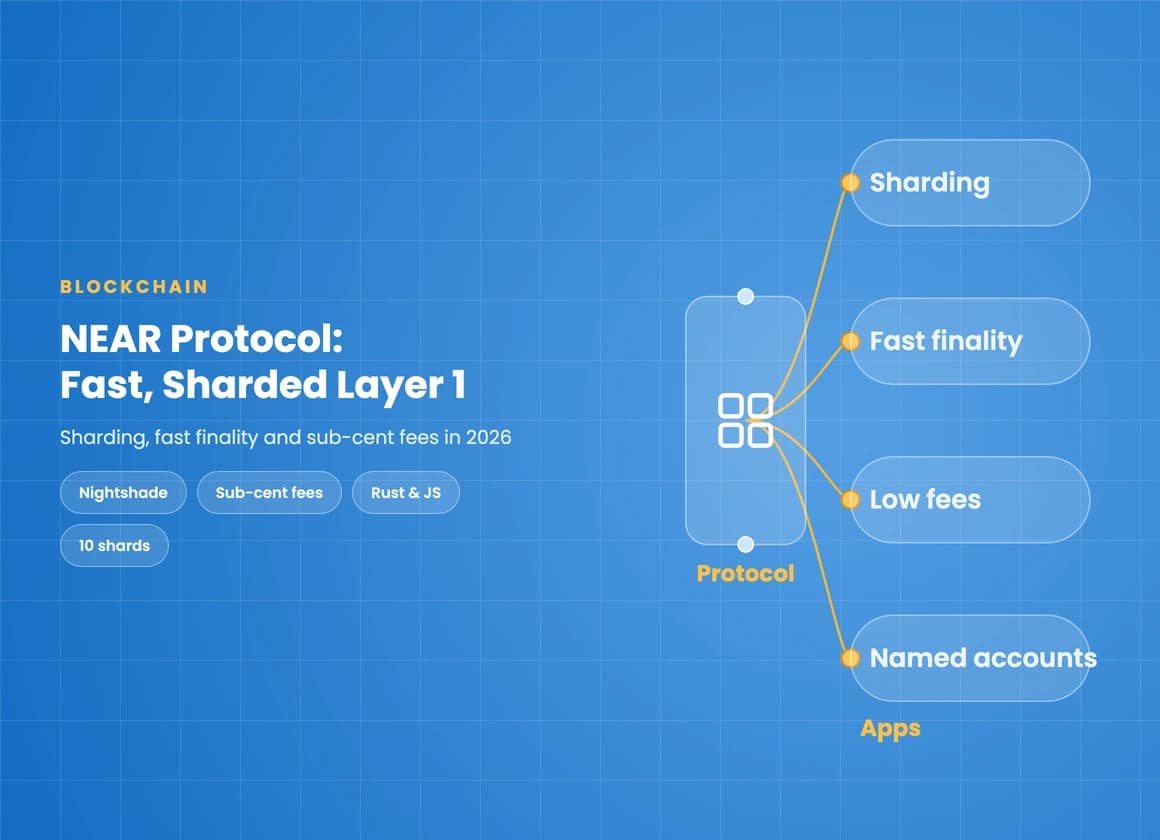

When this article first ran, NEAR had just launched its mainnet and sharding was a roadmap item, not a working feature. Six years on, NEAR runs a second generation of its sharding design, settles transactions in about a second, and has become one of the main chains for cross-chain "intents" swaps. 4IRE has built on NEAR since 2020, when we became a NEAR partner. This guide covers what NEAR is, how it actually performs today, and where it fits for a new product.
What Is NEAR Protocol?
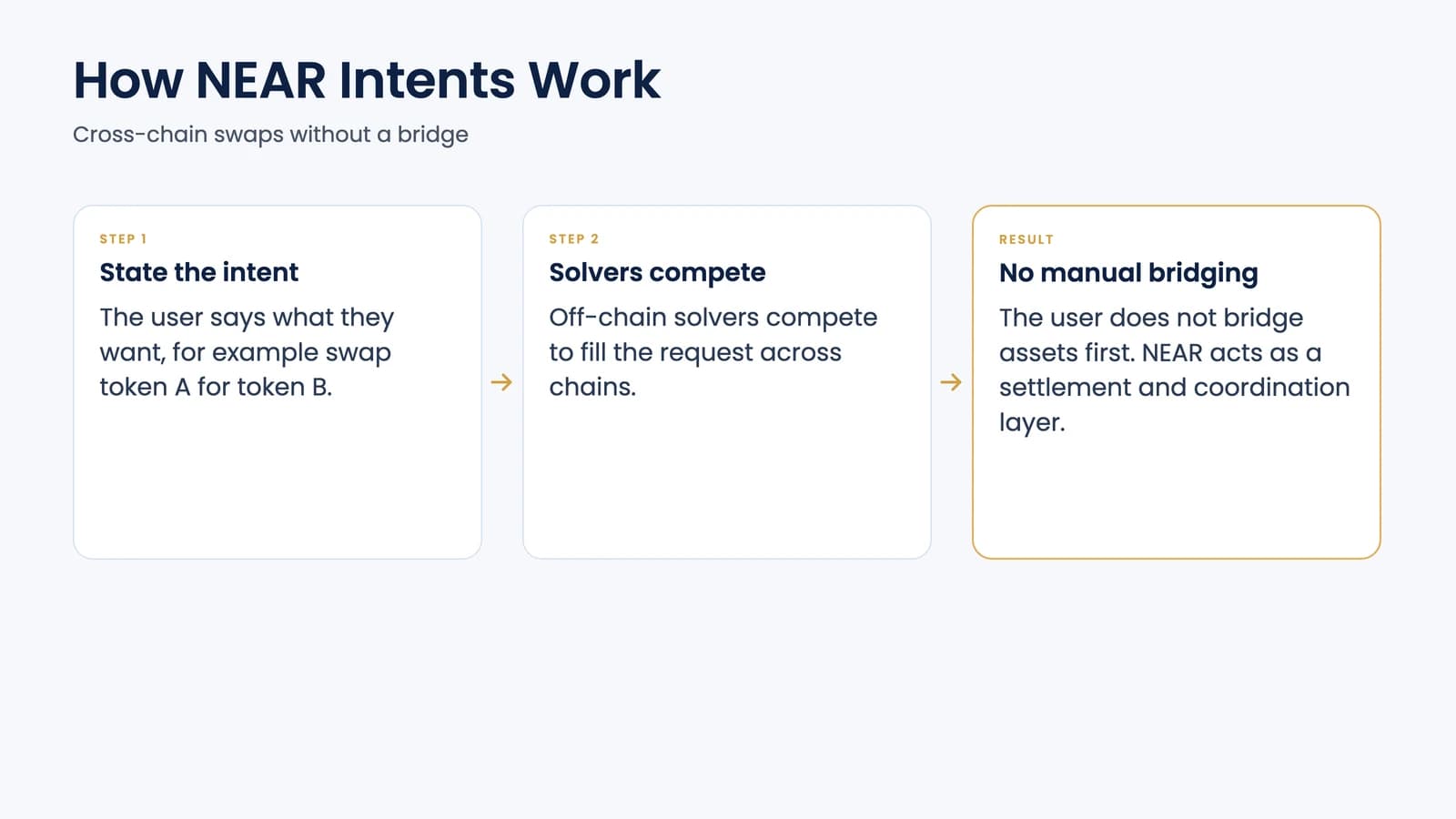
NEAR is a sharded, proof-of-stake layer-1 blockchain. Its mainnet launched in October 2020, and its Nightshade design splits state and transaction processing into shards that run in parallel while still behaving like one chain to users and developers: accounts, tokens and contracts can call each other across shards without any manual bridging.
The architecture changed significantly with Nightshade 2.0, shipped in nearcore 2.0 in August 2024. It introduced stateless validation, where chunk validators check a shard's work without storing that shard's full state, lowering hardware requirements and making room for more shards. We checked NEAR's own mainnet RPC directly on 1 October 2026: the live protocol configuration (protocol version 86) lists ten shards and a top validator set of 100 block and chunk producers.
How Fast and Cheap Is NEAR?
According to NEAR's own documentation, transactions reach finality in about 1.3 seconds and typically cost less than a cent. That combination is why NEAR gets used for consumer-facing products: payments, games and marketplaces that need an answer quickly, not just high theoretical throughput.
Other practical features carried over from NEAR's original design:
- Human-readable accounts such as `alice.near`, with full-access and limited function-call keys so an app can sign routine actions without exposing the main key.
- Meta transactions (NEP-366), letting a relayer pay gas on a user's behalf.
- Contracts written in Rust or JavaScript, plus Aurora, an EVM environment that runs Solidity code on top of NEAR.
NEAR Intents: Cross-Chain Swaps Without a Bridge
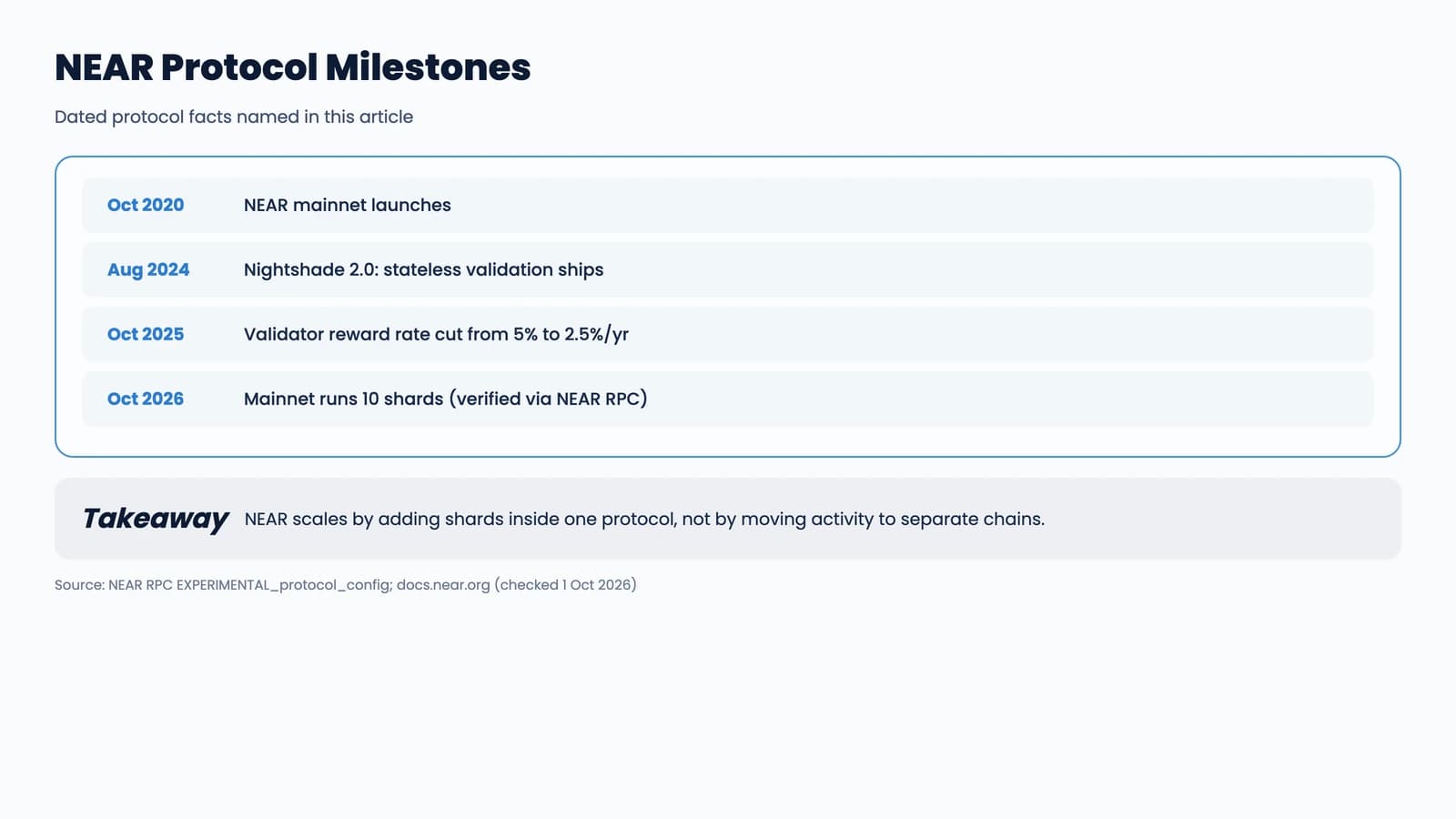
The newest part of the NEAR stack is NEAR Intents, a system launched in late 2024 that lets a user state what they want ("swap token A for token B") and lets off-chain solvers compete to fill that request across chains, instead of the user manually bridging assets first. NEAR Intents' own public explorer put cumulative swap volume at roughly $30.6 billion as of 1 October 2026, spanning chains that include Ethereum, Tron, BNB Chain and Arbitrum. We checked that figure directly rather than relying on a secondary news report, but it is still a protocol-reported number, not an independently audited one, and it moves daily.
For a product team, the practical takeaway is that NEAR increasingly positions itself as a settlement and coordination layer for moving value between chains, not only as a destination chain in its own right.
NEAR Token Economics
NEAR's economics are built into the protocol itself, not managed by a foundation. Validator rewards are targeted at 2.5% of total supply per year, a rate cut from 5% in October 2025. Transaction fees are burned, except that the contract being called receives 30% of the gas it burns during execution, which gives developers a revenue stream tied directly to usage, not to a token listing or a grant.
Where NEAR Fits Today
As of 1 October 2026, CoinGecko ranks ETH second by market capitalization (about $328 billion) and NEAR 21st (about $6.5 billion), with NEAR's own DeFi TVL at roughly $230 million per DefiLlama. For a fuller side-by-side on scaling design, fees and developer stack, see our dedicated NEAR vs Ethereum comparison. Compared against other layer-1s, our comparison of three public blockchains and our guide to choosing the right blockchain both walk through the broader decision.
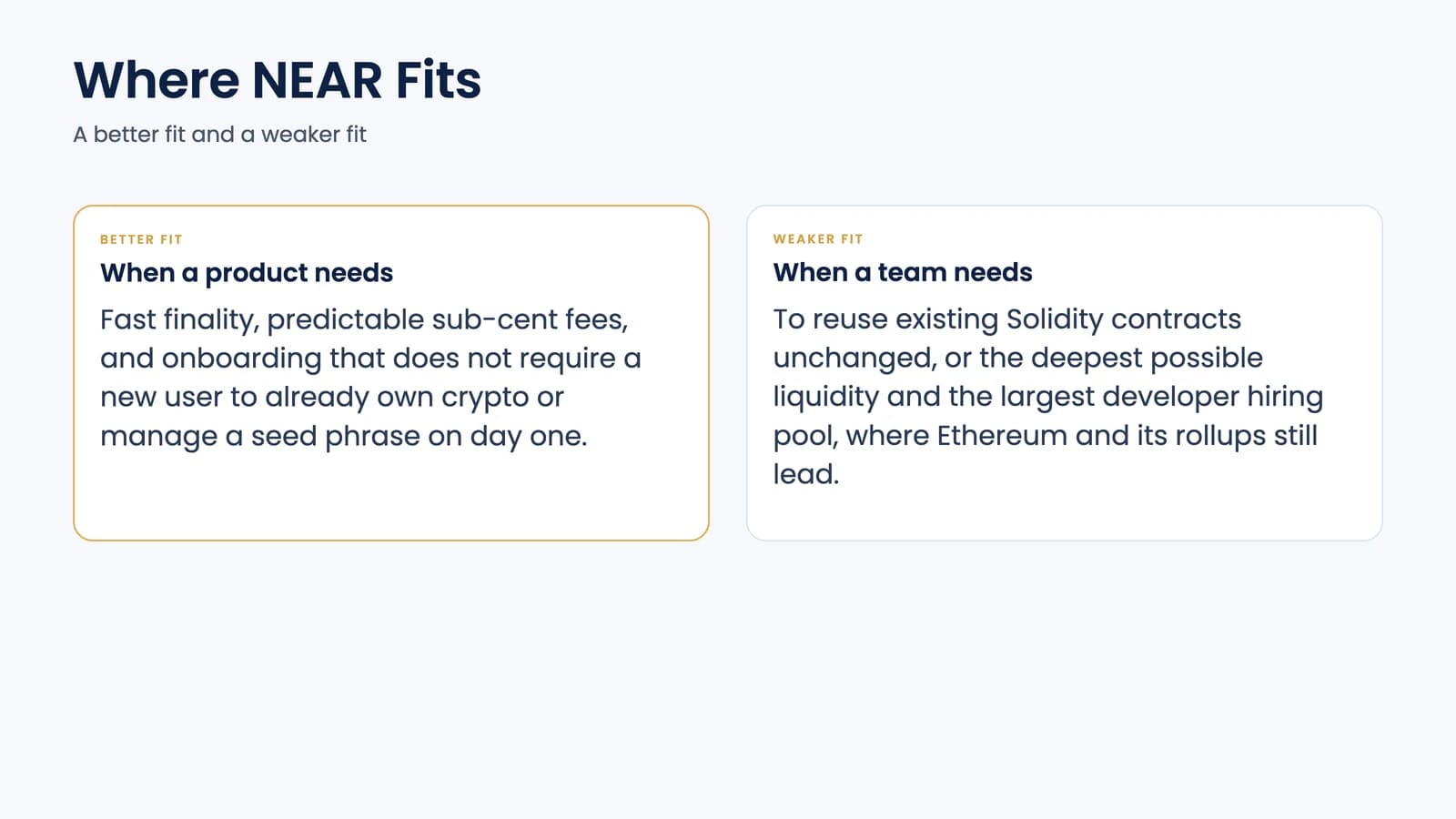
NEAR tends to be the better fit when a product needs fast finality, predictable sub-cent fees, and an onboarding flow that does not require a new user to already own crypto or manage a seed phrase on day one. It is a weaker fit when a team needs to reuse existing Solidity contracts unchanged, or needs the deepest possible liquidity and the largest developer hiring pool, where Ethereum and its rollups still lead by a wide margin.
Building and Migrating to NEAR
Most of 4IRE's NEAR work has involved either new consumer apps or teams migrating from Ethereum for lower fees and faster confirmations. NEAR's asynchronous cross-contract calls are the part most teams underestimate: a call to another contract resolves in a later block, so state changes and refunds have to be designed for partial failure from the start, not patched in afterward. A pattern that was safe in a synchronous Solidity contract can silently break once it is rewritten for NEAR's model, which is why a migration should include a fresh audit, not a line-by-line port. We shipped ARterra, an NFT marketplace built on NEAR, which is one example of that work in production.
For teams that want to keep existing Solidity contracts rather than rewrite them, Aurora runs an Ethereum Virtual Machine directly on top of NEAR, so EVM bytecode can execute using NEAR's finality and fees without a full rewrite. That trade-off, convenience over NEAR's native performance ceiling, is usually the right one for a team porting an existing product onto NEAR, not building a new one from scratch.
Conclusion
NEAR has kept the two promises it made at launch: fast finality and low fees, delivered through sharding, not through rollups. What has changed is the surface area, with Intents turning NEAR into a cross-chain coordination layer as well as a destination chain. Whether that is the right base for your product depends on your users, your team's language preferences and the assets you need to reach.
If you are evaluating NEAR for a new build or a migration from Ethereum, 4IRE's NEAR development team can review your contracts and plan the move.
Building on NEAR?
4IRE has built on NEAR since 2020. Our team can review your contracts and plan a migration or a new build.
Frequently asked questions
Yes. NEAR's mainnet runs ten shards as of October 2026, per its own RPC configuration, and NEAR Intents' public explorer reported roughly $30.6 billion in cumulative cross-chain volume as of 1 October 2026, since its late-2024 launch.
Around 1.3 seconds to finality, with fees typically under a cent, according to NEAR's own documentation.
Not natively. NEAR contracts are written in Rust or JavaScript. Solidity code can run through Aurora, an EVM environment built on top of NEAR, or be rewritten for NEAR directly.
A cross-chain swap system, launched in late 2024, where a user states the outcome they want and competing off-chain solvers fill it across a growing list of supported chains, without the user manually bridging assets first.