

How to Launch a Meme Coin and Build a Sustainable Ecosystem Around It?
What comes to your mind when you think about a meme token? The rises and falls of Dogecoin and Shiba Inu, I suppose. Or the recent sensations of PEPE and FLOKI that made many enthusiastic investors rich in 2023?
Many think of meme coins as some crazy hype that rises and falls within days, if not hours. Yet, things are not that simple for meme coins. Several recent studies have shown a steady interest in meme coins on the part of users and businesses. This is what has enabled this distinct crypto niche to reach $40 billion in market cap. Pretty impressive for a viral Internet trend, right?
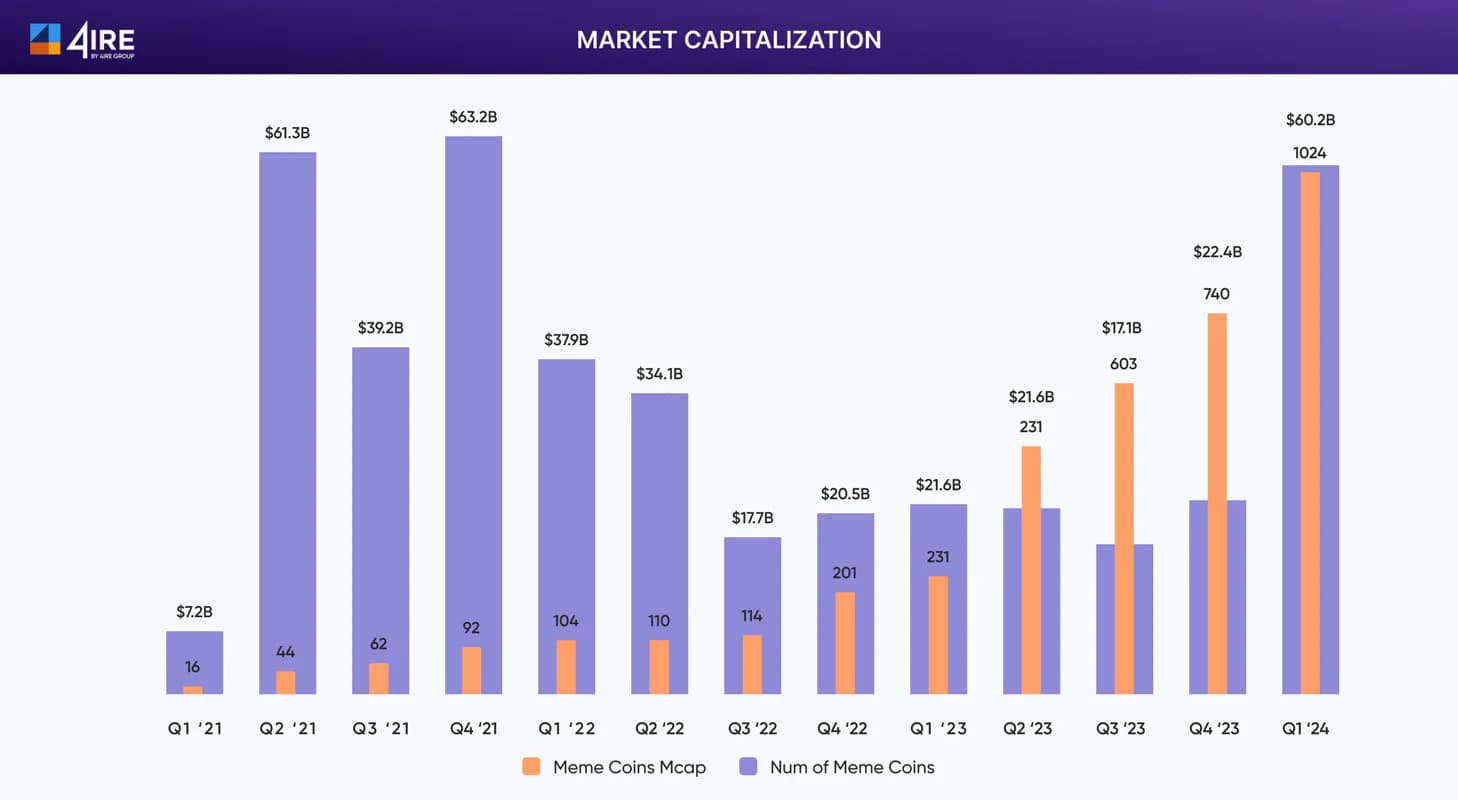
As its name suggests, a meme coin is a crypto token developed based on a relevant Internet trend or viral video. It is a product of modern pop culture – something that started like a joke but proved to have a solid monetization potential, though. And with the rise of meme coins, the demand for secure and scalable cryptocurrency exchange development has grown significantly, enabling seamless trading and liquidity for these digital assets.
Since memes are generally short-lived, so are meme coins. However, I would not be so quick to discount the overlapping trend for cryptocurrency and the power of Internet influencers to shape and sustain a viable meme coin ecosystem. Many factors suggest that even large crypto players take them seriously, such as the Culture Catalyst program by Avalanche Foundation and the Solana blockchain’s strong support for the meme coin project.
Thus, the crypto business’s task is not to guess whether the meme coin trend is here to stay or not (it definitely is). Your main task at present is to come to grips with how to create a meme coin that will make you money and shape a sustainable meme coin ecosystem around it.
In this article, I will examine the nuances of meme coin development and share some tokenomics design tips to welcome you to this promising crypto niche.
The Rise of Meme Coins and Their Ecosystem Potential
Experts associate the rise of meme coins with the launch of Dogecoin in 2013. This meme coin, born from Internet humor and a new viral trend, was the first playful cryptocurrency meant to entertain rather than earn money.
Yet, surprisingly, it made waves in the crypto market and persisted, creating a whole community-driven culture around it. There’s hardly anyone who won’t recognize the coin’s fun logo featuring a Shiba Inu dog’s face. Initially a joke, DOGE exceeded the $85 billion mark on May 5, 2021, giving its creators a hefty profit.
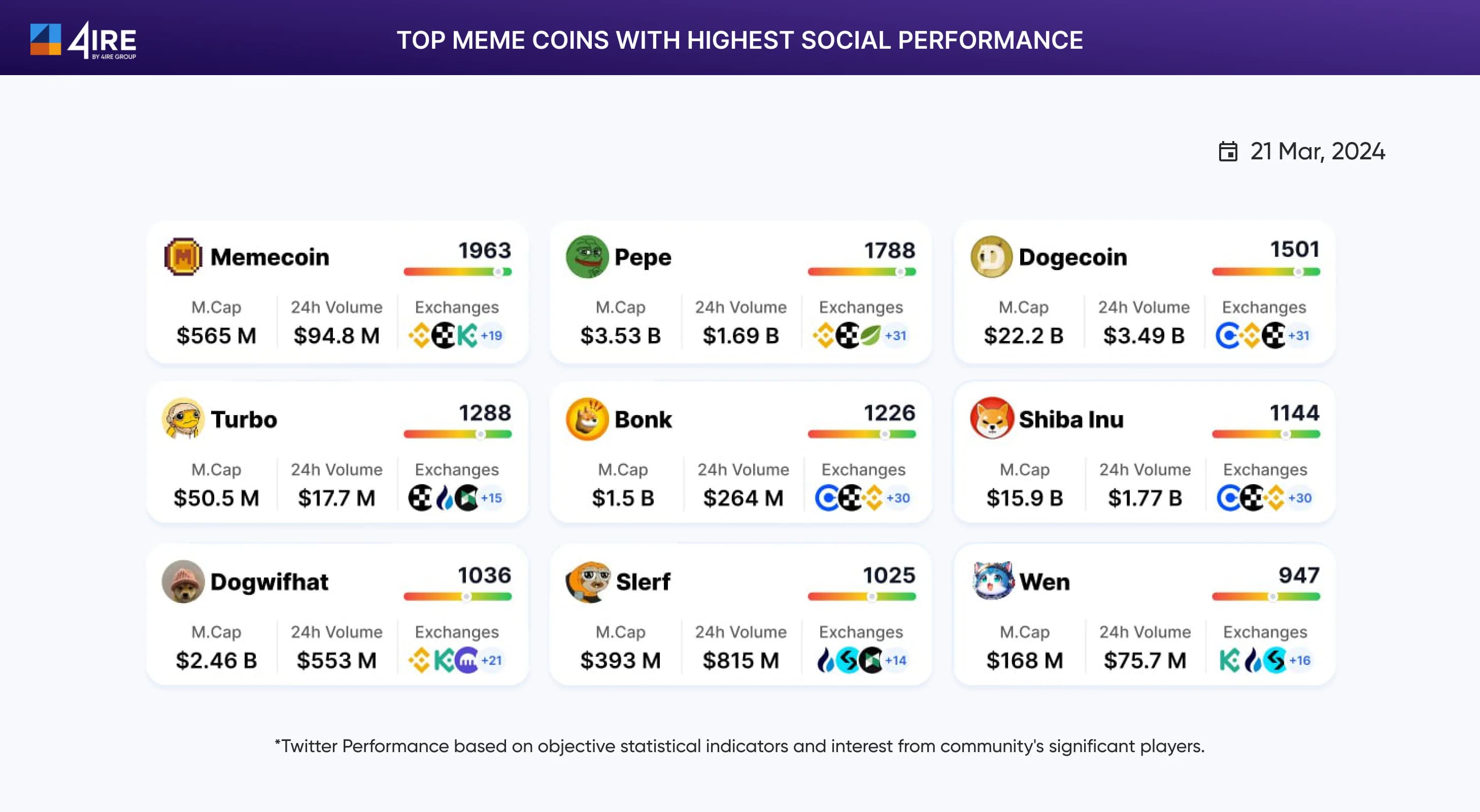
Many other successful meme coin projects followed suit. Some bright examples are Shiba Inu (SHIB), Pepe (PEPE), and Bonk (BONK), each with a market cap of over $1 billion. These stories illustrate that every meme coin that speaks to the audience can become a success, even with no substantial value or purpose behind it. That’s why meme coins possess an even greater potential than NFT marketplace solutions – a previous boom in the crypto world with a large number of use cases and attraction points.
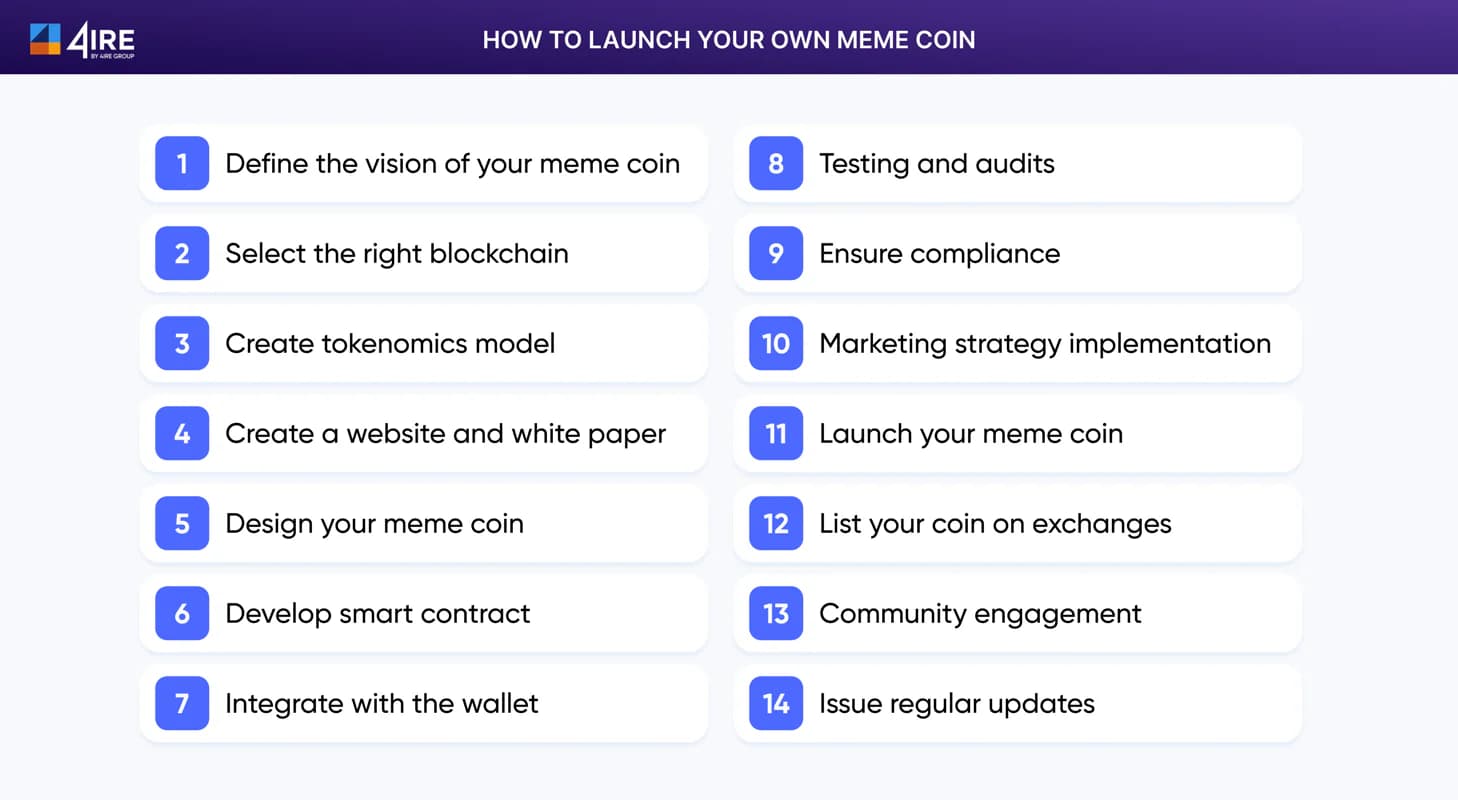
How to Launch Your Own Meme Coin: Step-by-Step Guide
Those who are new to the mechanics of token creation may find the process a bit confusing at first. How to create a meme coin step by step? Here, I’d like to give a few details about every stage to shed light on the mystery of meme coin emergence.
1. Start with a Vision
When you create meme coin projects that rock, it always starts with a unique vision. Thus, you should have a bright, captivating idea that aligns with the present-day hyping trend and offers an entertaining component to achieve user buy-in. Identify your target audience and develop a plan for building an ecosystem.
2. Choose a Blockchain
The right blockchain is the key to your meme coin project’s longevity, safety, and sustainability. Thus, you need to perform a rigorous blockchain platform comparison to make sure you are choosing the best option. Blockchains differ in terms of scalability, compatibility, and transaction fees – each representing a vital parameter that may affect the project’s viability. For instance, Ethereum is a golden standard for crypto development, but it’s slower and less scalable than other blockchains. Besides, the gas fees are very high. Solana is a more popular platform for meme coins because of its high throughput and low fees; it also possesses a high level of security and smart contract functionality, though with a smaller track record compared to that of Ethereum. Another viable option for meme coin development is Binance Smart Chain (BSC) – a scalable, fast blockchain protocol with low on-chain fees and a strong, active developer community behind it.
3. Develop a Tokenomics Model
Every meme coin should have its unique crypto tokenomics model, as all cryptocurrencies represent money. Thus, users have to understand what the economic aspects of the project are – how and when the tokens will be distributed, how they can be used in the ecosystem, and so on.
4. Create a Website and Whitepaper
How to make a meme coin popular and recognizable if there is no official resource where interested users can learn more about it? Thus, by creating a website with your UVP, a visually clear tokenomics model, the project’s development roadmap, and a list of team members and investors, you’re sure to raise people’s trust in the meme coin.
5. Design the Meme Coin
Since meme coins are more about an emotional impact than real utility, you should take design even more seriously than usual. Take your time to design an appealing logo, choose a visually attractive and modern color combination, and perform the proper branding to make the design recognizable.
6. Don’t Forget about Smart Contracts
Smart contract deployment is a vital milestone in meme coin development. Smart contracts are self-executing pieces of code that enable fair, predictable transactions between parties in the unsupervised crypto space. Therefore, you can’t play games with the smart contract’s coding. Your smart contracts should have no vulnerabilities or loopholes, as they determine your token’s key attributes, specify the minting and burning functions, and contain transfer and approval mechanisms.
7. Set up the Wallet
When you create meme coin projects, you need to think about the practical side early in the process. An important practical consideration is storing your meme coins after minting. For this purpose, you will need to create a wallet on the selected blockchain and fund it for gas and minting fee payments.
8. Test and Audit Everything
Once the meme coin is ready, with the smart contract functionality created by capable blockchain engineers, it’s time to test it in a controlled environment. You should complete an automated and manual audit to ensure that everything works correctly, and there is no space for exploits in the system. It’s important to understand how your smart contracts behave in various scenarios to eliminate bugs and errors before the launch.
9. Check for Compliance
How to make a meme coin that won’t land you in legal trouble? The answer is – by ensuring compliance. First, it relates to KYC/AML compliance, which is a security measure for projects in terms of avoiding litigation and fines on the part of authorities. It often happens that criminals and terrorists use gray channels to finance their illegal activities. Thus, KYC/AML compliance is vital to give your project a legal standing. Second, you should take care of the anti-dumping measures, which will protect you and your investors from the predatory activities of competitors.
10. Develop a Marketing Strategy
Meme marketing is a whole universe of tools and tactics that create hype and visibility around your project. You should launch a comprehensive campaign to increase your project’s visibility and attract users to it several weeks before its launch. It also makes sense to include crypto influencer marketing into your strategy, as people tend to believe other people instead of faceless testimonials on your website.
With so many activities and components of a winning marketing strategy, you will hardly succeed if you handle all of that on your own. The meme coin niche is pretty overcrowded, so you need to go the extra mile to get noticed. Thus, we recommend working with the best crypto marketing agencies to maximize your project’s visibility and chances for success.
11. Launch the Meme Coin
Now, it’s time to launch a meme coin to the open market so that it becomes tradable and accessible to interested users. Keep in mind that the coin’s deployment will engage considerable gas fees, so you should fund the wallet on the blockchain and perform the first transaction with the coin.
12. List the Coin on Crypto Exchanges
The token’s listing is day X for any meme coin project. You may list your coin on a decentralized exchange (DEX), which is simpler, or on a popular centralized exchange (CEX), which is harder. There are plenty of DEX launch options to consider, which may help you develop a long-term strategy for your coin’s circulation and diversification of use cases.
13. Take Care of Community Building
Crypto community building is the bloodstream of any meme coin project. You can’t expect users to find out about your new token if you don’t tell them about it. Thus, you should be active on social media platforms, thematic forums, the blockchain’s relevant communities, and other media. Run promotional campaigns and tease users with the forthcoming airdrops and feature updates. Engage users in staking, mining, and experience sharing to make the community live and active. Amplify your outreach with the help of ambassadors and influencers.
14. Issue Regular Updates
The cryptocurrency launch is not the end of your work on the project. If you’re genuinely interested in creating and sustaining a meme coin ecosystem, you will need to work on regular updates, feature upgrades, and other user engagement tactics. A meme coin’s life is usually short, and it’s only your responsibility to extend it by fueling the users’ interest.
Post-Launch Growth: Expanding Your Ecosystem on the Example of DOGE
Even if you know how to make a meme coin perfectly well, there’s no guarantee of success. In fact, hundreds of meme coin projects try to make it to the market every day. Most of them end in oblivion.
So, what are the secrets of long-term success for your project? I believe that it’s best to learn by example. Here is a story of Dogecoin that may offer some learning lessons and insights.
Dogechain
Though starting as a meme coin project, DOGE soon evolved into a broad ecosystem with practical uses. This became possible in part due to Dogechain – a PoS blockchain that works on the basis of Polygon Edge and provides a framework and SDK for developers. Dogechain is EVM-compatible, so you can mint NFTs on it, create a variety of token types, and even host dApps.
Dogecoin Foundation
Another element of a sustainable, long-term project, Dogecoin Foundation, is a non-profit organization supporting the DOGE community with advocacy and development activities. It oversees the ethical use of Dogecoin’s trademark to ensure fraud and abuse prevention. It also works on the development and implementation of the Dogecoin project’s roadmap.
Compatible Wallets
Many wallets allow storing DOGE, from its own DOGE Core and MyDoge wallets to third-party projects like Ledger, Coinbase Wallet, Binance, Exodus, and Trust Wallet.
Community
Dogecoin has attracted millions of people into its vibrant, active, and friendly global community. The Dogechain has slightly over 1,000 active nodes, which is 10 times smaller than that of BTC. DOGE’s fans are most active on Reddit, Twitter, and Discord, each with over 2 million members to date.
Charity Events
Dogecoin collaborates with many charities via its project – The Giving Block. It enables secure and tax-efficient donations in DOGE and other cryptocurrencies to charity funds like The American Cancer Society and The Water Project, among others.
DOGE Mining
Mining is at the heart of the Doge project, as it fuels its PoW consensus mechanism. Miners can join a variety of pools, many of which allow them to mine Litecoin and contribute to the Dogecoin network simultaneously. Most of them also come with a pool fee, typically set at 1% of the miner’s profit.
Memetic Culture
Dogecoin started from a viral meme that featured a Shiba Inu dog with a weird facial expression and some funny text. The image that laid the basis for the Doge meme features a Shiba Inu named Kabosu, made in 2010. The meme underwent many interpretations and updates, thus creating a distinct memetic culture of fancy, ironic images.
Key Features to Enhance Your Meme Coin for Ecosystem Growth
Now that your meme coin is live, you need to support and expand its ecosystem so that the project pays off. It’s possible to fuel the ecosystem’s heartbeat in many ways:
- Hold ICOs and token sales. An initial coin offering can boost interest in your project and help you disseminate coins into circulation, provided you give an attractive price for the ICO or manage to create hype around the coin’s launch.
- Expand the ecosystem via integrations. You may consider a wide range of integrations to let your meme coin grow and become part of the larger DeFi ecosystem. From NFT integration to wallet integration, any service addition will be favorable for your project’s visibility and usability.
- Offer mining and staking rewards. Users of your meme coin are sure to become more active in the project if they get tangible rewards for activity. For instance, you can give lucrative staking rewards for those who invest money in your liquidity pools and reward miners – other direct contributors to your coin’s market liquidity.
- Give your dedicated users a word in governance. By creating governance tokens and setting up a DAO, you can establish a self-governed and self-sustained ecosystem with interested, active users.
- Organize airdrops. Airdrops are a popular engagement measure that gives users activity rewards and chance prizes.
- Create related products. Your meme coin can keep the users’ interest high if you regularly deploy related products and extensions, like games, dApps, and merchandise.
How Can 4IRE Help You Launch a Meme Coin Ecosystem?
Launching a meme coin is not as easy as it looks for an outsider. In reality, it’s a thorough process of planning, technical development, and marketing. Thus, it’s better to work with professionals to maximize your chances of success and make your meme coin a hit.
4IRE can become your dedicated partner throughout the whole process of creating, launching, and supporting a meme coin project and its ecosystem. The 4IRE team will help you raise funds for crypto project due to our wide network of investor contacts and a capable marketing department that may present your project in the best light. We can also assist you with expert blockchain consulting services and further blockchain integration with your existing business infrastructure and wallets.
Learn more from us
 Blockchain news08 May 2026
The Complete Guide to Real World Asset Tokenization in 2026 | RWA
Discover how real-world asset tokenization transforms real estate, commodities, and securities into blockchain tokens. Expert guide covering RWA benefits, process, regulations, and…
Helen Petraschuk
 GreenFi23 Apr 2026
Carbon Credits Tokenization: Unlocking ReFi’s Potential in 2026
Tokenized carbon credits explained: How ReFi enhances transparency in carbon offsets. Start reading now!
Helen Petraschuk
 Understanding Blockchain23 Apr 2026
Quality Assurance in Web3: How to Mitigate Risks in Software Development
Web3 software faces similar risks and challenges that other software types do in the digital space. Here is your ultimate QA guide for Web3 projects.
Helen Petraschuk
FAQ
A sustainable meme coin system means that your coin is usable and valuable for its owners. This may be achieved by giving it utility value, listing it on crypto exchanges, expanding the list of compatible wallets, and continually offering new services and products that presuppose this coin’s use.
Meme coins are very short-lived, just like the vital trends they try to monetize. Thus, by investing in hype, you risk losing everything overnight as the trend changes, and your meme coin falls into oblivion.
The meme coin trend is well-established already, and some meme coins like PEPE and FLOKI have already made many people rich. However, due diligence and a bit of common sense are still necessary when picking meme coins for investment. Besides, you should invest only small sums of money that you’re ready to lose in cryptocurrencies of this type.
Gradual expansion of your meme coin’s ecosystem is possible by means of active user engagement, the addition of related decentralized services to it, making the coin listed on major exchanges, growing the list of wallets supporting it, and keeping users excited with new products, features, and upgrades.
As a rule, you will need from $5,000 to $50,000 for a meme coin project. Yet, the budget may vary widely depending on the size and location of your development team, the marketing budget, and the technical features of your project.