

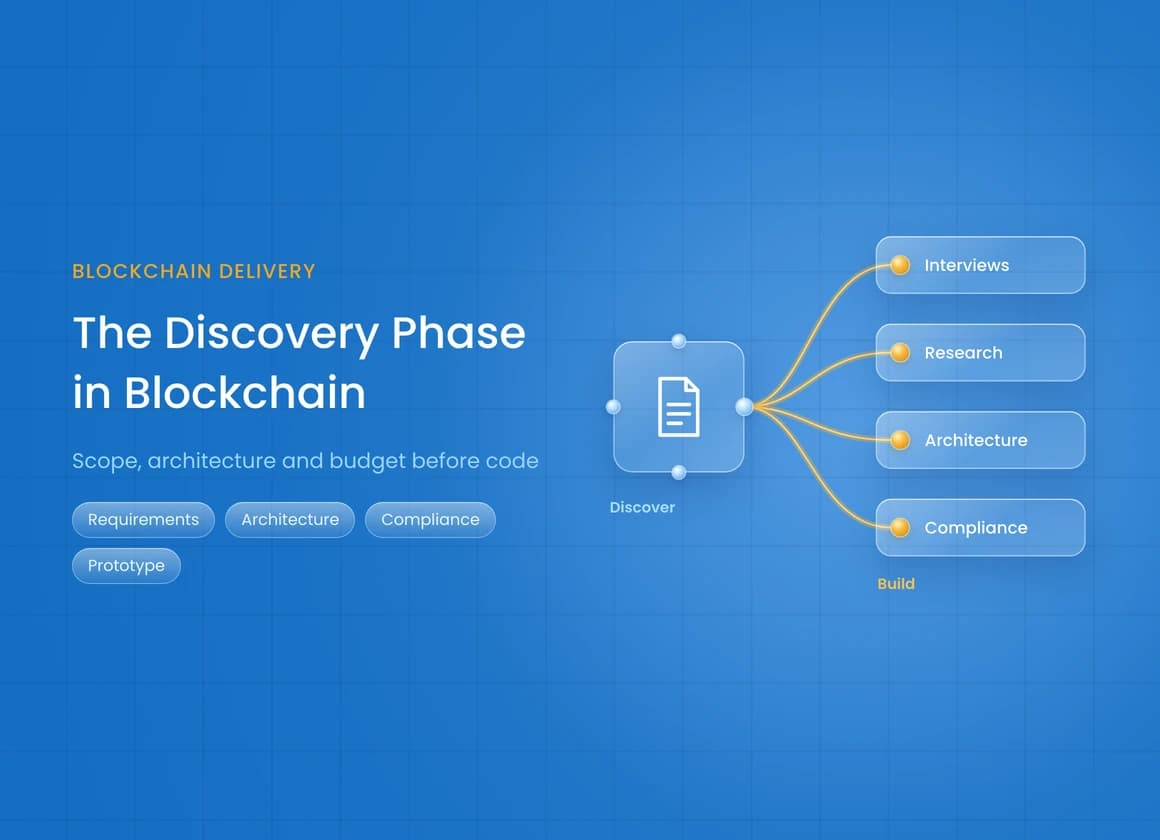

Blockchain projects are expensive to change once they ship. Smart contracts are hard to modify after deployment, token economics are public from day one, and licensing decisions shape the architecture. A mistake that costs an hour to fix on a whiteboard can cost months after launch.
That is why most serious blockchain projects start with a discovery phase: a short, structured stage of research and design before development. This article explains what discovery covers, who takes part, what you receive at the end, and what it typically costs and takes at 4IRE.
What Is the Discovery Phase?
The discovery phase is the pre-development stage of a software project. Its job is to turn a business idea into a plan that a team can build, estimate and defend to investors. In a blockchain project, it usually answers five questions:
- Does the product solve a real problem for a clear group of users, and does it need a blockchain at all?
- Which chain, custody model and smart contract design fit the use case?
- Which regulations apply, and what do they require from the product?
- What are the main technical, business and security risks?
- What will it cost, how long will it take, and which team is needed?
The output is a documented scope, an architecture and a roadmap that guide the build from idea to launch.
Why Discovery Matters More in Blockchain
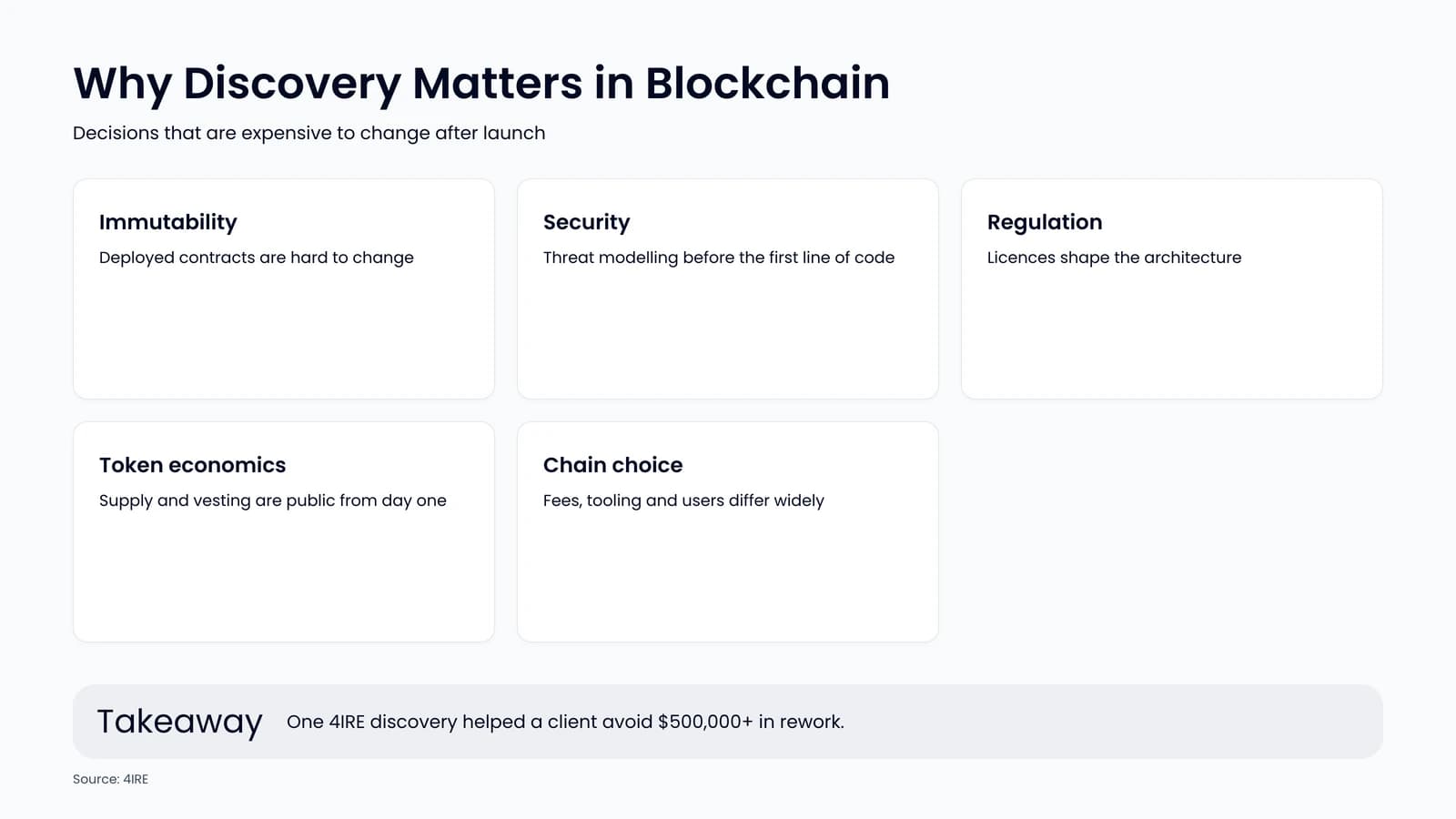
Every software project benefits from discovery, but blockchain raises the stakes:
- Immutability: deployed contracts are hard to change, so logic errors are expensive and upgrade paths must be designed in advance.
- Security: contracts that hold value are public targets; threat modelling belongs before the first line of code.
- Regulation: custody, token issuance and payments can require licences, which in turn shape the architecture.
- Token economics: supply, incentives and vesting are visible to everyone and hard to change after launch; our tokenomics design guide shows what needs deciding.
- Chain choice: fees, throughput, tooling and community support differ widely, as our guide on how to choose the right blockchain explains.
The savings can be large. In one engagement described on our gold tokenization page, 4IRE ran discovery for a client building a tokenization investment platform backed by physical gold and silver. The architecture, compliance framework, smart contract design and risk assessment helped the client avoid more than $500,000 in rework costs and reduced overall project risk by 40%.
Who Takes Part in Discovery
At 4IRE, a discovery team is small and senior:
- Business analyst: gathers requirements from stakeholders, defines business objectives and writes user stories and user flows.
- Blockchain solution architect: designs the smart contract architecture, chooses the chain and integrations, and assesses technical risks for a realistic estimate.
- UI/UX designer: builds wireframes and clickable prototypes of the main flows.
- Project or product manager: plans the work, keeps stakeholders aligned and owns the roadmap.
For technically complex projects, we add a full-stack developer to test integrations and check feasibility.
Key Activities of a Blockchain Discovery Phase
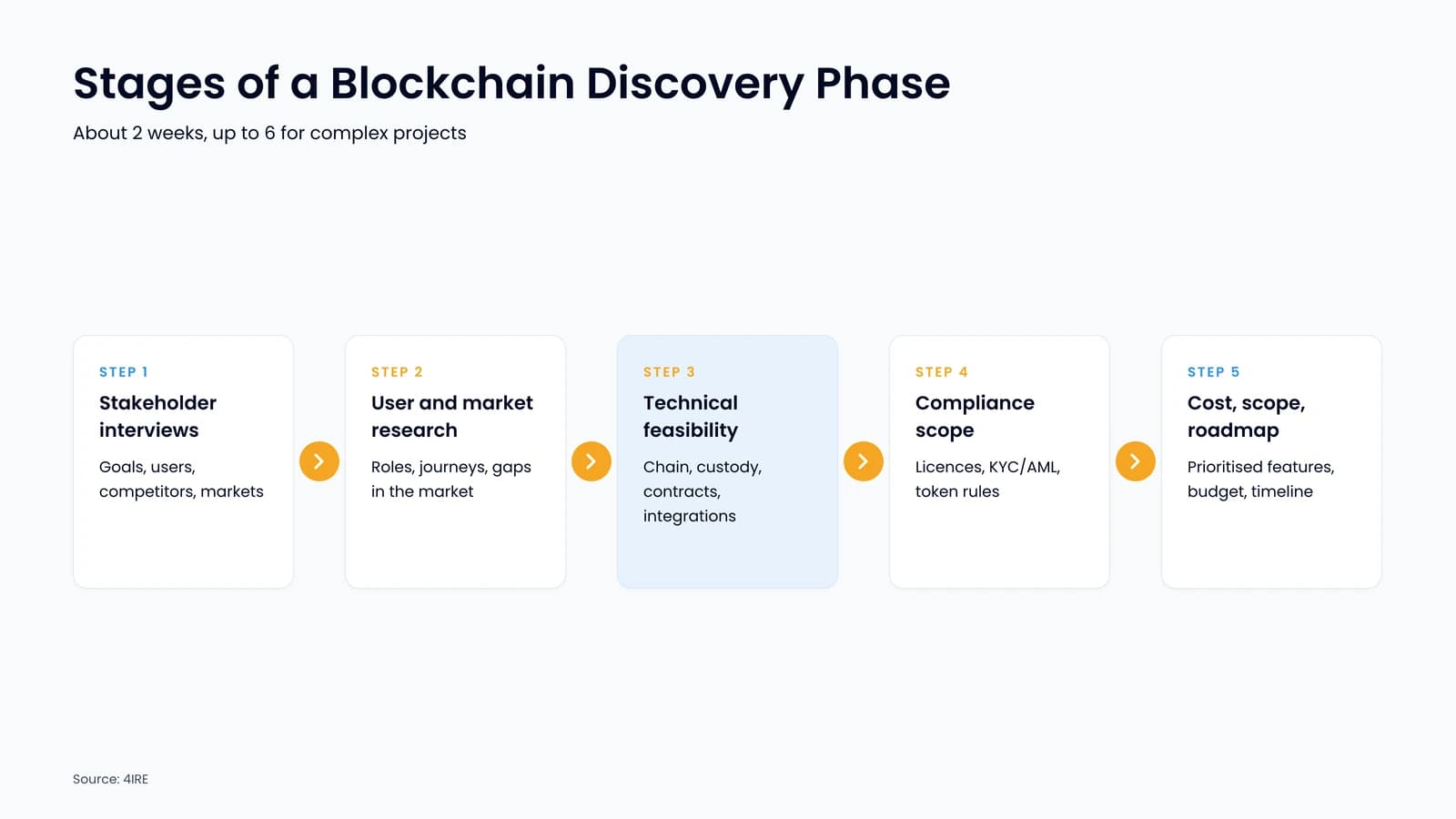
Stakeholder Interviews
Discovery starts with structured interviews with the product owner, the client's decision-makers and technical leads. Typical questions include:
- What problem does the product solve, and for whom?
- How will you measure success in the first year?
- Who are the main competitors, and how will you differ?
- What have you tried before, and what went wrong?
- What do you assume about your users that has not been tested yet?
- Which markets will you launch in first?
User Research
The team defines user roles and maps the user journeys from first visit to regular use. In blockchain products, this is where wallet onboarding, key recovery and transaction signing get designed, often the steps where users drop off. Our Web3 design services take these journeys into full product design.
Market and Competitor Analysis
Who else serves these users, how do they make money, and where are the gaps? This shapes the feature list and the business model.
Technical Feasibility
The architect assesses chain options, custody model, smart contract logic, back-end architecture, third-party APIs and integrations. Where a key assumption is uncertain, a small proof of concept can settle it.
Compliance Scope
The team maps which rules apply: licensing for custody or exchange services, KYC and AML, data protection, and securities or token rules in each market. Legal advisers confirm the conclusions, but the product design has to reflect them from the start.
Financial Feasibility and Scoping
Finally, the team estimates cost and time, prioritises features for the first release and fixes the scope. A clear budget also makes the project easier to present to investors.
What You Get at the End
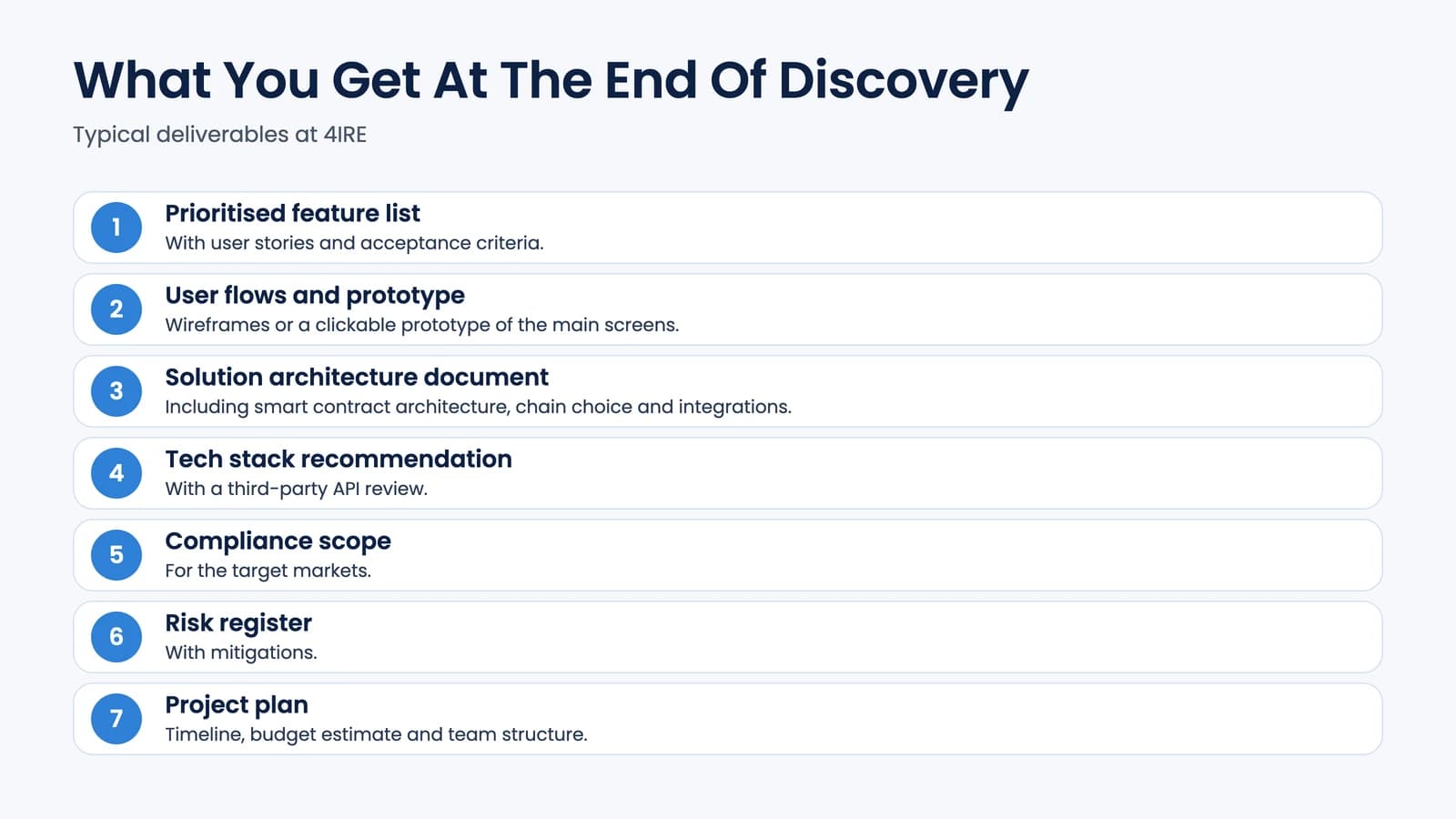
Typical discovery deliverables at 4IRE include:
- A prioritised feature list with user stories and acceptance criteria.
- User flows and wireframes or a clickable prototype of the main screens.
- A solution architecture document, including smart contract architecture, chain choice and integrations.
- A tech stack recommendation and a third-party API review.
- A compliance scope for the target markets.
- A risk register with mitigations.
- A project plan with timeline, budget estimate and team structure.
The same approach works across product types. For a wallet, discovery focuses on security architecture, threat modelling, key management and chain selection, as our breakdown of crypto wallet development cost shows. For a consumer product such as a prediction market, the licensing route decides much of the architecture, so it has to be settled first.
Mistakes Discovery Helps You Avoid
Most blockchain budget overruns we see trace back to decisions that were never made explicitly. Discovery forces them onto the table early:
- Building on-chain what belongs off-chain: storing data or logic on-chain that raises costs without adding trust.
- Choosing a chain for hype rather than fit: a network whose fees, tooling or user base does not match the product.
- Leaving compliance for later: adding custody, KYC or geoblocking after launch usually means redesigning core flows.
- No upgrade or emergency plan: contracts shipped without a way to pause or migrate them safely.
- Treating security as a final step: threat modelling in discovery shapes the design, so the later smart contract audit finds fewer structural problems.
How Long Does Discovery Take and What Does It Cost?
At 4IRE, discovery usually takes about 2 weeks; complex projects can take up to 6 weeks. By our estimates, discovery typically costs $4,000–$30,000 or more depending on the project's type and complexity, or roughly 5–10% of the overall development budget when the same team goes on to build the product. We also offer discovery as a standalone service.
How 4IRE Runs Discovery
Our blockchain consulting team runs discovery as a fixed-scope engagement with a clear set of outputs. You get a tech justification for the architecture, the design of the smart contract logic and token economics, the main screens of the application, and an estimate your investors can check.
Learn more from us
 Blockchain news28 Sept 2026
Crypto Wallet Development Cost in 2026: A Full Breakdown
How much does crypto wallet development cost in 2026? 4IRE's estimates by tier, platform and feature, plus running costs and what drives the budget.
Olena Petrashchuk
 Blockchain news28 Sept 2026
Real World Asset Tokenization in 2026: A Practical Guide to RWA
Real world asset tokenization explained: asset classes, how the stack works, 2026 RWA market data, US, EU, Singapore and UAE rules, and how to launch.
Olena Petrashchuk
 Blockchain news28 Sept 2026
Real Estate Tokenization in 2026: A Guide to Fractional Ownership
How real estate tokenization works: SPVs, token standards, fractional ownership, current market data, Deloitte's 2035 forecast, rules and real projects.
Olena Petrashchuk
Start Your Blockchain Project with Discovery
Book a discovery phase with 4IRE to validate your idea, fix the architecture and get a realistic estimate before development starts.
FAQ
It is the pre-development stage in which a small team researches, designs and scopes a blockchain product. It validates the idea, fixes the architecture and compliance scope, and produces a realistic budget and roadmap before development starts.
At 4IRE, a business analyst, a blockchain solution architect, a UI/UX designer and a project or product manager. A full-stack developer joins when integrations need a technical feasibility check.
A prioritised feature list with user stories, user flows and wireframes or a prototype, a solution architecture with smart contract design, a tech stack recommendation, a compliance scope, a risk register, and a project plan with timeline and budget.
At 4IRE, about 2 weeks for most projects and up to 6 weeks for complex ones.
By 4IRE's estimates, $4,000–$30,000 or more depending on the project's type and complexity, or roughly 5–10% of the overall development budget when the same team builds the product.