

Top 50 Billion-Dollar Blockchain & Crypto Business Ideas for 2026: Trends, Fundraising Insights, Launch Guides
TL;DR. Key Takeaways
- Crypto in 2026 is about real businesses, not speculation. Capital has shifted from infrastructure to RWAs, stablecoins, AI-crypto, and revenue-driven platforms.
- 4IRE analyzed $40B+ across 2,000+ deals (2024–2025) drawing from data by Galaxy Research, Messari, and CryptoRank.RWAs and AI-crypto now account for 35%+ of funding, while pure infrastructure has declined.
- 2026 is the execution year. Tokenized assets scale, stablecoins become financial rails, AI merges with blockchain, and regulation becomes a competitive moat.
- This article presents 50 billion-dollar blockchain ideas for 2026, grounded in real market demand and clear revenue models.
- Speed still wins but with discipline. With a proper discovery phase and proven infrastructure, platforms typically launch in 3–5 months, not 9–12 months.
- Discovery comes before development. It reduces costs by 20–30%, aligns stakeholders, and prevents expensive rework.
- Building from scratch is now a liability. Winning founders customize battle-tested cores and focus engineering effort on differentiation.
Crypto is no longer just a story about speculation.
In 2025, the blockchain industry quietly crossed a turning point. Despite ongoing volatility and regulatory pressure, more than $25B in crypto and blockchain funding flowed into the market. But the most important change wasn’t the total amount raised. It was where the capital went.
Funding rotated away from raw infrastructure and into real utility: tokenized real-world assets (RWAs), stablecoins, AI-driven protocols, and on-chain financial products with clear revenue models.
At 4IRE, we conducted deep internal research into crypto investment activity across 2024 and 2025, analyzing over $40 billion in total funding across more than 2,000 deals, using data from Galaxy Research, Messari, and CryptoRank. One pattern stood out immediately:
- Infrastructure’s share declined significantly (to ~16–20% range in recent reports)
- RWAs and AI-crypto projects together captured 30–40% of funding in 2025
- Stablecoins, payments, and core financial primitives moved back into focus
This shift tells us something critical.
The next wave of billion-dollar blockchain companies will not be protocol experiments.
They will be businesses.
2026 is the year where:
- Tokenized assets move from pilots to real scale
- Stablecoins become everyday financial rails
- AI and blockchain merge into machine-native economies
- Regulation stops being an obstacle and starts becoming a moat
This article expands our earlier “Top 33 Blockchain Ideas” into a comprehensive list of 50 billion-dollar crypto business ideas for 2026, grounded in fundraising data, market demand, and execution reality.
More importantly, it shows how founders can actually launch these platforms without burning years of time or millions of dollars on custom development that already exists.
Why Launch in 2026? The Window Is Open But It Won’t Stay That Way
Every breakout market has a short phase where opportunity, capital, and technology align.
For blockchain, 2026 is that phase.
In earlier cycles, founders could afford to experiment. Build slowly. Launch late. Explain away weak product-market fit with narratives. That era is over. In 2026, capital is patient only with teams that ship working, revenue-generating platforms.
There are four forces making this year different.
First, regulation is finally predictable enough to build on.
The regulatory landscape shifted meaningfully in 2025 from uncertainty to practical frameworks that enable compliant innovation at scale.
In the European Union, the full implementation of Markets in Crypto-Assets Regulation (MiCA) began in late 2024 and carried into 2025. For the first time, stablecoin issuers, crypto service providers, and tokenized security platforms operate under standardized rules across all 27 EU countries. This eliminated the fragmented, country-by-country compliance model that previously slowed launches and scared off institutional capital.
In the United States, regulatory clarity also improved materially. While comprehensive federal crypto legislation is still evolving, agencies have issued actionable guidance on custody, stablecoin reserves, tokenization structures, and DeFi compliance. The approval of spot Bitcoin and Ethereum ETFs by the U.S. Securities and Exchange Commission, alongside coordinated oversight with the Commodity Futures Trading Commission, signaled a clear willingness to approve well-structured, compliant crypto products rather than block innovation outright.
Crucially, this progress was reinforced by the introduction of the GENIUS Act in 2025. The bill establishes a clear federal framework for payment stablecoins, including requirements around reserve backing, custody, disclosures, and issuer supervision. Even prior to final passage, the GENIUS Act sent a strong signal: stablecoins are being recognized as core financial infrastructure, not fringe crypto experiments. For founders and institutions alike, this provides a credible path to design U.S.-compliant stablecoin and PayFi platforms with long-term certainty.
Across Asia, Singapore emerged as a regulatory blueprint. The Monetary Authority of Singapore released refined frameworks for stablecoins and tokenized assets in 2025, balancing consumer protection with innovation. These standards are now being adopted or mirrored across multiple Asia-Pacific jurisdictions, creating regional consistency instead of regulatory guesswork.
The result is a fundamentally different environment.
For founders, this means fewer surprises, clearer design constraints, and faster paths to market.
For institutions, it means something even more important: permission to deploy real capital.
In 2026, regulation is no longer just a risk factor.
When handled correctly, it becomes a competitive moat.
Second, institutional demand has matured.
Asset managers, fintechs, banks, and enterprises are no longer asking “Should we use blockchain?” They’re asking “Which product can we launch this quarter?” They want yield, settlement efficiency, transparency, and automation. Not experiments.
Third, the cost of moving slowly has exploded.
Your competitors are no longer starting from scratch. They’re customizing white-label cores, reusing audited smart contracts, and launching MVPs in weeks. If you’re still planning a nine-month build, you’re already behind.
Finally, users now expect real products.
Smooth onboarding. Clear value. No wallet gymnastics. No broken UX. Blockchain is no longer forgiven for being hard.
Yes, risks remain. Liquidity cycles will fluctuate. Regulations will evolve. Security expectations are unforgiving. But those risks don’t disappear by waiting. They compound.
2026 rewards teams that launch early, compliant, and fast then iterate in the market.
Blockchain Fundamentals That Actually Matter in 2026
You don’t need a technical deep dive. You need to understand what separates scalable platforms from expensive experiments.
In 2026, winning blockchain products share a few structural traits.
Modularity is no longer optional.
The days of monolithic smart-contract systems are over. Compliance rules change. Payment rails evolve. AI logic improves. Your architecture must allow parts to upgrade without rebuilding everything.
Chain abstraction is assumed.
End users don’t care which chain they’re on. Neither do most enterprises. Platforms that hard-lock themselves into a single ecosystem limit growth from day one.
Account abstraction defines user experience.
If your product still relies on seed phrases and manual gas management, mainstream adoption will stall. Business users expect login flows, recovery options, and predictable fees.
Security is baseline, not a differentiator.
Audited contracts, role-based access, monitoring, and upgrade paths are assumed. Marketing security is a red flag. Shipping secure systems is table stakes.
This is why building everything from zero has become a liability. Most founders don’t fail because of bad ideas. They fail because they burn time and capital recreating infrastructure that already exists.
That’s why teams increasingly start with proven cores, then customize them around their specific market, asset class, or revenue model.
At 4IRE, this approach is foundational. Founders don’t give up ownership or flexibility. They skip the plumbing, focus on differentiation, and launch while the market window is open.
Top Blockchain Trends Shaping 2026 (Backed by Real Funding Data)
Before listing 50 business ideas, it’s worth understanding why these ideas exist now and not earlier.
Based on 4IRE’s internal analysis of over $40 billion in crypto funding across 2024–2025, combined with public reporting from Galaxy Research and Messari, five trends clearly define 2026.
| Category | 2024 Funding Share | 2025 Funding Share | 2026 Projection | Key Drivers |
|---|---|---|---|---|
| RWA Tokenization | 8-10% | 20-22% | 25-28% | Institutional adoption, regulatory clarity, $50B+ TVL target |
| AI x Blockchain | 5-7% | 13-15% | 18-20% | Autonomous agents, DePIN compute, data provenance |
| Stablecoins & Payments | 12-14% | 16-18% | 20-22% | PayFi explosion, yield-bearing products, treasury use |
| DeFi Infrastructure | 18-20% | 15-17% | 12-15% | Maturation, competition, shift to specialized apps |
| Trading & Exchanges | 15-18% | 12-14% | 10-12% | Market saturation, regulatory scrutiny |
| Prediction Markets | 2-3% | 6-8% | 8-10% | Polymarket success, mainstream validation |
| Gaming & Metaverse | 10-12% | 6-8% | 5-7% | Cooling after 2021-2022 hype cycle |
| Infrastructure (General) | 16-18% | 10-12% | 8-10% | Commoditization of basic blockchain tech |
| Other (Identity, Supply Chain, etc.) | 12-15% | 10-12% | 10-12% | Steady enterprise adoption |
1. Real-World Assets Move From Narrative to Infrastructure
Tokenized treasuries, private credit, real estate, commodities, and carbon credits all moved from pilot programs into live platforms in 2025. RWA total value on-chain more than tripled, and institutions are now demanding compliant issuance, secondary trading, and reporting.
In 2026, the biggest opportunities aren’t single assets. They’re platforms that tokenize, manage, and distribute entire asset classes.
2. AI and Blockchain Stop “Integrating” and Start Merging
AI is no longer a dashboard feature. It’s becoming the logic layer. Autonomous agents, AI-priced markets, compute coordination, and machine-to-machine payments are emerging as real economic systems.
Crypto provides the rails. AI provides the intelligence. Together, they unlock machine-native businesses.
3. Stablecoins Become Financial Infrastructure
Stablecoins are evolving into programmable money for:
- Payments
- Yield
- Payroll
- Treasury management
- Cross-border settlement
They’re no longer trading tools. They’re financial rails. Platforms that abstract complexity and embed compliance will dominate.
4. Prediction Markets Break Out of Crypto-Native Silos
Once niche and speculative, prediction markets are expanding into culture, macro risk, insurance, and enterprise hedging. AI-assisted odds and better UX are pushing these platforms toward mainstream relevance.
5. DeFi Grows Up
The next phase of DeFi is less about yield farming and more about:
- Credit
- Perpetuals
- Restaking
- Institutional liquidity
- Intent-based execution
Complexity moves under the hood. Users see simpler products with clearer outcomes.
What This Means for You
The message from the data is consistent: 2026 rewards execution over experimentation.
The platforms that win will:
- Solve real financial problems
- Launch faster than competitors
- Customize proven infrastructure instead of rebuilding it
- Generate revenue early
In the next section, I’ll break this down into 50 specific business ideas, each mapped to market demand, revenue models, real-world examples, and the fastest way to launch.
Top 50 Billion-Dollar Blockchain & Crypto Business Ideas for 2026
RWAs & Tokenization blockchain # crypto business ideas
Idea #1: RWA Tokenization Platform for Private Credit & Equities
What if you could unlock institutional-grade private markets on-chain and launch before incumbents move?
Why This Idea Explodes in 2026
Private credit and private equity are absorbing institutional demand as RWAs scale. In 2025, RWA TVL more than tripled, and allocators want compliant, on-chain access now not pilots.
Market Potential & Revenue Model
- Origination & issuance fees (0.5–2%)
- Ongoing servicing & admin fees
- Secondary trading fees
- Data & reporting subscriptions
Real-World Examples & Recent Raises
Figure and Ondo demonstrated demand with large-scale private credit tokenization and rapid TVL growth.
How You Can Launch This Fast (Without Wasting Months on Code)
Grab 4IRE’s RWA Tokenization Solution core. It’s audited, compliance-ready, and includes asset onboarding, token sales, role-based access, and DEX integration. Customize investor eligibility, reporting, and payout logic. Launch in 3–5 months, not 9–12 months.

Risks to Watch (and How to Crush Them)
- Compliance complexity → Build KYC/AML hooks from day one
- Liquidity depth → Enable secondary markets early
Next Step for You
Book a strategy call and map your private markets MVP.
Idea #2: Tokenized Real Estate Marketplace
What if everyday investors could own fractions of prime property and you launched in under 5 months?
Why This Idea Explodes in 2026
Real estate leads RWA adoption as regulations clarify. Tokenization brings liquidity, fractional access, and global capital to a $300T+ market.
Market Potential & Revenue Model
- Transaction fees (0.2–0.5%)
- Token minting/redemption fees
- Property listing subscriptions
- Yield distribution fees
Real-World Examples & Recent Raises
Tokenized RE pilots expanded in 2025 as institutional interest accelerated.
How You Can Launch This Fast (Without Wasting Months on Code)
Use 4IRE’s RWA Tokenization Solution core and customize for real estate: property verification, escrow logic, rental yield distribution, investor dashboards. Launch in 3–5 months with full IP ownership.
Risks to Watch (and How to Crush Them)
- Title verification → Integrate licensed data providers
- Jurisdictional rules → Modular compliance by region
Next Step for You
See a live demo of a tokenized property flow.
Idea #3: Tokenized Carbon Credits Marketplace
What if carbon markets were transparent, fraud-proof, and liquid and you shipped fast?
Why This Idea Explodes in 2026
Sustainability regulation and ESG pressure push carbon markets past $120B+. Blockchain solves double-counting and traceability.
Market Potential & Revenue Model
- Trade fees per credit
- Issuer onboarding fees
- Enterprise APIs
- Verification services
Real-World Examples & Recent Raises
On-chain carbon pilots scaled in 2025 as corporates sought auditable credits.
How You Can Launch This Fast (Without Wasting Months on Code)
Use 4IRE’s Carbon Credit Marketplace white-label. Verification, traceability, admin dashboards, and APIs are built in. Customize currencies, regions, and analytics. Go live in weeks.
Risks to Watch (and How to Crush Them)
- Data integrity → On-chain provenance + third-party audits
- Adoption → Enterprise-friendly UX
Next Step for You
Launch a compliant carbon market without rebuilding everything.
compliantly?
Why This Idea Explodes in 2026
Fund managers want programmable compliance, faster settlement, and global distribution.
Market Potential & Revenue Model
- Fund issuance fees
- AUM-based fees
- Secondary trading fees
- Compliance tooling subscriptions
Real-World Examples & Recent Raises
Tokenized funds expanded with institutional pilots in 2025.
How You Can Launch This Fast (Without Wasting Months on Code)
Start with 4IRE’s RWA Tokenization Solution core. Add fund lifecycle management, NAV updates, and investor gating. Launch fast, scale globally.
Risks to Watch (and How to Crush Them)
- Investor eligibility → Automated checks
- Reporting → Built-in dashboards
Next Step for You
Map your first fund launch timeline.
Idea #5: RWA Perpetuals & Derivatives Exchange
What if RWAs had liquid hedging markets on-chain?
Why This Idea Explodes in 2026
As RWAs scale, institutions demand hedging and price discovery.
Market Potential & Revenue Model
- Trading fees
- Funding rate spreads
- Market-maker incentives
Real-World Examples & Recent Raises
Derivatives platforms expanded beyond crypto-native assets in 2025.
How You Can Launch This Fast (Without Wasting Months on Code)
Customize a derivatives engine atop 4IRE’s RWA core for compliant collateral and settlement.
Risks to Watch (and How to Crush Them)
- Volatility → Risk controls and caps
- Liquidity → Incentivized market making
Next Step for You
Design your first RWA perp market.
Idea #6: Tokenized Commodities & Gold Trading Platform
What if commodities traded 24/7 with instant settlement?
Why This Idea Explodes in 2026
Inflation hedging and global access drive demand for tokenized commodities.
Market Potential & Revenue Model
- Trading spreads
- Custody fees
- Redemption premiums
Real-World Examples & Recent Raises
Gold-backed tokens saw renewed inflows in 2025.
How You Can Launch This Fast (Without Wasting Months on Code)
Use 4IRE’s RWA Tokenization Solution core with custody integrations and redemption logic.
Risks to Watch (and How to Crush Them)
- Custody trust → Regulated partners
- Pricing → Reliable oracles
Next Step for You
Launch a commodity MVP quickly.
Idea #7: On-Chain Private Markets for Startups
What if startup shares were liquid before IPOs?
Why This Idea Explodes in 2026
Secondary liquidity for private equity is in high demand.
Market Potential & Revenue Model
- Transaction fees
- Issuer onboarding
- Data subscriptions
Real-World Examples & Recent Raises
Private markets platforms expanded with tokenized pilots.
How You Can Launch This Fast (Without Wasting Months on Code)
Customize 4IRE’s RWA core for cap tables, transfer rules, and investor gating.
Risks to Watch (and How to Crush Them)
- Regulatory limits → Transfer restrictions
- Liquidity → Curated listings
Next Step for You
Build the private market of tomorrow.
Idea #8: Enterprise RWA Platforms for Bonds
What if bond issuance settled instantly on-chain?
Why This Idea Explodes in 2026
Governments and corporates want faster settlement and transparency.
Market Potential & Revenue Model
- Issuance fees
- Servicing contracts
- Analytics tools
Real-World Examples & Recent Raises
On-chain bond pilots expanded in 2025.
How You Can Launch This Fast (Without Wasting Months on Code)
Use 4IRE’s RWA Tokenization Solution core with enterprise controls.
Risks to Watch (and How to Crush Them)
- Integration → Modular APIs
- Compliance → Role-based access
Next Step for You
Prototype an on-chain bond.
Idea #9: Tokenized Intellectual Property Marketplace
What if creators monetized IP globally, instantly?
Why This Idea Explodes in 2026
AI licensing and digital IP demand programmable royalties.
Market Potential & Revenue Model
- Licensing fees
- Royalty automation
- Premium listings
Real-World Examples & Recent Raises
IP tokenization gained traction with creator platforms.
How You Can Launch This Fast (Without Wasting Months on Code)
Customize 4IRE’s RWA core for IP rights and royalty splits.
Risks to Watch (and How to Crush Them)
- Rights enforcement → Legal integrations
- Discovery → Curated markets
Next Step for You
Launch your IP marketplace MVP.
Idea #10: Fractional Ownership Platform for Art & Collectibles
What if blue-chip art was liquid and global?
Why This Idea Explodes in 2026
Collectors want access, liquidity, and transparency.
Market Potential & Revenue Model
- Fractional sale fees
- Custody & insurance
- Secondary trading fees
Real-World Examples & Recent Raises
Art tokenization rebounded with better custody and UX.
How You Can Launch This Fast (Without Wasting Months on Code)
Start with 4IRE’s RWA Tokenization Solution core and add valuation, custody, and resale logic.
Risks to Watch (and How to Crush Them)
- Valuation → Expert pricing + oracles
- Custody → Insured partners
Next Step for You
Own the next wave of cultural RWAs.
AI x Blockchain & DePIN. blockchain and crypto business ideas
Idea #11: AI-Driven Autonomous Trading & Yield Agents
What if capital managed itself 24/7 without human bottlenecks?
Why This Idea Explodes in 2026
AI agents moved from demos to production in 2025. In 2026, users want autonomous systems that allocate, rebalance, and compound yield across DeFi and RWAs without constant oversight.
Market Potential & Revenue Model
- Performance fees on generated yield
- Subscription tiers for advanced strategies
- White-label agent licensing for funds
Real-World Examples & Recent Raises
AI trading agents attracted strong funding as yields normalized and users sought automation.
How You Can Launch This Fast (Without Wasting Months on Code)
You don’t need to build a chain from scratch. Partner with 4IRE to deploy a custom execution layer on top of existing DeFi and RWA rails, then plug in your AI logic. Focus on strategy, not infrastructure.
Risks to Watch (and How to Crush Them)
- Model drift → Continuous retraining
- Smart contract risk → Audited execution layers
Next Step for You
Launch a single-agent MVP and expand fast.
Idea #12: DePIN Compute Network for AI Inference
What if idle GPUs became a global, permissionless AI cloud?
Why This Idea Explodes in 2026
AI demand is outpacing centralized compute. DePIN networks unlock distributed inference capacity at lower cost.
Market Potential & Revenue Model
- Compute usage fees
- Enterprise access plans
- Tokenized incentives for providers
Real-World Examples & Recent Raises
DePIN funding crossed the billion-dollar mark as AI workloads exploded.
How You Can Launch This Fast (Without Wasting Months on Code)
Build a lean coordination layer. Let blockchain handle payments and verification. Use 4IRE to design the economic and settlement logic quickly.
Risks to Watch (and How to Crush Them)
- Quality control → Reputation scoring
- Latency → Regional routing
Next Step for You
Prototype inference markets, not hardware.
Idea #13: Decentralized AI Data Provenance Marketplace
What if AI training data was verifiable, licensed, and paid for automatically?
Why This Idea Explodes in 2026
Data ownership and AI copyright issues are forcing transparent data markets.
Market Potential & Revenue Model
- Dataset licensing fees
- Royalty splits for contributors
- Enterprise compliance tools
Real-World Examples & Recent Raises
Data provenance startups gained traction as lawsuits mounted.
How You Can Launch This Fast (Without Wasting Months on Code)
Use blockchain for provenance and payments. Customize a marketplace core with 4IRE to manage rights, pricing, and royalties.
Risks to Watch (and How to Crush Them)
- Data validation → Cryptographic proofs
- Discovery → Curated datasets
Next Step for You
Launch with one high-demand vertical.
Idea #14: Quantum-Resistant Wallet with AI Security
What if wallets adapted to threats before users noticed?
Why This Idea Explodes in 2026
Quantum risk is long-term, but AI-driven attack detection is immediate. Security is becoming proactive.
Market Potential & Revenue Model
- Premium wallet subscriptions
- Enterprise custody solutions
- Security-as-a-service APIs
Real-World Examples & Recent Raises
Security-focused wallets gained users as exploits increased.
How You Can Launch This Fast (Without Wasting Months on Code)
Start with existing wallet standards. Add AI monitoring and recovery logic. Partner with 4IRE for secure architecture and compliance hooks.
Risks to Watch (and How to Crush Them)
- False positives → Adaptive models
- UX friction → Invisible security layers
Next Step for You
Ship security users can’t ignore.
Idea #15: AI-Odds Prediction Market Platform
What if probabilities updated themselves in real time?
Why This Idea Explodes in 2026
Prediction markets are scaling beyond crypto. AI improves pricing, liquidity, and user trust.
Market Potential & Revenue Model
- Trading fees
- Market creation fees
- Data licensing
Real-World Examples & Recent Raises
Prediction platforms hit record volumes with AI-assisted models.
How You Can Launch This Fast (Without Wasting Months on Code)
Combine an existing market engine with AI odds models. Use 4IRE to integrate settlement, compliance, and UX quickly.
Risks to Watch (and How to Crush Them)
- Market manipulation → AI anomaly detection
- Regulation → Jurisdictional controls
Next Step for You
Launch one vertical and expand.
Idea #16: DePAI Economy for Machine-Native Systems
What if machines earned, spent, and negotiated value autonomously?
Why This Idea Explodes in 2026
IoT, robotics, and AI agents need native economic rails.
Market Potential & Revenue Model
- Transaction fees
- Developer tooling
- Enterprise integrations
Real-World Examples & Recent Raises
Machine economies moved from theory to pilots in 2025.
How You Can Launch This Fast (Without Wasting Months on Code)
Build payment and identity rails first. Let 4IRE handle the blockchain backbone while you focus on machine logic.
Risks to Watch (and How to Crush Them)
- Security → Hardware attestation
- Standardization → Open protocols
Next Step for You
Own the rails machines run on.
Idea #17: AI-Linked DeFi Network for Real Utility
What if DeFi optimized itself continuously?
Why This Idea Explodes in 2026
Users want outcomes, not dashboards. AI can route liquidity and manage risk automatically.
Market Potential & Revenue Model
- Performance-based fees
- Protocol partnerships
- White-label deployments
Real-World Examples & Recent Raises
AI-optimized DeFi saw higher retention in 2025.
How You Can Launch This Fast (Without Wasting Months on Code)
Use existing DeFi primitives. Customize orchestration with 4IRE. Launch fast, iterate live.
Risks to Watch (and How to Crush Them)
- Model risk → Guardrails
- Transparency → Explainable AI
Next Step for You
Ship utility, not complexity.
Idea #18: Crypto Miners’ AI Compute Marketplace
What if mining infrastructure pivoted to AI overnight?
Why This Idea Explodes in 2026
Miners already own power and hardware. AI demand unlocks new revenue.
Market Potential & Revenue Model
- Compute rental fees
- Long-term enterprise contracts
- Revenue sharing
Real-World Examples & Recent Raises
Mining firms shifted to AI compute as margins compressed.
How You Can Launch This Fast (Without Wasting Months on Code)
Build a marketplace layer, not hardware. Use blockchain for settlement. Partner with 4IRE for fast deployment.
Risks to Watch (and How to Crush Them)
- Hardware variability → Tiered pricing
- Reliability → SLA enforcement
Next Step for You
Turn idle rigs into revenue engines.
Stablecoins, Payments & PayFi blockchain business ideas
Idea #19: Yield-Bearing Stablecoin Platform
What if your stablecoin paid users automatically without DeFi complexity?
Why This Idea Explodes in 2026
Stablecoins are no longer just trading pairs. Users now expect yield by default. As on-chain treasuries, RWAs, and short-term credit mature, yield-bearing stablecoins move from niche to mainstream.
Market Potential & Revenue Model
- Yield spread (net interest margin)
- Minting and redemption fees
- Institutional custody and API access
Real-World Examples & Recent Raises
Yield-backed stablecoins gained traction in 2025 as rates normalized and users demanded safer returns.
How You Can Launch This Fast (Without Wasting Months on Code)
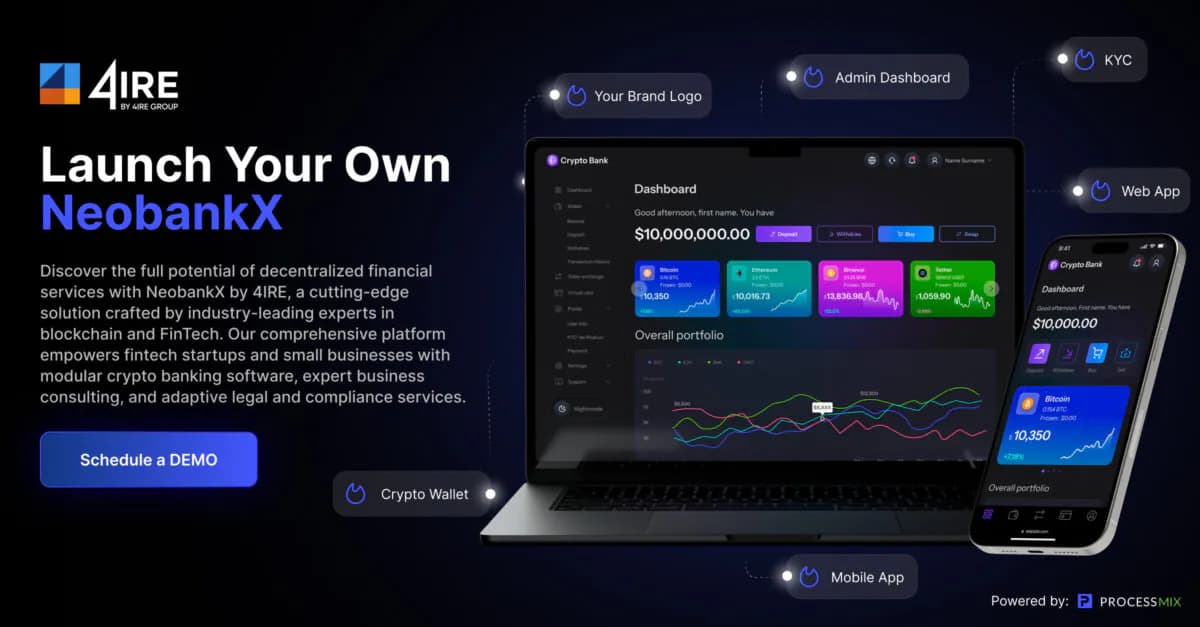
Start with NeobankX by 4IRE. Yield modules, fiat on/off-ramps, and compliance hooks are built in. You customize asset backing, payout logic, and UX. Go live in 3–7 months.
Risks to Watch (and How to Crush Them)
- Yield volatility → Diversified RWA backing
- Transparency → Real-time reserve reporting
Next Step for You
Launch a stablecoin users actually want to hold.
Idea #20: Institutional-Grade Stablecoin Issuer With Yield
What if banks could issue stablecoins without becoming crypto-native?
Why This Idea Explodes in 2026
Financial institutions want stablecoin exposure but need compliance, reporting, and control. White-labeled issuance is the unlock.
Market Potential & Revenue Model
- Issuance & servicing fees
- AUM-based yield participation
- Enterprise integrations
Real-World Examples & Recent Raises
Institutional pilots expanded rapidly in 2025 as regulators clarified custody rules.
How You Can Launch This Fast (Without Wasting Months on Code)
Use NeobankX as the core issuance and payments layer. Customize KYC, treasury controls, and yield strategies with 4IRE’s team.
Risks to Watch (and How to Crush Them)
- Regulatory oversight → Modular compliance
- Trust → Audits and disclosures
Next Step for You
Enable banks to issue programmable money.
Idea #21: x402 Machine-to-Machine Payment Rails
What if machines paid each other in real time?
Why This Idea Explodes in 2026
AI agents, APIs, and IoT devices need native payment rails. Stablecoins solve latency and settlement.
Market Potential & Revenue Model
- Transaction fees
- Developer APIs
- Enterprise contracts
Real-World Examples & Recent Raises
Machine payments moved from theory to pilots as AI agents proliferated.
How You Can Launch This Fast (Without Wasting Months on Code)
Build on stablecoin rails with programmable logic. Partner with 4IRE to deploy secure settlement and identity layers quickly.
Risks to Watch (and How to Crush Them)
- Security → Rate limits and identity checks
- Adoption → Developer-first tooling
Next Step for You
Own the payment layer machines depend on.
Idea #22: Enterprise Stablecoin Treasury Management Tool
What if CFOs managed stablecoins like cash?
Why This Idea Explodes in 2026
Enterprises now hold stablecoins but lack dashboards, controls, and yield optimization.
Market Potential & Revenue Model
- SaaS subscriptions
- Yield optimization fees
- Integrations and support
Real-World Examples & Recent Raises
Treasury tooling demand surged as enterprises adopted stablecoin rails.
How You Can Launch This Fast (Without Wasting Months on Code)
Use NeobankX’s multi-account and analytics modules. Customize treasury views, permissions, and reporting with 4IRE.
Risks to Watch (and How to Crush Them)
- Complexity → Role-based controls
- Reporting → Accounting integrations
Next Step for You
Become the CFO’s stablecoin dashboard.
Idea #23: Borderless PayFi Remittance Hub
What if global remittances settled instantly with stable fees?
Why This Idea Explodes in 2026
Traditional remittances are slow and expensive. Stablecoins offer instant settlement and predictable costs.
Market Potential & Revenue Model
- FX spreads
- Transfer fees
- B2B remittance APIs
Real-World Examples & Recent Raises
Stablecoin remittances grew rapidly in emerging markets in 2025.
How You Can Launch This Fast (Without Wasting Months on Code)
Start with NeobankX’s multi-currency rails. Add corridors, local compliance, and UX customization. Launch under 6 months.
Risks to Watch (and How to Crush Them)
- Regulatory variance → Regional modules
- Liquidity → Partnered market makers
Next Step for You
Replace SWIFT for underserved regions.
Idea #24: Stablecoin Payment Solution for E-Commerce
What if merchants accepted stablecoins as easily as cards?
Why This Idea Explodes in 2026
Merchants want lower fees, faster settlement, and global reach.
Market Potential & Revenue Model
- Merchant processing fees
- Value-added services
- Settlement spreads
Real-World Examples & Recent Raises
Stablecoin checkout pilots expanded as fees undercut card networks.
How You Can Launch This Fast (Without Wasting Months on Code)
Use NeobankX’s payment stack. Add plugins, merchant dashboards, and instant settlement. You keep the brand. 4IRE handles the plumbing.
Risks to Watch (and How to Crush Them)
- Merchant adoption → Simple integrations
- Volatility → Instant conversion options
Next Step for You
Own the checkout layer of crypto commerce.
Idea #25: Programmable Stablecoin for Automated Payouts
What if money followed rules automatically?
Why This Idea Explodes in 2026
Payroll, royalties, insurance, and gig payments all need automation.
Market Potential & Revenue Model
- Payout execution fees
- Enterprise subscriptions
- API usage
Real-World Examples & Recent Raises
Programmable payments gained traction in SaaS and Web3 platforms.
How You Can Launch This Fast (Without Wasting Months on Code)
Build payout logic on NeobankX rails. Customize triggers, schedules, and compliance with 4IRE.
Risks to Watch (and How to Crush Them)
- Edge cases → Override controls
- Compliance → Jurisdiction rules
Next Step for You
Make money programmable at scale.
Idea #26: Multi-Currency Stablecoin Neobank
What if one app replaced global banking?
Why This Idea Explodes in 2026
Users want fiat, crypto, yield, and payments in one place.
Market Potential & Revenue Model
- Account fees
- FX spreads
- Yield participation
Real-World Examples & Recent Raises
Crypto-native neobanks scaled rapidly as UX improved.
How You Can Launch This Fast (Without Wasting Months on Code)
NeobankX is built for this. Multi-currency accounts, cards, swaps, compliance ready. You customize and launch in under 6 months, not quarters.
Risks to Watch (and How to Crush Them)
- Regulatory scope → Modular licensing
- UX complexity → Progressive onboarding
Next Step for You
Launch the bank users actually want.
Idea #27: Prediction Market for Non-Crypto Events (Culture, Politics, Macro)
What if markets predicted the real world not just crypto prices?
Why This Idea Explodes in 2026
Prediction markets broke volume records in 2025, but most activity stayed crypto-native. In 2026, demand expands to culture, elections, policy, and macro events where information asymmetry is massive.
Market Potential & Revenue Model
- Trading fees per market
- Market creation fees
- Data licensing for institutions
Real-World Examples & Recent Raises
Non-crypto prediction platforms captured mainstream attention during major global events.
How You Can Launch This Fast (Without Wasting Months on Code)
You don’t need to invent market mechanics. Partner with 4IRE to deploy a compliant market engine, add AI-assisted market creation, and focus on UX and liquidity.
Risks to Watch (and How to Crush Them)
- Regulatory exposure → Jurisdictional gating
- Liquidity → Curated, high-signal markets
Next Step for You
Start with one vertical. Expand fast.
Idea #28: AI-Odds Platform for Sports & Entertainment
What if odds updated themselves instantly and intelligently?
Why This Idea Explodes in 2026
Static odds can’t keep up with real-time data. AI-driven pricing improves accuracy, liquidity, and user trust.
Market Potential & Revenue Model
- Betting spreads
- Market-making fees
- B2B odds APIs
Real-World Examples & Recent Raises
AI-assisted odds platforms outperformed manual models in pilot programs.
How You Can Launch This Fast (Without Wasting Months on Code)
Combine an existing betting engine with AI pricing models. Use 4IRE to integrate settlement, wallets.
Risks to Watch (and How to Crush Them)
- Model bias → Continuous retraining
- Fairness → Transparency controls
Next Step for You
Launch smarter markets, not bigger ones.
Idea #29: Hedging Tool for Macro Events
What if companies hedged geopolitical and economic risk on-chain?
Why This Idea Explodes in 2026
Enterprises face uncertainty around rates, policy, and supply chains. Prediction-based hedging offers flexible protection.
Market Potential & Revenue Model
- Hedging premiums
- Enterprise subscriptions
- Data analytics services
Real-World Examples & Recent Raises
Macro-hedging platforms gained interest as volatility persisted.
How You Can Launch This Fast (Without Wasting Months on Code)
Use prediction outcomes as settlement triggers. Partner with 4IRE to build compliant payout and reporting layers fast.
Risks to Watch (and How to Crush Them)
- Complexity → Clear payoff structures
- Trust → Transparent settlement logic
Next Step for You
Turn uncertainty into a product.
Idea #30: Community-Driven Niche Prediction DAO
What if expert communities priced outcomes better than institutions?
Why This Idea Explodes in 2026
Small, focused communities often outperform broad markets in niche domains like biotech, climate, or gaming.
Market Potential & Revenue Model
- DAO treasury fees
- Premium community access
- Governance token value
Real-World Examples & Recent Raises
Niche DAOs attracted loyal, high-signal users.
How You Can Launch This Fast (Without Wasting Months on Code)
Deploy DAO tooling with prediction primitives. Let 4IRE handle governance, treasury, and market settlement quickly.
Risks to Watch (and How to Crush Them)
- Low participation → Incentive design
- Governance friction → Simple voting
Next Step for You
Build markets experts trust.
Idea #31: Prediction-Integrated Perpetual Markets
What if traders hedged uncertainty directly inside perp markets?
Why This Idea Explodes in 2026
Perpetuals dominate trading volume. Adding prediction signals improves risk pricing and capital efficiency.
Market Potential & Revenue Model
- Trading fees
- Funding rate spreads
- Advanced analytics tiers
Real-World Examples & Recent Raises
Hybrid derivatives platforms gained traction with sophisticated traders.
How You Can Launch This Fast (Without Wasting Months on Code)
Extend a perp engine with prediction settlement logic. Partner with 4IRE to integrate risk controls and UX fast.
Risks to Watch (and How to Crush Them)
- Complexity → Clear UI abstraction
- Liquidity fragmentation → Shared pools
Next Step for You
Differentiate perps with intelligence.
Idea #32: Decentralized Insurance via Prediction Outcomes
What if insurance paid out automatically no claims, no delays?
Why This Idea Explodes in 2026
Traditional insurance is slow and opaque. Prediction-based triggers enable instant, transparent payouts.
Market Potential & Revenue Model
- Policy premiums
- Risk pooling fees
- Enterprise insurance APIs
Real-World Examples & Recent Raises
Parametric insurance pilots expanded across climate and logistics.
How You Can Launch This Fast (Without Wasting Months on Code)
Use prediction markets as settlement oracles. Partner with 4IRE to build compliant payout flows and reporting.
Risks to Watch (and How to Crush Them)
- Oracle accuracy → Multi-source validation
- Regulatory oversight → Structured products framing
Next Step for You
Rebuild insurance from the outcome up.
DeFi & Finance Innovations blockchain business ideas
Idea #33: Undercollateralized On-Chain Lending (Reputation or ZK-Based)
What if credit worked on-chain without locking up 150% collateral?
Why This Idea Explodes in 2026
DeFi lending hit a ceiling with overcollateralization. In 2026, identity, reputation, and ZK proofs unlock real credit models institutions actually want.
Market Potential & Revenue Model
- Interest spreads
- Origination fees
- Credit scoring subscriptions
Real-World Examples & Recent Raises
Reputation-based lending pilots gained traction as RWAs matured.
How You Can Launch This Fast (Without Wasting Months on Code)
You don’t need to invent DeFi primitives. Partner with 4IRE to build a lending core with modular identity, ZK attestations, and liquidation logic fast.
Risks to Watch (and How to Crush Them)
- Default risk → Conservative limits + gradual scaling
- Identity accuracy → Multi-source attestations
Next Step for You
Launch credit that actually scales.
Idea #34: Hybrid CeDeFi Neobank for Institutions
What if institutions got DeFi yield with CeFi controls?
Why This Idea Explodes in 2026
Institutions want yield but with reporting, custody, and risk management.
Market Potential & Revenue Model
- Yield participation
- Custody and servicing fees
- White-label deployments
Real-World Examples & Recent Raises
Hybrid platforms gained adoption as institutions re-entered DeFi.
How You Can Launch This Fast (Without Wasting Months on Code)
Start with NeobankX as the custody and payment layer. Add DeFi routing and controls with 4IRE customization.
Risks to Watch (and How to Crush Them)
- Compliance → Segregated accounts
- UX → Familiar banking flows
Next Step for You
Bridge institutions into DeFi safely.
Idea #35: Intent-Based DEX With Chain Abstraction
What if users just stated outcomes—and the system handled the rest?
Why This Idea Explodes in 2026
Intent-based execution simplifies UX and improves price discovery across chains.
Market Potential & Revenue Model
- Execution fees
- Aggregation spreads
- Enterprise APIs
Real-World Examples & Recent Raises
Intent-based models gained traction as cross-chain demand surged.
How You Can Launch This Fast (Without Wasting Months on Code)
Build the intent layer, not liquidity from scratch. Use 4IRE to integrate routing, settlement, and security.
Risks to Watch (and How to Crush Them)
- MEV → Private execution
- Complexity → Clear abstractions
Next Step for You
Make DeFi usable for everyone.
Idea #36: Composable Perpetual Markets Platform
What if perp markets were modular instead of monolithic?
Why This Idea Explodes in 2026
Institutions want custom risk, margin, and settlement logic.
Market Potential & Revenue Model
- Trading fees
- White-label modules
- Liquidity provisioning
Real-World Examples & Recent Raises
Composable derivatives platforms attracted advanced traders.
How You Can Launch This Fast (Without Wasting Months on Code)
Customize a perp engine with 4IRE. Add modules per asset class without rewriting the core.
Risks to Watch (and How to Crush Them)
- Liquidity → Shared pools
- Risk → Dynamic margining
Next Step for You
Launch perps institutions trust.
Idea #37: Unsecured On-Chain Credit Protocol
What if credit limits grew with on-chain behavior?
Why This Idea Explodes in 2026
As wallets accumulate history, unsecured credit becomes viable.
Market Potential & Revenue Model
- Interest spreads
- Credit scoring tools
- Partner integrations
Real-World Examples & Recent Raises
Credit protocols expanded beyond collateral-only models.
How You Can Launch This Fast (Without Wasting Months on Code)
Build scoring and risk layers. Let 4IRE handle settlement, compliance hooks, and security.
Risks to Watch (and How to Crush Them)
- Sybil attacks → Identity weighting
- Defaults → Progressive limits
Next Step for You
Turn behavior into credit.
Idea #38: Prop-AMM Specialized Exchange What if AMMs were built for one job—and did it perfectly?
Why This Idea Explodes in 2026
General-purpose AMMs are inefficient for specialized assets.
Market Potential & Revenue Model
- Trading fees
- Strategy licensing
- Liquidity management services
Real-World Examples & Recent Raises
Specialized AMMs outperformed generic pools.
How You Can Launch This Fast (Without Wasting Months on Code)
Design the AMM logic. Use 4IRE for deployment, audits, and integrations.
Risks to Watch (and How to Crush Them)
- Liquidity concentration → Incentives
- Model risk → Stress testing
Next Step for You
Own a niche market.
Idea #39: Next-Gen DeFi App With Meta-Yields
What if users earned yield from multiple layers automatically?
Why This Idea Explodes in 2026
Users want outcomes, not strategies.
Market Potential & Revenue Model
- Performance fees
- Premium access tiers
- White-label integrations
Real-World Examples & Recent Raises
Yield aggregators evolved into full-stack platforms.
How You Can Launch This Fast (Without Wasting Months on Code)
Aggregate existing protocols. Let 4IRE handle orchestration and security.
Risks to Watch (and How to Crush Them)
- Complexity → Simple UX
- Dependency risk → Diversification
Next Step for You
Ship yield without friction.
Idea #40: Perpetual DEX With Faster Finality
What if perps settled instantly?
Why This Idea Explodes in 2026
Latency kills institutional trading.
Market Potential & Revenue Model
- Trading fees
- Market-maker incentives
- Premium execution services
Real-World Examples & Recent Raises
Low-latency DEXs gained traction with pro traders.
How You Can Launch This Fast (Without Wasting Months on Code)
Use L2s or appchains. Partner with 4IRE to deploy optimized settlement.
Risks to Watch (and How to Crush Them)
- Security → Finality guarantees
- Liquidity → Incentive alignment
Next Step for You
Compete with centralized exchanges.
Idea #41: Bitcoin Layer 2 DeFi Hub for Restaking
What if Bitcoin earned yield without leaving its ecosystem?
Why This Idea Explodes in 2026
Bitcoin capital is massive and underutilized.
Market Potential & Revenue Model
- Staking fees
- Protocol integrations
- Yield sharing
Real-World Examples & Recent Raises
BTC L2s gained attention as restaking emerged.
How You Can Launch This Fast (Without Wasting Months on Code)
Build restaking logic. Use 4IRE for secure bridges and UX.
Risks to Watch (and How to Crush Them)
- Security → Conservative designs
- Education → Clear UX
Next Step for You
Unlock Bitcoin’s idle capital.
Idea #42: Modular Ethereum Project Builder for Restaking
What if launching restaking apps took under 6 months, not years?
Why This Idea Explodes in 2026
Restaking creates demand for rapid experimentation.
Market Potential & Revenue Model
- Platform fees
- Developer subscriptions
- Enterprise licensing
Real-World Examples & Recent Raises
Restaking tooling platforms attracted strong interest.
How You Can Launch This Fast (Without Wasting Months on Code)
Build modular templates. Let 4IRE help you design secure, upgradeable cores.
Risks to Watch (and How to Crush Them)
- Fragmentation → Standards
- Security → Audits
Next Step for You
Become the Shopify of restaking.
Supply Chain, Identity & Enterprise blockchain solution ideas
Idea #43: Decentralized Identity Verification for Enterprises
What if identity checks were instant, reusable, and privacy-first?
Why This Idea Explodes in 2026
Enterprises are drowning in KYC costs and data liability. Decentralized identity lets users verify once and reuse proofs everywhere, without exposing raw data.
Market Potential & Revenue Model
- Per-verification fees
- Enterprise SaaS subscriptions
- API access for partners
Real-World Examples & Recent Raises
Enterprise identity platforms gained momentum as privacy regulations tightened.
How You Can Launch This Fast (Without Wasting Months on Code)
Build credential logic and integrations. Partner with 4IRE to deploy identity contracts, role management, and compliance hooks quickly.
Risks to Watch (and How to Crush Them)
- Adoption friction → Enterprise-first UX
- Interoperability → Open standards
Next Step for You
Replace legacy KYC with reusable identity.
Idea #44: Sustainable / Green Blockchain for Supply Chain Traceability
What if sustainability claims were provable in real time?
Why This Idea Explodes in 2026
Regulators and consumers now demand proof of origin, emissions, and labor practices—not PDFs.
Market Potential & Revenue Model
- Enterprise subscriptions
- Certification and audit fees
- Data analytics services
Real-World Examples & Recent Raises
Supply-chain traceability platforms expanded with ESG mandates.
How You Can Launch This Fast (Without Wasting Months on Code)
Use blockchain for provenance and audit trails. Customize dashboards and reporting with 4IRE to go live fast.
Risks to Watch (and How to Crush Them)
- Data accuracy → IoT and oracle integrations
- Adoption → Partner onboarding
Next Step for You
Make sustainability verifiable, not optional.
Idea #45: Real-Time On-Chain Information Aggregator
What if enterprises saw risk as it emerged—not months later?
Why This Idea Explodes in 2026
Fragmented data hides risk. On-chain aggregation delivers transparency across operations and finance.
Market Potential & Revenue Model
- SaaS subscriptions
- Premium analytics
- Custom integrations
Real-World Examples & Recent Raises
On-chain analytics platforms expanded beyond crypto-native users.
How You Can Launch This Fast (Without Wasting Months on Code)
Aggregate on-chain and off-chain data. Use 4IRE to build secure ingestion and visualization layers.
Risks to Watch (and How to Crush Them)
- Signal overload → Curated insights
- Data quality → Trusted sources
Next Step for You
Become the enterprise’s real-time lens.
Idea #46: Enterprise Compliance Tools With Zero-Knowledge Proofs
What if companies proved compliance without revealing data?
Why This Idea Explodes in 2026
ZK proofs allow regulatory verification while preserving confidentiality—critical for enterprises.
Market Potential & Revenue Model
- Compliance-as-a-service fees
- Industry-specific tooling
- Regulator integrations
Real-World Examples & Recent Raises
ZK compliance pilots gained traction in finance and healthcare.
How You Can Launch This Fast (Without Wasting Months on Code)
Focus on proof logic. Partner with 4IRE to deploy secure workflows, reporting, and access control.
Risks to Watch (and How to Crush Them)
- Complexity → Abstracted UX
- Regulator trust → Auditable proofs
Next Step for You
Turn compliance into a competitive edge.
Idea #47: Blockchain-Based Insurance Solutions
What if insurance ran on code, not paperwork?
Why This Idea Explodes in 2026
Automation cuts claims time from months to minutes.
Market Potential & Revenue Model
- Policy premiums
- Risk pool fees
- Enterprise insurance APIs
Real-World Examples & Recent Raises
Parametric insurance expanded across logistics and climate.
How You Can Launch This Fast (Without Wasting Months on Code)
Build parametric logic. Use 4IRE to integrate payouts, compliance, and monitoring quickly.
Risks to Watch (and How to Crush Them)
- Oracle risk → Multi-source validation
- Regulation → Structured products
Next Step for You
Modernize insurance end to end.
Idea #48: Smart Contracts for Automated Enterprise Operations
What if contracts executed themselves across departments?
Why This Idea Explodes in 2026
Enterprises want automation without ripping out legacy systems.
Market Potential & Revenue Model
- Contract execution fees
- Enterprise licensing
- Integration services
Real-World Examples & Recent Raises
Smart contract ops expanded in procurement and logistics.
How You Can Launch This Fast (Without Wasting Months on Code)
Focus on orchestration. Let 4IRE handle secure execution layers and integrations.
Risks to Watch (and How to Crush Them)
- Change management → Gradual rollout
- Errors → Failsafe controls
Next Step for You
Automate operations, not just finance.
Idea #49: Decentralized KYC/AML Platform
What if compliance scaled without central databases?
Why This Idea Explodes in 2026
Centralized KYC creates risk. Decentralized models reduce liability and cost.
Market Potential & Revenue Model
- Verification fees
- Enterprise subscriptions
- Compliance APIs
Real-World Examples & Recent Raises
Decentralized compliance platforms gained adoption in fintech.
How You Can Launch This Fast (Without Wasting Months on Code)
Use reusable credentials and attestations. Partner with 4IRE for fast deployment and audits.
Risks to Watch (and How to Crush Them)
- Regulator buy-in → Standards alignment
- Interoperability → Open frameworks
Next Step for You
Make compliance portable.
Idea #50: Tokenized Supply Chain Finance Platform
What if suppliers got paid instantly—without banks in the middle?
Why This Idea Explodes in 2026
SMEs struggle with cash flow. Tokenized invoices unlock liquidity.
Market Potential & Revenue Model
- Financing spreads
- Invoice tokenization fees
- Enterprise partnerships
Real-World Examples & Recent Raises
Supply chain finance pilots expanded as rates stayed high.
How You Can Launch This Fast (Without Wasting Months on Code)
Start with 4IRE’s RWA Tokenization Solution core. Tokenize invoices, manage investors, and automate settlement. Launch in weeks, not quarters.
Risks to Watch (and How to Crush Them)
- Credit risk → Invoice verification
- Adoption → Anchor buyers
Next Step for You
Unlock capital where it’s needed most
Implementation Guide: From Idea to Live Platform (Without Burning Time or Capital)
You’ve seen the ideas. You understand the trends.
Now comes the part where most founders lose time, money, and momentum: execution without clarity.
In 2026, winning isn’t about building faster at any cost. It’s about building the right thing first — then launching fast with confidence.
That’s why every successful blockchain platform we’ve seen starts before development, with a proper discovery phase.
Step 0: The Discovery Phase (Where Smart Teams Save 30%+ in Costs)
Before you design architecture or write a single smart contract, you need answers to questions that code can’t fix later.
The discovery phase is where you:
- Validate the real business model (not just the idea)
- Define what must exist at launch vs what can wait
- Choose the right blockchain stack, custody model, and compliance scope
- Prevent overbuilding features users won’t pay for
At 4IRE Labs, discovery is a structured process — not a brainstorming call. It typically includes:
- Market and competitor analysis
- User flow and role mapping
- Regulatory and compliance assumptions
- Technical architecture design
- Feature prioritization tied to revenue
This phase alone often determines whether a platform launches in 8 weeks or 8 months.
Real result:
In a recent tokenized gold investment platform, 4IRE’s discovery phase helped the client cut projected development costs by more than 30% by:
- Eliminating unnecessary features early
- Selecting a more efficient tokenization model
- Designing a modular architecture instead of a monolith
The platform launched faster, stayed compliant, and avoided costly rework later.
Skipping discovery doesn’t save time.
It just delays the mistakes until they’re more expensive.
Step 1: Validate Demand Before You Write Production Code
Once discovery defines the direction, validation becomes precise instead of vague.
You should clearly know:
- Who pays first
- What problem you replace today
- Which workflows generate revenue immediately
In 2026, strong teams don’t validate ideas with hype. They validate with:
- Target customer interviews
- MVP user journeys
- Clear pricing assumptions
- Realistic launch scope
Discovery turns “we think” into “we know.”
Step 2: Choose a Proven Core, Then Customize
Only after discovery and validation does serious development begin.
This is where most founders still make a costly mistake: building everything from scratch.
In reality, rebuilding wallets, KYC flows, token issuance, dashboards, and settlement logic:
- Delays launch by months
- Increases security risk
- Burns capital on solved problems
That’s why winning teams start from battle-tested cores and customize only what creates differentiation.
With 4IRE, you don’t license black-box software. You own the code, extend it, and ship faster with lower risk.
Typical starting points
- RWA platforms → RWA Tokenization Solution core
- Stablecoin & payment products → NeobankX
- Sustainability markets → Carbon Credit Marketplace
You skip the plumbing. You keep full control.
Step 3: Design Compliance and Security Into the Architecture
By 2026, compliance is no longer optional — and no longer a blocker.
The smartest platforms treat compliance as infrastructure, not an afterthought:
- Modular KYC/AML
- Role-based permissions
- Jurisdiction-aware logic
- Upgradeable smart contracts
This lets you launch in friendly regions first, then expand without rewrites.
Security follows the same principle. Audits, monitoring, and upgrade paths are expected — not marketing points
Step 4: Launch an MVP in Weeks, Not Quarters
Your first launch is not about perfection.
It’s about learning in production.
Strong MVPs in 2026:
- Solve one painful problem extremely well
- Have clean onboarding and simple UX
- Generate revenue immediately
- Are designed to evolve
Starting from proven infrastructure, most teams can launch in 4–12 weeks, instead of 9–12 months.
That time advantage compounds fast.
Step 5: Iterate in Production, Not in Isolation
Once live, assumptions disappear. You’ll quickly see:
- What users actually use
- Where friction kills conversion
- Which revenue streams scale
From there, you expand:
- More asset classes
- More regions
- AI optimization
- Enterprise integrations
Because you own the platform, iteration is a choice not a limitation.
The Execution Mindset That Wins in 2026
The most successful founders don’t ask:
“How fast can we start coding?”
They ask:
“What do we need to understand before we build?”
Discovery isn’t a delay.
It’s how serious teams launch faster, cheaper, and with fewer regrets.
FAQ on TOP 50 Billion-Dollar Blockchain & Crypto Business Ideas for 2026
2026 represents the transition from speculative adoption to utility-driven growth. According to Galaxy Research and Messari, capital allocation has shifted decisively toward real-world assets (RWAs), stablecoins, and revenue-generating financial infrastructure. Regulatory clarity in key jurisdictions, combined with institutional demand for compliant on-chain products, creates a rare window where innovation and scale align.
Models tied to real cash flows and institutional use cases show the strongest potential. These include RWA tokenization platforms, stablecoin payment and treasury systems, AI-crypto infrastructure, enterprise DeFi (credit, perps, settlement), and compliance-first marketplaces. Historically, platforms that abstract complexity and monetize infrastructure outperform speculative protocols.
Yes. Data from RWA.xyz and DeFiLlama shows RWA total value on-chain grew rapidly through 2024–2025, driven by tokenized treasuries, private credit, commodities, and funds. Institutions now demand scalable issuance, secondary liquidity, reporting, and compliance—all of which are achievable with modern modular architectures.
With proper discovery and reuse of proven infrastructure, most platforms can launch in 4–7 months. Building everything from scratch often takes 9–14 months and introduces higher security and compliance risk. Speed-to-market has become a competitive advantage, not a technical compromise.
The most common reasons are not technical. Projects fail due to unclear business models, overengineering, delayed launches, poor UX, and underestimating regulatory complexity. Many teams spend months building infrastructure users never asked for.
A discovery phase is a structured pre-development process that defines business logic, regulatory scope, technical architecture, and MVP features. It aligns stakeholders early and prevents costly rework. In enterprise and fintech-grade blockchain projects, discovery is considered best practice.
Yes. Industry experience shows discovery phases typically reduce total development costs by 20–30%. By validating assumptions early and eliminating unnecessary features, teams avoid building components that don’t generate revenue or adoption.
No. Choosing infrastructure too early often leads to lock-in or redesigns. Discovery helps determine whether a project needs Ethereum, an L2, a modular stack, or a multi-chain approach based on users, costs, compliance, and performance requirements.
In most cases, no. Building from scratch increases risk and slows launch without delivering proportional benefits. Modern platforms succeed by customizing audited, modular cores while focusing engineering effort on differentiation, UX, and revenue logic.
4IRE combines structured discovery, battle-tested white-label cores, and deep customization. Founders start from proven infrastructure (RWA tokenization, stablecoin payments, carbon markets) and extend it to their exact business model. This reduces launch timelines from months to weeks while maintaining full IP ownership.
No. Clients retain 100% ownership of the code and IP. 4IRE does not operate SaaS lock-ins. The engagement model is focused on acceleration and customization, not licensing dependency.
4IRE specializes in RWA platforms, stablecoin and PayFi systems, neobanks, DeFi infrastructure, AI-crypto hybrids, and enterprise blockchain solutions where compliance, scalability, and speed matter.
Yes. Many projects involve banks, fintechs, asset managers, and enterprises entering crypto. 4IRE designs systems with reporting, compliance hooks, and operational controls required for institutional adoption.
Key risks include regulatory misalignment, overengineering, delayed launches, poor UX, and insufficient liquidity planning. These risks are mitigated through discovery, modular design, and phased market entry.