How 4IRE’s discovery work cut 30% off development costs for an investment platform, while defining a secure gold tokenization strategy
Schedule a call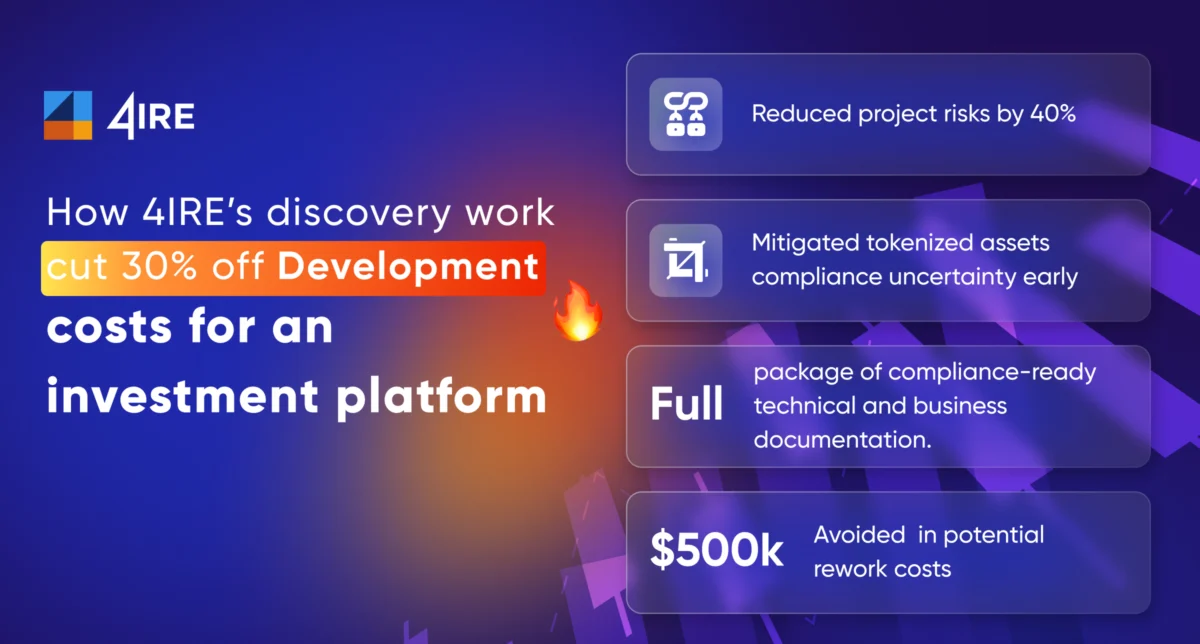
Global digital finance and investment industries are undergoing fundamental changes due to the rise of Web3 and DeFi, which enable financial freedom and inclusion. This case study illustrates how 4IRE’s technical and business analysts approached a new Web3 project in the form of in-depth blockchain development consulting, also referred to as discovery. In this discovery phase for tokenized investment platform case study, you will find out about how tokenization investment platforms simplify user access to investment assets, how a discovery phase in blockchain product development informs wise, well-planned decisions, and what elements of a DeFi platform design discovery can help determine and conceptualize.
What Is a Tokenization Investment Platform?
A tokenization investment platform is a digital platform on which tokens of real-world assets (RWAs) are available for blockchain-based acquisition, trading, and storage. RWAs can cover a wide range of asset types, from precious metals (e.g., gold, silver) to stocks and real estate objects. The process of tokenization refers to the conversion of traditional assets into digital tokens using advanced cryptographic methods. Features of tokenized RWAs include:
- Fractional ownership. Investors can acquire a small share of a larger asset, even if the latter is non-fungible.
- Transparency. The public ledger of blockchain ecosystems allows transparent transaction tracking without fraud or manipulation risks.
- Liquidity. Tokenized assets are traded without friction, slippage, or delays on Web3 platforms with considerable liquidity pools.
- Access and inclusion. RWA acquisition and trading are accessible even to small-budget investors because high-value assets are divided into small fractions available for purchase.
Client’s Profile
The Client is a Web3 business targeting the creation of a modular, scalable investment platform utilizing DeFi technology for secure, accessible financial transactions and investment operations using fiat currencies and secure tokenized assets.
What Are The Client Goals?
The Client approached 4IRE with an ambitious goal to launch a tokenization investment platform to transform the local investment landscape with secure, accessible Web3 services. The platform should enable operations on the basis of precious metal digital assets backed by physical gold and silver, as well as tokenized investment assets like stock certificates, giving users transparency, access to innovation, and secure financial opportunities. The project should integrate fiat assets and blockchain-based tokens to empower users and give them control over the full spectrum of financial operations using USDT.
Business Challenge
The 4IRE team faced the following challenges in the process of working on the project’s discovery phase:
- Gaps in project requirements. The initial input from the Client lacked vital technical details that made the project’s scoping more challenging.
- Technical feasibility risks. The Client’s business idea included many potential friction points, including blockchain integration, smart contract development, Web3 wallet design and integration, etc. These risks could not be given full account at the discovery
- phase.
- Resource and budget estimates. The absence of critical technical details made it hard for the 4IRE team to make accurate resource calculations and budget estimates, thus potentially leading to budget overruns at later implementation stages.
- Third-party dependency. The Web3 platform was initially designed as reliant on third-party asset custody, which created security and reliability risks for the project’s launch and operation.
- Scalability and timeline estimates. The initial ambiguity of technical specifications created potential risks for performance scalability and implementation delays.
Implementation
Project discovery matters a lot in the competitive, dynamically developing blockchain industry. Therefore, it is strongly recommended as the initial stage of business idea validation that can save clients from failed investments (we strongly recommend to read this article about discovery). In line with industry best practices, the 4IRE team of business analysts worked on the discovery phase for the Client with a focus on the following project dimensions:
- Formulation of business objectives and the project’s vision statement.
- Identification of business and project-specific risks.
- Development of a detailed glossary for the project’s technical documentation.
- Design of the platform’s core functional requirements (C1-level list of features, major platform components, and C1-level non-functional requirements).
- Additional research compiled into relevant reports.
- Formulation of technical objectives for the project.
- Development and visualization of the platform’s architecture.
- Estimates of the team composition and budget for the project’s technical execution.
What Insights Were Gained During Discovery?
The discovery phase for the Tokenized investment platform culminated in the delivery of a full documentation package on the following project aspects.
Business Objectives
Our team developed a comprehensive technical and business vision of the new Web3 platform and created its detailed and realistic description of the platform, its features, and user value. We also developed and negotiated a complete list of discovery objectives with the Client to understand the goals of this step and measure its effectiveness.
Business and Project Risk Estimation
4IRE analysts evaluated the Client’s business idea against the existing market landscape and formulated the list of risks that the project should address. The analytical summary included market adoption, regulations and compliance, competition, and economy- and currency-related risks as sources of potential project challenges.
Along with business risks, 4IRE experts conducted a project risk assessment with a focus on technical aspects of its planning and execution. The preliminary evaluation pointed to the incomplete technical requirements, feasibility and integration risks, resource and budgeting issues, security and data protection, third-party dependency bottlenecks, and scalability and timing risks that could not be excluded from the overall project planning roadmap.
Core Functional Requirements
The technical team of 4IRE prepared a detailed description of the core functional components with their purposes in the practical platform navigation. High-level descriptions and acceptance criteria were formulated for every major component, such as user authorization, email confirmation, user settings, notifications, etc. Tech requirements and detailed descriptions accompanied a list of core non-functional C-level components.
Technical Objectives
4IRE also prepared an extensive analysis of the platform’s technical features. The solution’s architecture was visualized for a user-friendly comprehension of data and operation flows on the platform. We created a visual diagram for every technical aspect of the platform’s work and accompanied them with a detailed description, including the smart contract flow, the order book’s work, interactions between back-end, users, and certificate managers in the smart contract, order creation and execution, as well as operations with tokens on the platform. This information was accompanied by a tech stack summary that broke down the technologies and expertise needed for the platform’s development and launch.
Why is Discovery Critical for Tokenization Investment Platforms?
Discovery phase benefits for Web3 businesses include:
Mitigating risks in blockchain and Web3 projects
Every cryptocurrency investment platform is a time-consuming, expensive project that requires careful planning and expert execution. Such projects come with multiple risks ranging from technical friction to compliance, which an experienced consulting team can anticipate and mitigate.
Enabling secure, compliant tokenization strategies
Regulatory compliance in blockchain is a significant source of risk for startups. Every jurisdiction offers a patchwork of legal requirements for crypto projects, which a competent legal team can address for a smooth project launch.
Improving budgeting, resource allocation, and scalability
A lot depends on proper, systemic project scoping in blockchain at the early stages of project development. A professionally executed discovery phase gives clarity about the needed budget and resources, as well as the project’s scaling potential.
Delivering measurable business and technical value
Project discovery is equal to thorough business idea testing and validation, which adds strategic clarity for all further stages of project development, thus reducing the number of costly revisions and delays.
By investing in a structured discovery phase, the client not only managed to reduce blockchain development costs but also minimized project risks and gained the technical and business clarity needed to attract investors, ensure compliance, and confidently plan project development.
Business Impact of Discovery: Financial Savings, Strategic Clarity, and Risk Mitigation for Tokenization Project
Risk reduction:
- Scope creep reduction and feasibility risks by 40%+.
- Mitigated tokenized assets compliance uncertainty early.
Financial impact:
- Avoided $500K+ in potential rework costs.
- Development cost reduction by 30–35% from initial dev cost estimates.
Strategic clarity:
- Defined clear business & technical requirements.
- Validated compliance-first tokenization model.
- Created investor-ready documentation.
Time-to-market acceleration:
- Prevented 3–6 months of potential launch delays
4IRE engineers addressed an initial lack of specifications with a comprehensive feasibility study for Web3 projects, which enabled more accurate project risk mitigation and assessment, as well as budget and resource estimation. Our experts prepared a comprehensive research and analysis package of investor-ready documentation, reports, core architectural features, and user flow diagrams, which visualized the platform’s work and simplified further planning. The output included:
- Thorough analysis of Client’s requirements and collaborative validation of core project features.
- Comprehensive blockchain project risk mitigation at all levels of asset tokenization platform development.
- Complete smart contract development services and architecture design for the Web3 platform.
- Use case development for cryptocurrency transactions on the platform.
- Development of the token pagination system for real-world asset (RWA) tokenization on the platform.
The Web3 platform discovery services delivered by 4IRE experts helped the Client uncover several important milestones of the DeFi investment platform development and implementation. A number of important decisions on the project’s business and technical objectives, including a detailed digital asset tokenization architecture, were made in the process of discovery to lay a solid foundation for the platform’s development and launch. Our input helped the Client transform a vague business idea into a realistic, feasible silver tokenization and gold tokenization strategy that meets the needs of local users and investors.
What Are the Key Takeaways for Businesses and Investors?
The resulting output of the project’s discovery phase covered all technical documentation for the system’s architecture, all transaction types, and the mechanics of performing all activities on the user and admin parts of the Web3 platform. In the end, the client:
- Avoided $500K+ in rework costs.
- Reduced project risks by 40%.
- Received a hands-on technical guide for structured tokenization for gold, silver, and stock assets in USDT.
- Obtained the complete package of compliance-ready technical and business documentation.
Common Questions About 4IRE’s Tokenization Investment Platform Case Study
What risks can be avoided through a structured discovery phase?
By entrusting project discovery to a competent team of blockchain consultants, project owners can eliminate avoidable development delays and costly errors, mitigate technical and compliance risks, and reduce market risks by deriving insights about the present-day competitive landscape.
2. Why is defining a tokenization strategy critical for asset-backed platforms?
Asset tokenization is a technically important aspect of asset-backed platform development. Smart contract logic, tokenization strategy and architecture, as well as the broader platform architecture enabling token-related transactions, make or break the project’s development success.
3. What is the discovery phase in Web3 development, and why does it matter?
Project discovery in Web3 and blockchain starts with an in-depth analysis of the project’s technical feasibility and the availability of the tech stack required for its development. Next comes the budget and resource allocation stage, with accurate time estimations. Architecture development and extensive investor-ready documentation may also be included in the discovery service bundle.
4. What technical documentation is typically delivered during a discovery phase?
The output of the discovery phase submitted to the client includes a comprehensive risk analysis report, a glossary of key terms and system components, core functional and non-functional components of the proposed platform, research findings on related services and technical elements of the project, and solution architecture with relevant visualizations.
5. How can businesses know if they need a discovery phase before development?
Businesses need project discovery if they have vague project specifications and lack a clear idea of the technical side of the project’s realization. Ambiguous resource, budget, and time estimations can cause a project to stagnate underway, while an absence of clarity about the compliance landscape may block the project’s launch, thus resulting in a huge investment failure. Thus, projects need a discovery phase to scope their business project in terms of time, money, tech stack required, and compliance issues to address.

Our Latest Insights

The Illusory Promise of Fast-Track AI Tech Startups: Lovable Dev Trends 2026

Circle vs Paxos: A Side-by-Side Comparison for FinTech Builders