

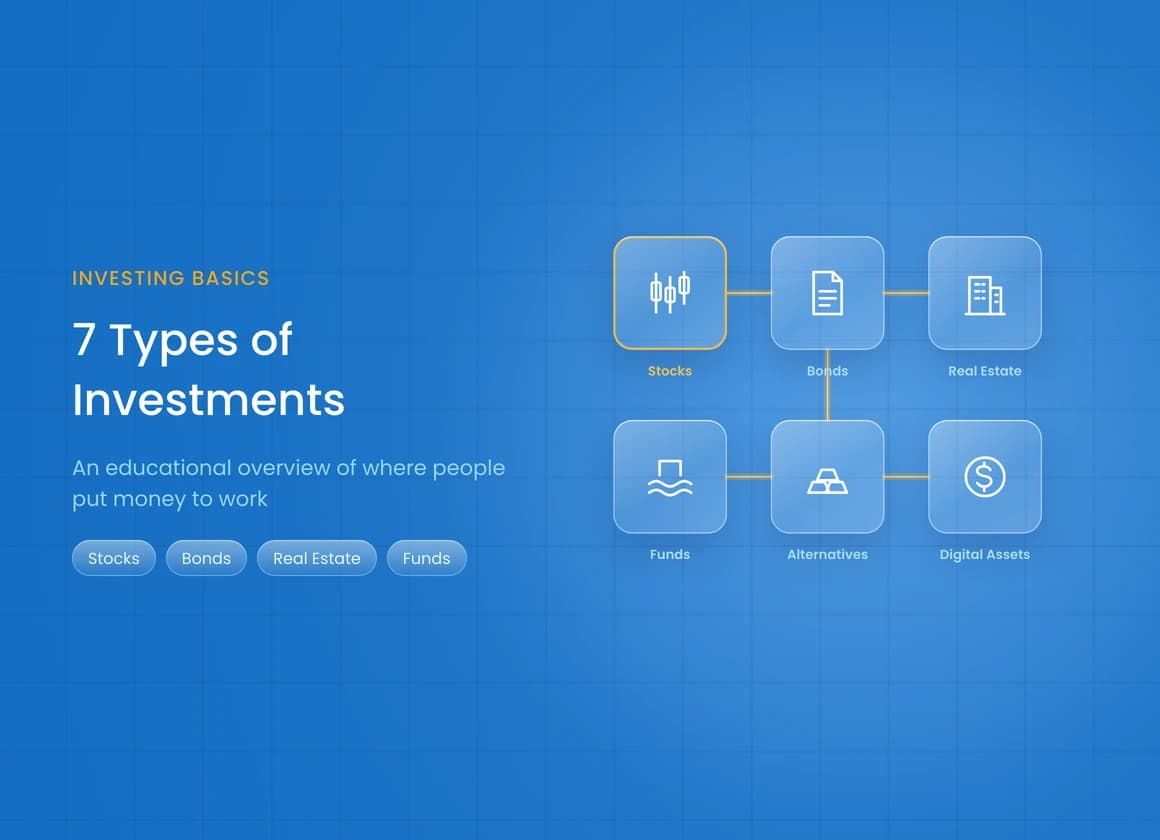

This is an educational overview of the main categories investors put money into, not financial or investment advice. It does not recommend any specific product, and nothing here should replace a conversation with a licensed financial advisor who knows your actual situation.
Most money sits in seven broad categories, each trading off risk, liquidity and expected volatility differently. Understanding the category matters more than chasing a specific pick, since the category is what determines how a position behaves when markets move.
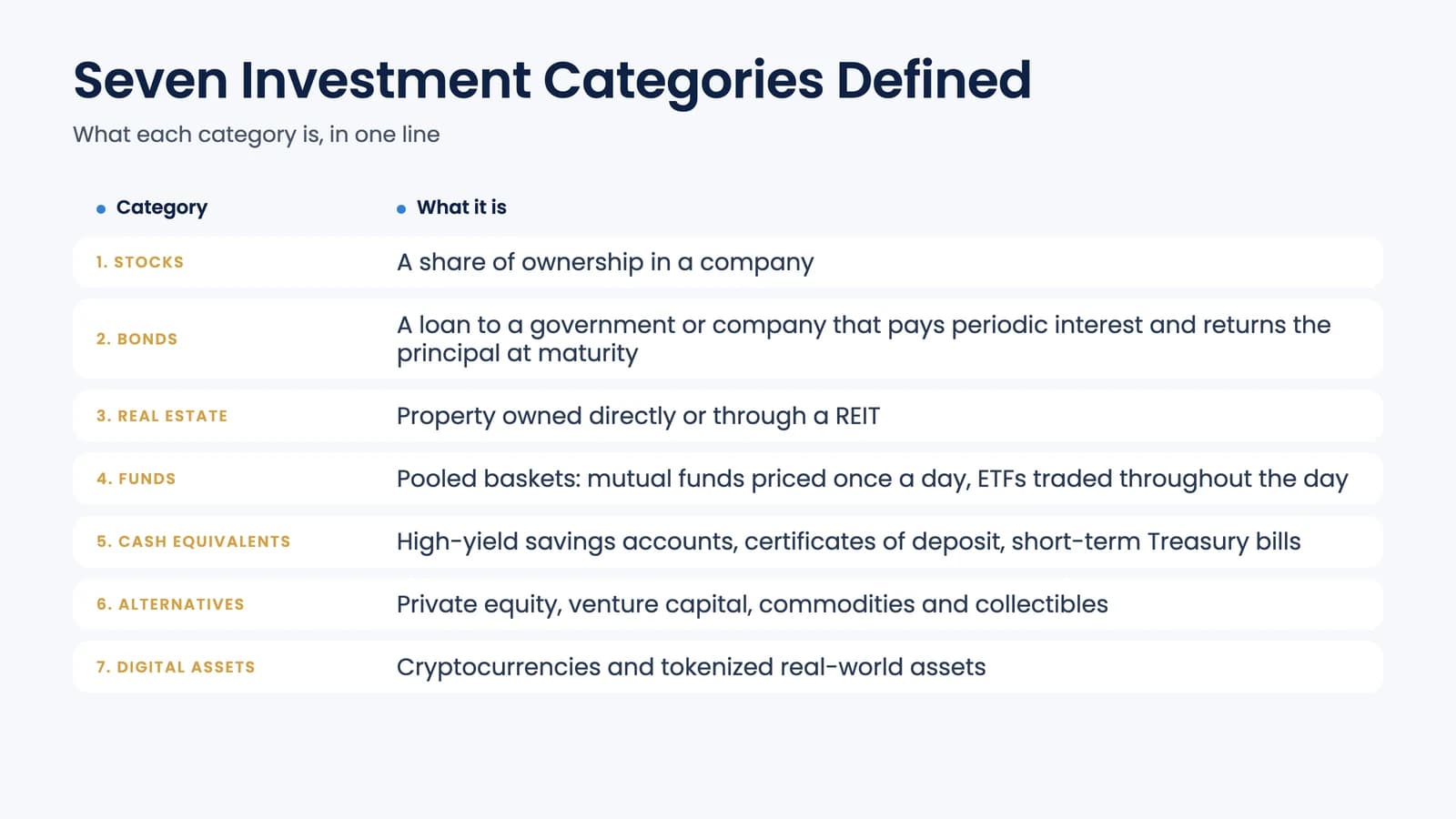
1. Stocks
A stock is a share of ownership in a company. Its value moves with the company's earnings and with broader market sentiment, which makes stocks more volatile than most other categories on this list but also historically the strongest long-run grower among them. The S&P 500's compound annual growth rate from 1928 to 2024, dividends reinvested, works out to roughly 10.2% before inflation, according to NYU Stern's historical return dataset. That is a backward-looking average over nearly a century, not a forecast, and any single year can land far above or below it.
2. Bonds
A bond is a loan to a government or a company that pays periodic interest and returns the principal at maturity, assuming the issuer does not default. Government bonds are generally the lowest-risk category here, since they are backed by a government's ability to tax and issue currency; municipal and corporate bonds pay more to compensate for more credit risk, and that extra yield is the market pricing in the chance the issuer struggles to pay.
Short-term government debt is a useful benchmark for how bond yields move: the 3-month US Treasury bill yielded around 4.1% in late September 2026, per the Federal Reserve's H.15 release, a figure that shifts with monetary policy and says nothing about where it will sit a year from now. Bond prices and yields move in opposite directions, so a bond bought today can lose market value if rates rise before it matures, even though it still pays its stated interest.
3. Real Estate
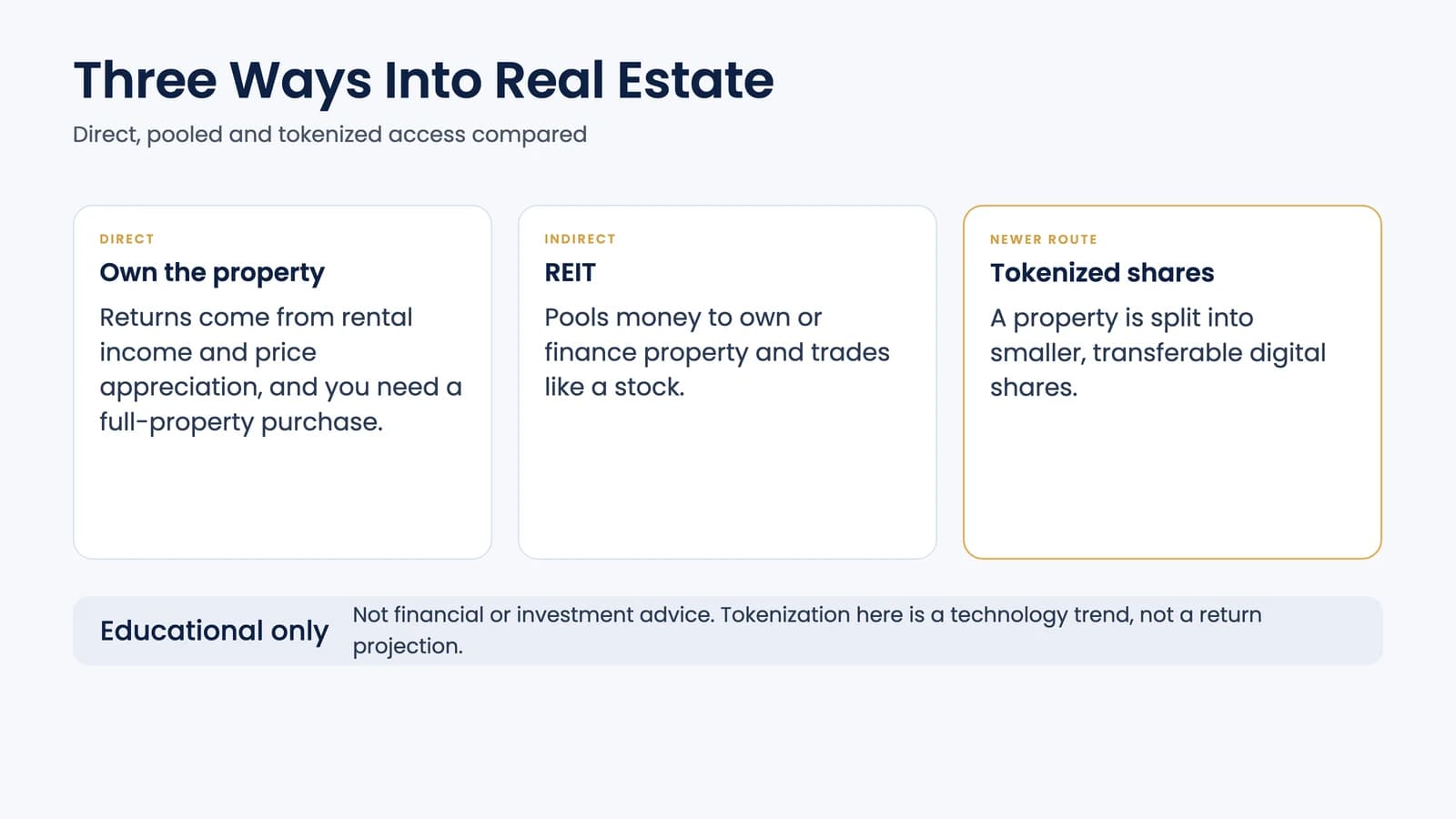
Real estate means owning property directly, through rental income and price appreciation, or indirectly through a real estate investment trust (REIT), which pools money to own or finance property and trades like a stock. Tokenized real estate is a newer access route, splitting a property into smaller, transferable digital shares instead of requiring a full-property purchase. Our 2026 outlook on real estate tokenization covers how that market is developing, as a technology trend, not a return projection.
4. Mutual Funds and ETFs
Funds pool money from many investors into one diversified basket, instead of requiring each investor to pick individual holdings. A mutual fund is typically priced once a day and often actively managed; an ETF trades on an exchange throughout the day like a stock and is more often built to track an index at low cost. Both reduce single-company risk relative to buying one stock directly, though they inherit the volatility of whatever they hold.
5. Cash and Cash Equivalents
High-yield savings accounts, certificates of deposit and short-term Treasury bills sit at the low-risk, low-growth end of the spectrum, useful for money that needs to stay liquid or cannot afford to lose value. Rates here move with central bank policy and change often: the average savings account APY in the US sat at 0.38% as of 17 August 2026, while the top advertised high-yield accounts reached up to 4.50% APY as of 1 October 2026, according to rate-tracking coverage from that week. Whatever the figure is when you read this, check a current source before assuming it still holds.
6. Alternative Investments
Private equity, venture capital, commodities and collectibles fall outside the categories above and typically come with less liquidity, meaning it can take months or years to exit a position, and less public pricing information to check a fair value against. Commodities such as gold or oil add a different kind of exposure again, tied to physical supply and demand rather than a company's earnings or a government's credit.
This category tends to suit investors who can tie up capital for a long horizon and absorb a total loss on any single position, which is most of why alternatives show up far more often in institutional and high-net-worth portfolios than in a typical retail one. Minimum investment sizes and accreditation requirements also keep direct access to private equity and venture capital out of reach for most individual investors.
7. Digital Assets
Cryptocurrencies and tokenized real-world assets are the newest and most volatile category here. Crypto prices can move by double-digit percentages in a single day, and regulatory treatment still varies significantly by jurisdiction, so what is permitted or taxed one way in one country may not be in another. Tokenization of non-crypto assets, gold, carbon credits, private credit, is a related but distinct trend: it uses blockchain as a settlement and ownership-transfer rail for an asset whose value still comes from the underlying thing, not from the token itself. Our explainers on real-world asset tokenization, gold tokenization and stablecoins cover the mechanics without predicting where any of these markets go next.
A Side-by-Side Snapshot
None of these labels are precise, a REIT behaves differently from a rental property, and a stablecoin behaves differently from a volatile token, but this gives a rough sense of where each category typically sits:
| Category | Typical risk | Typical liquidity |
|---|---|---|
| Stocks | Medium-high, varies by company | High (public markets) |
| Bonds | Low-medium, varies by issuer | Medium-high |
| Real estate | Medium, illiquid if held directly | Low direct / high via REITs |
| Funds (mutual funds, ETFs) | Depends on holdings | High for ETFs, daily for mutual funds |
| Cash equivalents | Low | High |
| Alternatives | High, often illiquid | Low |
| Digital assets | High to very high | High for major tokens, variable otherwise |
How to Think About Fit
Rather than ranking these seven categories, it helps to score your own situation against three questions:
- Risk tolerance: how much short-term loss can you absorb without needing to sell at the worst possible time?
- Time horizon: money needed within a year or two behaves very differently from money that will not be touched for a decade.
- Liquidity needs: real estate and private alternatives can take months to convert back to cash; cash equivalents convert instantly, at the cost of lower long-run growth.
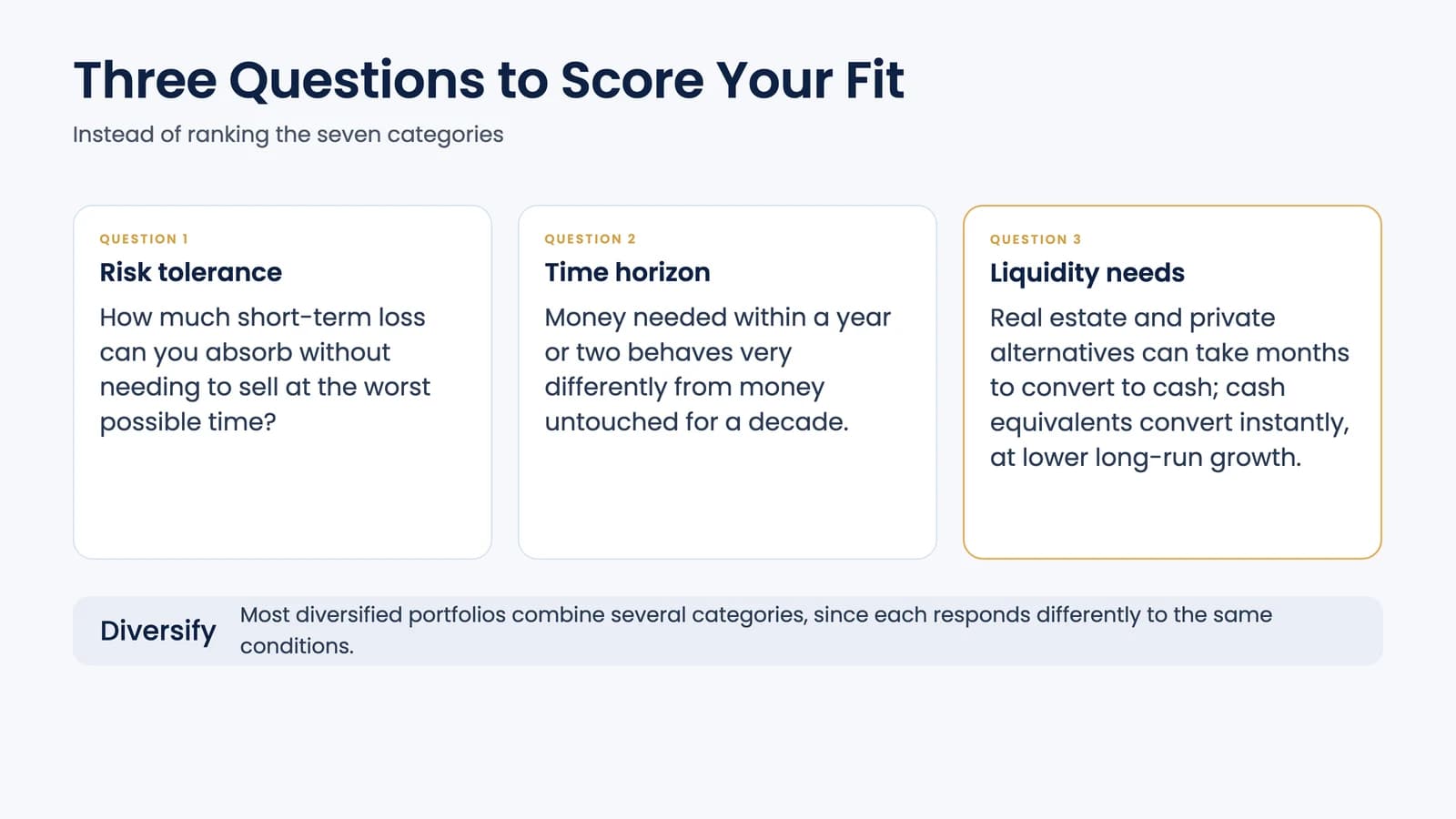
Most diversified portfolios combine several of these categories rather than concentrating in one, precisely because each one responds differently to the same economic conditions.
Conclusion
Stocks, bonds, real estate, funds, cash equivalents, alternatives and digital assets each solve a different problem in a portfolio, and none of them is inherently the right or wrong choice without knowing your own time horizon and risk tolerance. This overview is meant to help you ask a licensed advisor better questions, not to replace one.
Learn more from us
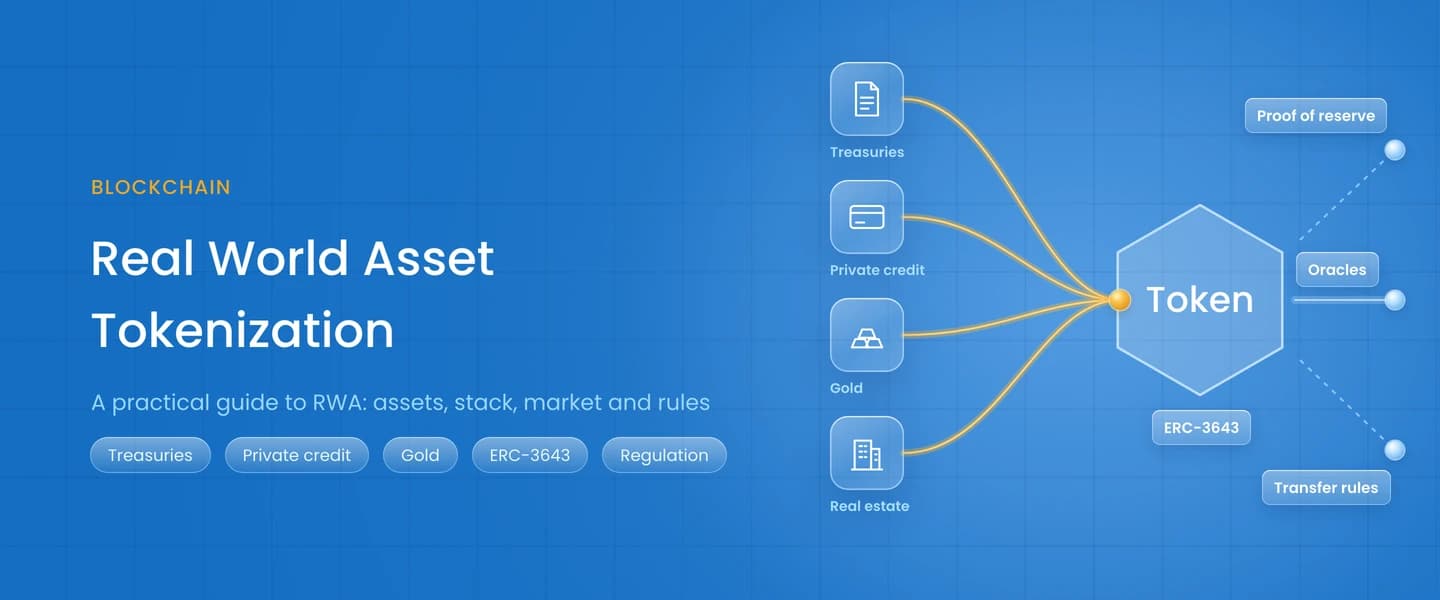 Blockchain news28 Sept 2026
Real World Asset Tokenization in 2026: A Practical Guide to RWA
Real world asset tokenization explained: asset classes, how the stack works, 2026 RWA market data, US, EU, Singapore and UAE rules, and how to launch.
Olena Petrashchuk
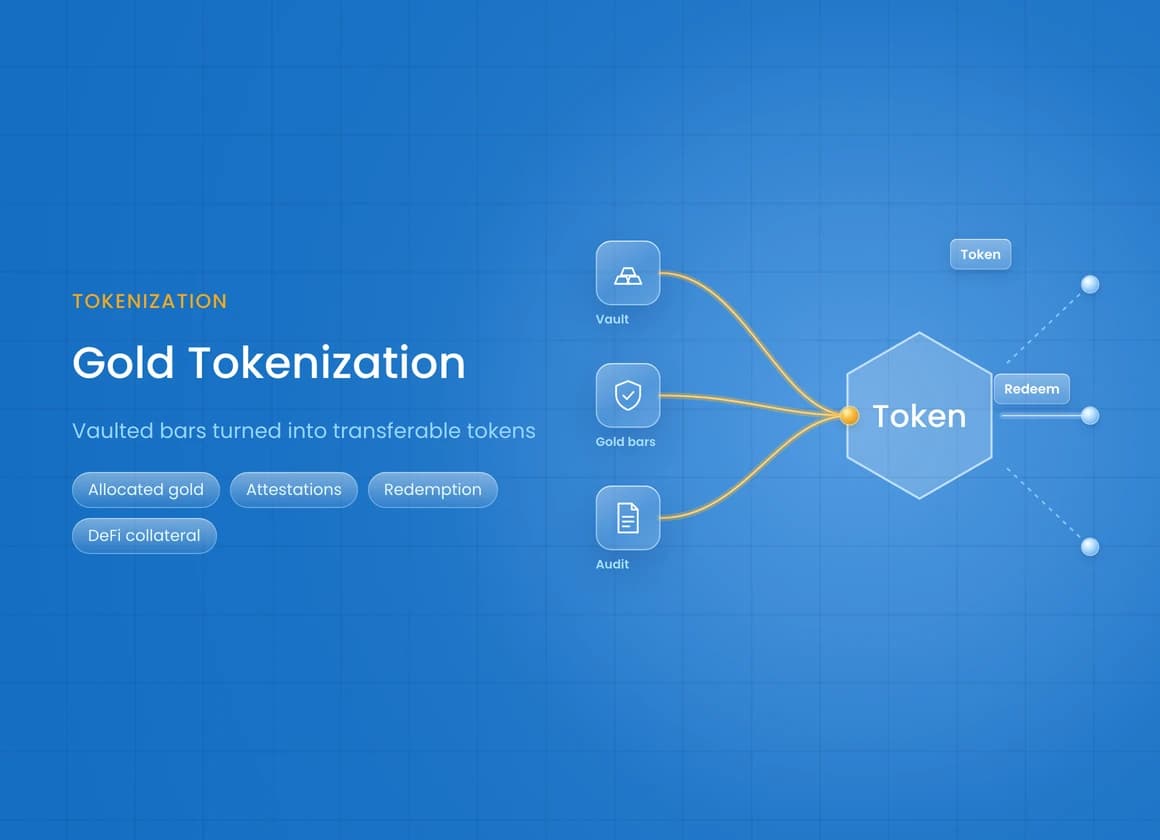 Blockchain Use Cases28 Sept 2026
Gold Tokenization in 2026: What It Is, How It Works and How to Build a Platform
What gold tokenization is, how PAXG and XAUT are backed, market size, benefits, risks and rules, and the steps to build a tokenized gold platform.
Olena Petrashchuk
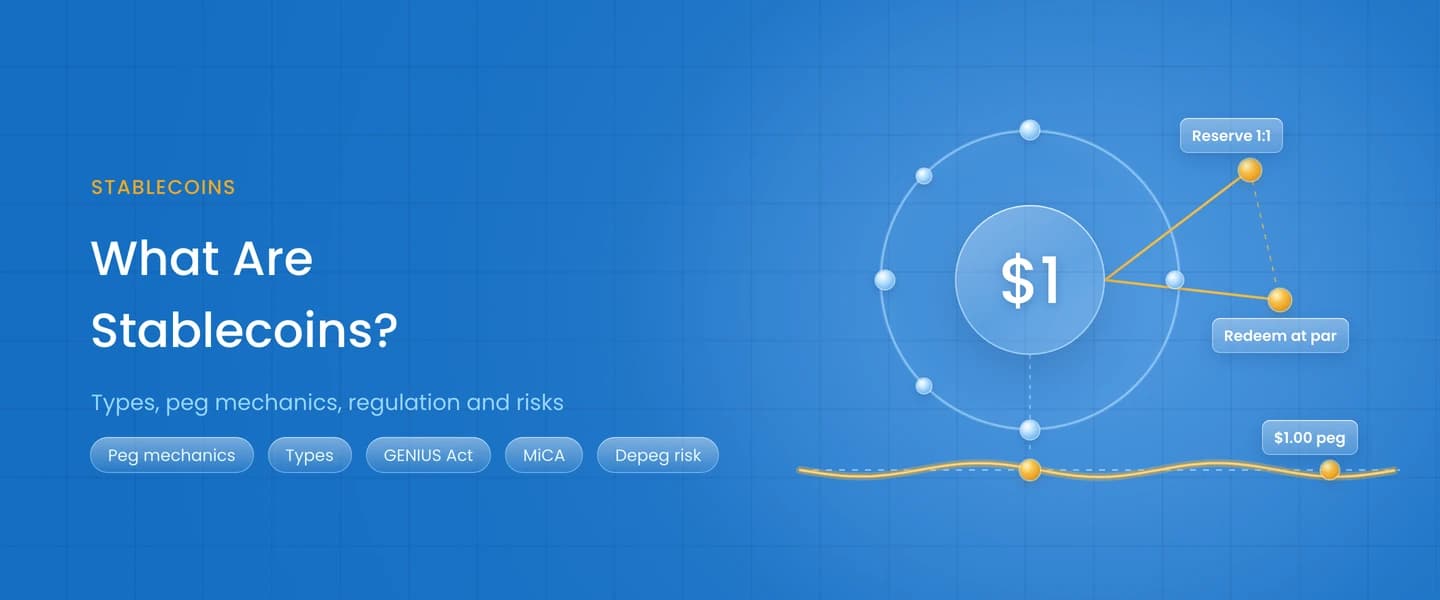 Stablecoin news28 Sept 2026
What Are Stablecoins? Types, Regulation and Risks in 2026
What are stablecoins? How fiat-backed, crypto-backed and synthetic stablecoins hold their peg, how they are regulated, and the risks to know.
Vladislav Malynovskyi
Building a tokenization or investment platform, not just investing in one?
Our team designs and builds the on-chain infrastructure behind tokenized real-world assets, from gold to real estate to private credit. Let's talk about your product.
FAQ
A stock is ownership in a company, with returns tied to its performance and no promised payout. A bond is a loan that pays fixed or scheduled interest and returns principal at maturity, generally with lower volatility than stocks but also a lower long-run growth ceiling.
That depends entirely on your own risk tolerance and time horizon, and this article does not make investment recommendations. What's verifiable is that crypto is among the most volatile categories here and that its regulatory treatment varies by jurisdiction, both of which are worth weighing with a licensed advisor before allocating money to it.
A real estate investment trust: a company that owns or finances income-producing property and distributes most of its taxable income to shareholders, letting investors gain real estate exposure without buying property directly.
No. It is an educational overview of investment categories, not a recommendation to buy, sell or hold any specific asset. Speak with a licensed financial advisor about your own circumstances before making investment decisions.