


Crypto markets trade 24/7 and move fast enough that a human watching a screen is already at a disadvantage. That is the whole case for a trading bot: an algorithm that executes a defined strategy without needing sleep, without hesitating, and without deviating from the plan when the market gets emotional. As of late September 2026, total crypto market capitalisation sits at roughly $2.96 trillion with daily trading volume in the $100–130 billion range, according to CoinGecko, a large enough market that even a narrow, well-run strategy can be worth automating.
How crypto trading bots work
A crypto trading bot is software that watches market data against a set of pre-programmed conditions and places buy or sell orders when those conditions are met. Simple bots run a fixed rule set; more advanced ones use machine learning to weigh a wider, faster-changing set of signals. Either way, the bot only does what it was told to do: it does not "understand" the market, it pattern-matches against the logic it was given.
Benefits of using a crypto trading bot
- Speed. Bots can evaluate and act on market data far faster than a person, and don't need to stay glued to a screen to do it.
- No emotional trading. A bot executes its programmed logic regardless of fear or greed, which is where a lot of manual trading losses come from.
- Round-the-clock operation. Crypto markets don't close, and a bot doesn't need to sleep.
- Broader, faster analysis. AI-assisted bots can weigh more signals in real time than a person tracking the same markets manually.
Common trading bot strategies
- Scalping. Many trades on small price differences, relying on volume and liquidity rather than big moves.
- Reversal trading. Trades placed against the current trend when early reversal signals appear.
- Momentum trading. Trades placed in the direction of a strong existing price trend.
- Arbitrage. Exploits price differences for the same asset across platforms.
- Market making. Profits from the spread between buy and sell orders; works best on lower-volatility pairs.
- News trading. Scans news feeds for events likely to move price and trades ahead of or on the reaction.
A separate category worth naming explicitly, because it is often marketed alongside these: MEV strategies such as sandwich bots (covered below) exploit the order in which pending transactions are processed on a decentralized exchange. They are technically possible on permissionless chains, but they extract value from other traders rather than from the market itself, and the equivalent practice (front-running) is illegal in regulated securities markets. Building or deploying one is a business and reputational decision as much as a technical one.
How to build a crypto trading bot
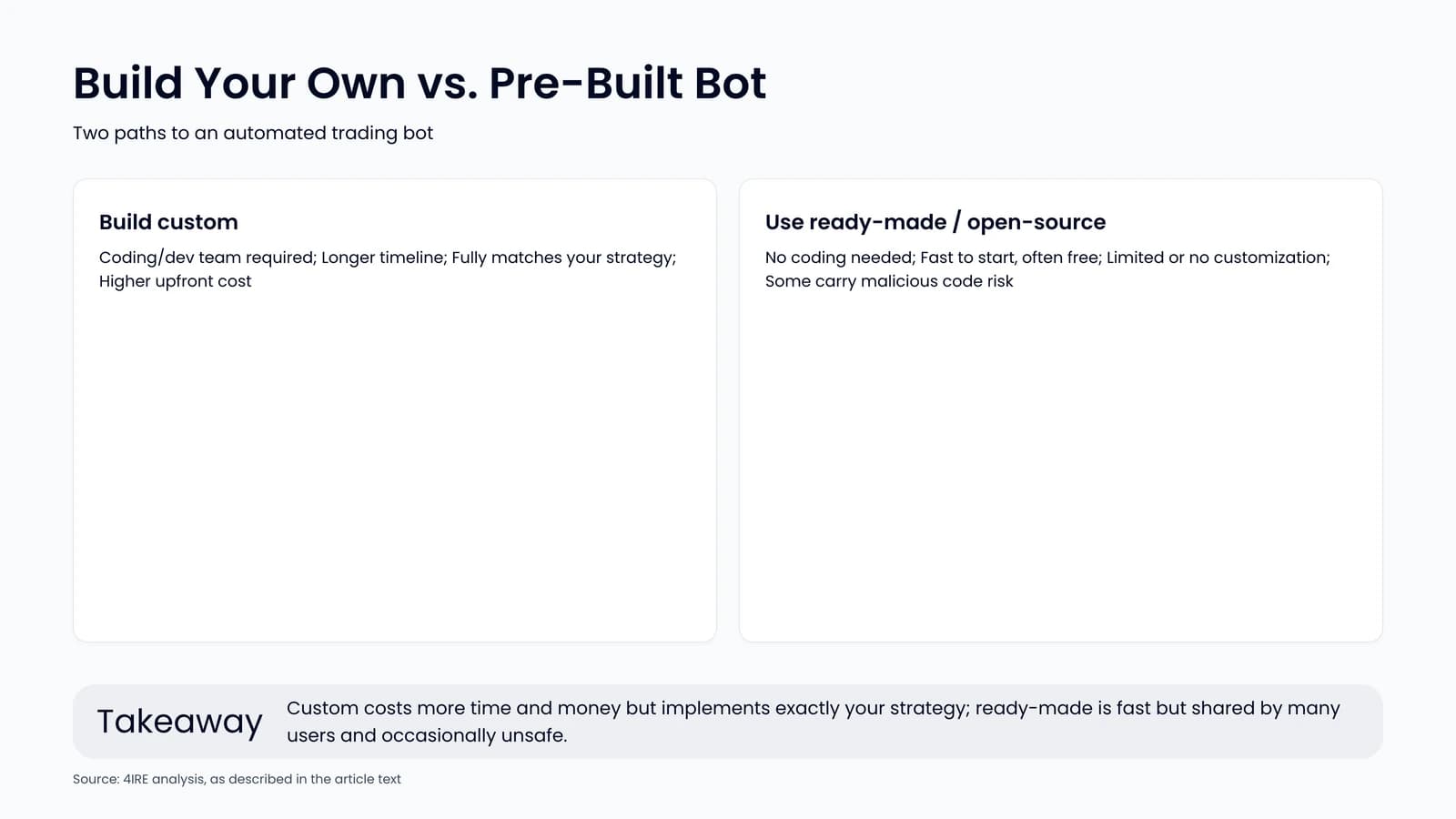
Once you decide to automate, you have two paths: use a ready-made or open-source bot, or build a custom one.
A ready-made bot is faster and cheaper, sometimes free, but you are running code many other people also run (which erodes any edge it might have), and free, unaudited bots occasionally carry malicious code aimed at draining connected accounts. A custom bot costs more and takes longer, but it can implement your specific strategy and nothing else.
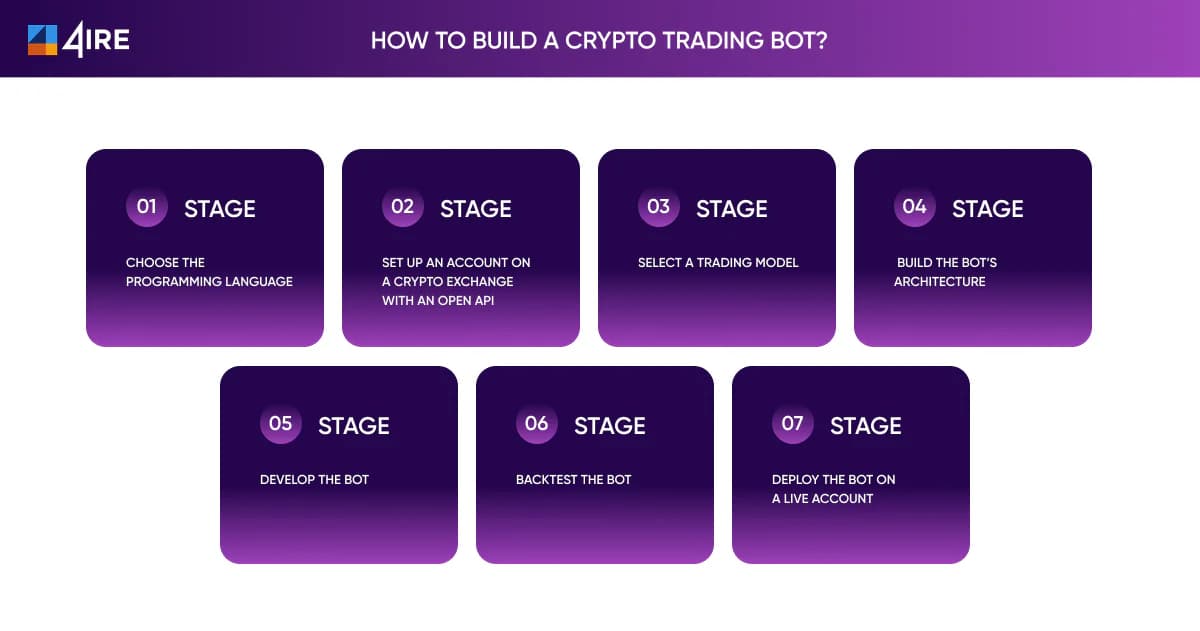
If you go custom, the build sequence looks like this:
- Choose the programming language. Python, Rust, C++ and JavaScript are all common choices for bot development; the right one depends on your team's skills and how latency-sensitive your strategy is.
- Set up an exchange account with API access. You'll need to complete KYC in advance on most exchanges, and confirm the exchange actually exposes an open API for algorithmic trading, since some restrict or ban it.
- Select a trading model. Pick the strategy (from the list above or a variant of your own) the bot will execute; this determines most of what comes next.
- Design the bot's architecture. Define the decision logic and the full set of parameters the bot will act on before writing code.
- Develop the bot. Build it against that specification.
- Backtest it. Run it against historical data to confirm it behaves as intended, then specifically test how it performs in both calm and volatile conditions: a strategy that only works in one regime is not done yet.
- Deploy on a live account, and keep tuning it. A bot is not "set and forget"; markets change and a strategy that worked last quarter can stop working without warning.
Notable types of crypto trading bots
- Sniper bots. Built to place the fastest possible bid in a token launch or auction, aiming to win an allocation or price ahead of other buyers.
- Copy-trading bots. Replicate a chosen trader's positions in near real time, for example mirroring activity on a DEX like Uniswap.
- Sandwich bots. Monitor pending orders and insert trades immediately before and after a target transaction to profit from the price impact, in effect front-running the target trader. This is technically possible on public chains but extracts value from other users rather than the market, and the closest analogue in regulated markets is illegal.
- Telegram trading bots. Connect via API to an exchange account and let users trade, or just receive price and news alerts, from inside Telegram, which is why they've grown alongside Telegram's own crypto-adjacent features.
What's next for trading bots
The clearest near-term trend is more AI in the decision loop, not less: bots doing sentiment analysis on news and social data alongside price action, which is part of the broader shift covered in our guide to AI in finance. Expect continued spread of automated trading beyond spot crypto into DeFi and adjacent markets, and gradual improvement in risk controls, though bots remain, at bottom, an execution tool rather than a substitute for a sound strategy.
How 4IRE can help
4IRE builds custom crypto trading bots and the cryptocurrency exchange and DeFi integrations they run on, from a single-strategy bot to a full copy-trading or market-making system. If you're evaluating build options more broadly, our roundup of trading software development companies is a useful starting point, and our blockchain consulting team can help you scope a bot project and a realistic testing plan before you commit budget.
Learn more from us
 Cryptocurrency28 Sept 2026
How to Build a Cryptocurrency Exchange Platform in 2026
How to build a cryptocurrency exchange platform: choose CEX, DEX or hybrid, white-label or custom, plan features, then build, license and launch.
Yaroslav Tumanov
 Fintech news26 Feb 2026
Top 7 Trading Software Development Companies in 2026
The top trading software development companies in 2026: what each one builds, team size and specialty, from brokerage systems to crypto market making.
Olena Petrashchuk
 28 Sept 2026
AI in Finance: How AI Solutions Reshape the Financial Sector
AI in finance in 2026: fraud and AML, credit scoring, GenAI assistants, agentic payments, EU AI Act rules and how to start an AI project.
Olena Petrashchuk
Ready to Build Your Trading Bot?
Our blockchain team designs, builds and backtests custom crypto trading bots and exchange integrations. Book a call to scope your strategy and timeline.
FAQ on Crypto Trading Bots
They can be, with a sound strategy, proper backtesting and ongoing tuning. A bot amplifies whatever strategy it runs; a bad strategy automated is just a bad strategy executed faster. No bot guarantees profit.
Yes, if you or your team can code, or you can commission one from a development team. Either way, you'll need exchange API access, a defined strategy, and a backtesting process before running it on a live account.
Market risk is the main one: a bot can lose money quickly in fast-moving conditions because it only sees the parameters it was given, not broader context. Free or open-source bots carry an additional risk of hidden malicious code that can drain a connected account.
On permissionless blockchains, sandwich bots are technically possible and not illegal in the way front-running is in regulated securities markets, but they extract value from other traders rather than the market itself. Treat this as a reputational and business decision, not just a technical one.
4IRE is a blockchain and fintech development company with hands-on experience building exchange integrations and automated trading tools. Talk to our team about your strategy, target exchanges and timeline for a scoped estimate.