

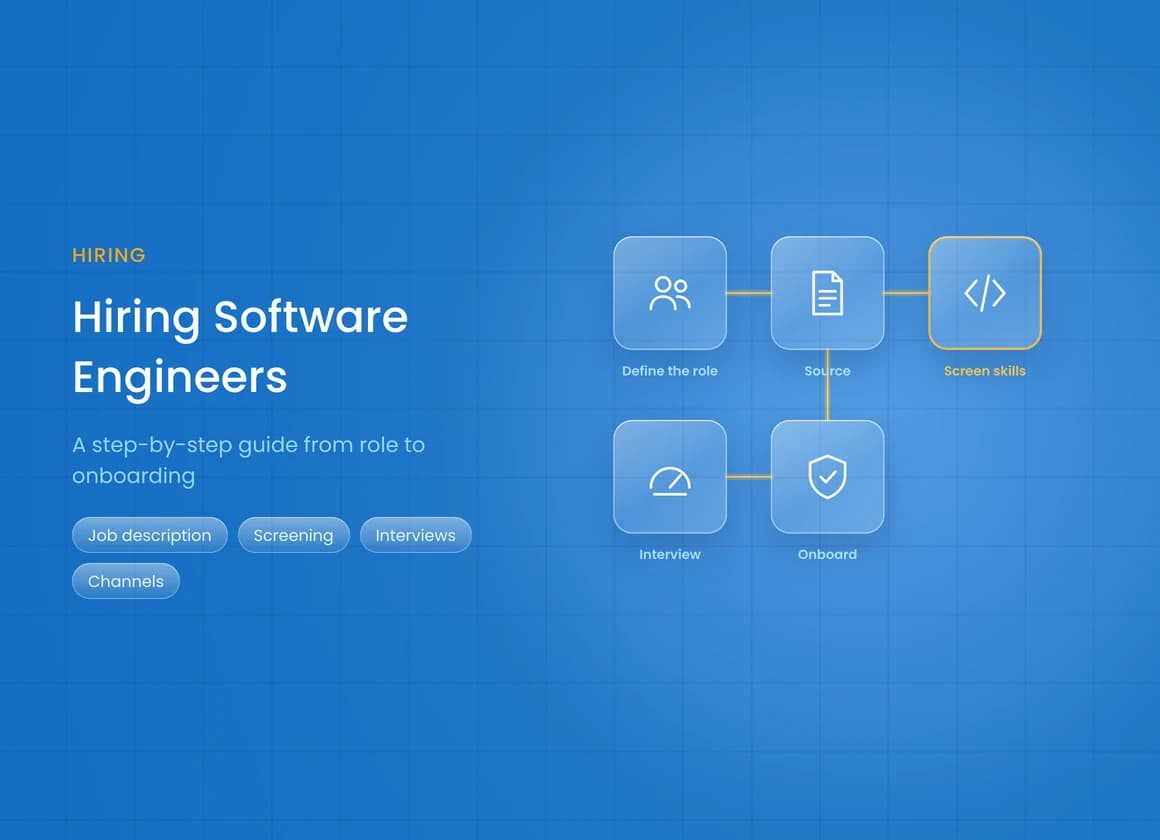

Hiring software engineers is one of the most expensive decisions a growing company makes, and one of the easiest to get wrong. A good engineer multiplies the output of the whole team; a poor fit costs months of salary, onboarding time and rework. The process is also slow: strong candidates rarely stay on the market for long, and specialist skills such as AI, cloud or blockchain are harder still to find.
This guide walks through what to decide before you start, a step-by-step hiring process, the main hiring channels, and the mistakes that most often derail a hire.
The Market for Software Engineers in 2026
Demand for software engineers remains strong. According to the US Bureau of Labor Statistics, the median annual wage for software developers in the US was $135,980 in May 2025, and employment of software developers, QA analysts and testers is projected to grow 10% from 2025 to 2035, much faster than the average for all occupations, with about 106,100 openings a year.
Specialist roles are the hardest to fill. Companies building AI features, cloud infrastructure or blockchain products compete for a small pool of experienced engineers, which is why many turn to AI developers or smart contract developers from external teams rather than waiting months for a local hire.
What to Decide Before You Start Hiring
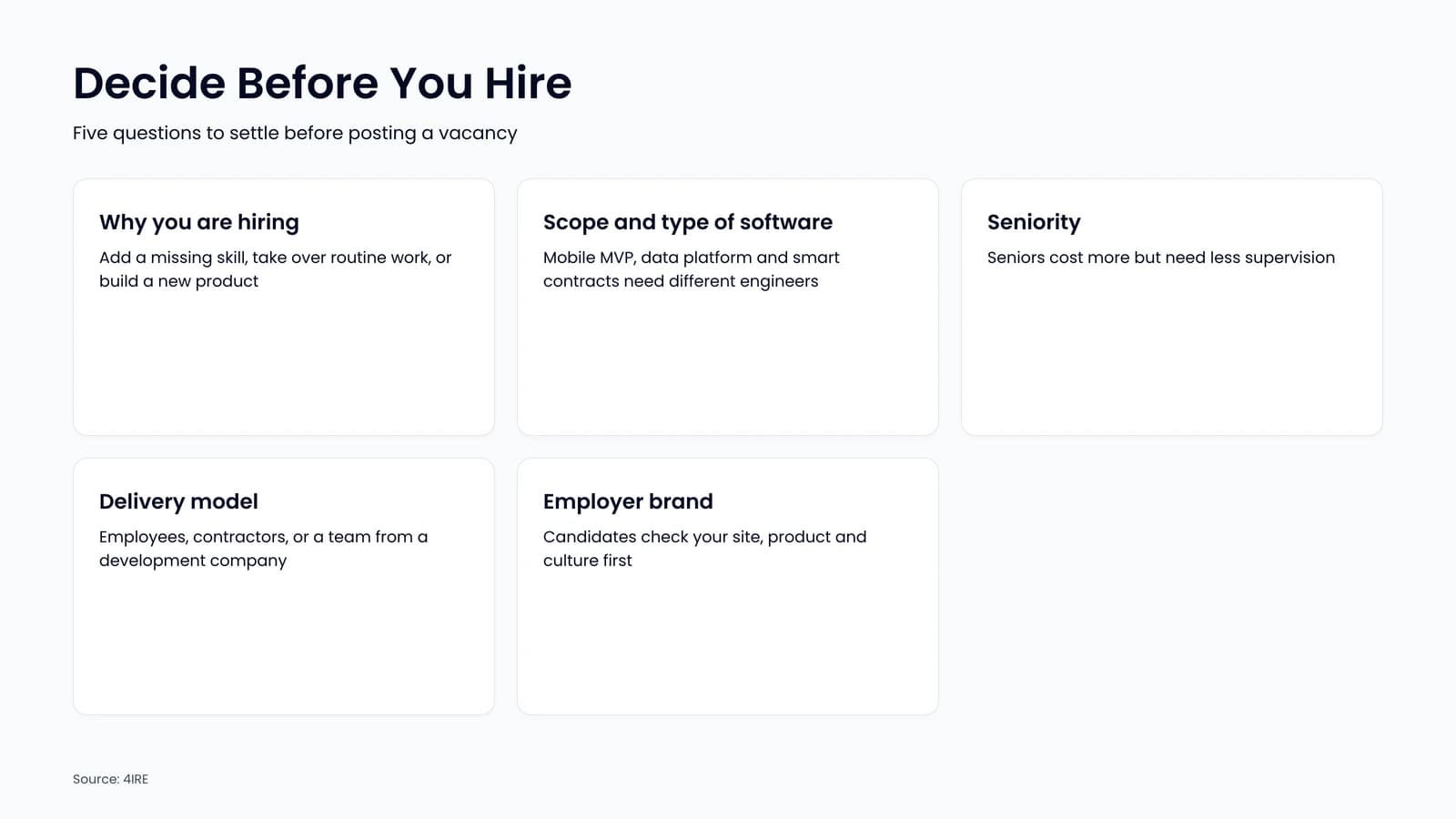
- Why you are hiring. Are you adding a missing skill, taking over routine work, or building a new product? Each needs a different profile.
- Scope and type of software. A mobile MVP, a data platform and a smart contract system need different engineers and different budgets.
- Seniority. Senior engineers cost more but need less supervision; a team of only juniors rarely ships a complex product on time.
- Budget and delivery model. Decide whether you are hiring employees, contracting individuals or bringing in a team from a development company.
- Employer brand. Candidates will check your website, product and engineering culture before they reply.
How to Hire Software Engineers: Step by Step
1. Define the role precisely
Front-end, back-end, full-stack, DevOps, data and blockchain engineers are different jobs. Name the languages, frameworks and infrastructure the person will actually use, and whether the work is on a server, in the cloud or on-chain.
2. Write a clear job description
List the responsibilities, the must-have and nice-to-have skills, the team the engineer will join, and the salary range. A specific, honest description filters out mismatched applicants and attracts the right ones.
3. Choose your sourcing channels
Posting a vacancy and waiting rarely finds the best engineers, who are usually not looking. Combine job posts with direct outreach, referrals and, where speed matters, an agency or a dedicated team.
4. Screen skills early
Move technical assessment to the start of the funnel. A short, paid take-home task or a live coding session saves days of interviews with candidates who cannot do the work.
5. Interview for skills and fit
Combine a technical interview, a system design discussion for senior roles, and a conversation about how the candidate works with others. Ask about real past projects, not hypotheticals.
6. Decide, offer and onboard
Compare candidates against the same criteria, make a competitive offer quickly, and prepare onboarding before day one: access, documentation, a mentor and a first small task.
Hiring Channels Compared
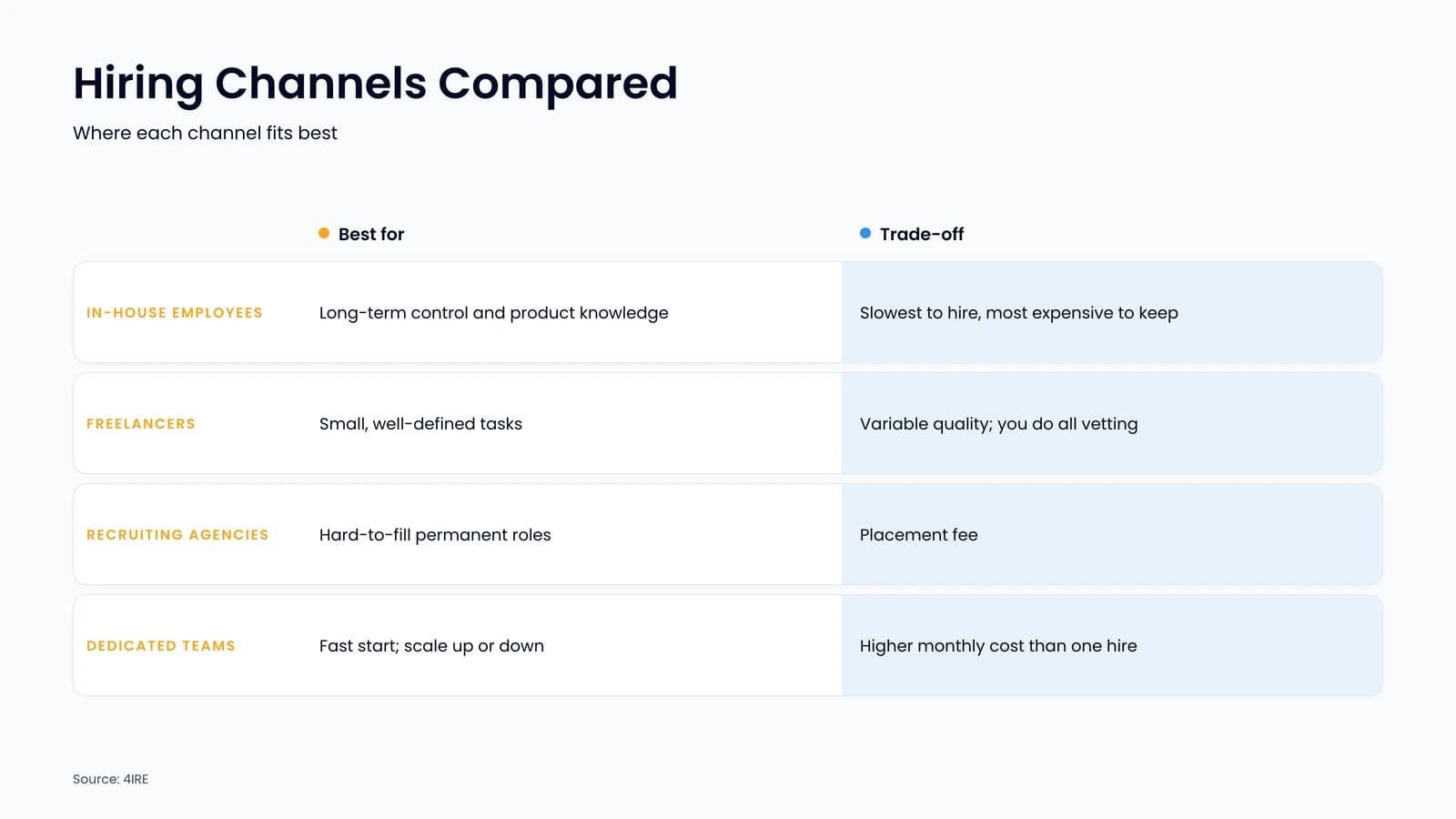
- In-house employees: full control and long-term knowledge in the company, but slow to hire and the most expensive to keep.
- Freelancers: fast and flexible for small, well-defined tasks, but availability and quality vary and you carry all the vetting.
- Recruiting agencies: save sourcing time for permanent roles, in exchange for a placement fee.
- Dedicated teams and staff augmentation: engineers from a development company join your project quickly, and you can scale the team up or down without hiring and firing.
Individual Developers or a Complete Team?
Hiring one developer makes sense when you already have a team, processes and technical leadership, and need to fill a specific gap. A complete team is better when you are starting a new product or lack senior engineering leadership: it arrives with a project manager, QA and established ways of working, so you skip months of team building. It costs more per month, but it usually reaches a working product sooner.
What Does It Cost to Hire a Software Engineer?
Costs depend on seniority, stack and location. For salaried roles in the US, the BLS median above is a useful anchor. For contracted engineers, 4IRE's own estimate from the market we work in is roughly $20 to $50 an hour in much of Asia, Africa and Latin America, $40 to $80 in Ukraine, and $50 to $100 or more in Western Europe and North America. Specialists cost more: senior blockchain developers typically run $130 to $160 an hour in the US and $55 to $75 in Eastern Europe on our estimates. Our guide on where to hire DeFi developers covers that niche in detail.
Common Mistakes When Hiring Software Engineers
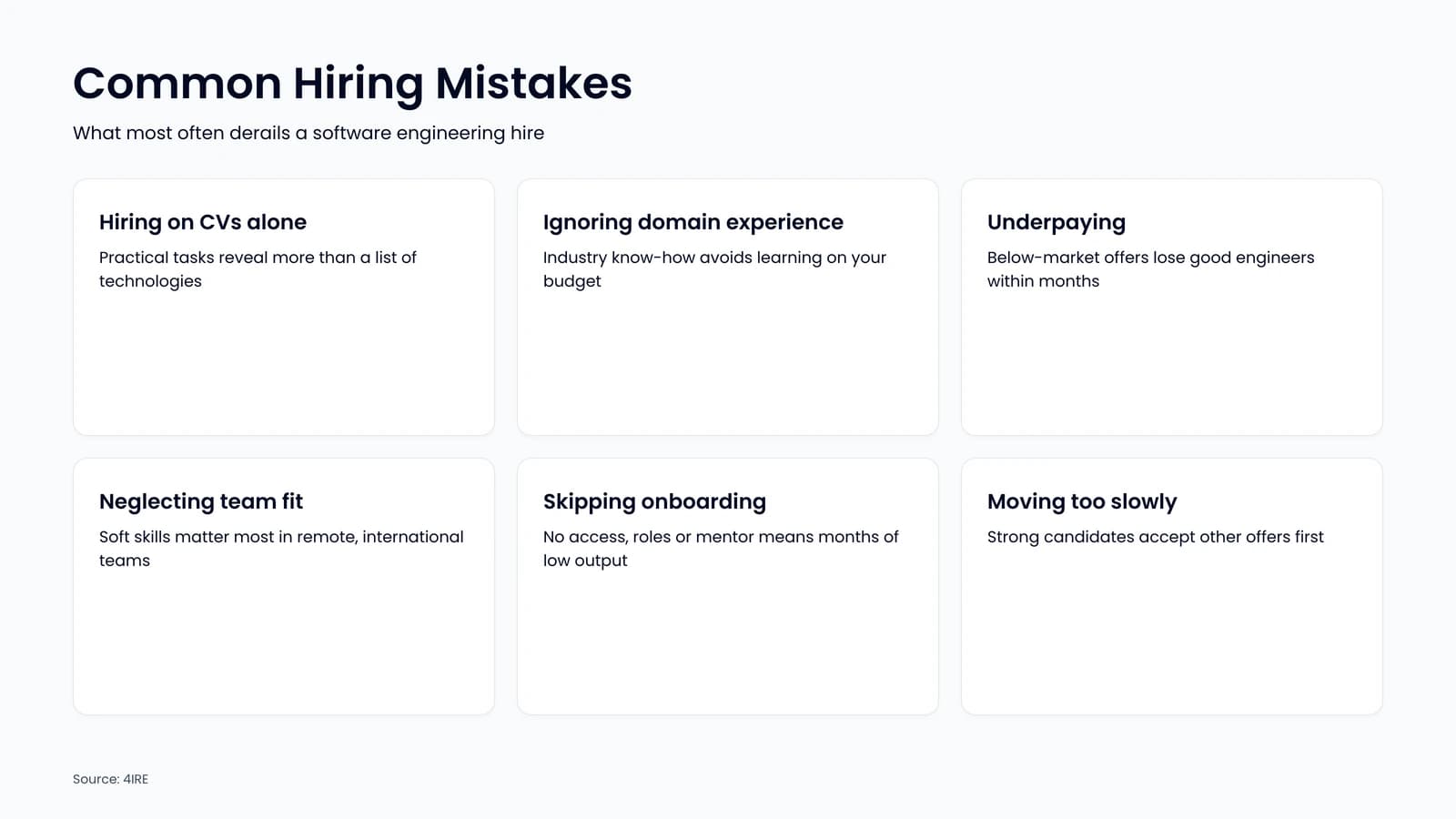
- Hiring on CVs alone. Practical tasks reveal far more than a list of technologies.
- Ignoring domain experience. An engineer who has built in your industry, such as payments or DeFi, avoids costly learning on your budget.
- Underpaying. Below-market offers attract weaker candidates and lose good ones within months.
- Neglecting soft skills and team fit, especially in remote, international teams.
- Skipping onboarding. Without clear roles, access and a mentor, even strong hires take months to become productive.
- Moving too slowly. Good candidates accept other offers while you schedule a fifth interview.
Keeping the Engineers You Hire
Hiring does not end with a signed offer. Replacing an engineer who leaves after six months means repeating the whole process and losing what they learned about your product. Retention starts with the basics: pay that keeps pace with the market, interesting work, a clear path to more responsibility and a manager who removes obstacles rather than adding them.
- Review salaries at least once a year against current market data, not last year's offer.
- Give engineers ownership of a product area, not just a queue of tickets.
- Budget time for learning, especially in fast-moving fields such as AI and blockchain.
- Keep documentation and code review in place so knowledge does not live in one person's head.
Hiring Software Engineers with 4IRE
If you need engineers quickly or want to avoid the recruiting overhead, 4IRE provides dedicated teams and individual specialists, from full-stack developers to AI, data and blockchain engineers. We match candidates to your stack and budget, can usually share relevant CVs within 24 hours, and let you scale the team up or down as the project changes. For blockchain work in particular, our list of top blockchain development companies and our guide to blockchain programming languages help you define what you need.

Conclusion
Successful hiring starts before the job post: know why you are hiring, what skills you need and which channel fits your timeline and budget. Assess skills early, move quickly, and invest in onboarding. When speed or specialist skills matter more than building everything in-house, a dedicated team can close the gap while you grow your own.
Learn more from us
 Blockchain news28 Sept 2026
Crypto Wallet Development Cost in 2026: A Full Breakdown
How much does crypto wallet development cost in 2026? 4IRE's estimates by tier, platform and feature, plus running costs and what drives the budget.
Olena Petrashchuk
 Blockchain news28 Sept 2026
Real World Asset Tokenization in 2026: A Practical Guide to RWA
Real world asset tokenization explained: asset classes, how the stack works, 2026 RWA market data, US, EU, Singapore and UAE rules, and how to launch.
Olena Petrashchuk
 Blockchain news28 Sept 2026
Real Estate Tokenization in 2026: A Guide to Fractional Ownership
How real estate tokenization works: SPVs, token standards, fractional ownership, current market data, Deloitte's 2035 forecast, rules and real projects.
Olena Petrashchuk
Need Engineers Fast?
Tell us which skills you are missing, and we will propose developers or a dedicated team that fits your stack and budget. Schedule a free consultation with our experts.
FAQ
Experienced engineers are in high demand, and specialist skills such as AI, cloud and blockchain are scarce. Local talent pools may lack the stack you need, strong candidates receive several offers, and a slow hiring process loses them to faster employers.
Use a mix of channels: job boards and LinkedIn for permanent roles, referrals, freelance marketplaces for small tasks, recruiting agencies for hard-to-fill positions, and development companies when you need a team or specialists quickly.
In the US, the median annual wage for software developers was $135,980 in May 2025, according to the BLS. For contracted engineers, 4IRE estimates roughly $20 to $50 an hour in much of Asia, Africa and Latin America, $40 to $80 in Ukraine and $50 to $100 or more in Western Europe and North America, with specialists such as senior blockchain developers costing more.
Define the role precisely, assess skills early to shorten the funnel, and consider nearshore or offshore teams. A dedicated team from a development company avoids recruiting fees and lets you scale capacity without long-term hiring commitments.
Doing it yourself often takes several weeks to a few months, depending on seniority and location. Working with a development company is much faster: 4IRE can usually share matching CVs within 24 hours of receiving your requirements.