

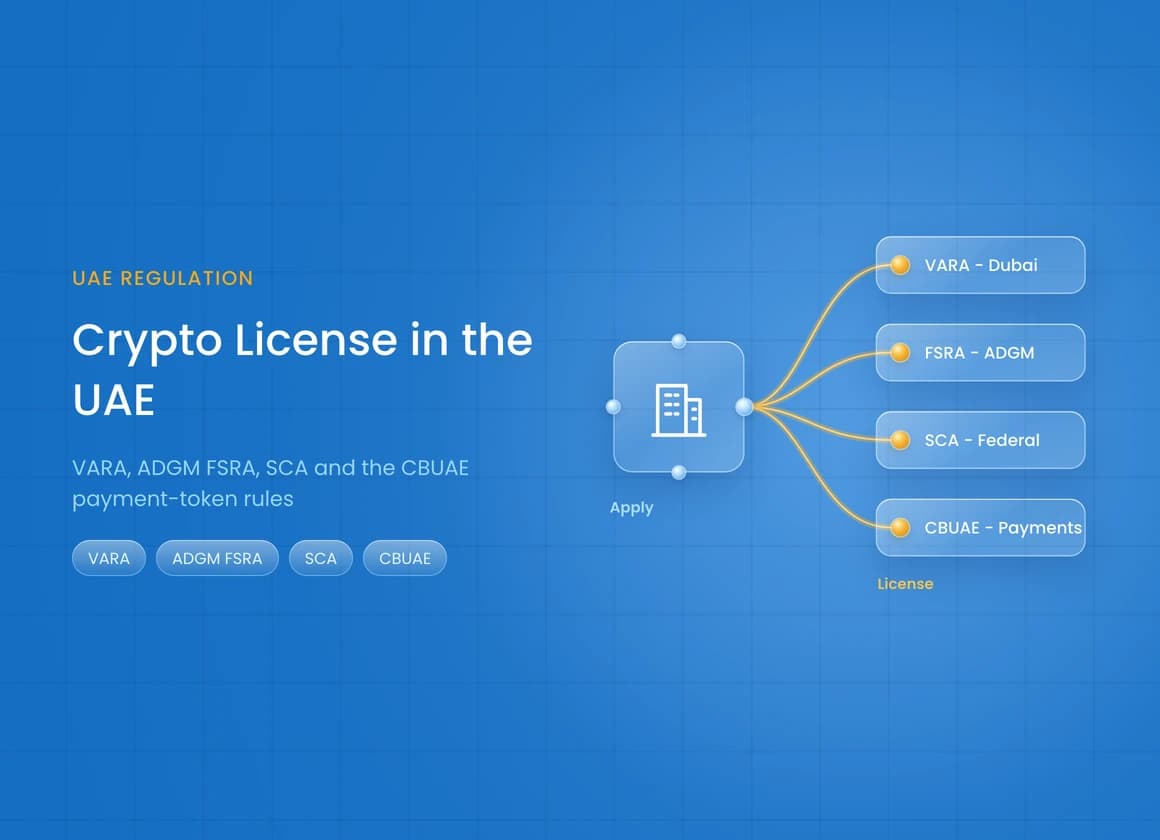

The UAE is not one crypto jurisdiction with one license. It is four regulators, each with its own rulebook and its own territory, and the first real decision in any UAE crypto license project is figuring out which one actually applies to you. Get that wrong and the rest of the application, the AML program, the office lease, the compliance officer, is built for the wrong regulator.
This guide maps the four regulators as they stand in October 2026, then walks through what applying actually involves. We first covered this with crypto lawyer Ivan Herasymenko in a video podcast; the regulatory specifics in that conversation predate the 2025-2026 rulebook updates below, but the fundamentals of structuring a UAE crypto business that he covers still hold.
Four Regulators, Four Territories
Each UAE jurisdiction licenses virtual asset activity separately, and a license from one does not automatically cover the others:
| Regulator | Territory | Covers |
|---|---|---|
| VARA | Dubai, excluding the DIFC | Virtual asset service providers: exchanges, brokers, custodians, advisors and issuers |
| FSRA (ADGM) | Abu Dhabi Global Market | Virtual assets, fiat-referenced tokens and digital securities under a Financial Services Permission |
| SCA | Mainland UAE and other commercial free zones | The federal Crypto Assets Regulation, in force since 2020 |
| DFSA | Dubai International Financial Centre (DIFC) | Financial services, including digital assets, within the DIFC free zone |
The CBUAE adds a fifth layer that cuts across all of the above except DIFC and ADGM: a separate regulation for payment tokens, covered below, that applies regardless of which authority licenses your core virtual-asset business.
VARA: Dubai's Dedicated Virtual Asset Regulator
VARA operates under the Virtual Assets and Related Activities Regulations 2023 and licenses eight categories of activity, per its own published FAQ: VA Advisory, VA Broker-Dealer, VA Custody, VA Exchange, VA Lending and Borrowing, VA Management and Investment, VA Transfer and Settlement, and VA Issuance (Category 1 issuances need a full license; Category 2 issuances need approval rather than a license). VARA's position is that no virtual asset activity in Dubai is exempt from oversight, it requires a license, a registration, or a no-objection certificate in every case.
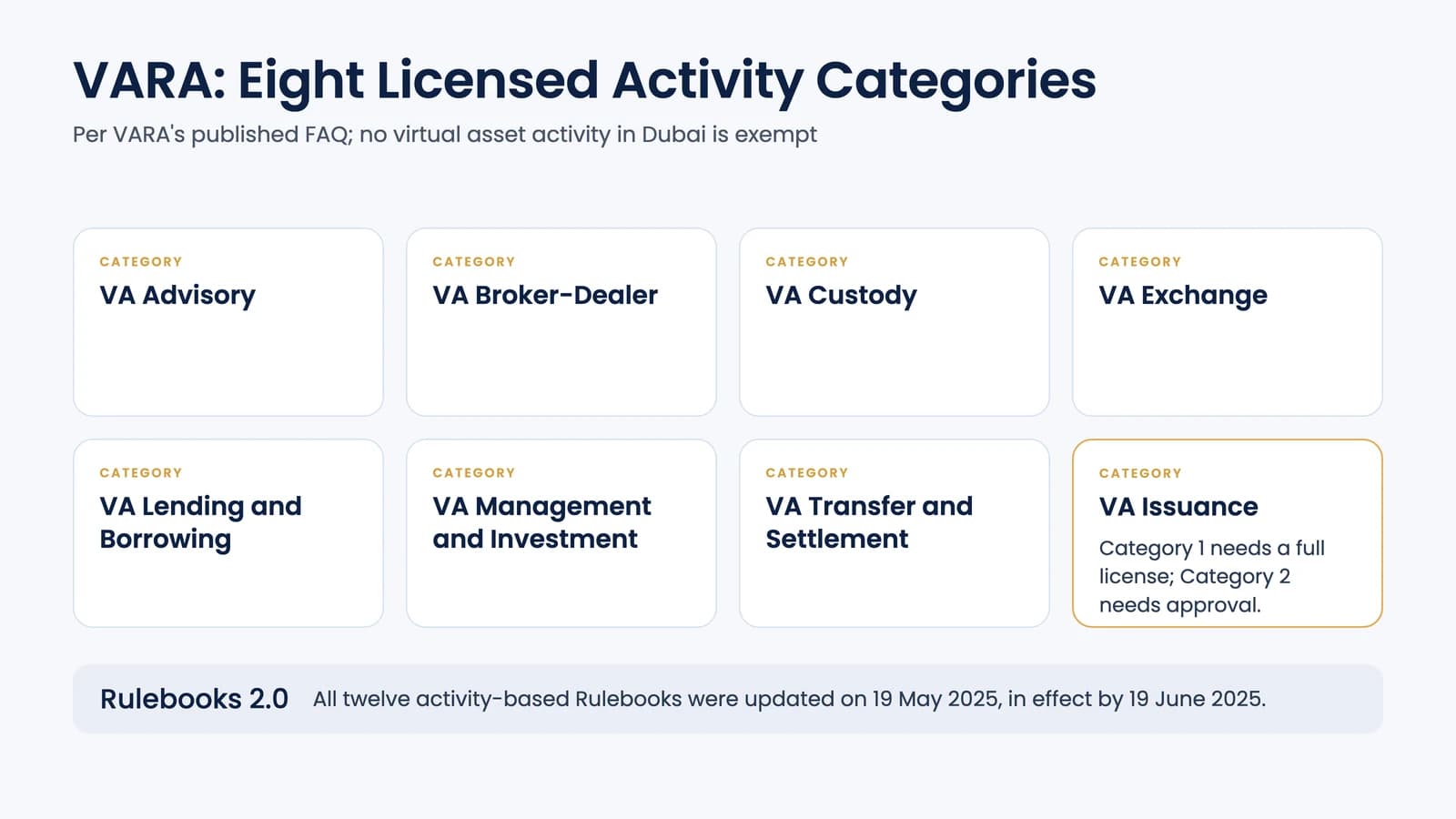
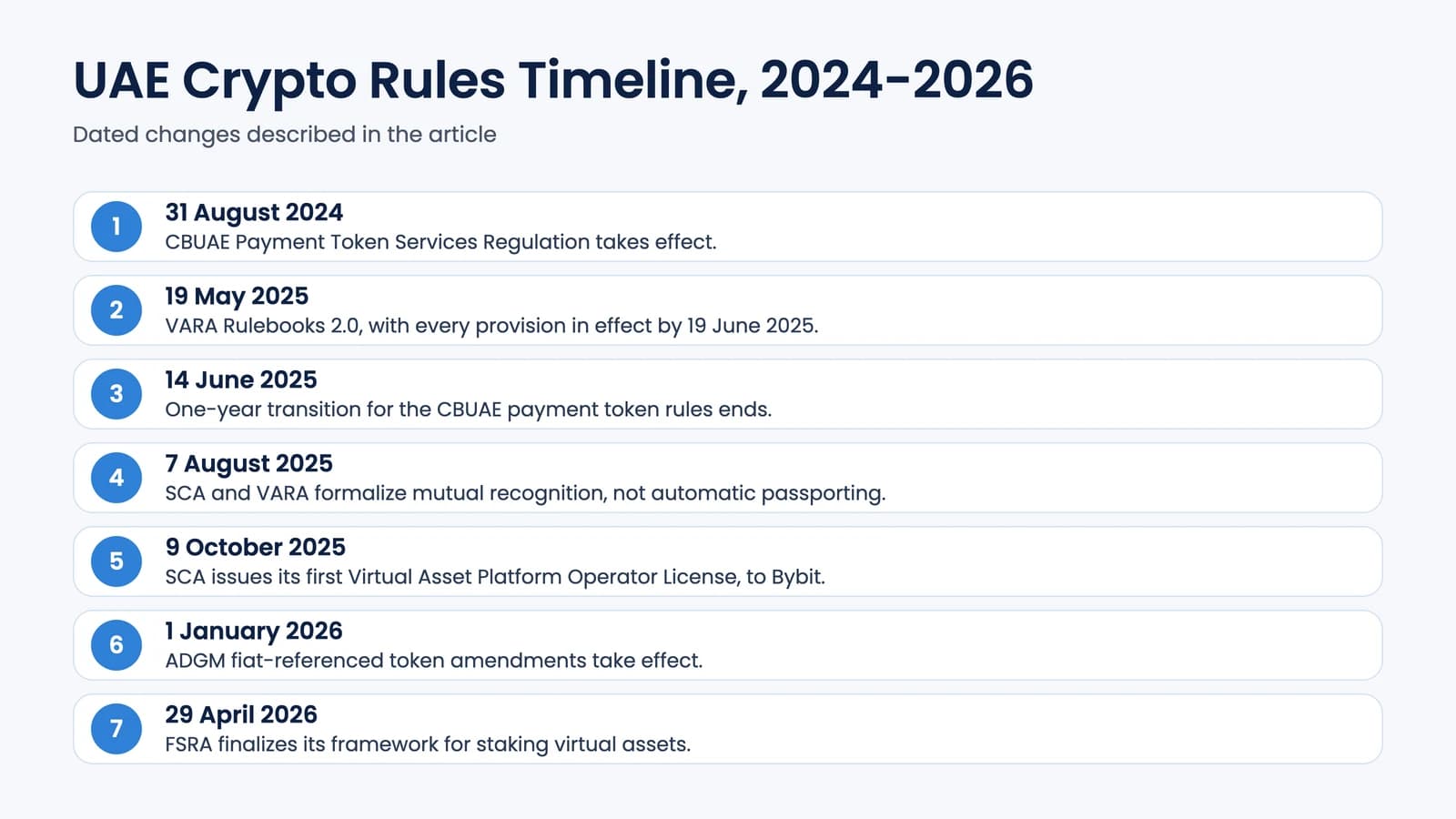
VARA updated all twelve of its activity-based Rulebooks to version 2.0 on 19 May 2025, with every provision in effect by 19 June 2025, so any plan built against an older rulebook needs a fresh read. VARA's own FAQ page is the primary source for current activity categories; minimum capital and fee requirements differ by activity and change as the Rulebooks are updated, so confirm the current figures directly with VARA or a licensed UAE corporate services provider before budgeting rather than relying on a third-party estimate.
ADGM's FSRA: Abu Dhabi's Framework
In the Abu Dhabi Global Market, the Financial Services Regulatory Authority licenses virtual assets, fiat-referenced tokens and digital securities, along with derivatives and funds linked to them, under a Financial Services Permission. The framework has moved quickly through 2026: fiat-referenced token amendments took effect on 1 January 2026, and on 29 April 2026 the FSRA finalized a regulatory framework for staking virtual assets, setting reward limits, client disclosure rules and reporting requirements for authorized entities that stake client assets.
The Federal Layer: SCA and the CBUAE
The Securities and Commodities Authority has run a federal Crypto Assets Regulation since 2020, covering mainland UAE and commercial free zones outside Dubai, ADGM and the DIFC. On 7 August 2025, the SCA and VARA formalized a partnership that establishes mutual recognition between the two regulators, not automatic passporting: a VASP licensed by one can be recognized by the other, but each case still goes through that regulator's own AML and compliance checks.
The SCA issued its first Virtual Asset Platform Operator License under this framework to Bybit on 9 October 2025, following an in-principle approval from February 2025, according to the exchange's own press release. It is the clearest public example so far of the SCA route actually being used for trading, brokerage, custody and fiat conversion rather than staying a paper framework.
The CBUAE's Payment Token Services Regulation sits outside the VASP licensing picture entirely. It took effect on 31 August 2024, covers the whole UAE except the DIFC and ADGM, and its one-year transition period ended on 14 June 2025. It defines three categories of regulated activity, payment token issuance, conversion and custody and transfer, and applies to anyone issuing or servicing a dirham-referenced or other payment-purpose token, separately from whatever VASP license covers their exchange or custody business.
What Getting Licensed Actually Takes
- Incorporate in the relevant jurisdiction, through the Department of Economy and Tourism for mainland Dubai or the appropriate free zone authority for VARA, or directly in ADGM for an FSRA application.
- Secure a genuine, leased physical office; VARA explicitly requires this rather than a virtual address.
- Stand up an AML and KYC program before applying: transaction monitoring, customer due diligence, a named compliance officer and a suspicious-activity reporting process.
- Apply to the correct regulator for your activity and territory, not the one with the most name recognition.
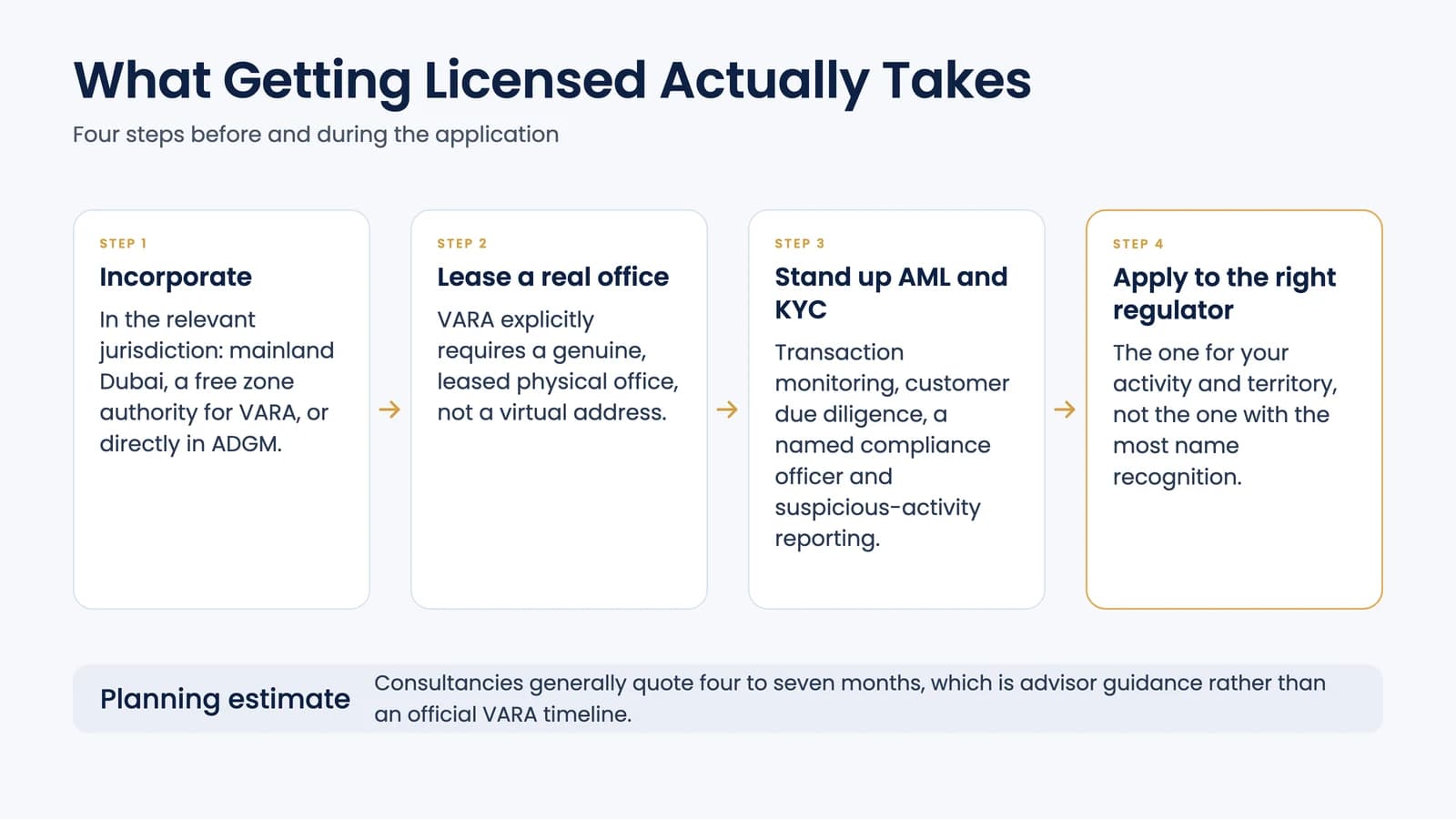
Licensing consultancies tracking VARA applications through 2026 generally quote four to seven months from initial application to a full VASP license; treat that as a planning estimate from advisors, not an official VARA timeline, since it depends heavily on how complete the AML program is on day one.
Building a Crypto Business in the UAE
A license is the regulatory half of the picture. The operational half, picking a banking partner, structuring custody, deciding what to build in-house versus license, is covered in our guides on how to build a crypto bank and on banks that work with crypto businesses. For the broader question of which license type your product needs anywhere, not only in the UAE, see our overview of fintech and crypto licensing types.
Watch: The Original Video Podcast
Our conversation with crypto lawyer Ivan Herasymenko, CEO of IN SE Corporate Services Providers in Dubai, covers the practical side of structuring a crypto business in the UAE, including the challenges banks in particular face when applying. The specific rules discussed predate the VARA Rulebooks 2.0 update and the 2025-2026 ADGM and CBUAE changes above, so treat the regulatory detail in the video as historical context and the sections above as current.
Conclusion
Four regulators, one federal and three territorial, cover UAE crypto activity, plus a fifth, UAE-wide rule for payment tokens specifically. Matching your activity and jurisdiction to the right one first saves months of rework later. Rulebooks, fees and capital requirements all moved during 2025 and 2026, so treat any UAE license guide, including this one, as a starting point to verify with the regulator before you file.
Learn more from us
 08 Oct 2026
Types of Licenses for Your Fintech Business: EMI, PSP and Crypto Licenses
EMI, PSP, MiCA CASP and MSB licenses compared: what each allows, capital needs, the end of MiCA transition, and UK, UAE and Canada rules.
Davyd Davyskyba
 Bank08 Oct 2026
How to Build a Crypto Bank in 2026: A Step-by-Step Guide
How to build a crypto bank in 2026: choose a model and license, design ledger and custody, build in compliance, then go custom or white-label.
Andrew Klesov
 Bank29 Sept 2026
Top 12 Best Crypto-Friendly Banks Worldwide in 2026
The 12 best crypto-friendly banks in 2026 for startups and crypto businesses — what each offers, who it fits, and how to evaluate one for your project.
Olena Petrashchuk
Structuring a crypto business for the UAE market?
Our team builds the technology side, exchange, custody, wallet or compliance tooling, that a UAE license application needs to stand on. Let's talk through your structure.
FAQ
It depends on where you operate: VARA for Dubai outside the DIFC, the FSRA for the Abu Dhabi Global Market, the DFSA for the DIFC, and the SCA for mainland UAE and other commercial free zones. If you issue or service payment tokens, the CBUAE's Payment Token Services Regulation applies UAE-wide except in the DIFC and ADGM, on top of whichever VASP license covers your core business.
Licensing consultancies tracking 2026 applications generally cite four to seven months from initial application to a full VASP license. That is a planning estimate from advisors, not an official VARA figure, and it depends heavily on how complete your AML program is when you apply.
Yes. VARA, the FSRA and the SCA all require incorporation in their respective jurisdictions, and VARA specifically requires a genuine leased office rather than a virtual address.
A VARA license covers virtual asset activities such as exchange, custody, brokerage or advisory services in Dubai. The CBUAE's Payment Token Services Regulation is a separate, UAE-wide rule specifically for issuing, converting or custodying payment tokens, and applies on top of a VASP license rather than instead of it.