

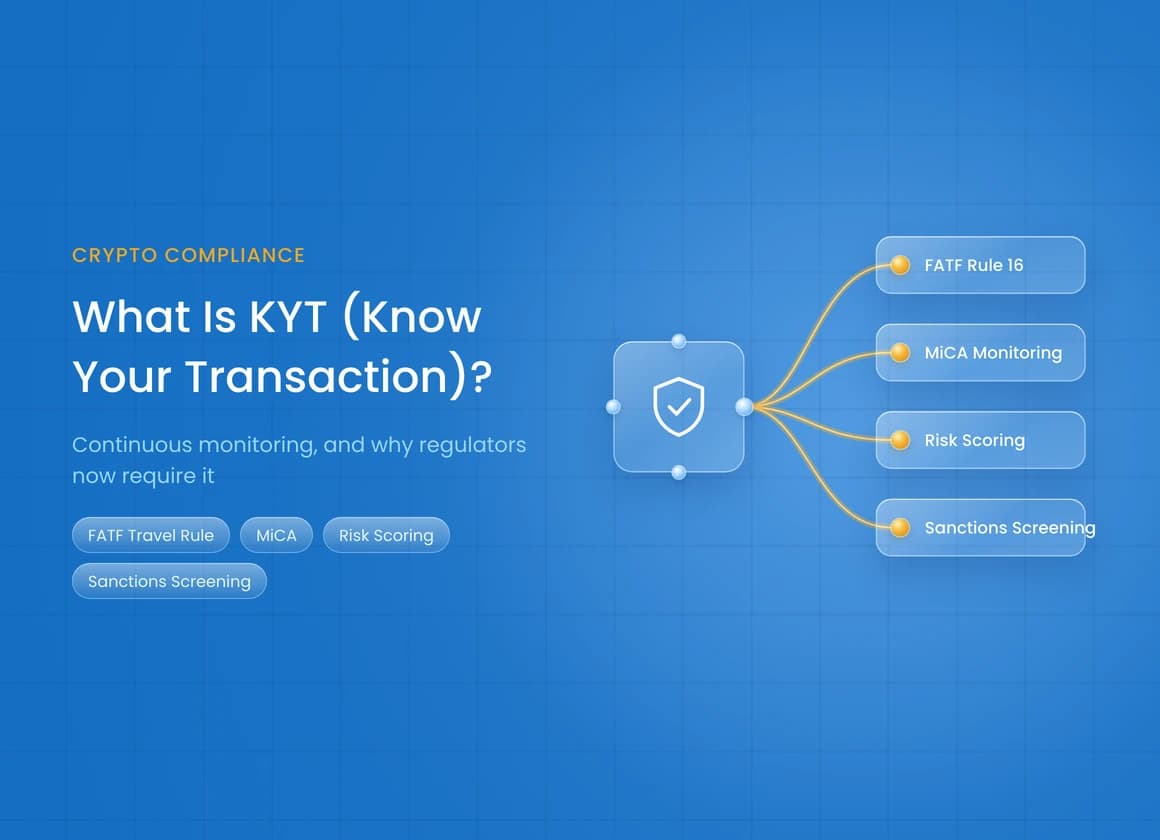

Know Your Transaction (KYT) is the name the crypto industry now uses for continuous, automated monitoring of blockchain transactions, built to catch illicit activity that onboarding checks never see. It grew out of a literal product name Chainalysis KYT, launched in 2019, and the term has since become generic across the industry, the way Elliptic and other vendors use it.
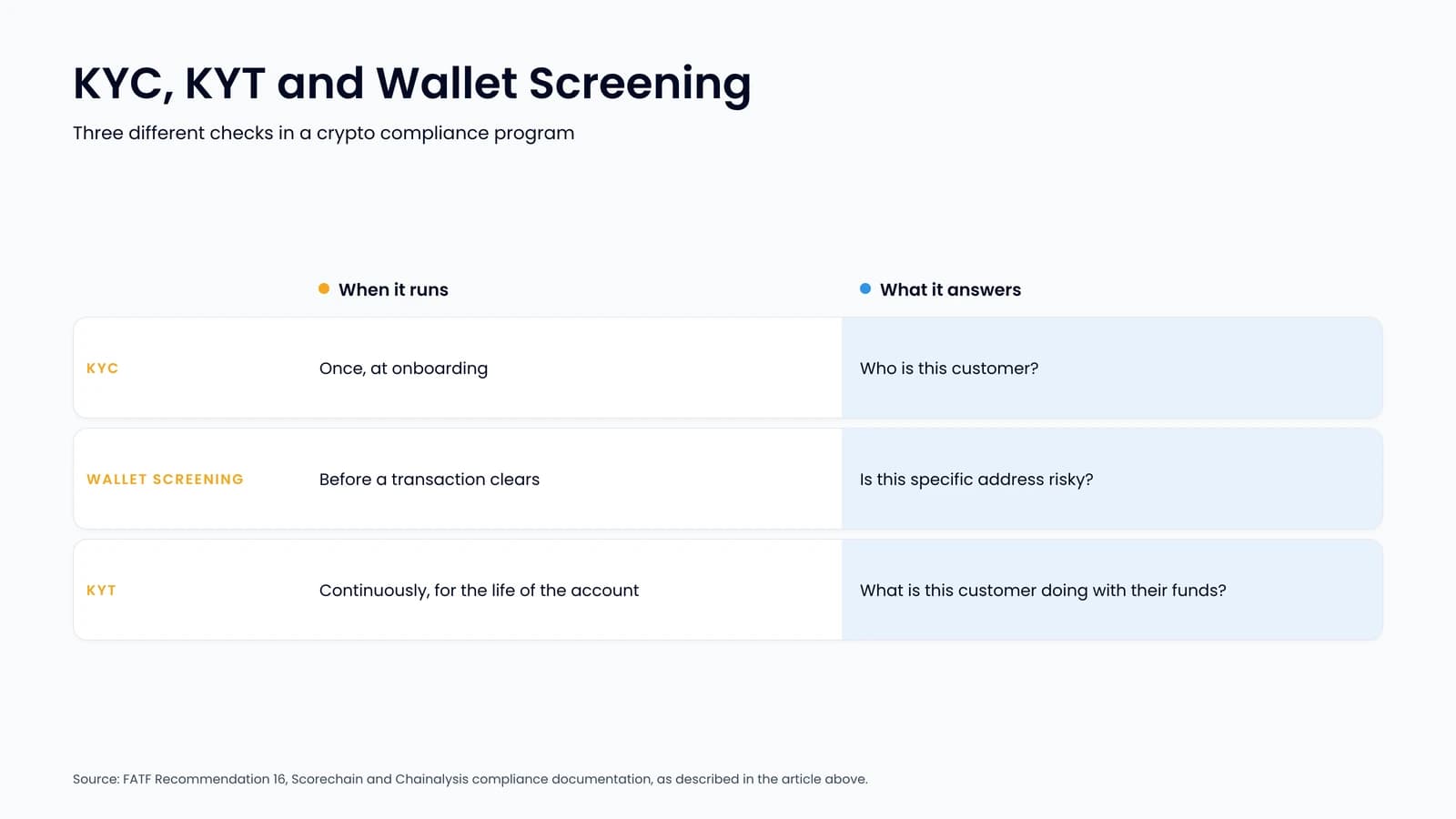
KYC verifies who a customer is at onboarding. KYT watches what that customer's funds do afterward, for as long as the account exists. A wallet can pass every KYC check on day one and still receive funds from a sanctioned address on day ninety; KYT is the control built to catch that second case.
KYT vs. KYC: two different jobs
The two checks sit next to each other in a compliance program but answer different questions:
- KYC verifies identity once, at onboarding: a government ID, a liveness check, sometimes proof of address.
- KYT monitors behavior continuously: every transaction a wallet sends or receives, scored for risk and checked against sanctions and known illicit addresses.
- Wallet screening sits between the two: a point-in-time check of a specific address before a transaction clears it.
A crypto exchange or bank that only runs KYC at signup has a blind spot that lasts the entire lifetime of the account. Regulators now expect the monitoring layer as well.
Why regulators require it
Three rules drive most KYT deployments in 2026:
- FATF Recommendation 16 (the "Travel Rule") requires a virtual asset service provider to pass originator and beneficiary information to the counterparty institution on every transfer. 83% of surveyed jurisdictions had passed Travel Rule legislation as of July 2026, up from 73% in 2025, though enforcement still varies by country.
- The EU's Transfer of Funds Regulation, in force since 2024 under MiCA, applies the rule from the first euro: there is no minimum-value exemption, unlike the USD/EUR 1,000 threshold FATF itself recommends.
- MiCA requires every licensed crypto-asset service provider in the EU to run ongoing transaction monitoring, not just onboarding checks, as part of its AML obligations.
US exchanges face the equivalent obligation through FinCEN's recordkeeping and travel rules, and UK-licensed firms through the Money Laundering Regulations 2017. The jurisdictions differ; the requirement for continuous monitoring, not a one-time check, does not.
How KYT actually works
A KYT platform ingests transaction data straight from supported blockchains and compares every address against a database of labeled entities: exchanges, mixers, darknet markets, ransomware wallets, sanctioned addresses. Vendors differ in scale and depth, but the mechanics are similar across the market:
- Entity attribution. Wallet addresses are matched to known categories, exchanges, OTC desks, sanctioned entities, so a transfer involving a flagged address triggers a review before it shows up in an audit.
- Multi-hop tracing. Funds that pass through two or three intermediate wallets before reaching a flagged address still carry risk, so KYT tools trace exposure several hops back and do not stop at the immediate counterparty.
- Risk scoring. Instead of flagging every transaction, the system assigns a score and routes only high-risk activity to a human analyst, which is what keeps false-positive rates manageable at exchange volume.
- Retroactive re-scoring. When a new address gets labeled as sanctioned or compromised, a KYT platform re-evaluates past transactions that touched it, not only new ones going forward.
Who builds this
The market has a handful of specialists. Chainalysis KYT and Elliptic are the two names most exchanges evaluate first; both price enterprise contracts for exchanges and financial institutions; neither publishes a list price. Global Ledger, a Swiss blockchain-analytics firm founded in 2019, runs a smaller but actively growing KYT product aimed at banks and fintechs entering crypto, built around a database it says covers more than 2,000 digital assets. Telindus, a Luxembourg systems integrator, sells a KYT module alongside its DigitalKYC onboarding platform, aimed at banks that want the two checks from one vendor.
None of this is free: a KYT contract at exchange scale typically runs in the tens of thousands of dollars a year and up, which is why most smaller platforms buy a monitoring product and reserve engineering effort for the parts specific to their own risk model.
Why risk scoring matters more than blanket blocking
A system that flags every transaction touching a high-risk category drowns compliance teams in alerts and frustrates legitimate customers, an effect analysts call over-detection. NetGuardians, a Swiss vendor whose behavioral-analytics platform targets traditional bank fraud rather than crypto specifically, reports that banks using its real-time monitoring cut false alerts by up to 83% and spend up to 93% less analyst time chasing them (vendor-reported figures, published on its own site as of 2026). The same logic applies inside crypto KYT: a platform that scores risk and only escalates the worst cases keeps the compliance team focused on the transactions that actually warrant a look.
What a KYT integration actually involves
For a product team, adding KYT to an exchange, wallet, or cryptobank is less about choosing a vendor and more about wiring its output into decisions your platform already makes:
- Deciding which risk score blocks a withdrawal automatically versus routes to manual review, and documenting that threshold for your regulator.
- Building the case-management workflow compliance staff use when a transaction is flagged, including how long a hold can legally last before you must release or report it.
- Keeping screening and transaction monitoring in sync so a wallet rated high risk at onboarding does not get a clean read from the transaction monitor only because it has not transacted yet.
- Logging every decision in a form your regulator can audit, since the Travel Rule and MiCA both expect you to show your monitoring worked, not just that you own a license for a tool that could have.
This is the part of KYT that a vendor contract does not solve on its own, and it is usually the larger share of the engineering effort in a real deployment.
Conclusion
KYT has moved from a vendor's product name to a baseline compliance control: FATF, MiCA and national regulators now expect continuous transaction monitoring as a matter of course, not a nice-to-have layered on top of KYC. For a crypto exchange, bank or fintech, the hard part is rarely picking Chainalysis over Elliptic; it is wiring the monitoring output into a workflow that a regulator will accept as evidence of real oversight.
4IRE builds AML and transaction-monitoring integrations into the cryptocurrency exchange platforms and cryptobank products we develop for clients. If you are scoping a KYT integration or the compliance workflow around it, our financial software development team can help you plan it.
FAQ on KYT
KYT stands for Know Your Transaction: the continuous, automated monitoring of blockchain transactions for financial-crime risk, sanctions exposure and suspicious patterns, as distinct from the one-time identity check performed under KYC.
KYC verifies a customer's identity at onboarding, once. KYT monitors every transaction that customer's wallet sends or receives for the life of the account, which is why a wallet can pass KYC and still be flagged later by KYT when it interacts with a sanctioned address.
It depends on the jurisdiction, but the direction is the same everywhere: the FATF Travel Rule (Recommendation 16), the EU's MiCA and Transfer of Funds Regulation, and FinCEN's US rules all expect ongoing transaction monitoring, not only onboarding checks, from licensed virtual asset service providers.
Chainalysis KYT and Elliptic are the two vendors most exchanges evaluate first; Global Ledger and Telindus's DigitalKYC/KYT module serve banks and fintechs entering crypto compliance. Pricing is typically a custom enterprise contract rather than a published list price.