

The Hidden Risks of SaaS for Tokenization and Investment Platforms
Businesses with a working concept often start with the SaaS model as their first investment platform infrastructure. A SaaS-based tokenization platform is a cloud-based system that clients can access on a subscription basis or in a fee-based, revenue-share format to issue, manage, and trade tokenized assets. It provides the full developer toolkit, from the wallet layer and smart contract logic to compliance modules and data environment, accessible on a shared multi-tenant architecture.
The promise of SaaS is tangible: no need to hire an infrastructure team or invest six-figure sums into platform engineering. The time-to-market generally takes up to eight weeks. These benefits seem rational in a fast-paced market with tightening competition.
However, a closer look at the SaaS business model exposes the limitations and tokenization platform risks that not every founder is ready to tolerate. First, the architecture you use belongs to the vendor only, with clients exercising no control or ownership rights. Second, security risks are way higher for businesses using a shared infrastructure, so regulatory scrutiny or investor due diligence is hard to pass. Selling a business turns into a hassle, and fees mount as your platform grows.
At 4IRE, working across regulated financial infrastructure projects, we see founders make the same infrastructure decisions at similar points in time: once the concept is validated and first investors express interest, the question of fast platform launch becomes critical. The easiest solution for many is a SaaS-based tokenization platform. This article breaks down four key risks of launching a SaaS tokenization platform architecture to show why this decision carries more structural risk than it appears.
What ‘Building on SaaS’ Actually Means for a Financial Platform
When a financial platform is built on SaaS, in literal terms, it means that the client has zero control or ownership of the entire underlying infrastructure. The SaaS model works as follows: the vendor allows clients to rent its proprietary core operational layer, which includes wallets, transaction logic, compliance workflows, and investor data. At times, the client has no control over smart contracts, with the vendor controlling the full environment. Thus, the only dimension of business operation in which clients exercise authority is the interface.
SaaS is not uniform, with several architectural patterns possible:
- White-label SaaS. A widespread market offer is a fully packaged platform, with ready-made issuance engine, investor portal, and secondary market features. Front-end customization is available to match the platform to customer branding, but vendor dependency is total. The client’s platform always remains the vendor’s platform.
- API-dependent Builds. This SaaS design is more sophisticated, but it also comes with a high dependency level. The client receives control over front-end design and UX, but the core modules, like KYC/AML verification, wallet custody, and payment rails, are outsourced to third-party vendors. This way, the SaaS dependency financial platform operates as a proprietary software product until providers change the terms of service or exit the market.
No-Code or Low-Code Environments. This is the fastest-growing segment of the tokenization platform architecture market. These tools unlock RWA tokenization platform design possibilities to non-technical teams. Still, structural dependency is profound: the client’s infrastructure exists within the vendor’s broader environment. Thus, clients receive no independent codebase or portable data architecture. In practice, it means rebuilding the SaaS tokenization platform from scratch if the client decides (or is urged to) switch vendors.
While some differences between these architecture patterns make a difference, they share one overarching limitation: no control over the infrastructure. This makes the SaaS pathway unsuitable for an institutional tokenization platform, which requires auditable code and due diligence.
Why Does SaaS Look Like the Right Choice at Launch?
Opting for the SaaS blockchain platform infrastructure at the MVP stage is acceptable because it comes with lower upfront costs and faster time to market. Yet, it is suitable only for the project’s phase at which you validate a concept, test distribution, and attract early investors. SaaS is fine for the Proof-of-Concept (PoC) work, but as soon as your project passes on to real asset processing, raising institutional capital, and licensing, SaaS is no longer an option.
| Dimension | SaaS | Module Deployment |
|---|---|---|
| Infrastructure ownership | Vendor-owned; client has no title to underlying systems | Client owns and controls the full environment |
| Security responsibility | Shared model; vendor sets baseline security posture | Client defines and enforces security architecture end-to-end |
| IP / source code | Source code belongs to vendor; client holds a license | Client owns codebase or holds transferable IP rights |
| Investor due diligence | Vendor dependency visible in data room; material risk flag | Clean ownership structure; auditable and self-contained |
| Margin structure | Vendor takes ongoing percentage or seat fee; margin erodes at scale | Fixed or amortized deployment cost; margin improves at scale |
| Regulatory audit trail | Audit data held in vendor environment; extraction may be contractually constrained | Audit trail fully within client's control; accessible on demand |
| Exit / migration path | Migration requires rebuilding core functions; data portability often limited by contract | Full data portability; stack transfers with the business |
Risk #1. The Shared Breach Problem: One Vulnerability, Every Client Exposed
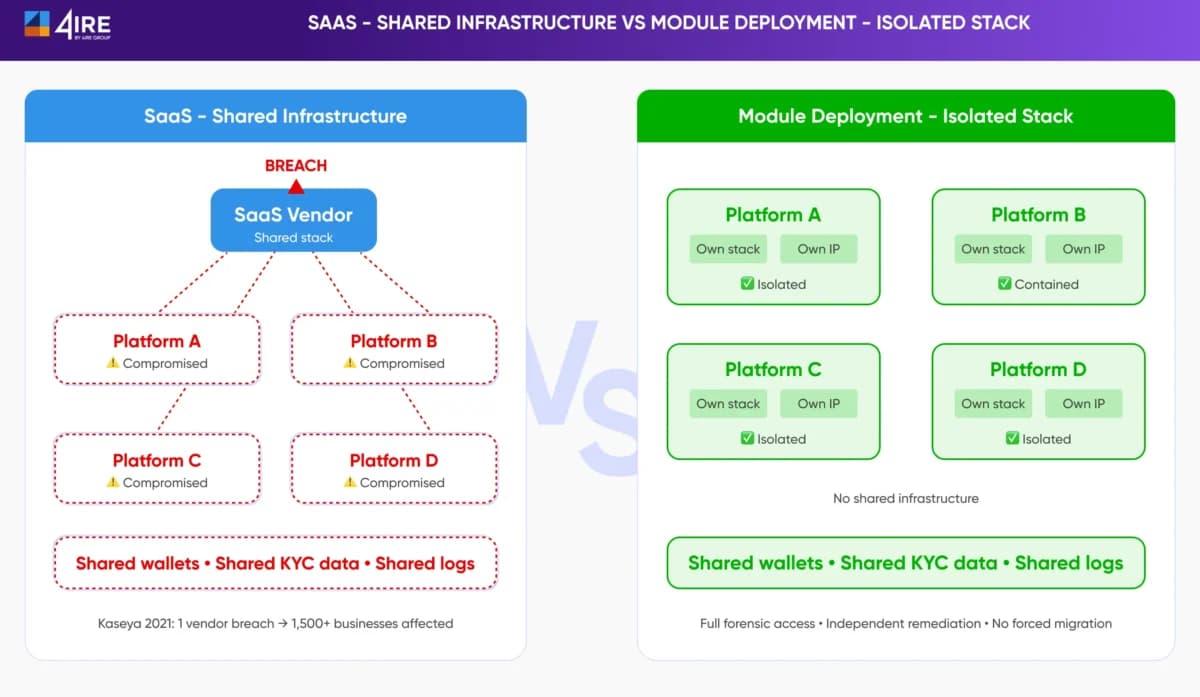
Many investors approach the security question from the wrong perspective, focusing solely on ISO 27001 certification and SOC 2 compliance. While these issues are of core importance, the architectural aspect of the SaaS tokenization platform security is far more complicated. The multi-tenant environment always creates shared infrastructure risk, which makes a single vulnerability in the common architecture layer a problem for every client.
SaaS security vulnerability may affect wallets, transaction records, KYC documentation, or investor data. As tenants’ rented spaces are separated from each other with logical partitions instead of comprehensive architectural isolation, the platform may be unable to contain damage. If a tokenization platform operates on DIFC or ADGM licenses, the blockchain investment platform breach causes massive reputational damage to companies because of the mandatory regulatory disclosure requirement.
The notorious case of the 2021 Kaseya VSA supply chain attack, which compromised over 1,500 businesses operating on its infrastructure, illustrates the risk perfectly. A single software update failure at Solar Winds in 2020 led to a breach that affected 18,000 organizations. Each of these attacks was massive in scale and damage because they targeted a shared infrastructure layer instead of focusing on concrete clients.
What Happens When Your SaaS Tokenization Provider Gets Breached?
As soon as the breach is confirmed on the vendor’s level, none of its clients can evaluate forensic data, determine the scope of their exposure to the vulnerability, or isolate their environment from the affected infrastructure. In these cases, the only way out is reliance on the vendor’s capacity to act precisely and quickly. None of this happens on a dedicated infrastructure model, which ensures independent forensic investigation for every client, provides an internal remediation timeline, and guarantees the highest level of accountability and transparency.
Risk #2. Why SaaS-Built Platforms Fail Institutional Due Diligence
The tokenization platform investor due diligence employed by institutional capital investors goes far beyond pitch decks. Infrastructure is subjected to in-depth scrutiny before a regulating authority issues a license or a serious investor commits to tokenization on this platform. The due diligence protocol unchangeably includes the question of control:
- Who owns and controls the core infrastructure?
- Can the platform exhibit clean, scalable unit economics without flawed dependencies?
- Does the operator hold IP ownership rights?
SaaS models fail these checks, which makes their environments unsuitable for the setup of an institutional tokenization platform. According to a recent Gartner report, 73% of organizations cited vendor lock-in as a primary concern of SaaS. The 2023 IBM Cost of a Data Breach Report evaluated an average breach at $4.45 million, including regulatory fines, license revocation, and reputational costs.
Another barrier for institutional adoption is the SaaS fee structure. Vendors charge several fees, commonly including the flat platform use fee, the per-transaction charge, and the primary issuance commission of 1-3% of the raised capital sum. Some platforms also add the ongoing AUM fee and commissions calculated based on the total assets in the client’s management. This multi-tier fee structure makes the operating leverage curve unfit for institutional scale. Thus, the SaaS margin structure and costs are a failing financial model for businesses built with long-term development trajectories. Exit strategy is also too costly and problematic for institutional investors to regard SaaS seriously.
Why Do Institutional Investors Flag SaaS Infrastructure During Due Diligence?
The SaaS infrastructure is unsuitable for institutional investors because of three core weaknesses. Ownership remains in the vendor’s hands, which reduces the platform’s valuation and affects the blockchain investment platform cash flow. Portability is another limitation, making migration problematic. The auditability problem is a matter of compliance-related caution, with absent audit trails challenging licensure.
Risk #3. The Margin Trap: How SaaS Pricing Erodes Platform Economics
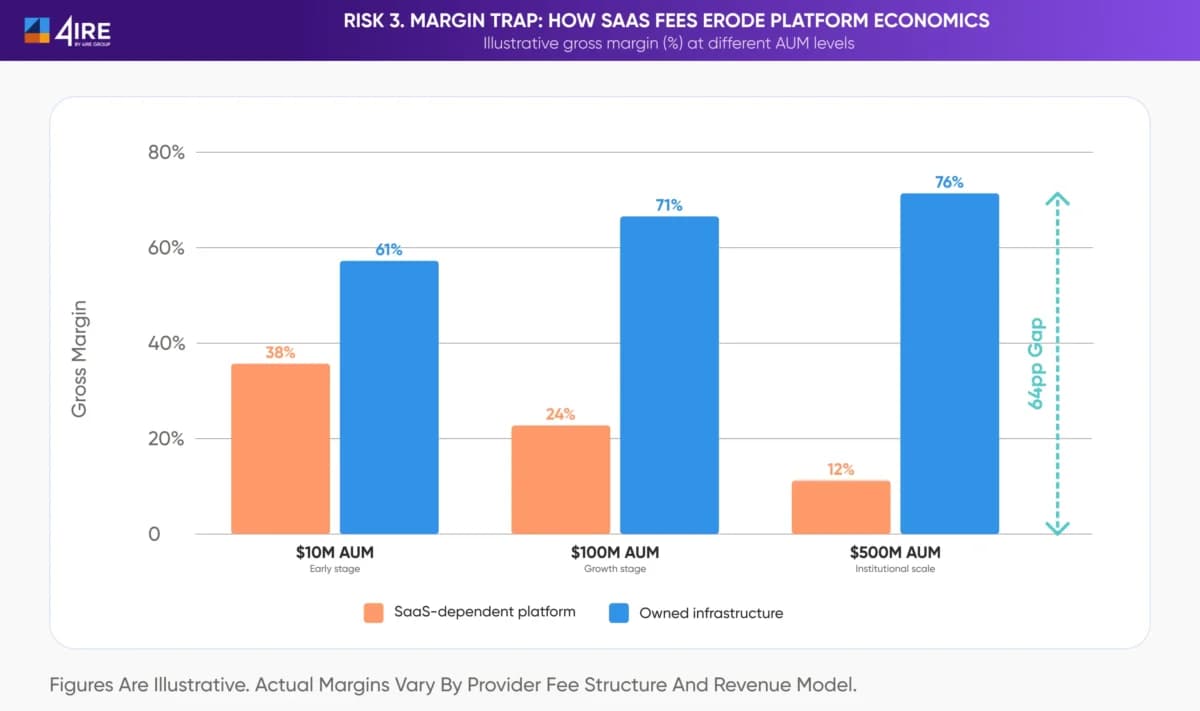
The tokenization platform scalability question is not as simple as it seems at first. The pricing structure of SaaS solutions looks affordable at first, but blockchain platform operating costs mount if your project is successful. Base subscription combines with transaction fees and charges per wallet, turning into unfavorable revenue-sharing arrangements. As soon as your transaction volume grows and more people join the platform, your fees play against growth rather than in its favor. At an institutional scale, the cost structure becomes totally unviable, with the SaaS fee structure eroding the operating leverage.
How Does SaaS Pricing Scale Against You?
The main paradox of the tokenization platform margin is that your revenues grow, but your margin doesn’t follow suit. The more successful your commercial strategy is, the greater your costs, which ruins the financial model of a volume-dependent business. Precise figures differ by provider, but the rule of thumb is to regard anything below $10 million AUM as a reasonable transaction volume for a SaaS dependency financial platform. Anything above requires an alternative solution to reach a margin profile that supports your steady revenue instead of eroding it.
Risk #4. Vendor Lock-In and the IP Ownership Problem
The blockchain platform vendor lock-in is also a significant issue with SaaS. Clients working with SaaS vendors have no smart contract ownership, cannot control the code that processes their transactions, don’t enforce compliance logic, and have no management rights in regard to investor wallets. Many treat tokenization platform IP ownership and license access interchangeably, and things may work smoothly for some time. However, the vulnerability of a vendor lock-in blockchain platform surfaces when the vendor decides to revise its fee structure or deprecates some features. The vendor’s acquisition by another firm may also change the equation, not in the client’s favor. All three risks are a common occurrence in the SaaS industry, and each points to the comparative benefit of opting for a custom tokenization platform from the very beginning.
What Happens When Your SaaS Vendor Gets Acquired or Shuts Down?
Business continuity can be seriously undermined when SaaS vendors leave the market or are acquired by larger businesses. As a rule, clients receive a 30- to 90-day migration notice, facing unpredictable costs and hassle. Core infrastructure migration is a very complicated process, with transaction engine redesign, re-establishment of the wallet architecture, and re-engineering of compliance workflows within tight timeframes. Those running an ADGM or DIFC blockchain investment platform also need to notify regulatory authorities and undergo a compliance check.
Why These Risks Are Amplified in the UAE and GCC
If you launch a tokenization platform UAE, all four risks discussed above become even more pronounced. The reason is the structural uniqueness of the operating environment that comes with certain implications for the GCC investment platform infrastructure. First, the regulatory architecture of ADGM and DIFC is quite tight on safety and resilience. The Financial Services Regulatory Authority and the Dubai Financial Services Authority require a solid degree of infrastructure control from platforms eligible for licensing. Requirements are as follows:
- The tokenization platform DIFC will license must be able to produce independent audit trails.
- The ADGM fintech infrastructure must comply with residency obligations.
- A licensed blockchain investment platform UAE must maintain operational continuity without dependency on third-party vendors.
The SaaS architecture, which gives clients no control over servers, is incompatible with residency obligations and audit trail licensing requirements, which authorities treat as GCC investment platform risks. Besides, the D33 tokenization infrastructure requirement treats technology sovereignty and domestic infrastructure capability as components of the broader economic strategy. In these circumstances, IP ownership stops being a risk management strategy and turns into the project’s alignment with the broader jurisdictional and regulatory requirements.
Why Are SaaS Risks Amplified for Platforms Operating in the UAE and GCC?
GCC tokenization platform due diligence procedures penalize SaaS by design because they prioritize infrastructure control that this model can’t give. Professional networks in the GCC are small and reputation-driven, so companies that can’t meet tokenization platform investor requirements fail licensing. Founders considering DeFi development in the GCC go beyond the build versus buy dilemma; they consider the project’s long-term development trajectory and the infrastructure risks, including mounting tokenization platform operating costs.
The Faster Alternative to Custom Development – RWA Tokenization Core
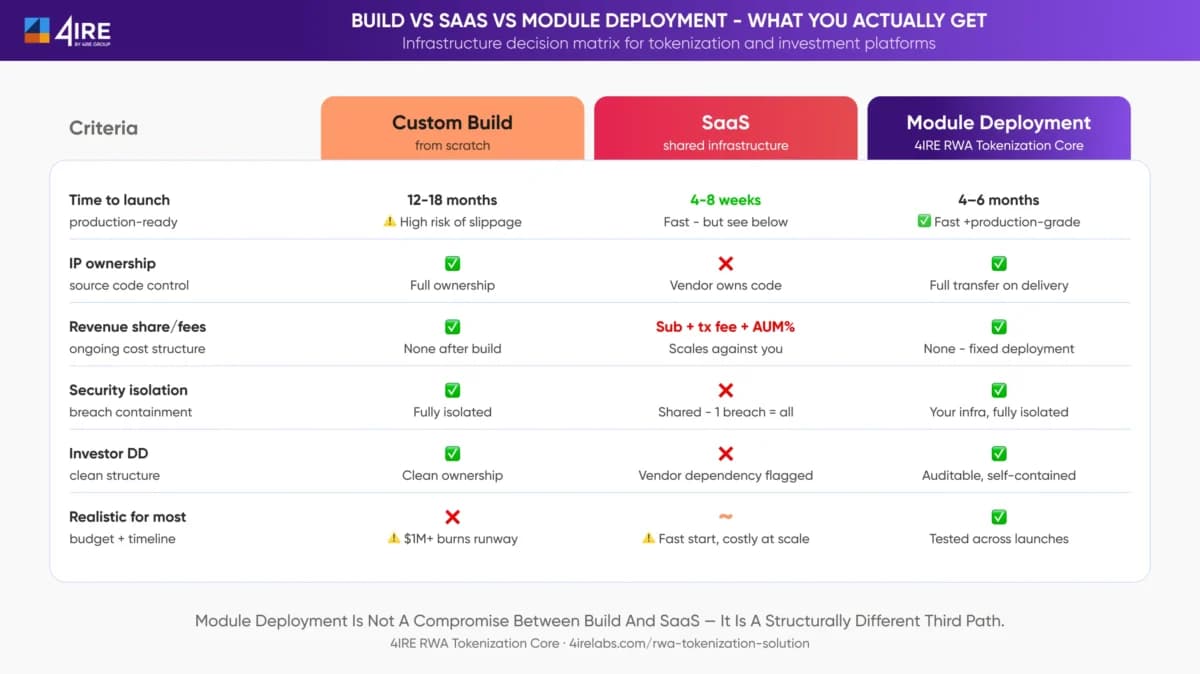
A logical answer to the four risks discussed above is to build a smart contract ownership platform that will comply with the IP ownership requirements of the RWA tokenization core. The problem is that engineering a custom tokenization platform from the ground up takes 12-18 months and millions of dollars in investment. This option comes with its risks as well; capital is consumed long before the project starts generating revenue, quickly evolving compliance requires the integration of adaptive design, and the launch window moves further as new market conditions emerge.
Projects not wishing to put up with SaaS dependencies and striving for genuine tokenization infrastructure sovereignty, but having no time and budget for custom development, can explore the third option – the RWA tokenization solution by 4IRE. The 4IRE RWA Tokenization Core contains pre-built, audited tokenization platform architecture modules, such as the token issuance engine, KYC/AML compliance tools, an investor portal, and revenue distribution automation features. Compliance is built on ERC-1400, ERC-3643, and ERC-20 formats, with production-grade infrastructure shipped as the client’s owned code.
The solution is widely customizable, making it suitable for green finance development and ReFi and carbon offsets tokenization. Other use cases include building a standalone, fully isolated carbon credit marketplace, which is a growing DeFi market segment with immense potential. The platform has already been used for gold tokenization, and more energy and real estate projects are underway.
4IRE’s RWA tokenization platform comes with no revenue-sharing requirements and presupposes full blockchain platform IP ownership transfer to clients. Once the platform is deployed, clients hold full control over their economics and margins. This peculiarity positions 4IRE’s software product as a true market differentiator, giving it the best of the SaaS and custom development worlds.
What Is the Difference Between SaaS and Pre-Built Module Deployment?
The distinction is structural; SaaS gives access to shared infrastructure on the vendor’s platform in a subscription format, which means clients simply rent the infrastructure. White-label module development is transferred to the client with fully IP ownership and code control. Under this arrangement, clients operate audited, production-ready code on their own infrastructures.
Conclusion
SaaS comes with tangible risks: shared breach exposure, investor due diligence failure, margin erosion, and vendor lock-in. A custom tokenization platform seems to be a solid alternative, but its costs and development duration place it out of reach for some projects. In the industry where infrastructure control turns into a strategic requirement, risking your reputation with SaaS is not the solution that blockchain investment platform investors will appreciate. The third way of white-label development that 4IRE guarantees with full IP ownership is a great alternative that meets the infrastructure control demands of licensing authorities and lets you launch a platform quickly.
Read our real-world asset tokenization guide to learn more about the industry and the technical capacity our tokenization platform architecture provides. You can always book a blockchain consulting session with our CTO, who will walk you through the technicalities of your business idea and match it to practical solutions.
FAQ on SaaS risks launching investment platform with tokenized assets
SaaS-based platforms pose four risks: exposure hazards associated with shared infrastructure tokenization, a higher risk for institutional investors resulting from a lack of infrastructure ownership, margin erosion at scale, and vendor lock-in that limits migration control and IP ownership.
It can, but the goal is harder to accomplish because institutional investors prefer tokenization platforms with full infrastructure ownership and IP control. SaaS infrastructure doesn’t meet these requirements, failing due diligence protocols of institutional investors and financial regulators.
SaaS deployment means that your tokenization platform runs on the vendor’s servers without access to the underlying code and audit possibilities. White-label tokenization platform deployment occurs on your own infrastructure, with pre-built, audited code customized to your business objectives and needs. The latter scenario gives full IP ownership, environment control, and excludes shared exposure.
SaaS platforms charge fees per transaction or per wallet, with commissions mounting at scale. At low volumes, the blockchain platform margin may seem manageable, but as your business crosses the $100M threshold, SaaS fees turn into the main expenditure.
Users of SaaS platforms typically receive 30-90-day migration notices. Migrating complex financial infrastructures without downtime and with full security of investor funds is unattainable within this timeframe.
Yes, SaaS infrastructure is generally incompliant with the ADGM and DIFC regulatory frameworks of the GCC and the UAE. The ADGM tokenization platform must guarantee data residency compliance and infrastructure control. Besides, a blockchain platform security breach that represents a typical SaaS risk is detrimental to the project’s reputation in tight UAE/GCC investment communities.
Custom development of the RWA tokenization infrastructure takes 12-18 months on average. You can save time by deploying pre-built, audited modules on fully owned infrastructure, such as 4IRE’s RWA Tokenization Core. It offers launch-ready token issuance, KYC/AML, and revenue distribution modules, as well as a customizable investor portal.
Evaluate your options across five dimensions: tokenization platform IP ownership, security guarantees, infrastructure ownership, regulatory auditability, and margin structure. Investment platform SaaS risks typically surface across all five aspects, pointing to the need for alternative solutions.