


Enterprises evaluating blockchain quickly run into a mismatch: public blockchains are built for openness, and most enterprise use cases need the opposite: known participants, controlled data visibility, and predictable governance. That's what permissioned blockchain frameworks are for. This guide covers what makes a framework enterprise-ready, how to evaluate one, and the three frameworks actually worth shortlisting in 2026.

Why Enterprises Choose Permissioned Blockchain
A public, permissionless network lets anyone join, read the ledger and, on most chains, help validate it. That openness is the point for a consumer dApp; it's a liability for a bank, an insurer or a supply-chain consortium that needs to control who can see a transaction. Permissioned blockchain gives enterprises the properties that made blockchain interesting (tamper-evident records, smart contracts, cryptographic verification) without opening the network to the public.
In practice, that trades off against the fully decentralized ideal, but it buys back what regulated industries actually need:
- Lower transaction cost, since consensus runs among a small, known validator set instead of a global network
- No single company controlling the ledger, even though membership is restricted
- Fewer manual reconciliation errors between counterparties, since everyone reads the same state
- Real-time, shared visibility into transactions for every permitted party
- Granular access control: different nodes can be restricted to different data or roles
- Regulatory and audit trails that satisfy compliance teams by design, not by retrofit
What a Framework Actually Gives You
None of the production permissioned networks in use today were built from scratch. Every one of them runs on a framework (the equivalent of choosing Django instead of writing your own web server). A framework handles consensus, node identity, network permissioning and smart-contract execution, so an enterprise team can focus on their application logic instead of reinventing distributed-systems plumbing that's already been solved and audited by a large open-source community.
This also means the framework decision is not purely technical. You are also picking a support model: who patches security issues, who maintains compatibility across upgrades, and whether a commercial vendor stands behind the open-source core if something breaks in production. The framework's governance answers that question as much as its architecture does.
How to Evaluate a Permissioned Blockchain Framework
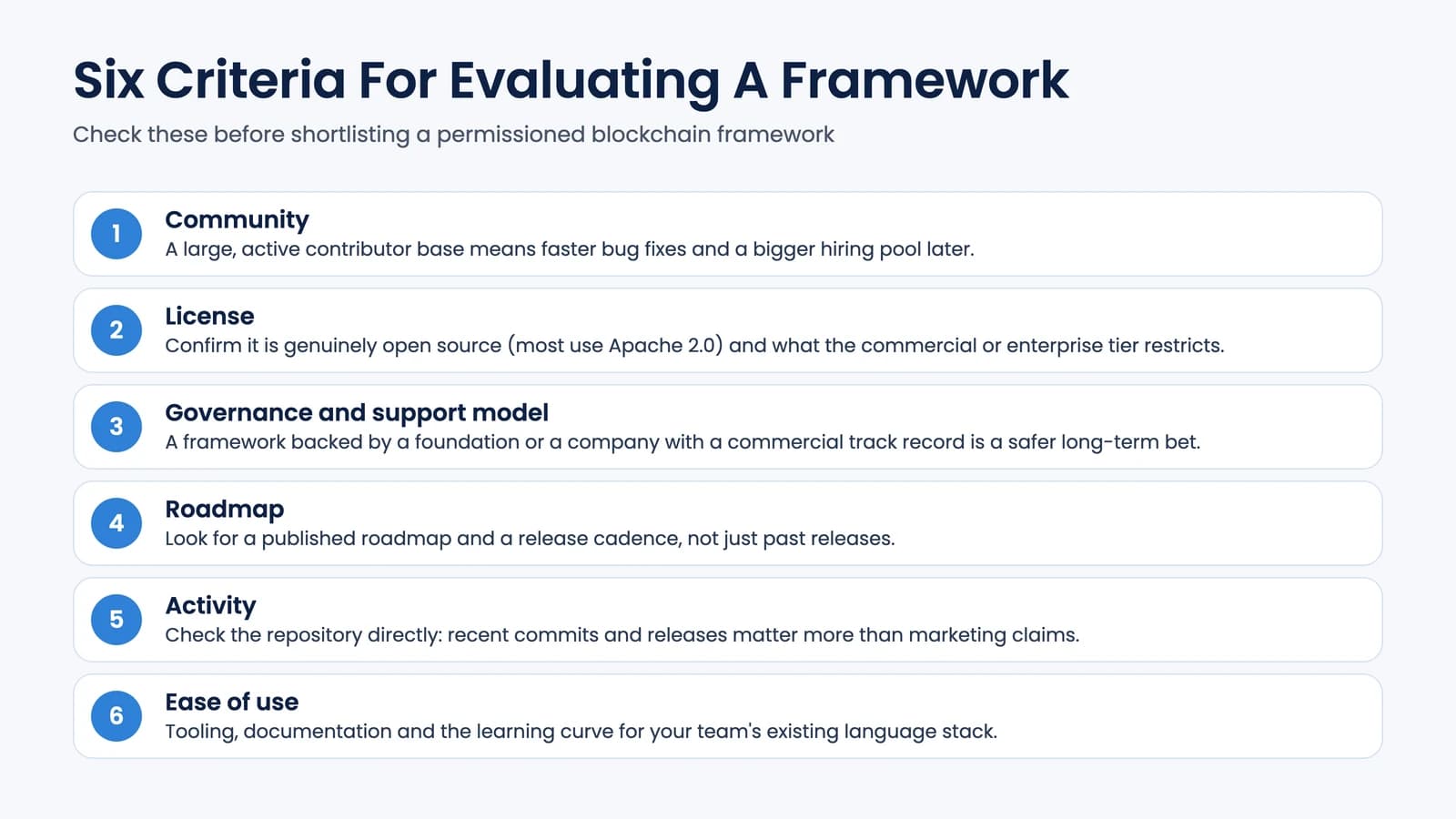
Before shortlisting a framework, check it against six criteria:
- Community. A large, active contributor base means faster bug fixes and a bigger hiring pool later.
- License. Confirm the framework is genuinely open source (most enterprise frameworks use Apache 2.0) and what, if anything, the commercial or enterprise tier restricts.
- Governance and support model. A framework backed by a foundation or a company with a commercial track record is a safer long-term bet than a single-vendor side project.
- Roadmap. Look for a published roadmap and a release cadence, not just past releases.
- Activity. Check the project's repository directly: recent commits and releases matter more than marketing claims.
- Ease of use. Tooling, documentation and the learning curve for your team's existing language stack.
The Frameworks Worth Knowing in 2026
The field has consolidated since permissioned blockchain first became an enterprise talking point in 2016–17. Several early frameworks have been discontinued or folded into others; three are worth a serious look today. Before shortlisting any of them, check the project's own repository and governance page directly (not a marketing page) for its most recent release, since “active” in an old blog post is not the same as active today.
Hyperledger Fabric
Hyperledger Fabric is the most established permissioned blockchain framework, first released in 2016 and now governed, alongside Hyperledger Besu and other projects, under LF Decentralized Trust, the Linux Foundation's umbrella for decentralized-technology projects that Hyperledger Foundation became part of in September 2024. Fabric now runs two supported release lines: 3.1.x is current, with the earlier 2.5.x line still receiving maintenance updates. Its defining feature is a modular, pluggable architecture: consensus, membership services and chaincode (Fabric's term for smart contracts, written in Go, Java or Node.js) are all swappable components, which makes Fabric adaptable across industries such as trade finance, supply chain and healthcare records, at the cost of a steeper setup than a single-purpose framework.
R3 Corda
Corda takes a different architectural approach: instead of broadcasting every transaction to every node, it shares data only between the specific parties involved in a deal, validated by notary nodes rather than a network-wide consensus vote. That makes it a strong fit for bilateral and multilateral financial agreements (trade finance, syndicated lending, insurance) where confidentiality between counterparties matters as much as trust in the record. We cover Corda's architecture and a real deployment in detail in why we chose Corda for a client project.
Hyperledger Besu
Hyperledger Besu is an Apache-2.0 Ethereum client, written in Java, that runs on both public Ethereum and private, permissioned networks with the same EVM and Solidity tooling developers already know. It has effectively become the default choice for enterprise Ethereum deployments: ConsenSys archived its GoQuorum client on 5 June 2026, stating plainly that GoQuorum “is no longer actively maintained or supported” and recommending against it for new projects. One of its own consensus protocols, QBFT, is interoperable with Besu, which is the natural migration path for teams still running it. Besu remains under active development and is one of the clients backing production and pilot deployments coordinated through the Enterprise Ethereum Alliance, the member-led standards body connecting institutions to Ethereum, whose members include major banks and infrastructure providers.
| Hyperledger Fabric | R3 Corda | Hyperledger Besu | |
|---|---|---|---|
| Governance | LF Decentralized Trust | R3 (commercial) + open-source core | LF Decentralized Trust |
| Ledger model | Shared ledger per channel | Point-to-point, notary-validated | Shared EVM-compatible ledger |
| Consensus | Pluggable (Raft, BFT) | Notary services (single node, Raft, BFT) | QBFT, IBFT 2.0, Clique |
| Smart contract language | Go, Java, Node.js | Java, Kotlin | Solidity |
| Native token | None | None | None (private); ETH-compatible (public) |
| Best fit | Cross-industry consortiums | Bilateral financial agreements | Teams that want Ethereum tooling privately |
How to Choose Between Them
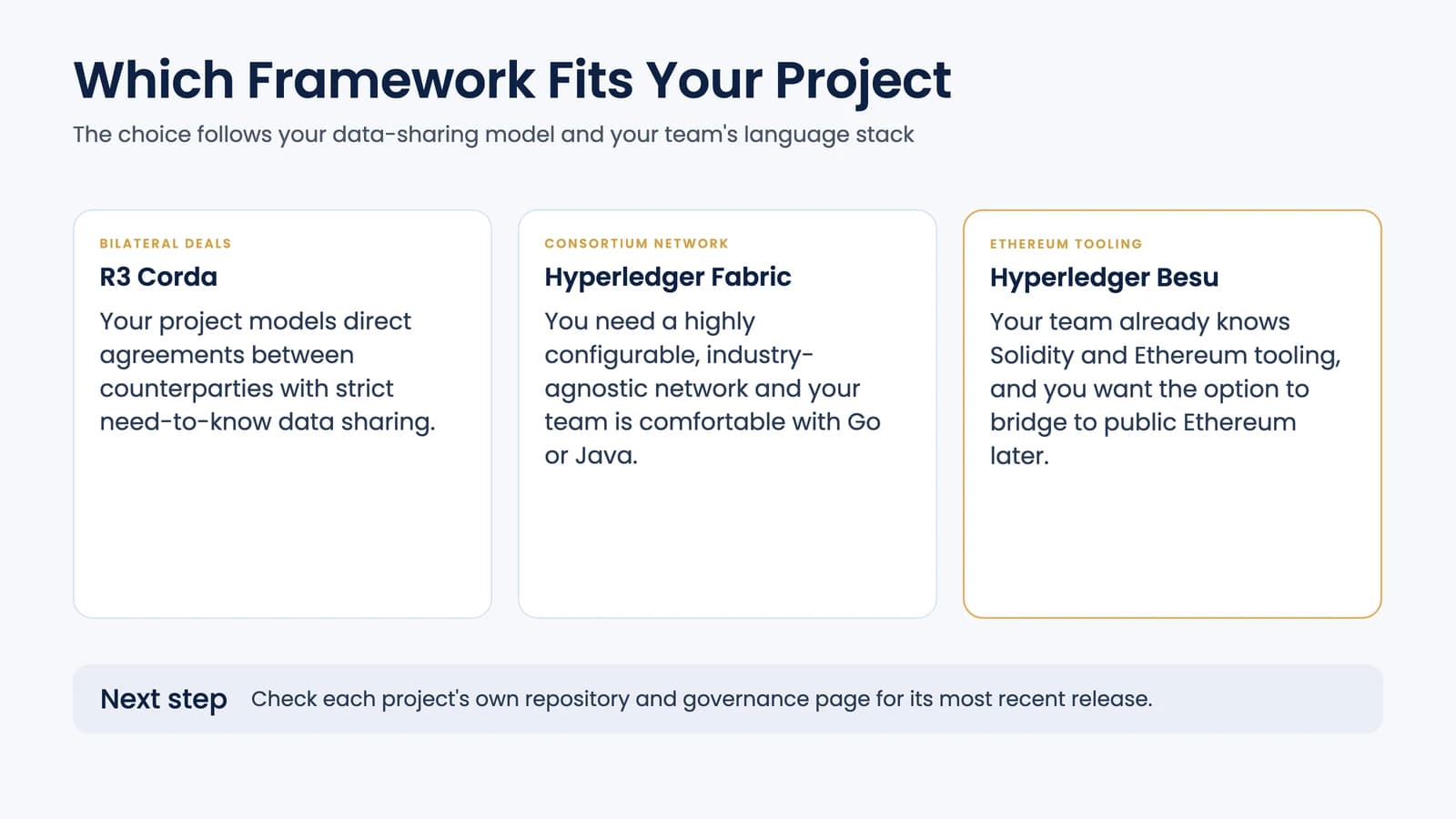
If your project needs to model direct, bilateral agreements between counterparties with strict need-to-know data sharing, Corda's architecture fits that shape better than a broadcast ledger. If you need a highly configurable, industry-agnostic consortium network and your team is comfortable with Go or Java, Fabric's modularity is the safer long-term bet. If your team already knows Solidity and the Ethereum tooling, and you want the option to bridge to public Ethereum later, Besu is the more direct path. For a wider look at when permissioned DLT beats a public chain in the first place, see our guide to choosing a distributed ledger technology; for public-chain dApp platforms, see how to choose the right blockchain.
Conclusion
The permissioned blockchain field is smaller and more mature than it was in 2018: several early entrants have been discontinued, and the frameworks that remain are backed by real production deployments rather than pilots alone. Hyperledger Fabric, R3 Corda and Hyperledger Besu each solve a genuinely different shape of enterprise problem, so the right choice comes down to your data-sharing model and your team's language stack more than any single feature comparison. 4IRE's blockchain consulting team works across all three and can help you match a framework to your specific consortium, compliance and integration requirements.
FAQ
It's still the most widely deployed, but not automatically the right default. Fabric suits broad, configurable consortium networks; Corda suits bilateral financial agreements; Hyperledger Besu suits teams that want private, Ethereum-compatible infrastructure. The right pick depends on your data-sharing model, not on which framework is most established.
ConsenSys archived the GoQuorum repository on 5 June 2026 and no longer maintains or supports it, recommending against its use for new projects. Hyperledger Besu, which shares QBFT consensus compatibility with GoQuorum, is the recommended migration path for teams that were building on it.
No. Hyperledger Fabric, Corda and Hyperledger Besu all run without a native token in their private deployments. A token is a feature of permissionless, public networks, not a requirement of blockchain technology itself.
It depends on the framework. Hyperledger Besu runs the same EVM as public Ethereum, so a private Besu network can bridge to public Ethereum more directly than Fabric or Corda, which use different transaction and data models from any public chain.