

 Payment Gateway

Picture a mid-sized electronics brand in Warsaw, selling goods across the EU, a couple of years ago. Polish shoppers want to pay with BLIK. Dutch customers inquire about iDEAL. Belgians are more used to Bancontact, and customers from other countries use card payments. Previously, each of these payment methods required a separate contract, separate integrations, and a separate settlement report. The brand’s finance team reconciled them manually at the end of each month.
Now, payments look different. The same retailer connects to a single payment gateway, which handles BLIK, iDEAL, Bancontact, Visa, Mastercard, and any other possible option with one API. Every transaction is routed to the right provider automatically, and all payments land in a single dashboard. This simplicity and universal coverage are the new normal in digital payments, and payment gateways, like PSPs, payment facilitators, and aggregators, stand behind it.
If you’re selecting the best payment gateway vendor right now, our guide will come in handy. It offers an honest, methodical comparison of the top 8 providers in the present-day market, giving you a clear decision-making framework. For a wider look at how gateways work for apps, see our overview of payment gateways for mobile apps.
Market Summary
The payment gateway market is heading to over $48 billion in 2029, up from $26.7 billion in 2024, which suggests a CAGR of 12.6%, according to MarketsandMarkets. Interestingly, the growing share of that market goes not to merchants but to companies that handle their payments: PSPs, payment facilitators, and aggregators. As of late 2026, businesses that need checkouts can remain with Stripe or PayPal, while those wishing to accept payments from a variety of channels or branch out into a branded payment service provider need different solutions. This report includes top payment solution providers with white-label software that can become your loyal partners in this business journey.
Comparison: Framework & Results
We completed a market-wide analysis to identify companies that provide genuine payment gateway solutions. To make it to our list, the company had to meet the following criteria. 4IRE is on the list ourselves, so we applied the same criteria to our own product.
- A confirmed white-label model. The vendor offers branding, resale, or a partner program to clients.
- Design for PSPs, acquirers, and/or aggregators. Businesses offering tools only for merchants were excluded from the rating.
- Public compliance. PCI DSS status is explicitly stated on the vendor’s official website.
- Verifiable evidence. The vendor offers proof of supported payment methods, regions, and launch times.
| Solution | Model | Payment methods | Regions and PCI DSS level | Best for |
|---|---|---|---|---|
| 4IRE | Custom build | Any local or global method the market needs, e.g. Mada, Sadad, Visa, Mastercard, Amex | MENA, EU, North America; PCI DSS: built to the standard, certified under the client’s entity | Aggregators in markets that boxed platforms don’t cover |
| Akurateco | License: SaaS or on-premise | 700+ connectors: cards, APMs, banks, acquirers | Global; PCI DSS: Level 1 | PSPs that want breadth and a choice of deployment |
| Corefy | SaaS with white-label package | 550+ integrations with PSPs and acquirers | Global; PCI DSS: Level 1 | PSPs and PayFacs launching on multi-provider orchestration |
| Payneteasy | Licensed white-label platform | 1,000+ integrations, incl. crypto and payouts | 150+ countries; PCI DSS: Level 1 | Banks and PSPs needing a fast branded launch |
| PayCore | License or processing outsourcing | Cards, virtual POS, tokenized card storage | EMEA (250+ clients in 30+ countries); PCI DSS: Certified processing center | Banks and acquirers adding e-commerce acquiring |
| Spreedly | SaaS orchestration | Hundreds of gateways via one API | Global; PCI DSS: Level 1 | Platforms connecting many processors, not a standalone gateway |
| Paysafe | Partner / ISO program on Paysafe processing | Cards, digital wallets, eCash | North America, Europe; PCI DSS: Certified service provider | ISOs reselling processing under their brand |
| Nuvei | Processor with white-label elements (boxed) | 700+ APMs, 150+ currencies | 200+ markets; PCI DSS: Level 1 | Comparison point: buying processing, not owning a gateway |
White-Label Gateway vs. Payment Provider
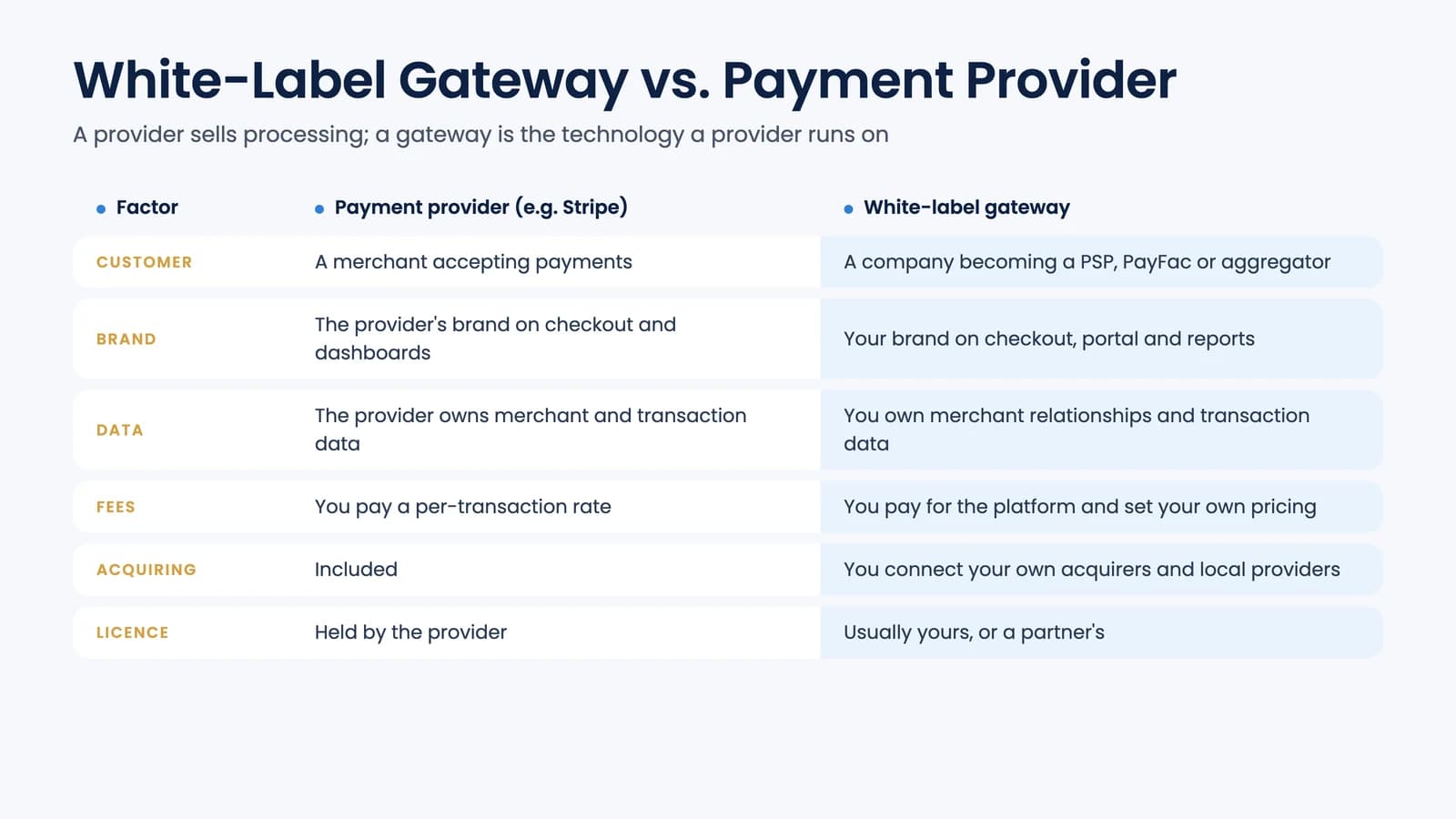
If you only need to accept payments, messing with a white-label gateway is a waste of time and money. Yet, if your core business model is related to processing revenue, owning the gateway gives you an appealing business margin. Here, the distinction between a payment provider and a payment gateway is critical: the first is the business that sells processing to merchants, while the second is the technology on which the provider runs. The difference is real in an array of business dimensions as shown below.
| Factor | Payment provider (e.g. Stripe) | White-label gateway |
|---|---|---|
| Customer | A merchant accepting payments | A company becoming a PSP, PayFac or aggregator |
| Brand | The provider’s brand on checkout and dashboards | Your brand on checkout, merchant portal and reports |
| Data | The provider owns merchant and transaction data | You own merchant relationships and transaction data |
| Fees | You pay a per-transaction rate | You pay for the platform and set your own merchant pricing and markup |
| Acquiring | Included | You connect your own acquirers and local providers |
| Licence | Held by the provider | Usually yours, or a partner’s |
Must-Have Features of Your White-Label Gateway
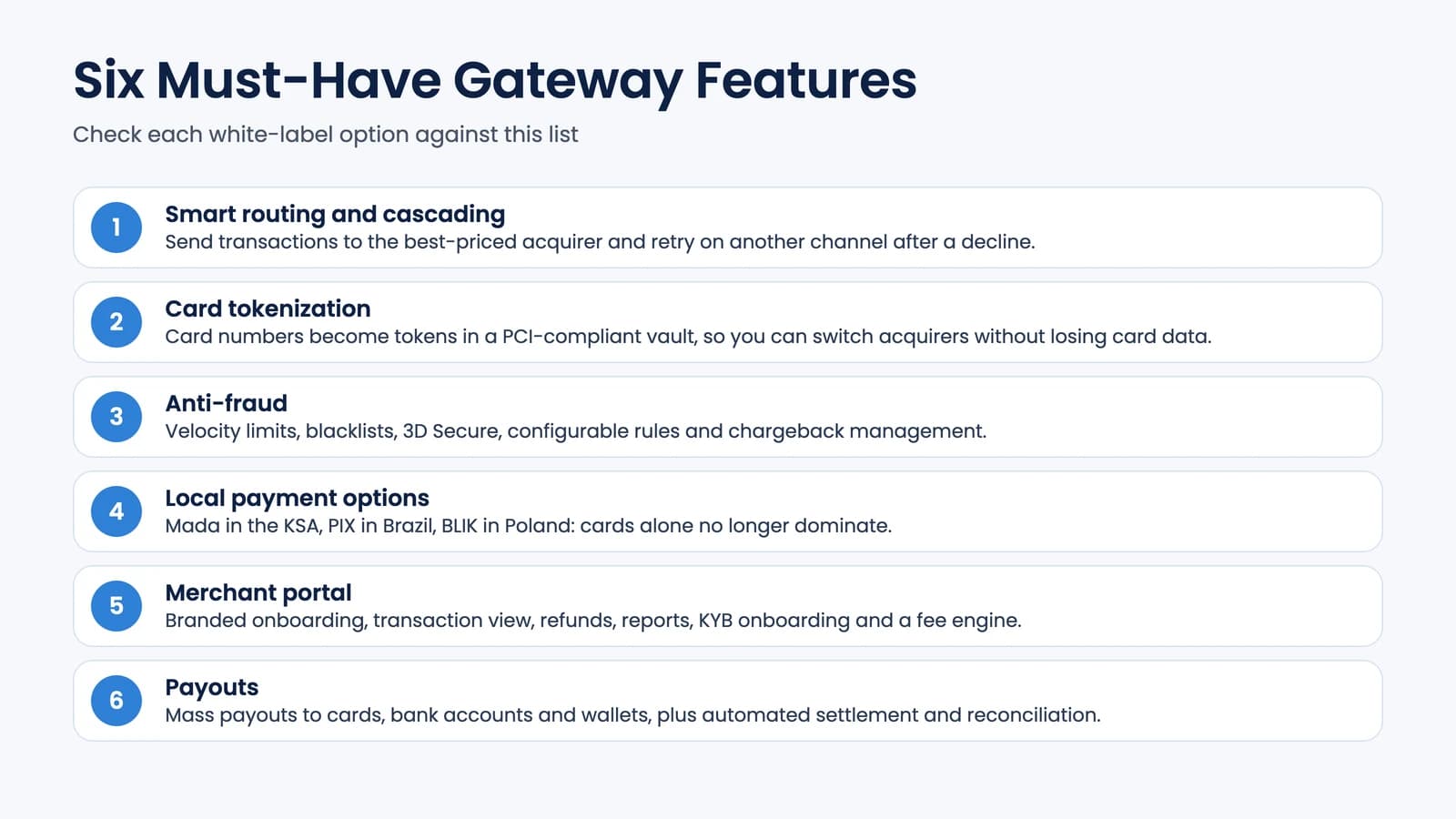
Once you’ve made sure you need a gateway, your next step is vendor selection. Take a closer look at each white-label payment processing option to verify that they have the following features.
- Smart routing and cascading. This feature enables you to send transactions to the acquirer at optimal rates and costs. If one channel declines, you can try others.
- Card tokenization. Card numbers are replaced with tokens stored in a PCI-compliant vault. This measure improves compliance and lets you switch acquirers without losing card data.
- Anti-fraud. The standard package currently includes velocity limits, blacklists, 3D Secure payments, configurable rules, and chargeback management.
- Local payment options. Cards alone don’t dominate anymore. Mada in the KSA, PIX in Brazil, and BLIK in Poland are just a couple of examples of local payment methods that you should factor into your business model.
- Merchant portal. A branded merchant onboarding portal should enable a 360-degree view of transactions, refund issuance, and report downloads. A KYB onboarding feature and a fee engine come on top of it.
- Payouts. This feature is essential for mass card payouts, bank accounts, and wallets. It is also responsible for automated settlement and reconciliation with merchants. If wallets are part of your plan, see how to build a mobile wallet app.
None of these is negotiable in the 2026 market. These are the new normal, and a payment gateway vendor missing on any of these trends is less reliable than companies keeping pace with digital payments progress.
Top 8 White-Label Payment Gateway Solutions in 2026
Here is our selection of payment gateway development companies you can trust in 2026.
1. 4IRE: Custom Gateway and Aggregator Builder
4IRE was founded in 2010 and is currently headquartered in Tallinn, Estonia. 4IRE’s custom payment gateway and payment app development services suit businesses whose target market can’t be covered by boxed solutions. We build a payment gateway around the client’s custom list of payment methods, acquirers, and regulations. The flagship proof is a payment gateway aggregator and e-wallet created for Loop, a SAMA-licensed payments company in Saudi Arabia. This platform serves B2B, B2C and B2G payment flows, covering Sadad, Mada, Visa/Mastercard, and Amex payments. It is built in full compliance with PCI DSS requirements and offers a functional combination of local rails, government payments, and domestic compliance that no off-the-shelf payment solution can offer. We’ve delivered 65+ banking and payment automation projects since 2010, offering expertise and customization to every client.
2. Akurateco: Brandable SaaS Gateway
PSPs that seek feature breadth and a choice of deployment options will appreciate the offer of Akurateco. Founded in 2019 in Amsterdam, this company supplies a fully brandable payment gateway with a suite of 700+ connectors, smart routing with cascading, tokenization, smart fraud filters and merchant management. The platform is PCI DSS Level 1 certified, so it gives a sure head start for businesses without the need to seek independent licensure from day one. The product is available for deployment as a SaaS or on-premise license, and it suits PSPs, acquirers, and banks equally well.
3. Corefy: SaaS with White-Label Package
Corefy, founded as PayCore.io in 2016, offers an optimal software package for PSPs and PayFacs targeting multi-provider orchestration. The London-based company has supplied the payment gateway solution for banks, acquirers, and PSPs since 2019. The package includes a branded checkout, merchant portal, and over 550 ready integrations. This product is also PCI DSS Level 1 certified. Clients report a fast launch within weeks as a strong competitive advantage of this vendor.
4. Payneteasy: Licensed White-Label Platform
Payneteasy was founded in 2005 in Gibraltar. Banks and PSPs looking for a fully brandable gateway and orchestration platform choose Payneteasy for 1,000+ integrations and broad geographical coverage of 150+ countries. It is PCI DSS Level 1 certified, audited by a QSA. The company promises a fast-track white-label launch within 2–4 weeks.
5. PayCore: License or Processing Outsourcing
This Istanbul-headquartered company has been in the payment services market since 2001. PayCore’s software package is suitable for banks and acquirers adding e-commerce acquiring functions to their service suites. This company has been in the payment software market for over 20 years, so it has 250+ active clients in over 30 countries, with the strongest regional presence in EMEA. Banks are free to choose whether to license the software independently or outsource processing to PayCore’s PCI DSS-certified center.
6. Spreedly: Top-Quality SaaS Orchestration
Spreedly was founded in 2007 in North Carolina. Its SaaS orchestration is beneficial for platforms connecting many processors. One thing should be noted: this software is a payment orchestration layer only, not a gateway. It supplies an API that connects Spreedly to hundreds of gateways and payment services. Security is guaranteed with a PCI DSS Level 1 vault and universal tokenization features. Thus, Spreedly can become a valuable partner for platforms with existing acquiring partnerships that they want to optimize under a single front-end.
7. Paysafe: Branded ISO/Partner Solution
Paysafe is one of the longest-operating companies in the industry, founded in 1996 in London, UK. Its core proposition is a partner program for ISOs, platforms, and payment facilitators. The programs cover white-label merchant onboarding through the company’s branded Applications API, boarding APIs, and white-label wallet functionality. Partners configure their linked merchants’ experience, but the processing, acquiring, and risk management operations stay in Paysafe’s core. Thus, it would be fairer to categorize it as a white-label sales model rather than a standalone payment gateway.
8. Nuvei: Processor with White-Label Elements
Nuvei was founded in 2003 in Montreal, currently positioning itself in the market as a full-stack processor. It offers a large suite of 700+ payment methods, 150+ supported currencies, and access to 200+ markets. It is also PCI DSS Level 1 certified, with white-label components like payout portals. It is included in the comparison as a benchmark, as it unlocks only processing services for clients, while the seven providers discussed above offer payment gateway ownership.
Compliance Matters: PCI DSS and Licensure
Compliance is a cornerstone of payments business; don’t reduce its role to an afterthought and build or buy with compliance in mind. Here, two compliance aspects should be noted.
PCI DSS
Companies that store, process, or transmit card data must comply with PCI DSS rules. Processing at scale qualifies as Level 1, with businesses falling under the oversight of a Qualified Security Assessor. This status implies annual audits, and the white-label vendor’s certificate covers only a part of these requirements. Businesses still need to validate their own environment and processes.
PSP or EMI License
If you process payments for merchants, you operate as a payment institution and need a PSP license. Holding customer balances or e-wallet operations requires an electronic money institution (EMI) license. Companies serving clients outside the UK and the EU need to double-check local requirements and licensing bodies. For instance, in the KSA, SAMA licenses payment companies operating in its territory. Thus, for a startup, it makes sense to start with the licensed partner’s umbrella and move on to an independent license later. Our guides to PSP, EMI and crypto licenses and to when a fintech business needs licensing cover the options.
Buy, Build, or Customize?
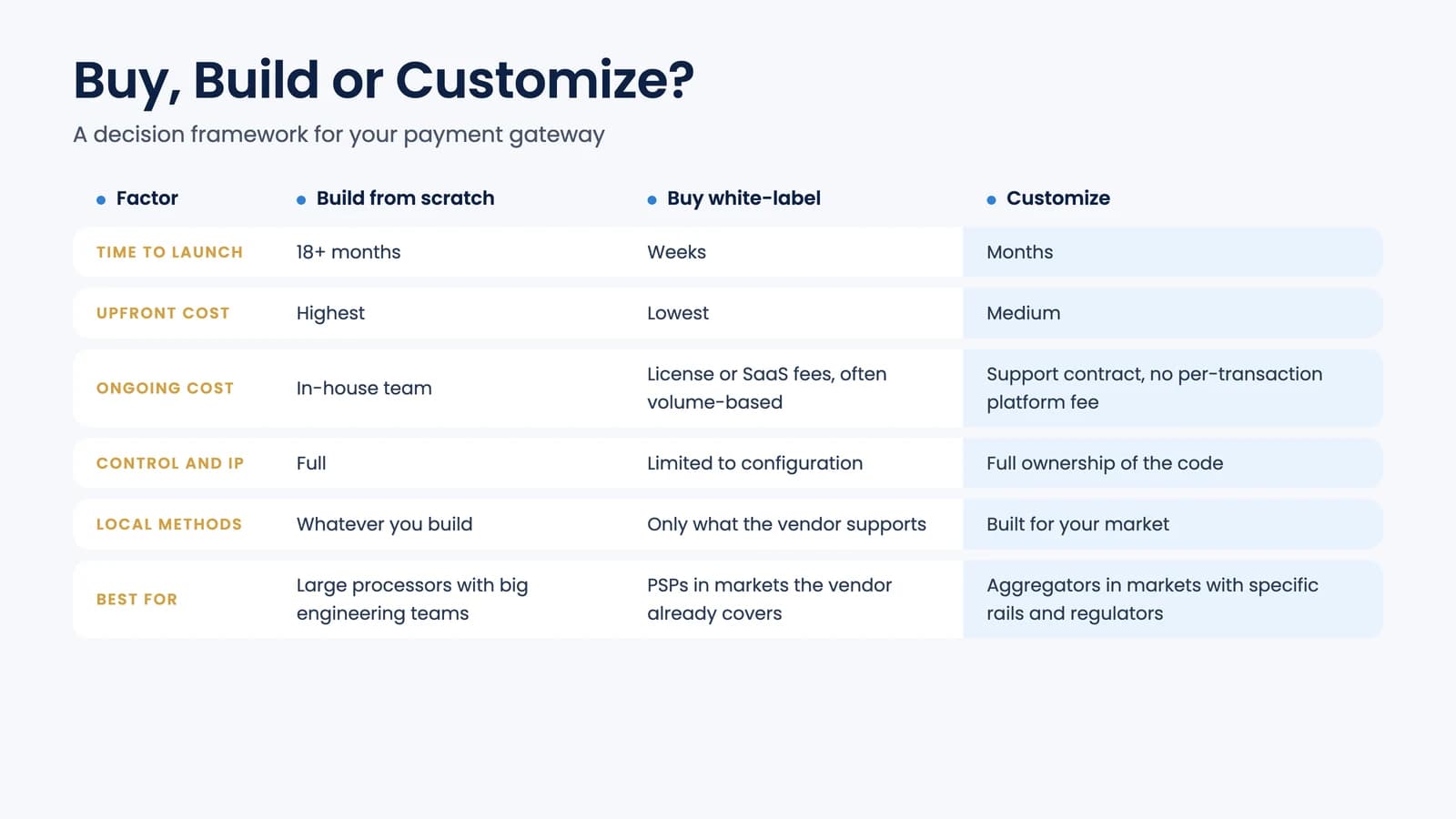
If you’re still undecided about the optimal pathway, use this decision-making framework.
| Factor | Build from scratch | Buy white-label | Customize (build on proven components) |
|---|---|---|---|
| Time to launch | 18+ months | Weeks | Months |
| Upfront cost | Highest | Lowest | Medium |
| Ongoing cost | In-house team | License or SaaS fees, often volume-based | Support contract, no per-transaction platform fee |
| Control and IP | Full | Limited to configuration | Full ownership of the code |
| Local methods and regulator fit | Whatever you build | Only what the vendor supports | Built for your market |
| Best for | Large processors with big engineering teams | PSPs in markets the vendor already covers | Aggregators in markets with specific rails and regulators |
Thus, the rule of thumb is to buy a software product if it includes all payment methods you need. Choose customizable software if it doesn’t, or when branding is a part of your business valuation. Build your own payment gateway from scratch only if you own a mature project with a substantial budget and plenty of time.
If a boxed solution doesn’t cover your local payment methods’ variety or doesn’t match regulatory requirements, 4IRE can build a fully customized, innovative payment gateway or aggregator the way we did it for Loop in Saudi Arabia. Consult our PSP and payment aggregation team to develop a solution that will meet your business needs to a tee. If you are weighing a branded neobank on top of a gateway, compare the options in our list of white-label solutions for neobanks and our ranking of core banking software providers.
Build Your Payment Gateway With 4IRE
Launch a custom payment gateway or aggregator built around your payment methods, acquirers and regulator. Schedule a free consultation.
FAQ
It is a payment processing software product rebranded and independently operated by a payment provider. The latter sells its payment acceptance services to merchants, connecting its acquirers and payment methods to the ecosystem.
As a rule, you do. Processing funds for merchants is possible under a PSP or payment institution license. If you need to hold balances on your accounts, an EMI license is needed. Yet, requirements are jurisdiction-specific.
If you opt for ready-made payments software, the full deployment may take from a few weeks to a few months. A custom-built gateway for a heavily regulated market may take up to a year to design. Licensing is also lengthy.
Operators earn revenue from the margin between merchant fees and payments to the acquirer and platform vendor. Transaction fees, FX margins, new client setup, monthly merchant fees, and value-added services may also be added as revenue streams.