

 Bank

The core banking software industry is enjoying rapid growth. Grand View Research projects the market to reach $28.5 billion by 2033, with a CAGR of 10.2%. Still, the same report points to the dominance of on-premises deployments in 2025. This highlights an important discrepancy: while the cloud is where new money goes, most banks still run on-premises systems.
This gap explains why digital banking software decisions are still tough in 2026. The choice is rarely about picking the best vendor and mostly about the cost and complexity of migration. Replacing a core that has been running for decades is expensive and slow, while building a new bank on a cloud core is faster, though still demanding.
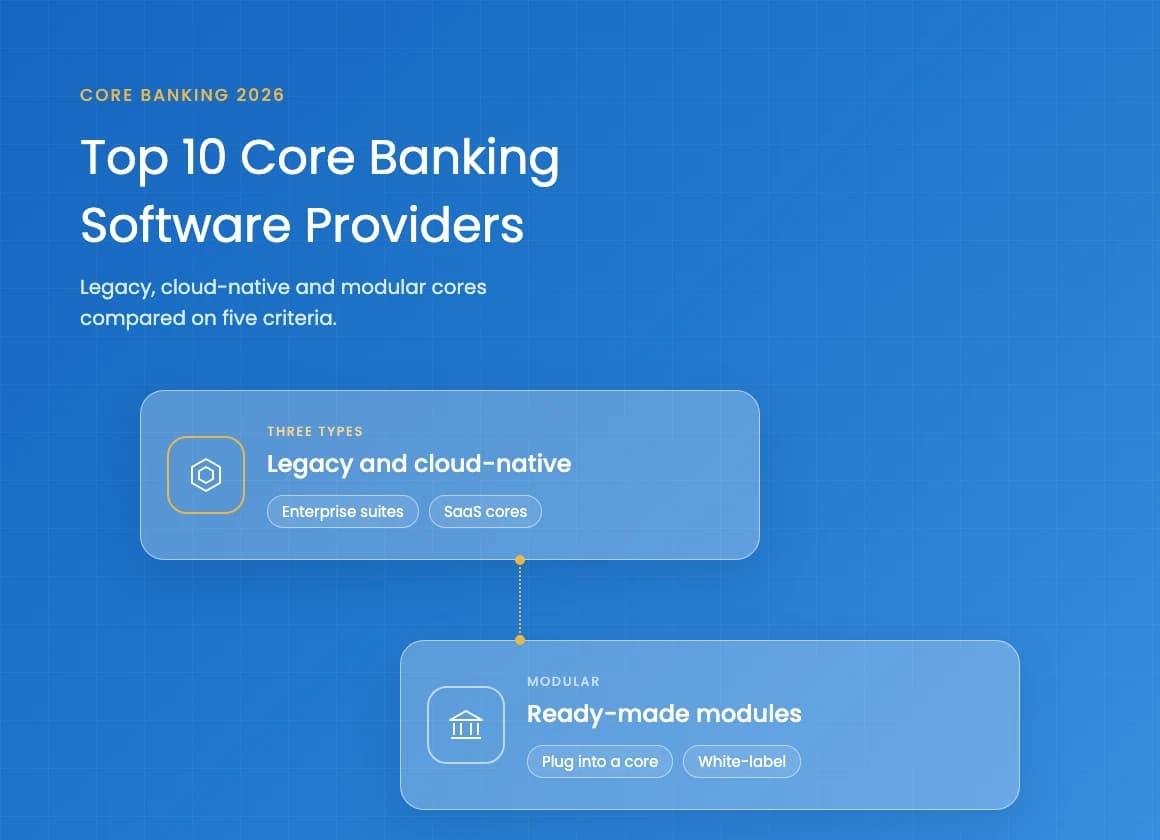
Not every banking institution needs or can afford a full replacement. Many banks, lenders and neobanks progress by adding new modules to their legacy cores or by launching on a white-label stack. This guide breaks the top 10 core banking software providers into three categories to simplify your decision:
- Large legacy cores for traditional banks with complex product sets.
- Cloud-native cores suitable for neobanks and banks targeting a new digital brand.
- Modular ready-made solutions with advanced customization, including white-label products.
How We Compared the Vendors
The 4IRE team scanned the market of banking core products and filtered the top performers by five essential criteria. 4IRE is on the list ourselves, so we applied the same criteria to our own product.
- Functional coverage. The availability of all features, including accounts, ledger, payments, lending and reporting.
- Versatility of deployment. On-premises, private cloud or SaaS.
- Time to launch. A reasonable turnaround for the core's live launch, as reported by the vendor and its clients.
- Openness. API coverage, configurability and code and data ownership arrangements. For a closer look at API access, see our guide to open banking APIs.
- Proof. Transparency about clients and successful launch cases.
The table below shows the results, to guide your choice in line with your software needs, deployment preferences and business type.
| Vendor | Deployment | Best for | Time to launch | Notable clients |
|---|---|---|---|---|
| Temenos | On-premises, private cloud, SaaS | Universal, retail and private banks | 12–36 months (full replacement) | 3,000+ firms, incl. 41 of the top 50 banks |
| Oracle FLEXCUBE | On-premises, Oracle Cloud | Multi-country universal banks | 12–36 months | SID Bank, Northern Arc Capital |
| Infosys Finacle | On-premises, public cloud (AWS) | Large retail banks in Asia, the Middle East and Africa | 12–36 months | Emirates NBD, State Bank of India (overseas) |
| FIS | On-premises, hosted, cloud | US banks of all sizes | 12–36 months | BMO (Modern Banking Platform) |
| Finastra | On-premises, cloud | Retail, corporate and community banks | 9–24 months | 8,000+ institutions in 130 countries |
| Thought Machine | Self-hosted or SaaS on AWS, GCP, Azure | Tier 1 banks building a new core | 6–18 months | JPMorgan Chase, Lloyds, Standard Chartered |
| Mambu | SaaS | Neobanks, digital lenders | 3–9 months | N26, Western Union, ABN AMRO (New10) |
| 10x Banking | SaaS, managed | Large banks launching digital brands | 6–18 months | Chase UK, Westpac, Nationwide |
| 4IRE | Cloud, on-premises, alongside an existing core | Fintechs, lenders and banks needing specific modules or a white-label neobank | From 2 months (lending modules) | My Neobank, BASIS Bank |
| Tuum | Cloud-agnostic SaaS | Banks adding products next to a legacy core | ~7 months on average | LHV Bank, SweepBank |
What Core Banking Software Does
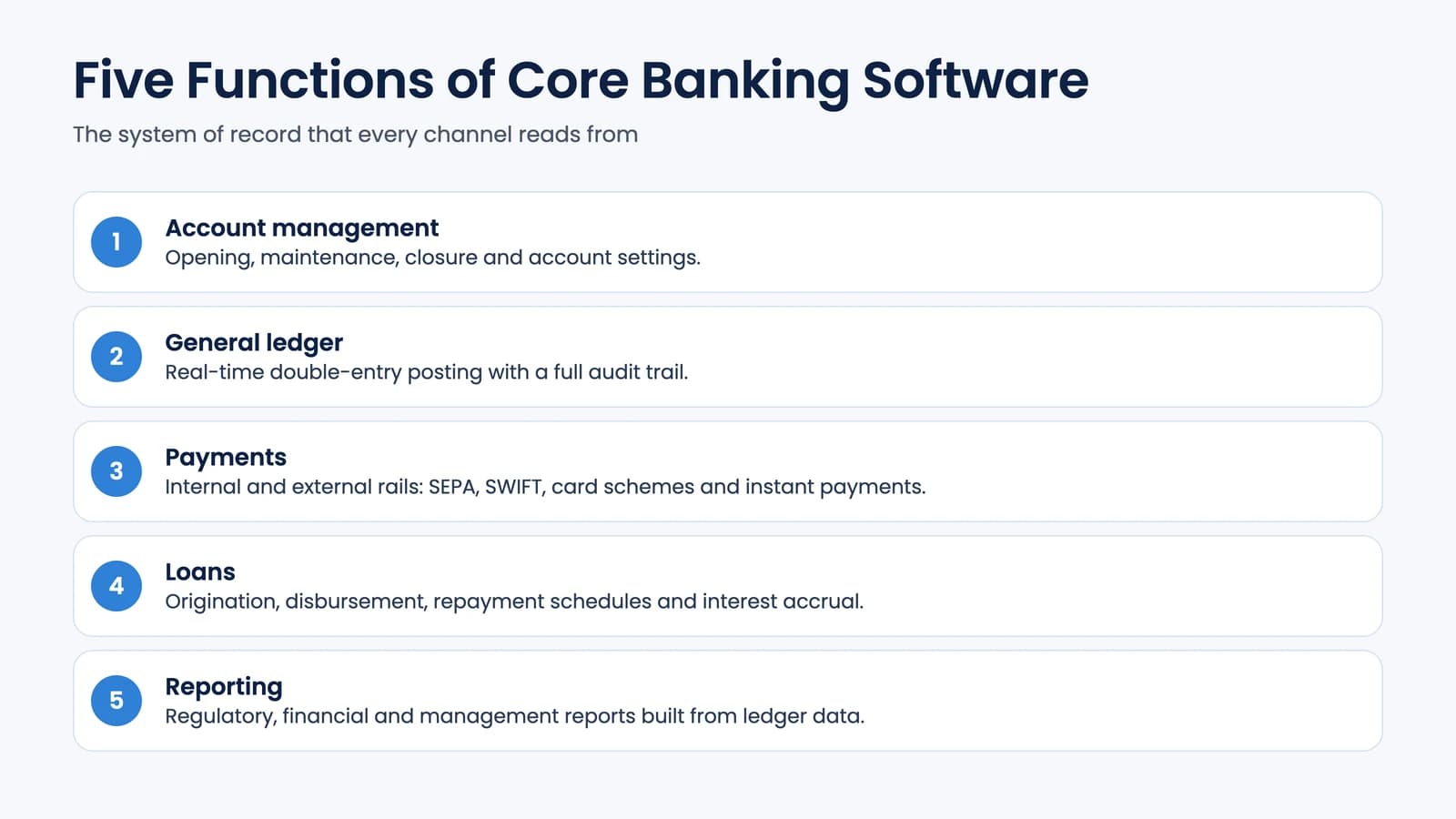
Core banking software is every financial institution's vital system of record. Client balances, posting and product rules are hosted in it, and every channel used by customers and staff draws data from it. Its key functions are as follows:
- Account management. All account-related actions, from opening to maintenance and closure, and account settings, belong here.
- General ledger. Real-time double-entry posting of every transaction with its full audit trail happens in the ledger, creating a single source of truth for accounting and checks.
- Payments. Internal and external payment rails (SEPA, SWIFT, card schemes and instant payments) are configured in this part of the core.
- Loans. Origination, disbursement, repayment schedules, interest accrual and more are handled here. Sometimes loan origination and scoring are singled out into adjacent systems responsible for credit risk management, as in a credit scoring system.
- Reporting. Regulatory, financial and management reports are generated here based on ledger data.
Core-adjacent aspects of banking operations are KYC, CRM, card management, fraud monitoring and digital banking channels. The way these adjacent systems are designed shapes the categories of vendors discussed below.
Three Types of Core Banking Systems
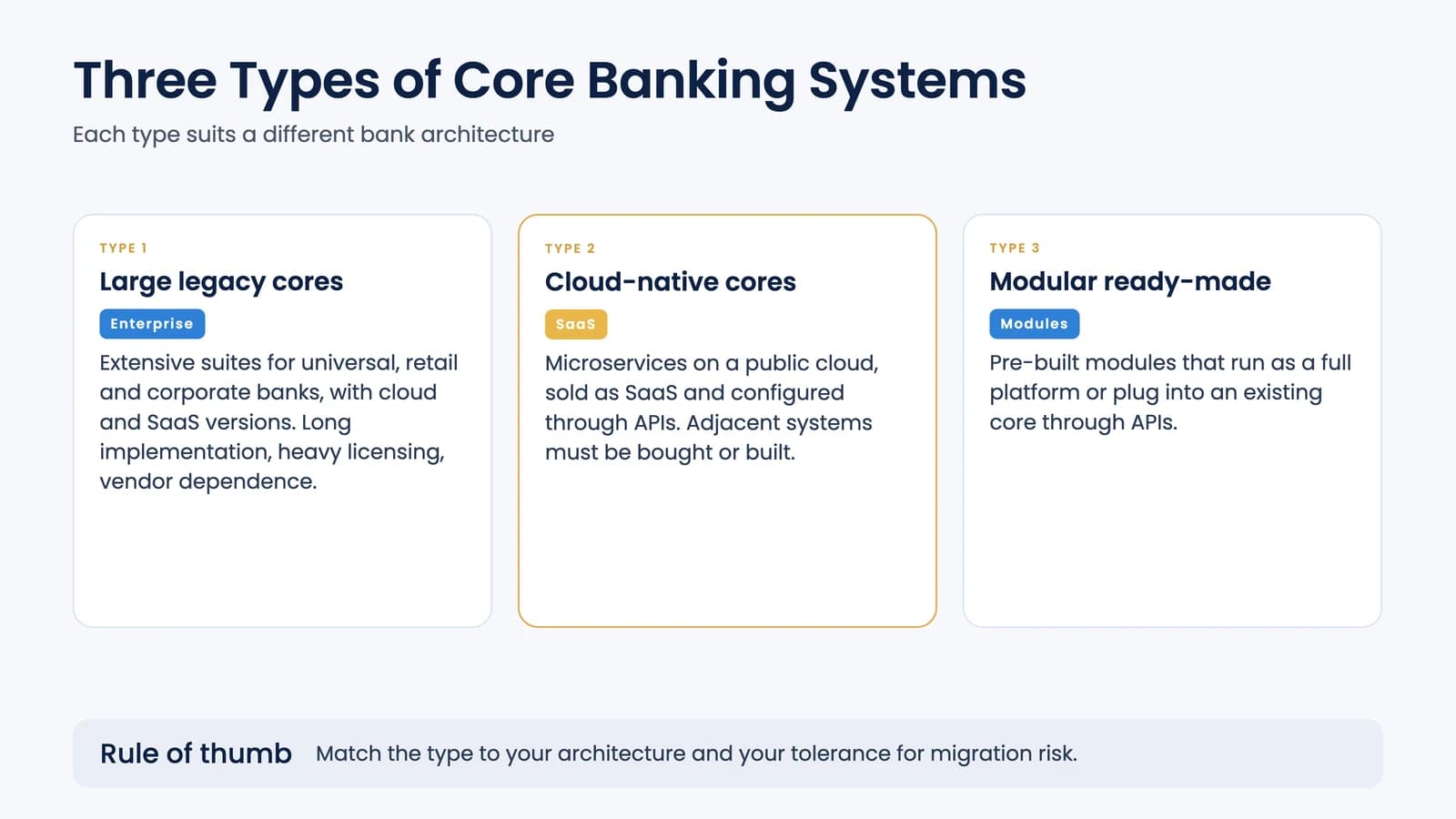
This guide distinguishes banking cores by type, as each suits specific business architectures and needs.
Large Legacy Cores
Legacy, or enterprise, cores are extensive feature suites built for universal, retail and corporate banks. They are product- and jurisdiction-universal, and contemporary versions also come in cloud and SaaS editions. The cost of staying with legacy cores is long implementation, heavy licensing and vendor dependence.
Cloud-Native Cores
This software is built as microservices on a public cloud from the start and sold as SaaS. Clients configure their banking cores rather than code them, using first-class APIs. The option suits neobanks and incumbents launching a digital brand as a separate banking product. Businesses should keep in mind that they must buy or build all adjacent systems, from apps and onboarding to card issuance and compliance.
Modular Ready-Made Software
These packages include pre-built modules that a client can customize at their discretion. They can run as a complete banking-as-a-service platform or be plugged into the existing core through APIs. This flexibility makes the option popular among fintechs, lenders and banks that want fast-track solutions without safety or compliance compromises.
Top 10 Core Banking Software Providers in 2026
Here is a list of the best core banking systems, grouped by the types discussed above.
Group 1. Large Legacy Cores for Traditional Banks
1. Temenos
- Founded: 1993
- Headquarters: Geneva, Switzerland
- Employees: 6,000+
- Core product: broadest functional coverage, built of composable modules
Temenos Transact (formerly T24) is one of the most popular core banking software products across the globe. The company reports a client portfolio of 3,000+ firms, including 41 of the top 50 banks. Its products cover retail, corporate, wealth management and payments services. It runs as on-premises software, in the bank's cloud or as Temenos SaaS.
2. Oracle FLEXCUBE
- Founded: 1977
- Headquarters: Austin, Texas
- Employees: 141,000+
- Core product: comprehensive package of core banking, database, infrastructure and cloud services
FLEXCUBE is Oracle's universal banking suite, originally built by the Oracle Financial Services Software division in Mumbai. It covers core banking functions, lending, payments, trade finance and Islamic banking functionality. The product has recently been adopted by significant development banks in Europe, Latin America and India. Its exceptional advantage is easy migration for banks already operating on Oracle infrastructure.
3. Infosys Finacle
- Founded: 1981
- Headquarters: Bengaluru, India
- Employees: 328,000
- Core product: scalable core suitable for high-volume retail banking
Finacle is the banking core product developed by Infosys and offered through its subsidiary, EdgeVerve. According to Finacle, it serves over 1,000 financial institutions in more than 100 countries, supporting over one billion accounts. Large-scale banks in India and many significant banking players in the Middle East and Africa choose this core for their deployments.
4. FIS
- Founded: 1968
- Headquarters: Jacksonville, USA
- Employees: 44,000
- Core product: outsourced, end-to-end banking core service provider for US institutions
FIS offers several banking core products: Systematics and IBS for large US banks, Horizon for community banks and the cloud-optimized Modern Banking Platform. The FIS offering combines core banking functionality with cards, payments and anti-fraud tools.
5. Finastra
- Founded: 2017
- Headquarters: London, UK
- Employees: 7,000+
- Core product: a full banking service suite with lending and payments; easy third-party app connectivity on Finastra's developer platform
Finastra's Fusion portfolio includes several core products: Essence, Equation and Phoenix. Its lending functionality comes from the Loan IQ and LaserPro products. It also offers payments and treasury coverage. The company serves over 8,000 institutional clients in over 130 countries.
Group 2. Cloud-Native Cores for Neobanks and Digital Brands
6. Thought Machine
- Founded: 2014
- Headquarters: London, UK
- Employees: 500
- Core product: banking core configurable for Tier 1 banks that rebuild their architectures from the ground up
Thought Machine's product is branded as Vault Core. It is a cloud-native, microservices core with Python smart contracts as products. The company has established partnerships with over 50 clients, including systemically important banks like JPMorgan Chase and Lloyds. The banking core comes in self-hosted and SaaS versions.
7. Mambu
- Founded: 2011
- Headquarters: Amsterdam, the Netherlands
- Employees: 750
- Core product: fast-launching banking core with subscription-based infrastructure ownership
Mambu is a SaaS-only, composable banking platform that offers deposit, lending and payments functionality. It connects all systems into an Intelligent Core, which helps financial institutions operate effectively and safely. Its client portfolio includes N26 and Western Union, among others.
8. 10x Banking
- Founded: 2016
- Headquarters: London, UK
- Employees: 500
- Core product: modern banking core for banks developing a standalone digital brand or migrating off legacy infrastructure
Anthony Jenkins, the former CEO of Barclays, is behind 10x Banking. Its flagship product is SuperCore, a cloud-native core delivered as a managed service. It powers the Chase UK and Westpac platforms.
Group 3. Modular Ready-Made Solutions with Customization
9. 4IRE
- Founded: 2010
- Headquarters: Tallinn, Estonia
- Employees: 100+
- Core product: full banking core capability available for deployment within weeks or months, without a one-time legacy core replacement
4IRE is not a Temenos-style monolith. The company offers ready-made banking modules that can be plugged into an existing banking core or run alongside a BaaS stack. The 4IRE product line-up includes NeobankX, a white-label bank with KYC/AML onboarding, IBAN accounts, cards, SWIFT/SEPA payments and crypto functionality. Its autonomous modules include Core Banking (accounts, ledger, limits and fees), Loan Management, Credit Scoring and BNPL. The key benefit for clients is full API ownership, which removes the risk of vendor lock-in.
The experience behind these products includes 65+ lending and banking automation projects and 6+ years of work on a FICO flagship decisioning product. My Neobank, a popular fiat-and-crypto app serving clients in Canada and the EU, runs on the NeobankX core. BASIS Bank in Georgia uses 4IRE's lending module for retail and SME loan origination.
10. Tuum
- Founded: 2019
- Headquarters: Tallinn, Estonia
- Employees: 100+
- Core product: progressive, flexible core transformation with module addition
Tuum is an API-first, cloud-agnostic core composed of individual modules. Clients can compile a plug-and-play banking core with accounts, payments, lending, BNPL and cards modules, each customizable to their business needs. Banks often choose one or several modules to reinforce or extend their existing legacy cores.
How to Choose a Core Banking Platform: 5 Questions to Ask
Still unsure how to launch a neobank and which banking core is your best fit? Go through this checklist.
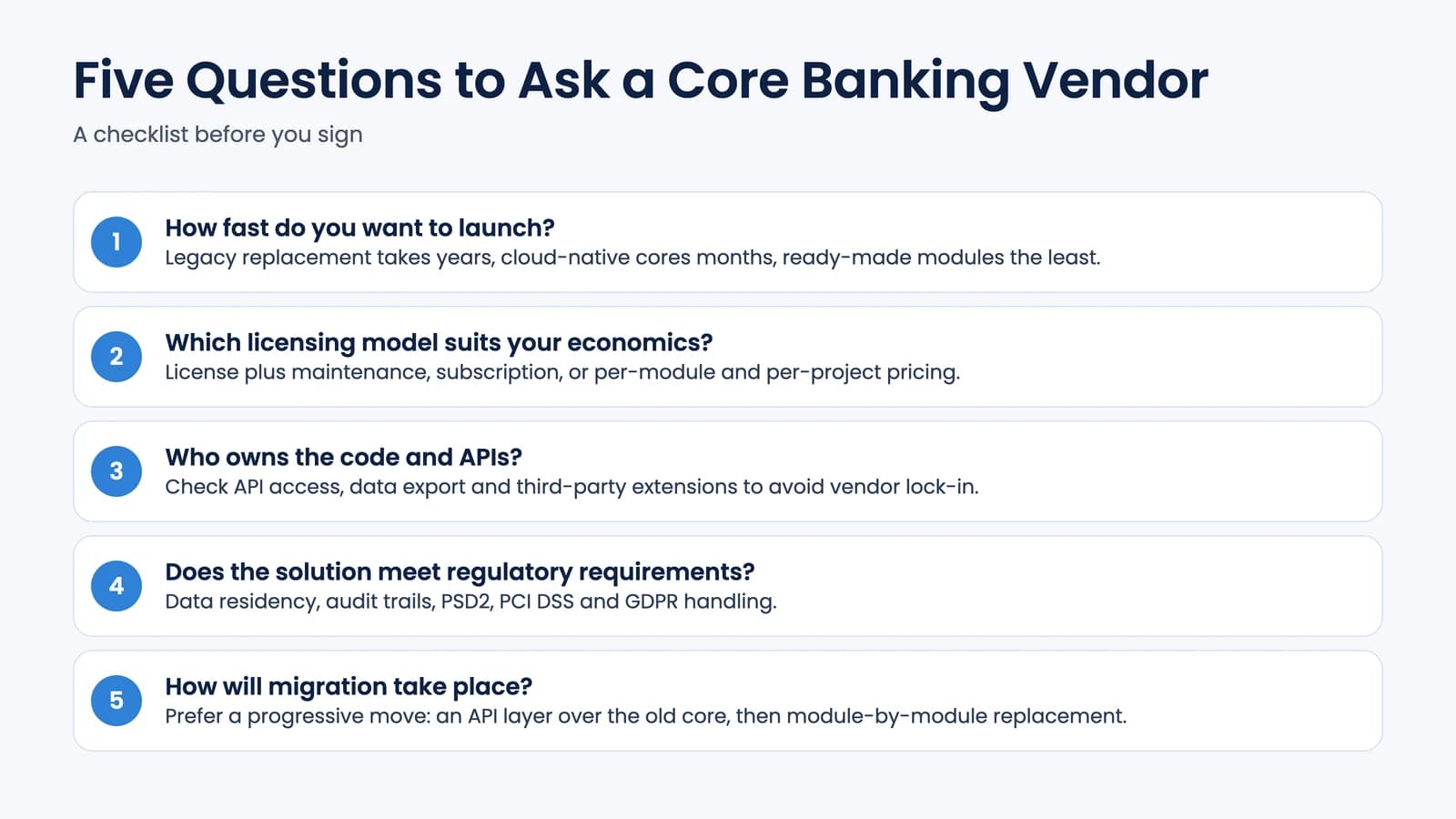
How fast do you want to launch?
Full legacy core replacement takes years, while a cloud-native core shortens this period to months. Ready-made modules offer the fastest banking development track.
Which licensing model suits your economics?
The cost of enterprise banking core software is always high, with upfront licensing fees and annual maintenance. SaaS cores are subscription-based, while modular solutions are priced per module or per project, which gives a transparent and affordable economic model.
Who owns the code and APIs?
Ask the vendor whether you get access to all APIs, can move your data out, or can engage third-party platform extensions. If these rights are not provided, you risk vendor lock-in.
Does the solution meet regulatory requirements?
Jurisdiction-specific compliance rules are essential for banking projects. Check data residency and audit trails, and ask how the vendor handles PSD2/PSD3, PCI DSS and GDPR compliance. If you are still deciding which authorization you need, our guide to fintech and crypto licenses can help.
How will migration take place?
One-time migrations are the riskiest. A safer option is a progressive transition, with an API layer built over the existing core and one-by-one module replacement. This approach keeps the bank running throughout the process without downtime.
Bottom Line
As banking keeps changing, the banking core remains a key success factor for financial startups. Need a banking module that plugs into your current core, or a white-label neobank you can launch in months? Talk to 4IRE about NeobankX and our ready-made banking modules. Enjoy full API rights and a smooth, progressive migration without downtime.
Launch Your Banking Core With 4IRE
Plug ready-made banking modules into your current core or launch a white-label neobank, with full API ownership. Schedule a free consultation.
FAQ
The banking core is the central system of record that keeps data about customer accounts, the general ledger with all transactions, payments and loans, and the reports built on them.
Full replacement of a legacy core typically takes from one to three years, depending on the data volume and the complexity of the existing system.
Yes. Many neobanks launch without a proprietary core, using a licensed partner bank's infrastructure or a white-label BaaS stack like NeobankX.
Enterprise core projects cost millions of dollars when licensing, integrations and migration are taken together. SaaS cores are more manageable because they are priced on a subscription basis. Modular solutions are the most affordable: at 4IRE, a mobile banking app with a back office starts from $25,000.