

 Bank

The “buy now, pay later” (BNPL) functionality is no longer a grey regulatory area. UK BNPL lenders have operated under FCA supervision since July 15, 2026, and the EU introduces the second Consumer Credit Directive (CCD2) on November 20, 2026, which brings interest-free instalment credit into a new regulatory regime.
The BNPL market is too large and too fast-growing to ignore as a business opportunity. According to Juniper Research, the global BNPL transaction value is expected to grow from $334 billion in 2024 to over $687 billion by 2028, an increase of more than 100%.
As regulation matures, FinTech BNPL providers have to build compliant infrastructure from day one. Banks and licensed lenders already hold credit licenses, run affordability checks and have standardized complaint handling. This is what new startups should target, so choosing a white-label BNPL software vendor becomes a strategic decision rather than a matter of cost or feature list. This review covers the top six loan management software brands that offer compliant BNPL solutions for future-ready businesses.
How We Compared and Scored the Providers
In this rating, we scanned the market for software vendors that let a bank or licensed lending business run a branded BNPL program on its own balance sheet. Consumer BNPL apps were left out. The facts come from vendor websites, press releases and reputable review platforms. Each provider scored from 1 to 5 points on five criteria, for a maximum of 25:
- White-label offering for banks. The bank can run the BNPL product under its own brand and keep all customer data.
- Match with the existing stack. The BNPL software integrates easily with the bank’s current core, ledger and channels.
- Credit decisioning availability. Providers with strong, flexible decisioning that can be configured to the bank’s credit policy rank higher.
- Product coverage. The best BNPL products cover both B2C and B2B segments.
- Regulatory compliance. The software fits FCA rules and CCD2 through licensing, client regulations or built-in compliance modules.
Here is the rating we have awarded to the six winners.
| Provider | White-label | Stack fit | Decision | Coverage | Reg. | Total |
|---|---|---|---|---|---|---|
| 4IRE | 5 | 5 | 5 | 5 | 4 | 24 |
| Jifiti | 5 | 4 | 5 | 5 | 5 | 24 |
| Mambu | 5 | 3 | 4 | 5 | 4 | 21 |
| Tymit | 5 | 3 | 3 | 2 | 5 | 18 |
| Pagaya | 4 | 4 | 4 | 2 | 3 | 17 |
| Two | 4 | 3 | 3 | 3 | 4 | 17 |
These scores reflect our team’s editorial judgment and are based on publicly available information. 4IRE publishes this website and is on the list itself, so we accept a degree of subjectivity in the scores. All ranking material comes from verifiable sources and can be double-checked on a demo request.
| Provider | Segments and white-label | Credit decisioning | Regions | Best for |
|---|---|---|---|---|
| 4IRE | B2C and B2B; white-label for banks | Bank’s own scoring or 4IRE’s decision engine; decisions in under one minute | EU, UK, Caucasus, Balkans, MENA | Banks adding BNPL to an existing core and scoring stack |
| Jifiti | B2C and B2B; white-label for banks | Bank’s own underwriting | North America, Europe, LATAM, Middle East, Africa | Banks distributing loan programs through many merchants |
| Mambu | B2C and B2B; white-label for banks | Via partners, plugged into the lending engine | Global | Banks building BNPL on a new cloud lending core |
| Tymit | B2C; white-label for banks | Real-time decisioning, risk-based APR | UK, Europe | Card-based instalment programs |
| Pagaya | B2C; white-label (powers partner brands) | Proprietary AI underwriting plus investor funding | US | Lenders raising approval rates without extra balance-sheet risk |
| Two | B2B; white-label (DNB, Santander, ABN AMRO) | AI-based instant business credit decisions | Nordics, UK, Europe, US | Banks launching B2B BNPL for business clients |
Why Banks Are Launching Their Own BNPL in 2026
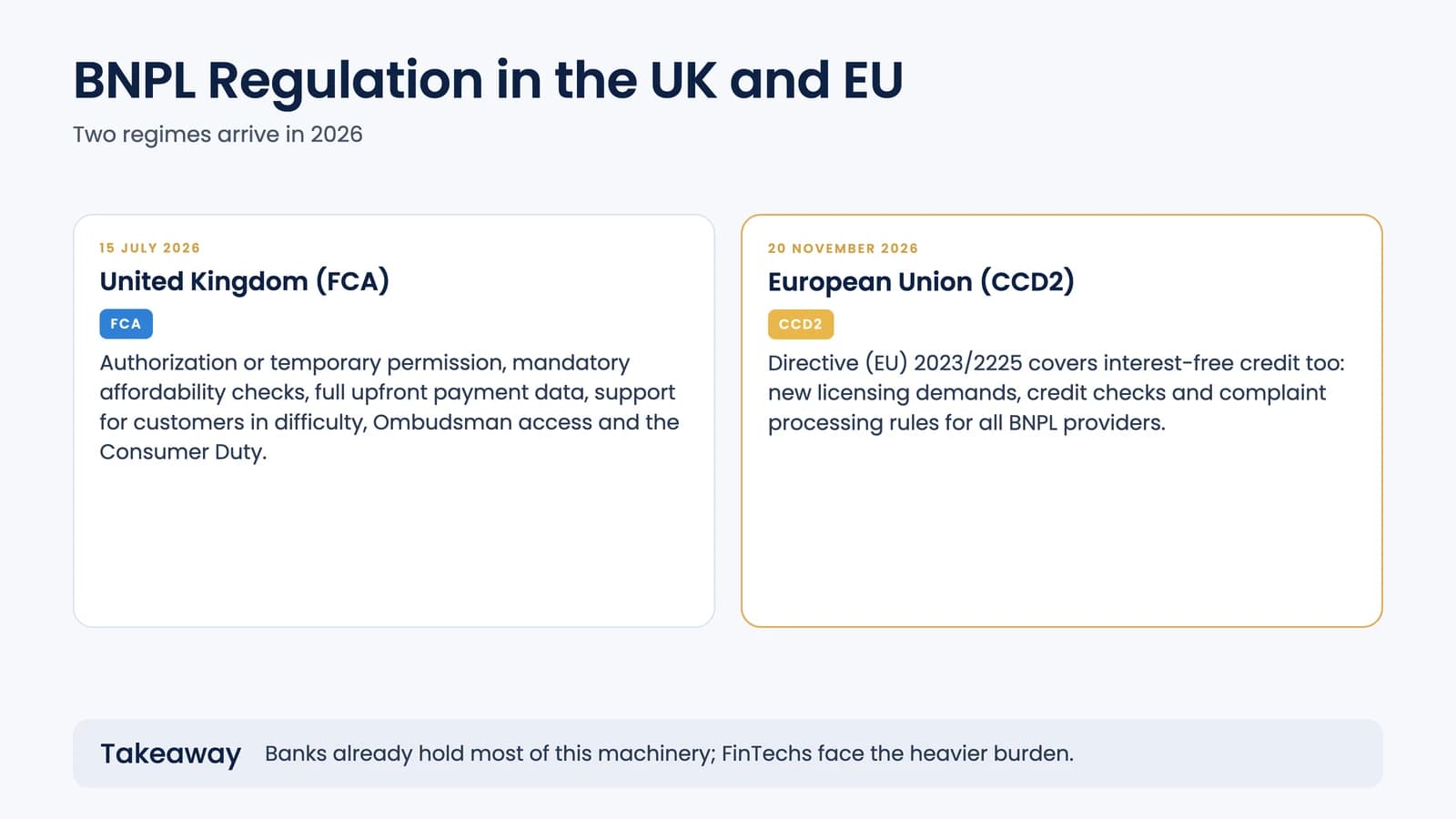
BNPL developed historically outside the consumer credit sector. Interest-free instalment plans were exempt from traditional banking regulation in the UK and fell outside the 2008 Consumer Credit Directive in the EU. FinTechs could approve credit for shoppers at checkout without extensive checks, while banks offering similar services had to go through a full regulatory review. In 2026 this gap closes.
United Kingdom
BNPL moved under FCA regulation on July 15, 2026. From that moment, lenders offering deferred payment credit must be authorized or hold a temporary permission under the FCA rules. In practice:
- Affordability checks become mandatory before lending.
- The lender must provide full upfront data on payment dates, amounts and penalties for missed payments.
- Support must be given to customers in financial difficulty.
- All clients must have access to the Financial Ombudsman Service.
- BNPL providers must comply with the Consumer Duty.
European Union
In the EU, the governing regulation is Directive (EU) 2023/2225 (CCD2), which applies to interest-free credit as well. From November 20, 2026, it applies to BNPL providers, bringing new licensing demands, credit checks and complaint processing rules. Banks already have them, but for FinTechs the change is a considerable regulatory burden.
What BNPL Software Must Include
When choosing white-label BNPL software, check the following features:
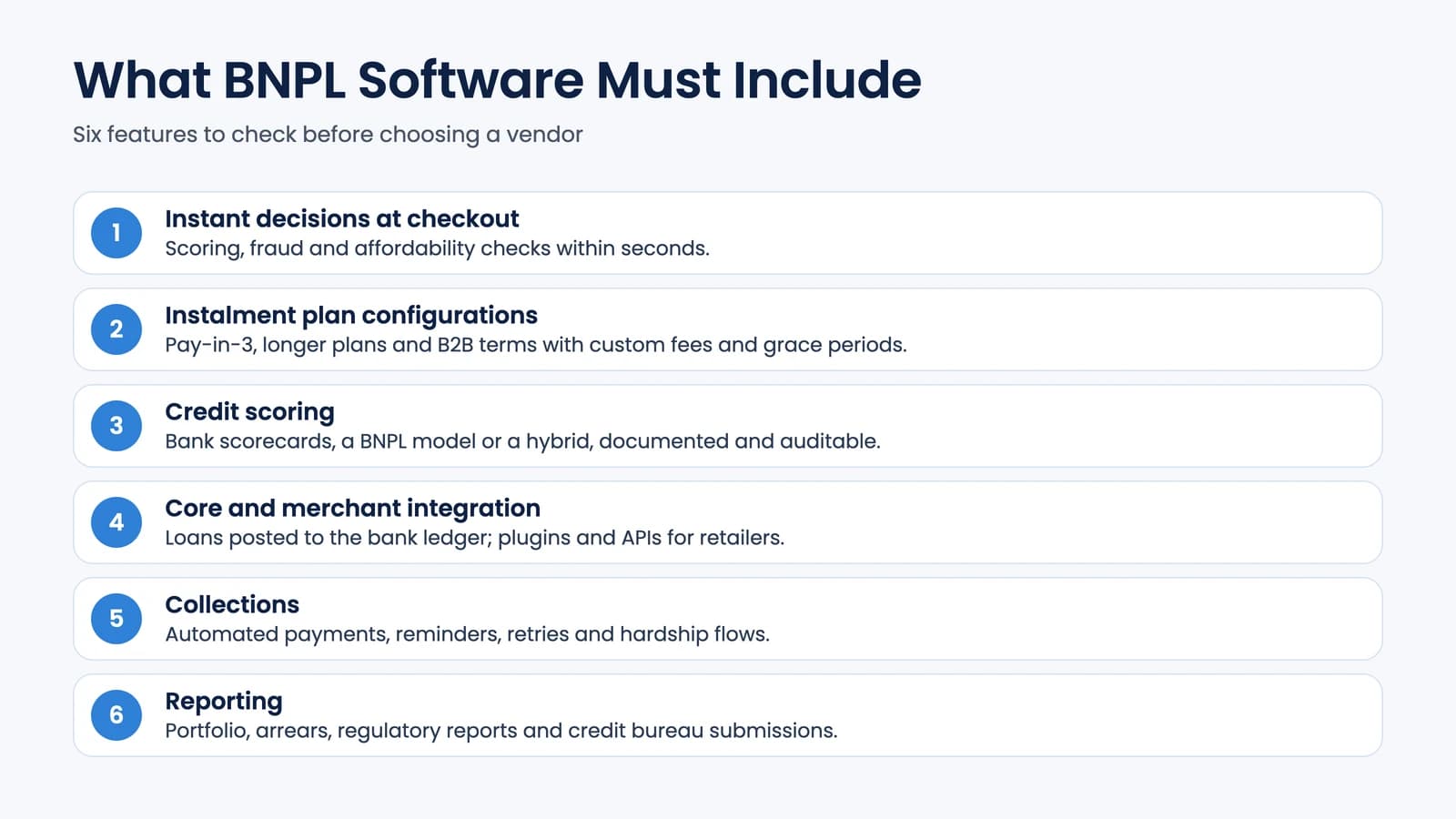
- Instant decisions at checkout. Buyers are impatient and nobody will wait minutes, let alone hours. The decision should be issued within seconds at checkout. This is the most demanding feature for the platform, as the lender must complete scoring, fraud and affordability checks fast enough that customers do not abandon their baskets.
- Instalment plan configurations. The software should offer easily configurable plans, such as pay-in-3, pay-in-24 or longer, with B2B coverage and customizable fees, interest and grace periods for each.
- Credit scoring. The bank’s existing scorecards, a dedicated BNPL model or a hybrid can be used. Under CCD2 and FCA rules, creditworthiness assessments must be documented and auditable. For the build side, see our guide to a credit scoring system.
- Core and merchant integration. BNPL loans should be recorded in the bank’s ledger like all other transactions. On the merchant side, the bank needs plugins, APIs and other connectors to simplify retailer onboarding. A good starting point is our overview of open banking APIs.
- Collections. FCA and CCD2 add support-for-difficulty rules, which the software should factor into automated payments, reminders, retries and hardship flows.
- Reporting. All activity needs an auditable paper trail, including portfolio performance, arrears, regulatory reports and credit bureau submissions.
Top 6 BNPL Software Providers for Banks and Lenders
Here is a closer look at the six lending software companies we rated, with their BNPL proposition for businesses.
1. 4IRE
- Founded: 2010
- HQ: Tallinn, Estonia
- Model: Ready-made BNPL module that can be customized and integrated into the bank’s existing stack
4IRE offers a BNPL and embedded lending module with instant credit decisioning at checkout, instalment plan customization without coding and merchant repayments. It integrates with the bank’s existing core banking and credit scoring engine and runs as part of the BaaS stack. The bank extends its brand to the BNPL offering and keeps all API rights.
The module consists of two components. ABLE™ handles loan origination and management, in the same line as the loan origination software we reviewed separately. ProcessMIX is a decision engine that issues credit decisions in under one minute.
4IRE has extensive experience in integrations for existing banks. We worked with BASIS Bank in Georgia, building a lending pipeline that connects loan origination to the bank’s internet and mobile banking. For BKT Bank in Albania, we delivered a decision module and scoring infrastructure. First Abu Dhabi Bank received a FICO-based scoring engine, built on the 4IRE team’s 6+ years of experience co-designing FICO’s flagship decisioning product. This makes 4IRE a fit for banks that want to extend their own core and scoring engine with BNPL without replacing the platform. Our banking software development page describes the modules in detail.
2. Jifiti
- Founded: 2011
- HQ: Columbus, USA
- Model: White-label embedded lending platform
Jifiti holds an EMI license from Sweden’s financial regulator. Its BNPL solution lets banks and lenders expand their loan programs at any merchant’s point of sale, online and in offline stores. Features include instalment loans, credit lines, split payments and B2B BNPL. Lenders keep their brand and customer data and retain full control over underwriting. Jifiti’s customers include Citizens Bank, CaixaBank and Crédit Agricole. It is a fit for banks that want to reach many merchants with their existing credit products.
3. Mambu
- Founded: 2011
- HQ: Amsterdam, Netherlands
- Model: SaaS cloud banking and lending
Mambu targets banks and lenders that build BNPL on a new cloud core and do not plan to integrate new BNPL modules into legacy systems. It runs BNPL and point-of-sale finance on the same engine as consumer, SME and mortgage lending products. API-first integrations cover decisioning, onboarding and servicing tools. Mambu’s known BNPL clients are Tilta and Carbon.
4. Tymit
- Founded: 2017
- HQ: London, UK
- Model: White-label instalment credit programs on card rails
Tymit suits banks that want to build BNPL into their card products instead of offering it as a checkout option. Its software is FCA-authorized and runs instalment programs end to end under the partner’s brand. The platform enables real-time origination decisioning, risk-based APR and Visa card issuance. Tymit powers Frasers Plus for Frasers Group and is an active Visa Ready partner for financial institutions.
5. Pagaya
- Founded: 2016
- HQ: New York, USA
- Model: AI underwriting and funding network
Pagaya suits US lenders that want to raise approval rates without adding balance-sheet risk. It does not offer a BNPL front end and plugs AI underwriting into the partner’s lending flow instead. This makes it possible to approve applicants that the bank’s internal credit risk engine would decline. The network is funded by institutional investors, which lets banks keep BNPL off their balance sheets. Its recent BNPL offering is Upgrade’s Flex Pay.
6. Two
- Founded: 2020
- HQ: Oslo, Norway
- Model: B2B BNPL infrastructure for banks and merchants
Two serves banks that launch B2B BNPL services for their existing business clients. Its software enables instant credit decisions for business buyers, together with invoicing and collections features. Banks like DNB, Santander and ABN AMRO use Two’s technology to distribute BNPL services to their clients. The company works with financial institutions in 15+ countries.
Compliance Checklist for FCA Rules and CCD2
Use this checklist as a starting point to confirm the main details with your chosen BNPL software provider.
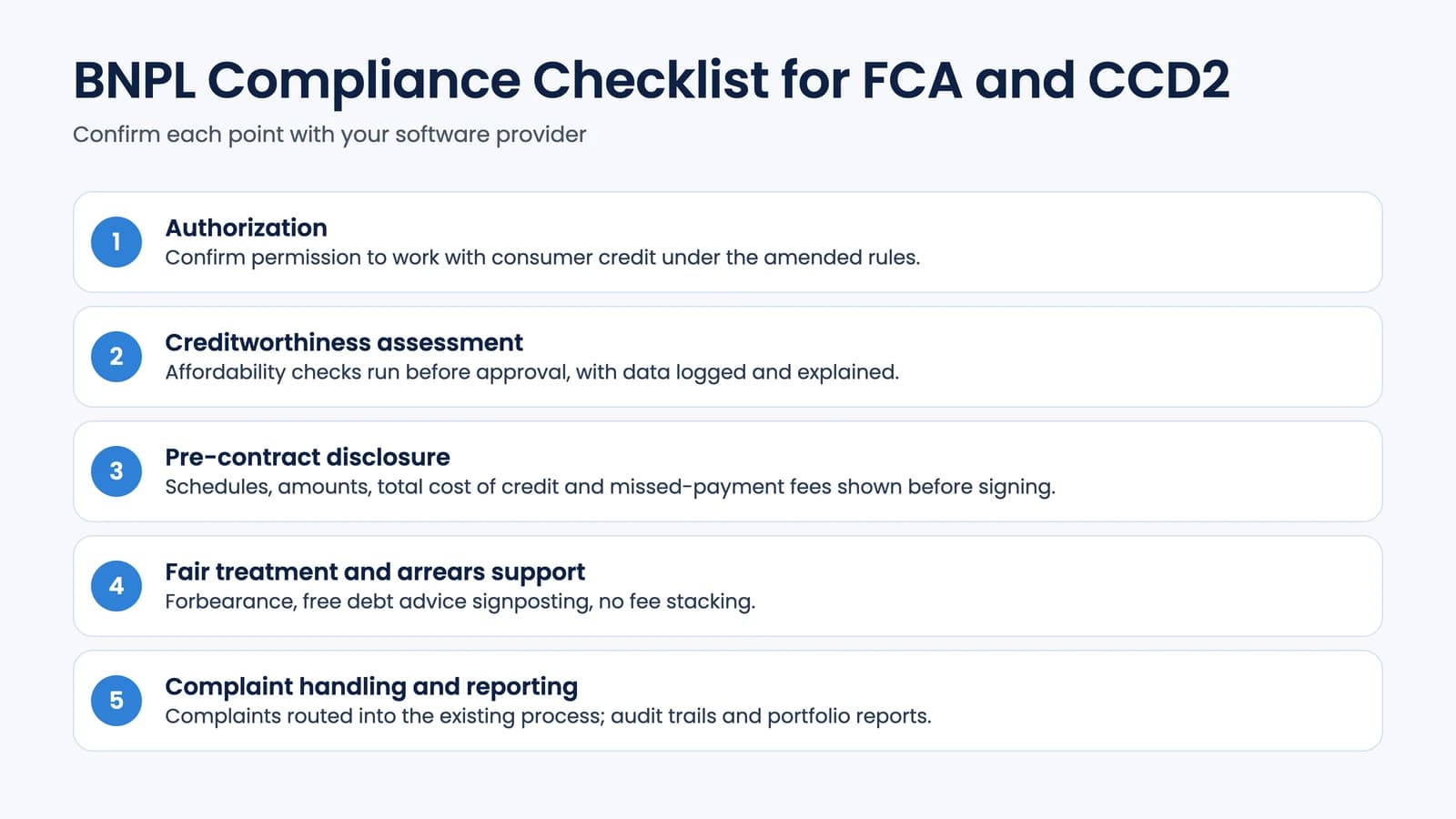
- Authorization. UK and EU businesses now need to confirm their permission to work with consumer credit under the amended rules.
- Creditworthiness assessment. Check whether the software runs affordability checks before approval, and whether the data is logged and explained properly. Our guide to fintech licenses helps if you are still deciding which authorization you need.
- Pre-contract disclosure. Verify that the provider shows repayment schedules, amounts, total cost of credit and missed payment fees before the customer signs the BNPL agreement.
- Fair treatment and arrears support. Verify whether the vendor offers forbearance, signposts free debt advice and avoids fee stacking in line with the Consumer Duty and CCD2. Hardship options should be configurable in the collections flow.
- Complaint handling and reporting. Complaints must be routed into the existing process, including the Financial Ombudsman Service for UK businesses. Audit trails and portfolio reports must be available for regulator audits.
Launch BNPL on Your Own Core
Get an embedded, customizable lending module for your existing banking core from 4IRE. We enable instalments at checkout under your brand, with compliance rules built into the module’s design. Book a BNPL demo to see how the solution fits your stack and architecture.
Launch BNPL With 4IRE
Plug an embedded, customizable BNPL module into your current core and keep full API rights. Book a free BNPL demo.
FAQ
Yes. Banks already have the licensing and capital to expand their range with credit, but they often lack software for instant checkout decisions, no-code instalment plan customization and merchant integration. This is what a white-label BNPL platform for banks provides.
Yes. BNPL has come under regulation in the UK (FCA) and the EU (CCD2) from 2026, and the rules apply even to interest-free loans.
Through APIs. After a loan is approved, the BNPL platform creates a credit account for the customer. The data goes into the bank’s ledger, including disbursement to the merchant and the repayment schedule. BNPL loan data reaches the same reports as other cash flows, as repayments flow back to the bank’s core.
B2B BNPL is a deferred payment service that banks provide to businesses. As a rule, 30-to-90-day net terms apply to B2B loans. The supplier is paid upfront, and the BNPL provider takes the entire repayment risk.