

 AI

FinTech cybersecurity risks at a glance:
- AI-assisted developers make commits 3-4 times faster but commit safety errors 10 times more often.
- AI-generated code is behind 1 in 5 corporate breaches
- 42% of all code is generated or assisted by AI
- A recent Stanford study found that AI-assisted coders supplied unsafe code and had a false sense of security
- AI-assisted commits leak secrets twice as often (3.2% of cases against 1.5% of human-written code commits)
- Out of 534 code samples from six LLMs (GPT-5.2, Claude Opus 4.6, Gemini 2.5 Pro, DeepSeek V3, Llama 4 Maverick, Grok 4), 25.1% contained confirmed LLM code vulnerabilities OWASP. 33.1% of all samples had injections.
You may love AI for the speed and cost-effectiveness of development or hate it for job risks. One thing remains unchanged: AI-created code sent to production without a thorough cybersecurity audit is a huge, avoidable risk. The price of AI coding flaws is not a bug; it may take the form of a ruined payment route authorization or a hard-coded transaction logic problem. In each of these cases, you risk your reputation and user money.
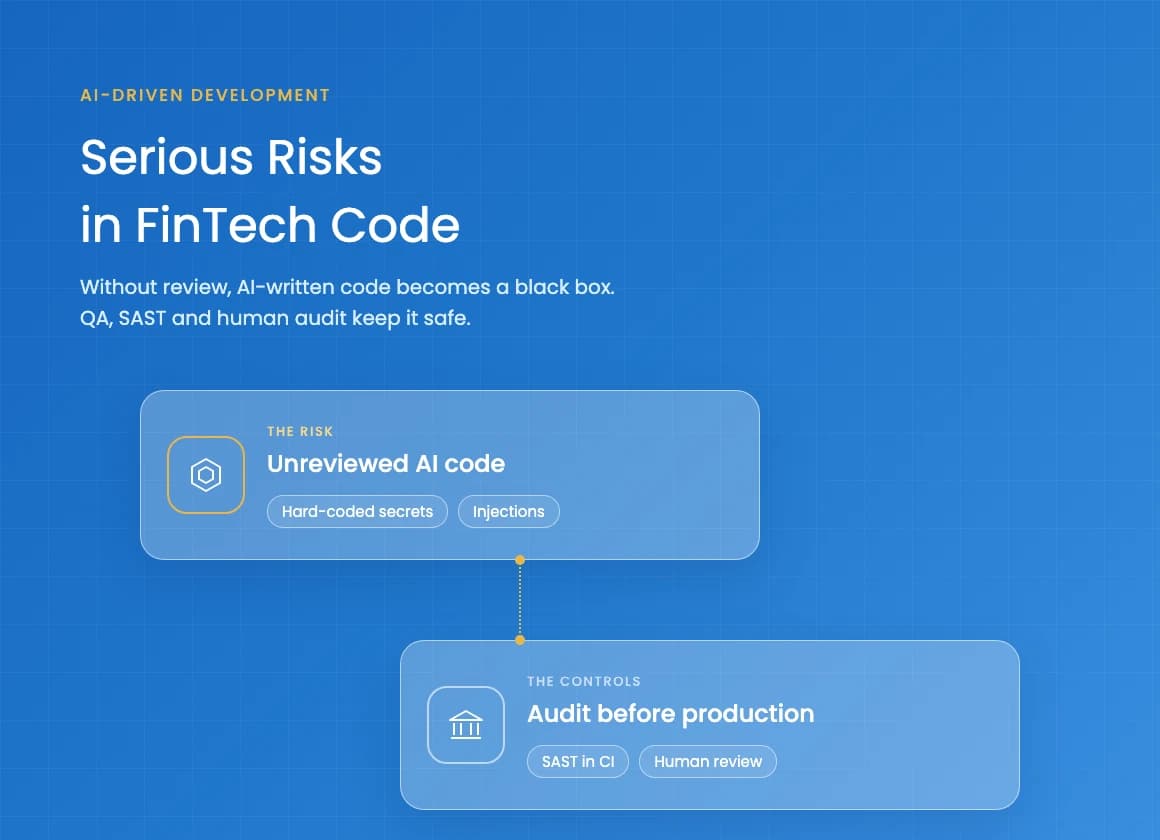
A recent Veracode survey has shown that only 55% of generated tasks yield safe code, leaving the rest with serious vulnerabilities. This percentage has stayed the same for over two years, showing that AI coding limitations persist. So, an honest and realistic conclusion is: AI is really fast, but without review, the code turns into a black box with many unpleasant surprises. Here, we examine vibe coding security vulnerabilities for FinTech and give recommendations for safe AI-driven development.
Why FinTech Is at Increased Risk
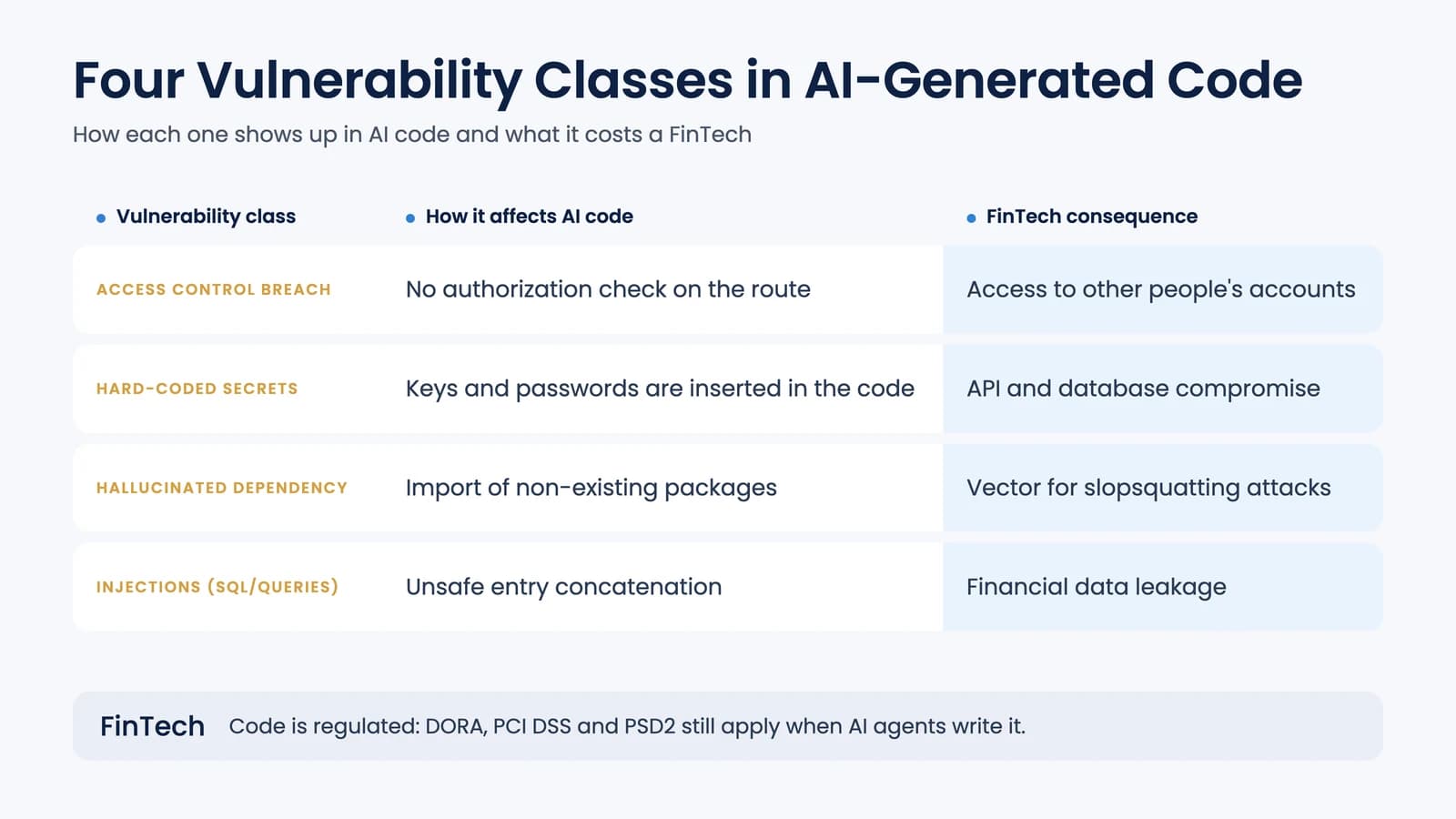
All FinTech code is regulated. In the EU, DORA oversees the accountability of licensed financial institutions for ICT risk management and testing, with severe MiCA compliance repercussions. The PCI DSS standard requires secure development practices for anything related to bank cards. PSD2 sets authentication and payment initiation safety standards. Therefore, using AI agents for coding doesn’t free you from all sorts of regulatory responsibilities.
Second, FinTechs deal with money, and a logic flow in these apps can lead to one of the following:
| Vulnerability Class | How It Affects AI Code | FinTech Consequences |
|---|---|---|
| Access control breach | No authorization check on the route | Access to other people’s accounts |
| Hard-coded secrets | Keys and passwords are inserted in the code | API and database compromise |
| Hallucinated dependency | Import of non-existing packets | Vector for slopsquatting attacks |
| Injections (SQL/queries) | Unsafe entry concatenation | Financial data leakage |
With FinTech companies being the highest-value targets on the Web, hackers eagerly explore all these vulnerabilities and often succeed.
Case Review: Moltbook
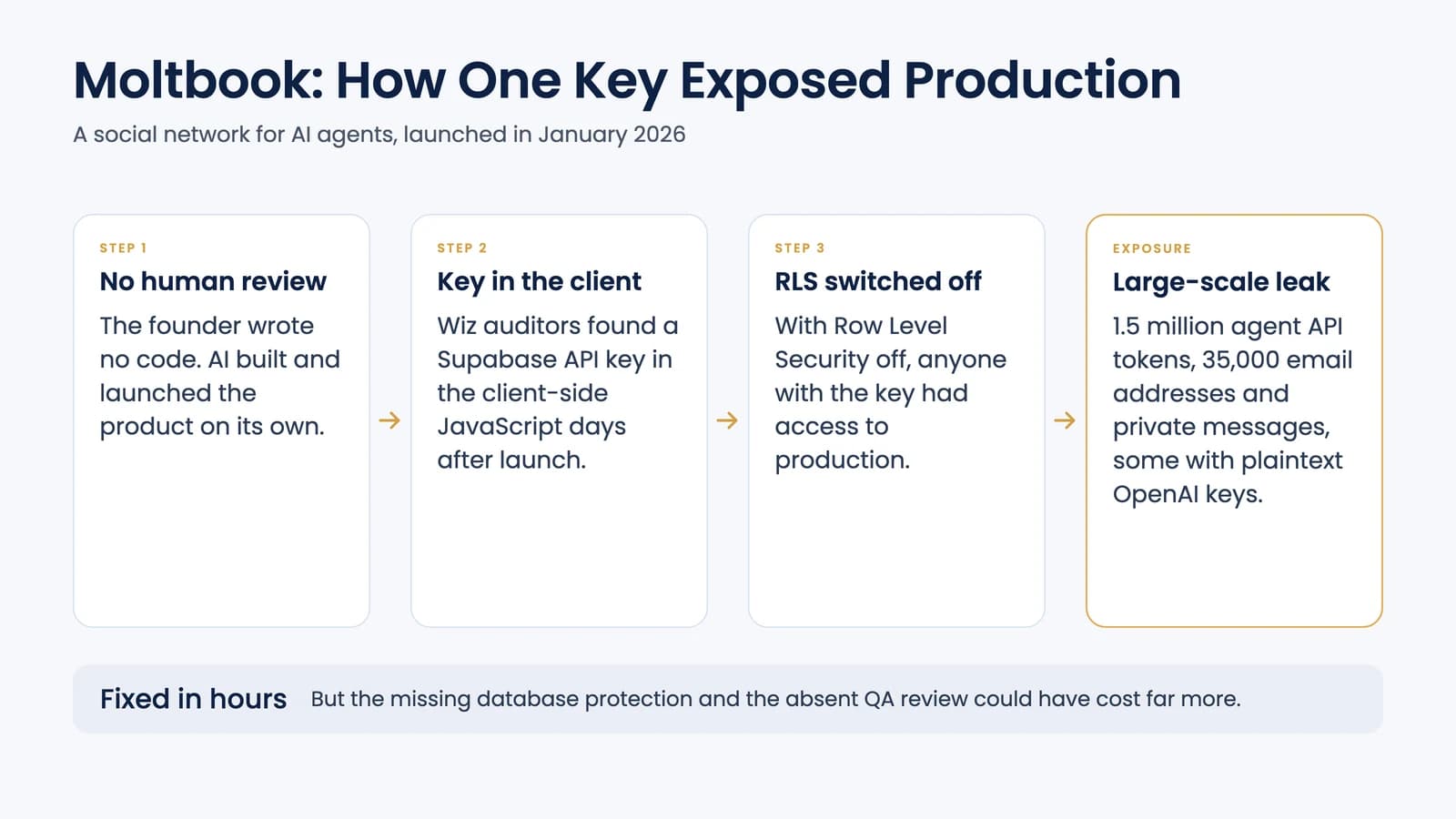
An illustrative case of why AI code review matters is Moltbook, a social network for AI agents, launched in January 2026. Its founder officially acknowledged that he hadn’t written a single line of code, with the resource’s autonomous AI development and launch.
Several days after launch, Wiz auditors detected a Supabase API key in the client-side JavaScript of Moltbook. The project’s database had Row Level Security switched off, meaning that anyone finding that key received access to production. The exposure’s scale was enormous:
- 1.5 million agent API tokens were compromised.
- 35,000 email addresses and private messages between agents were leaked.
- Some of the leaked messages contained plaintext OpenAI keys.
Attacks in Moltbook could hijack any of those accounts, edit owners’ posts, and inject prompt-injection payloads. The error was fixed in hours, but a small flaw in the missing database and an absence of QA review could cost people a lot of money and sensitive data.
How to Make AI-Driven Development Safe?
The Moltbook case shows that AI can’t replace developers; it only shifts the job from writing to auditing. Teams that keep treating code verification as an afterthought are doomed to shipping flawed code with serious security loopholes. Solutions to secure AI-assisted development include:
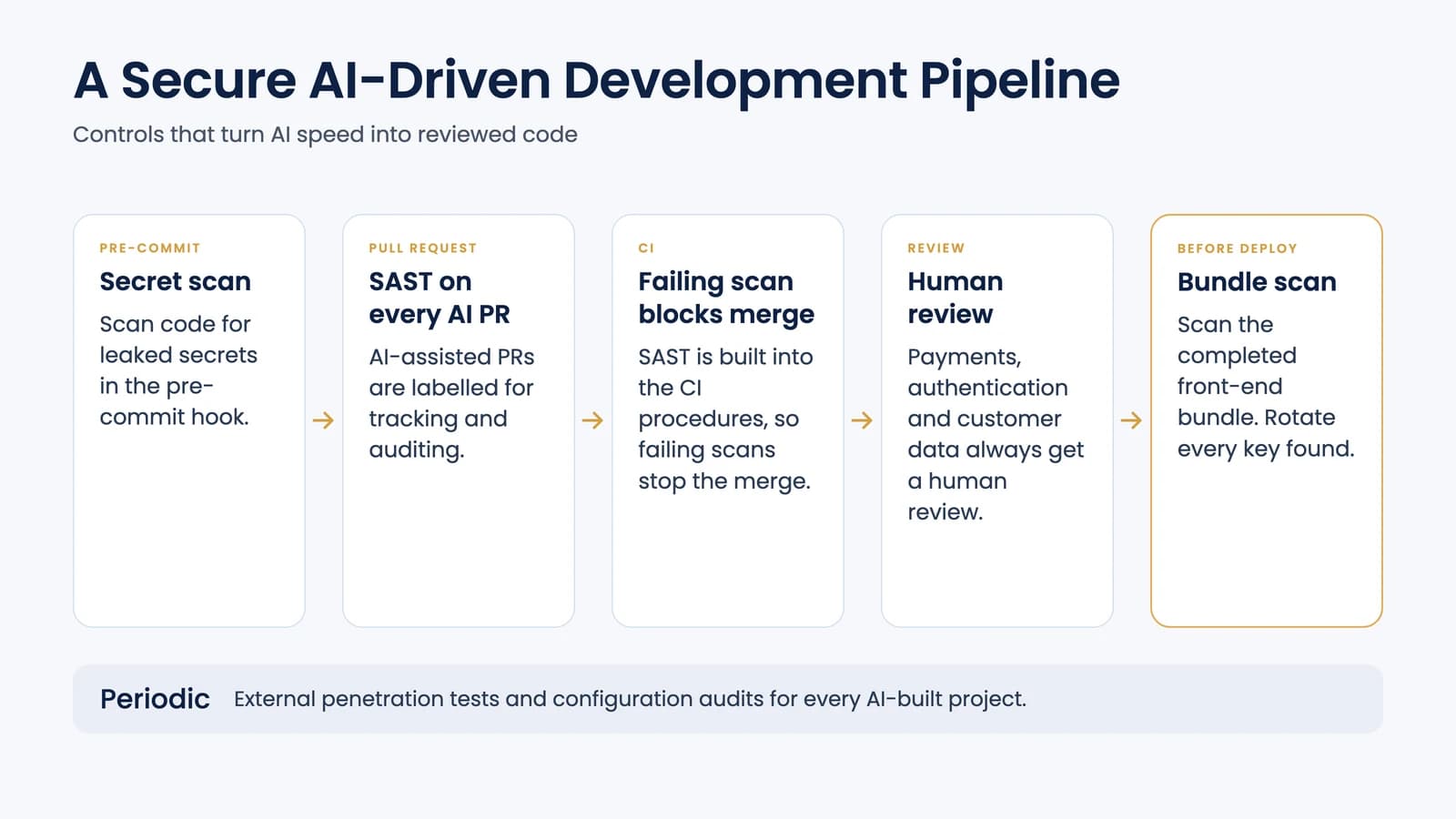
- Placing QA and cybersecurity audits at the center. AI cuts the development time roughly by half, so invest the saved time in review. Every change involving payments, authentication, and customer data should undergo human review. Manual reviews are also vital for edge conditions, which AI understands poorly. Every AI-built project should also be subjected to periodic external penetration tests and configuration audits.
- Running SAST on every AI-authored pull request. SAST stands for static application security testing, which catches string-concatenated SQL, weak ciphers, missing path canonicalization, or unsafe randomness as core AI generated code security risks in FinTech. SAST must be built into continuous integration (CI) procedures so that failing scans can block the merge. SAST will also label AI-assisted PRs for their concise tracking and auditing.
- Detecting secrets before they leave the config. Code scanning for secret leakage must take place at the pre-commit hook, in CI, and against the completed front-end bundle as AI code review best practices. The final stage is vital before deployment; all keys detected during an audit must be rotated.
None of these controls is brand-new, but their combination can make a real difference in FinTech development safety.
Key Takeaways: AI Coding Doesn’t Mean Fewer Coders
Our insights aren’t meant to talk you out of AI usage. However, AI-driven development doesn’t mean you can move on fast with fewer programmers. In practice, the expert role shifts from manual code writing to comprehensive review. We at 4IRE also provide AI-driven development services by combining AI’s speed with disciplined manual audit. Contact us to get the best of the two worlds, with accelerated development and mandatory cybersecurity tests, SAST, and human control at each stage.
Ship AI-Assisted FinTech Code Safely With 4IRE
We combine the speed of AI-driven development with disciplined manual audit: SAST, cybersecurity tests and human control at each stage. Schedule a free consultation.
FAQ
A blanket ban on AI will hardly stop this practice, only bringing usage underground. Tiered access offers a safer alternative: AI should be allowed freely for tests, tooling, and UI, with all code related to business logic subjected to senior developer review, and a complete restriction for cryptography and key management.
Yes, but only partly. AI reviewers can spot common vulnerabilities and explain their findings to junior developers, but they may also have blind spots similar to AI models that write the flawed code. Thus, human review and SAST are also needed.
Auditors look into how the code was reviewed and tested, and who gave the final go-ahead to it. Thus, you need to keep detailed records, AI use logs, and CI scan results to external cybersecurity audits.