

 AI

The agentic AI market is growing fast. Valued at $7.84 billion in 2025, it is projected to reach $52.62 billion by 2030, a CAGR of over 46%, according to MarketsandMarkets. A recent McKinsey survey shows that 23% of businesses are already scaling agentic systems somewhere in the enterprise, while another 39% are still experimenting with the technology.
Yet the industry is far from mature, and many AI agents fail a reality check in real-world use. Gartner predicts that over 40% of agentic AI projects will be canceled by the end of 2027 due to escalating costs, unclear business value or inadequate risk controls. It also estimates that only about 130 of the thousands of vendors selling “agentic AI” offer genuine agentic capabilities. The rest rebrand chatbots, AI assistants and RPA tools.
This makes a strong case for careful product design and vendor selection. In this guide, the 4IRE team compares the top 10 companies you can turn to for AI agent development. We are on the list ourselves, so we applied the same criteria to every vendor, our own company included, and listed our own weaknesses too.
How We Chose the Companies
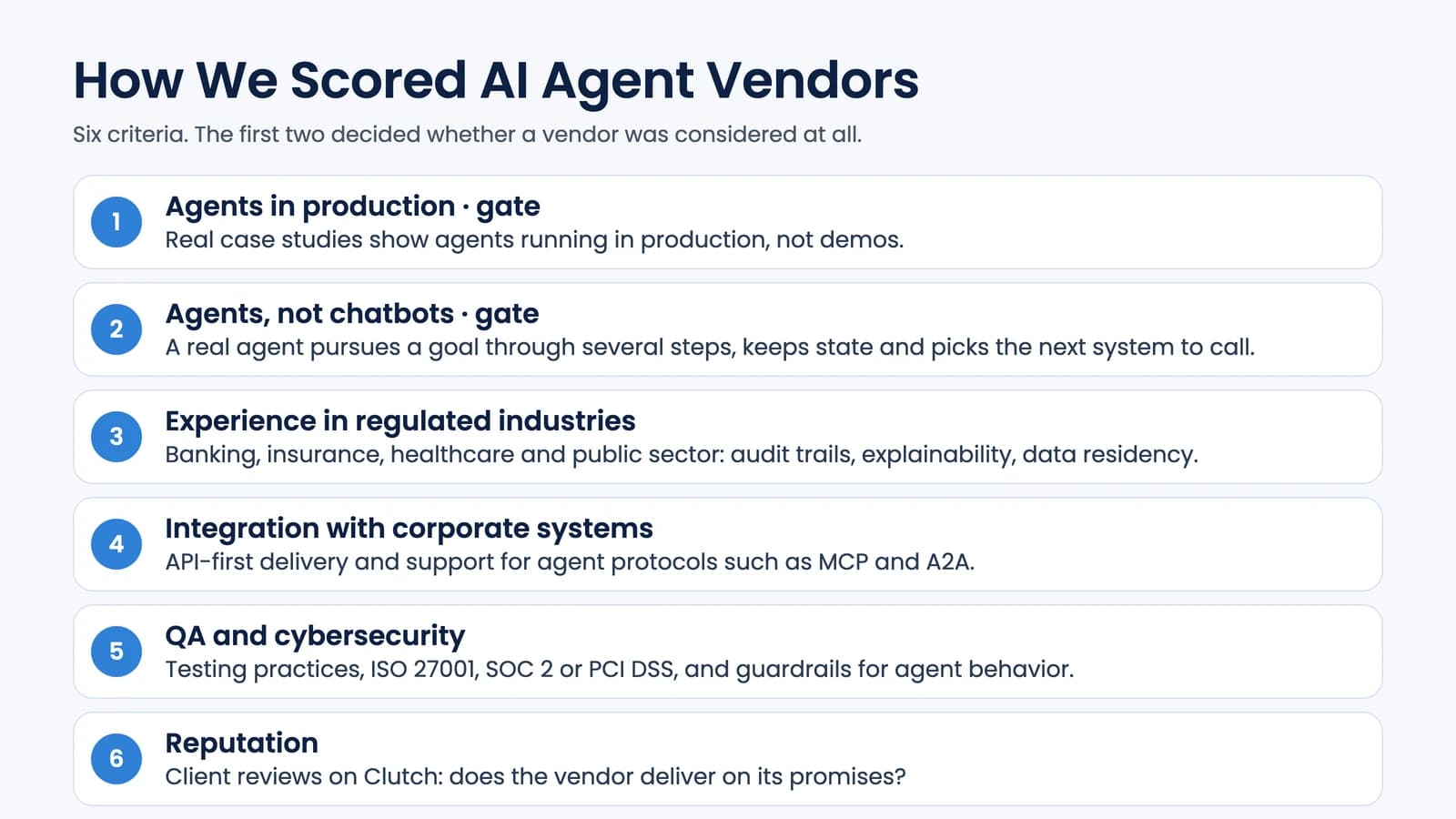
Choosing among hundreds of businesses that each claim to be the best is hard without a clear methodology. We scored every vendor against six criteria and checked company facts on official websites and Clutch profiles. The first two criteria decided whether a company was considered at all.
- Agents in production. We looked at each company’s case studies to see whether its AI agents run in production or remain demos.
- Agents, not chatbots. A real AI agent pursues a set goal through several steps, keeps state and decides which system to call next. A chatbot answers one prompt at a time.
- Experience in regulated industries. We gave weight to work in banking, insurance, healthcare and the public sector, where agents must meet requirements for audit trails, explainability and data residency.
- Integration with corporate systems. Agents deliver business value only when they can reach core systems. We checked for API-first delivery and support for agent protocols such as the Model Context Protocol (MCP) and Agent-to-Agent (A2A).
- QA and cybersecurity. We examined testing practices, security certifications (ISO 27001, SOC 2, PCI DSS) and guardrails for agent behavior.
- Reputation. We read client reviews on Clutch to see whether each vendor delivers on its promises and what customers say about the partnership.
Top 10 AI Agent Development Companies at a Glance
Applying this methodology to the global market of AI agent vendors, we arrived at the following list of the best AI agent development companies.
| Company | Best for | Use cases | Clutch rating | Team size |
|---|---|---|---|---|
| 4IRE | Banks and FinTechs | RAG assistant and agents in ProcessMIX, AI scoring, fraud detection, MCP/A2A infrastructure | 4.8 | 50+ |
| LeewayHertz | Platform-led enterprise rollouts | Multi-agent systems on ZBrain | 4.7 | 50–249 |
| ScienceSoft | Compliance-heavy healthcare and insurance | Finance, security and workflow agents, intelligent document processing | 4.8 | 750+ |
| Appinventiv | Large consumer-facing companies | Agents in mobile and web apps | 4.6 | 1,600+ |
| Markovate | Fast mid-market builds | Workflow, data-analysis and customer-service agents | 5.0 | 50–249 |
| SoluLab | FinTech and Web3 teams | Multi-agent fraud investigation, workflow automation | 4.9 | 250+ |
| Rapid Innovation | Startups that need a quick MVP | Digital-workforce automation | n/a | 100+ |
| EPAM Systems | Global 2000 enterprises | AI/Run platform, agentic QA | n/a | 62,000+ |
| Thoughtworks | Legacy modernization with agent governance | AI/works and Agent/works platforms | n/a | About 10,000 |
| Azumo | Nearshore agent teams for US firms | Production agents, voice agents, RAG | 4.9 | 50–249 |
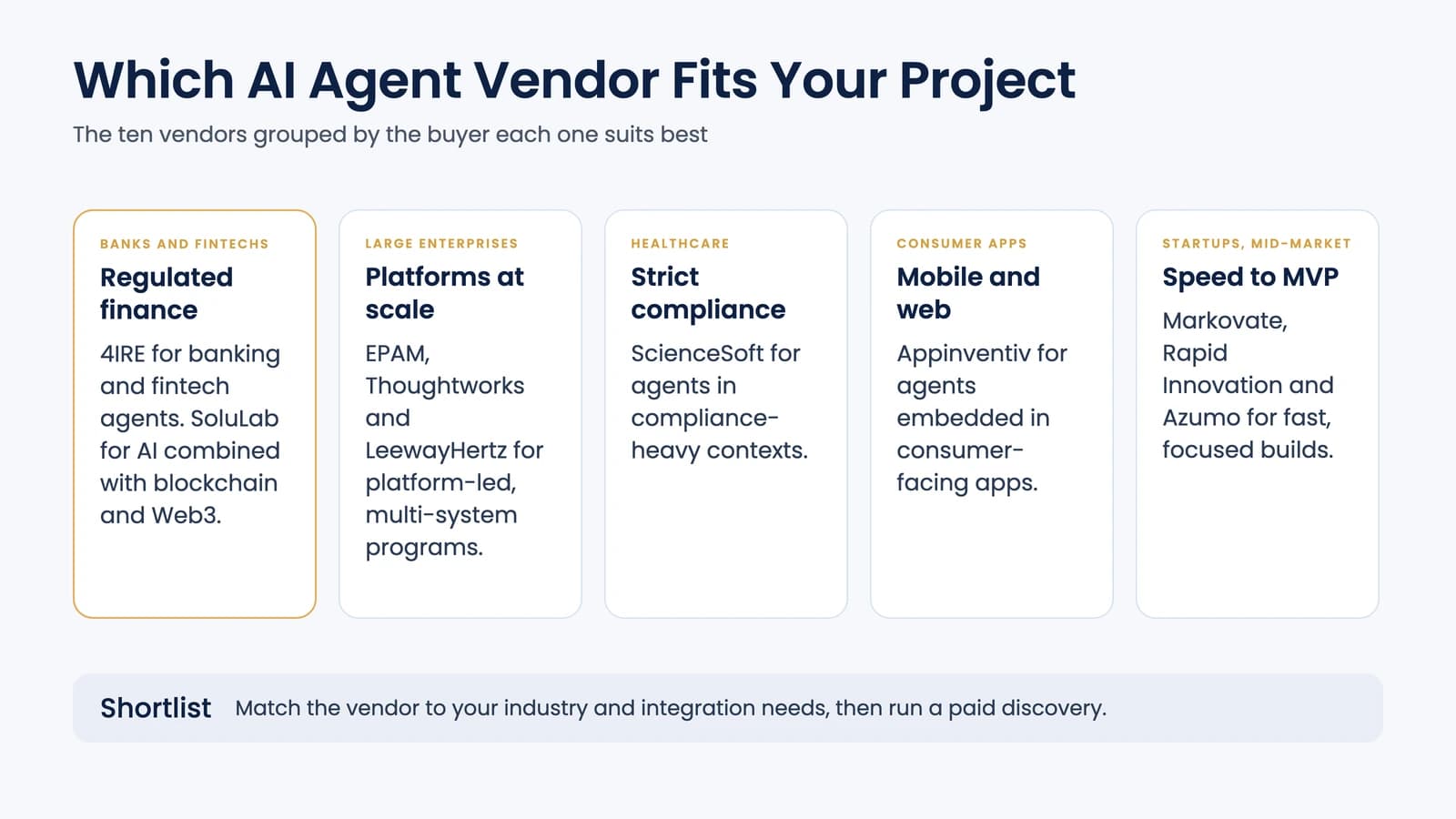
The map below groups the ten vendors by the kind of buyer each one suits best.
The 10 Best AI Agent Development Companies Reviewed
Let’s look at each vendor in more detail to see which one fits your custom AI agent development needs.
1. 4IRE
4IRE has built software for banks, FinTechs and regulated enterprises since 2010. It is led by CEO Olena Petrashchuk, with offices in Tallinn and Stockholm and a team of 50+ developers and IT professionals. The company has delivered 250+ projects and now offers agentic AI solutions for finance and FinTech, among other industries.
Best for: banks and FinTechs that need production-grade AI agents for regulated financial workflows.
Strengths:
- A RAG assistant and agentic functions in ProcessMIX, 4IRE’s low-code decision platform.
- AI scoring and fraud detection for banks.
- A behavior-scoring engine on FICO Blaze Advisor for First Abu Dhabi Bank.
- MCP and A2A infrastructure that gives agents agentic connectivity to payment and compliance systems.
Weaknesses:
- A small team compared to global-scale AI agent vendors.
- A strong focus on FinTech and banking, so fewer references in other industries.
2. LeewayHertz
LeewayHertz was founded in 2007 by Akash Takyar and has been part of The Hackett Group since 2024. Its Clutch profile lists Gurugram, India, as headquarters and AI agents as 25% of its service mix, with a 4.7 rating.
Best for: enterprises seeking a platform route to AI agents.
Strengths:
- Its ZBrain platform covers both use-case discovery and production agent and multi-agent system development.
- Clients across finance, healthcare, legal and manufacturing.
Weaknesses:
- A small review base on Clutch (nine reviews at the time of writing).
- Limited public client feedback on its agentic AI projects so far.
3. ScienceSoft
ScienceSoft is a software development veteran, founded in 1989 and headquartered in McKinney, Texas, with delivery centers in Europe. It builds finance, security, workflow and customer-service agents, AI assistants and intelligent document processing tools for regulated firms. It reports 750+ experts and a portfolio of over 4,300 projects.
Best for: healthcare, insurance and investment businesses that need AI agents in strict compliance contexts.
Strengths:
- ISO 9001, ISO/IEC 27001 and ISO/IEC 27701 certifications.
- Mature cybersecurity and penetration-testing practice.
- A 4.8 rating on Clutch across dozens of reviews.
Weaknesses:
- AI agents are one service line among many.
- A large-company delivery model can feel heavy for small, fast pilots.
4. Appinventiv
Sudeep Srivastava founded Appinventiv in 2015 in Noida, India. The company has offices in the USA, Canada, Australia and the UAE, and builds AI-native products that embed agents and conversational AI into mobile and web apps. It claims to have served over 3,000 enterprise and startup clients and holds a 4.6 rating on Clutch.
Best for: large companies seeking scalable agentic AI for consumer-facing apps.
Strengths:
- A global team of 1,600+ engineers.
- OpenAI Select Partner status, announced in September 2026.
- KFC, IKEA and KPMG among its clients.
Weaknesses:
- Mobile and web app development still dominates its service mix.
- A large account structure, so ask who stays on your project after kickoff.
5. Markovate
Founded in 2015, Markovate is headquartered in San Francisco and specializes in generative AI and agents. It builds workflow, data-analysis, research and customer-service agents that integrate with Salesforce, HubSpot and Google Workspace.
Best for: mid-market companies seeking fast agentic AI solutions.
Strengths:
- A sharp focus on AI: generative AI and AI agents make up 75% of its Clutch service mix.
- Published case results, such as a support-case classifier agent with 98% accuracy and a healthcare documentation agent that cut processing time by 40%.
- A 5.0 rating on Clutch.
Weaknesses:
- A small review base (12 reviews on Clutch).
- Limited public evidence of large regulated agent deployments.
6. SoluLab
Founded in 2014, SoluLab lists Los Angeles as headquarters on Clutch and runs a large delivery center in Ahmedabad, India. It reports 1,500+ finished projects and a team of 250+ engineers, data scientists and AI specialists. It builds AI agents and multi-agent systems and combines agentic AI with blockchain, tokenization and Web3 development.
Best for: FinTech and Web3 businesses that need AI agents coupled with blockchain expertise.
Strengths:
- CMMI Level 3, ISO 27001 and SOC 2 credentials.
- Proven agentic AI cases, such as a multi-agent fraud-investigation platform for a CPA firm built on LangGraph.
Weaknesses:
- Its roots and much of its portfolio are in blockchain engineering rather than AI.
7. Rapid Innovation
Rapid Innovation has been shipping products since 2019 from offices in Post Falls, Idaho, and Noida, India. It focuses on AI and blockchain development for startups and fast-moving product teams.
Best for: startups that need a quick MVP with agentic AI features.
Strengths:
- A fixed-price offer that promises a live product in six weeks.
- A strong focus on AI and digital-workforce automation.
- Hands-on Web3 and AI experience.
Weaknesses:
- No public Clutch rating to check client feedback against.
- A speed-first, sprint-based model suits MVPs better than long-term support of production agents.
8. EPAM Systems
Arkadiy Dobkin and Leo Lozner founded EPAM in Princeton, New Jersey, in 1993; the company is now headquartered in Newtown, Pennsylvania. It has the largest team in this rating, with about 62,000 employees in 55+ countries as of late 2025, and delivers enterprise AI through its own platforms.
Best for: Global 2000 enterprises running agentic AI programs across multiple core systems.
Strengths:
- The AI/Run platform for scaling AI applications.
- Agentic QA for agent-driven software testing.
- Long-term relationships with large enterprise clients.
- Capital-markets depth added through the First Derivative acquisition in 2024.
Weaknesses:
- Enterprise pricing and procurement cycles mostly suit large programs.
- A delivery base concentrated in Central and Eastern Europe, which EPAM itself lists as an operational risk.
- Heavy dependence on the North American market.
9. Thoughtworks
Thoughtworks is a Chicago-based technology consultancy founded in 1993. It employs about 10,000 people and specializes in custom software development, digital transformation and agile engineering. It sells its agentic AI products as part of consulting engagements and holds the AWS Agentic AI Specialization.
Best for: enterprises modernizing legacy core systems.
Strengths:
- AI/works, an agentic development platform launched in January 2026.
- Agent/works, launched in June 2026 to govern and run enterprise agents.
- Wealth management work with Iress.
Weaknesses:
- Premium consulting rates.
- Its agent platforms are deployed within consulting engagements, not sold as stand-alone products.
10. Azumo
Azumo was founded in 2016 in San Francisco and runs nearshore engineering teams across Latin America. It sells production agent builds as fixed-price packages covering evaluation sets, CI regression gates, audit logging, rollback paths and human escalation. It also offers RAG pipelines and voice agents.
Best for: North American companies seeking AI development teams in their time zone.
Strengths:
- A clear focus on AI and LLM applications.
- Time zones that overlap with North American working hours.
- A 4.9 rating on Clutch.
- Quick MVP delivery.
Weaknesses:
- Mid-market scale, which can limit very large programs.
- Less banking-specific depth than FinTech-focused vendors.
Agent vs. Chatbot: How to Spot Agent Washing
Gartner uses the term agent washing for rebranding existing products, such as AI assistants, RPA tools and chatbots, as agentic AI without real agentic capabilities. It is easy to spot if you ask the right questions:
- Which systems can the agent write to?
- What happens when a step fails?
- Where is the audit log of the agent’s decisions?
A rebranded chatbot can’t answer any of them in a meaningful way. The table below breaks down the differences in more detail.
| Feature | Chatbot | AI agent |
|---|---|---|
| Goal | Answers one inquiry | Completes a multi-step task |
| Planning | Follows a fixed, preconfigured script | Decides on the next step autonomously |
| Tools and systems | Pulls answers from a knowledge base | Calls APIs, MCP servers and other agents |
| Actions | Replies with text | Creates and updates records |
| Memory | Forgets past sessions | Keeps the task context |
| Control | Little to none | Guardrails, human approval, audit |
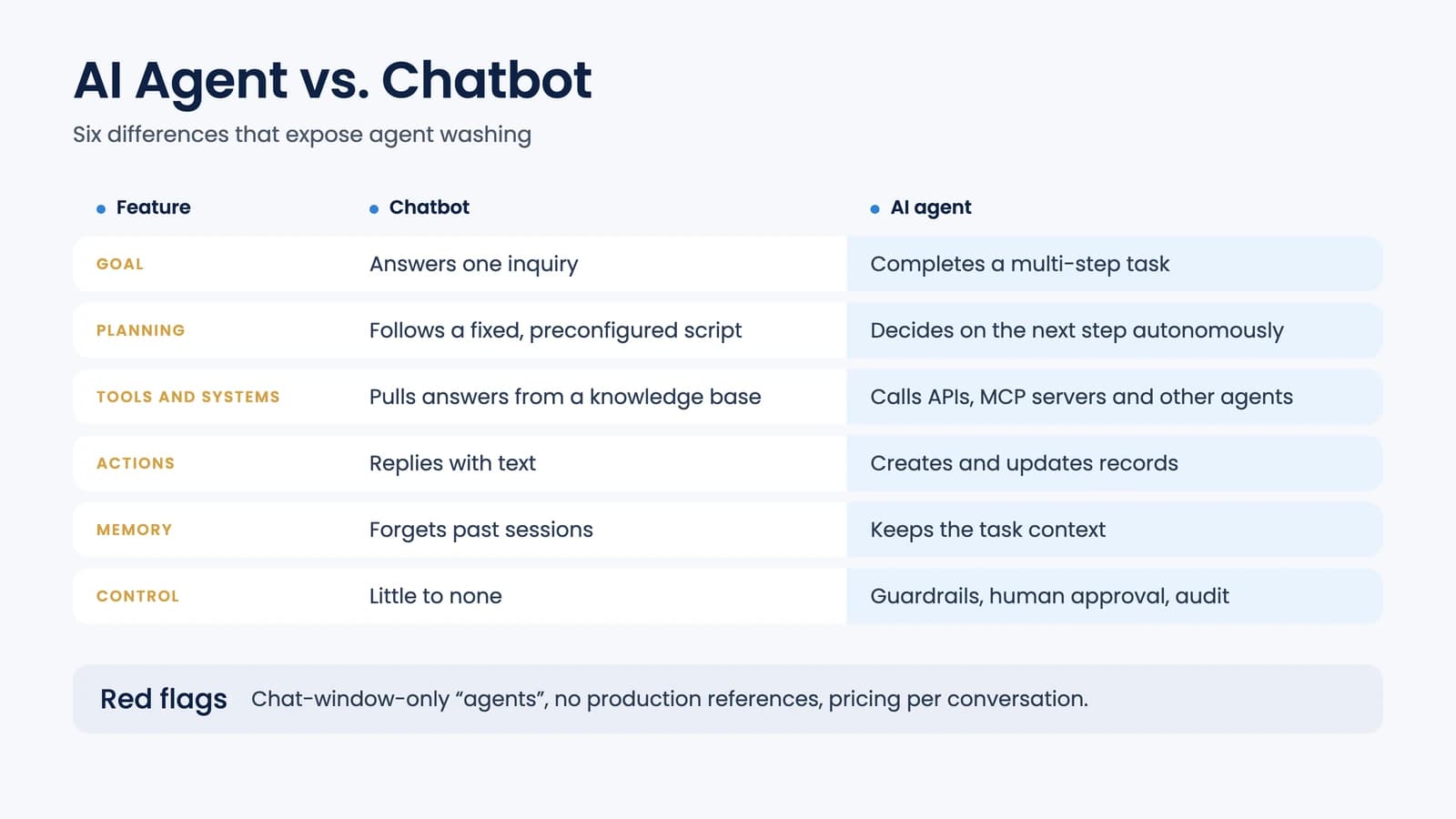
Other red flags include “agents” that work only inside a chat window, no production references, and pricing per conversation rather than per completed task.
Build Your AI Agent With 4IRE
Talk to 4IRE about agentic AI and LLM development, from AI scoring to fraud detection and MCP/A2A integrations with core systems. Our AI developers know the AI-driven development risks in finance and build agents with the audit trails, guardrails and human approvals that regulated businesses need.
Build Production AI Agents With 4IRE
From RAG assistants to AI scoring and fraud detection, we build agents that connect to your core systems with audit trails and human approval built in. Schedule a free consultation.
FAQ
It designs and builds AI agents tailored to the client’s business workflows, able to complete multi-step tasks with limited human involvement. The work typically covers use-case discovery, data preparation, integration with core business systems through APIs and MCP, guardrails and human approval rules, testing, a security audit and post-launch monitoring.
The price depends on the agent’s complexity, the number of systems it connects to and the regulatory context. Minimum project sizes listed on Clutch by the vendors above start at $5,000–$10,000, while production agents that integrate with several core systems and pass security reviews cost considerably more.
A chatbot answers one message at a time and retrieves information from its knowledge base. An AI agent works toward a set goal, performs a sequence of steps and chooses the next step on its own, calling APIs and other systems along the way.
It depends on scope. Rapid Innovation, for instance, advertises a live product in six weeks, while SoluLab’s multi-agent fraud prototype took four months. Agents for regulated businesses need extra time for security reviews and integration testing, so plan for several months to reach production.