

 Bank

CASP Licensing at a Glance
- The MiCA transitional period for existing crypto firms ended on 1 July 2026 at the latest. Many member states cut it shorter: the Netherlands, Poland and Finland allowed six months, Germany and Lithuania twelve.
- ESMA’s interim MiCA register listed about 360 authorised crypto-asset service providers (CASPs) in early October 2026, across the EU and EEA.
- A submitted application does not authorise anyone to provide crypto services. Only a granted CASP authorisation, or the Article 60 notification route for already-licensed financial firms, does (MiCA Article 59).
- For unlicensed crypto services, MiCA requires member states to allow fines of at least €5,000,000 or 5% of annual turnover for companies, and at least €700,000 for individuals (Article 111).
- Revolut received its CASP authorisation from the Cyprus regulator CySEC in October 2025 and uses it to serve all 30 EEA countries.
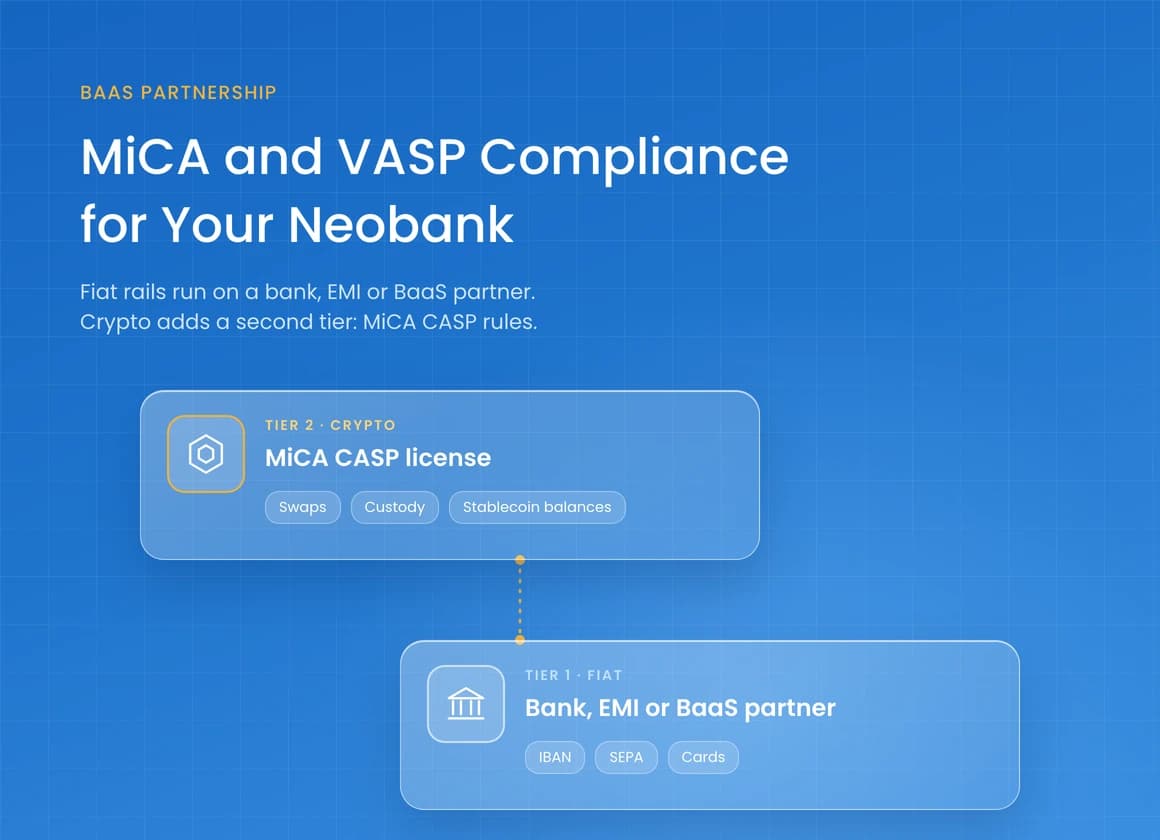
The trap that many neobank launch guides set for business owners is treating a BaaS or EMI partnership as the whole compliance picture. In reality, these models cover only fiat payment rails. Once you add crypto features (swaps, stablecoin balances, custody), your business enters a distinct MiCA/CASP regime that a BaaS partnership does not cover. Treating a BaaS agreement as a crypto license is a serious mistake: since the MiCA transitional period ended, it leaves a neobank providing crypto services without authorisation. Neobanks with fiat and crypto support operate under a two-tier compliance regime, and this guide walks through the crypto neobank licensing requirements on each tier.
Three Paths for Neobank Launch
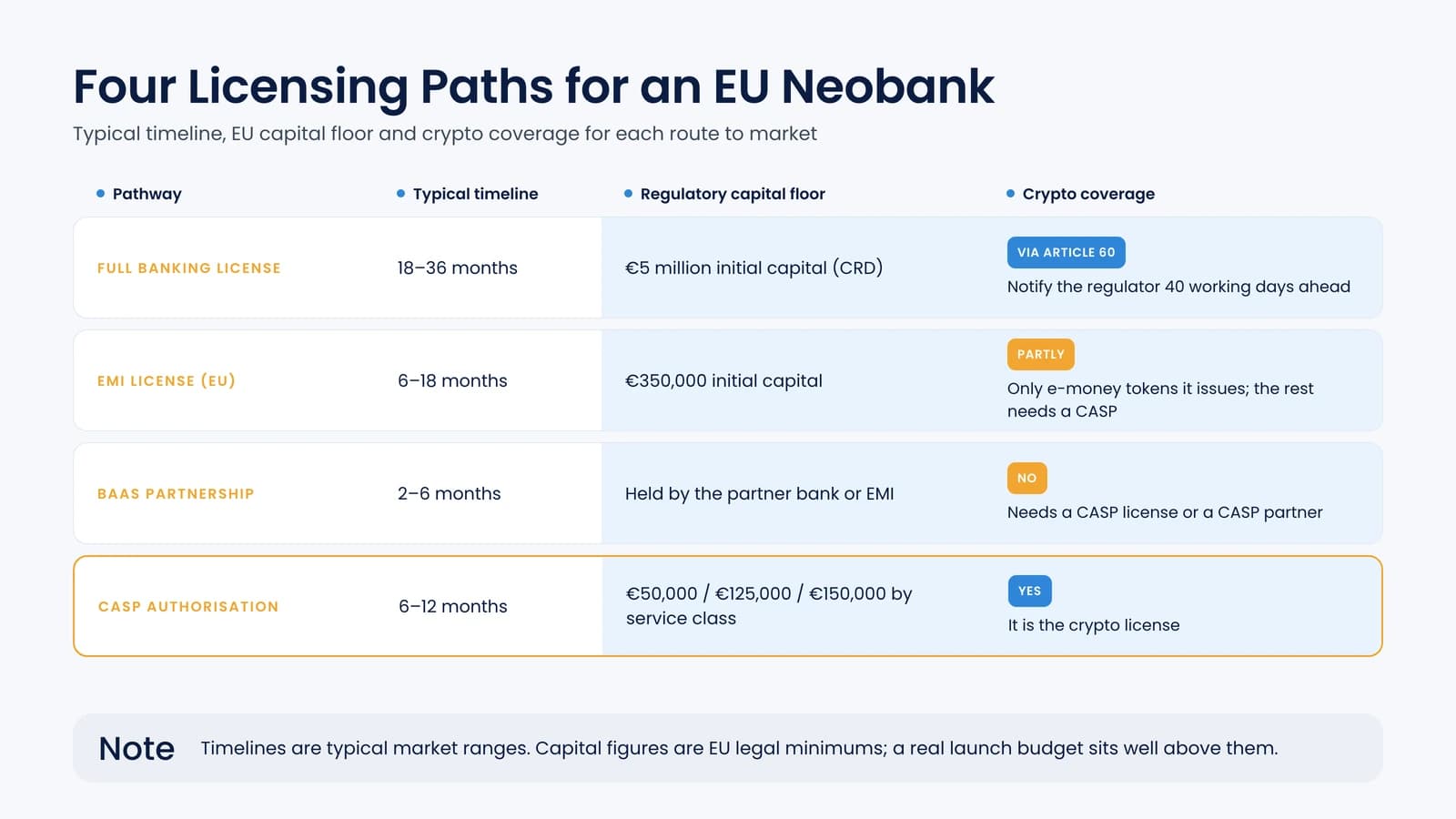
Starting out as a neobank that handles fiat means choosing between a full banking license, an EMI license or a BaaS partnership. Let’s look at all three options to help you choose a suitable licensing strategy.
- Full banking license: this approach buys you independence from third-party banks, but it comes at the highest price and takes the longest.
- EMI license: the EMI route is the middle ground that many European neobanks chose for their fiat rails. It still involves a substantial initial investment and a lengthy process, which is why it was most popular in the 2010s, before fast, cheap and low-risk BaaS services appeared.
- BaaS partnership: a fast and affordable option that leaves only the app and the brand as the neobank’s responsibility. The trade-off is vendor lock-in, with the provider’s risk appetite and roadmap outside your control.
| Pathway | Typical timeline | Regulatory capital floor | Crypto coverage |
|---|---|---|---|
| Full banking license | 18–36 months | €5 million initial capital (CRD) | Yes, via an Article 60 notification to the regulator |
| EMI license (EU) | 6–18 months | €350,000 initial capital | Only custody and transfer of e-money tokens it issues; other services need a CASP |
| BaaS partnership | 2–6 months | Held by the partner bank or EMI | No, a CASP license or a CASP partner is needed |
| CASP authorisation (MiCA) | 6–12 months | €50,000, €125,000 or €150,000, by service class | Yes, it is the crypto license |
Timelines are typical market ranges, not legal deadlines. The capital figures are the regulatory minimums set by EU law, and a real launch budget sits well above them.
Where BaaS Ends and MiCA Starts
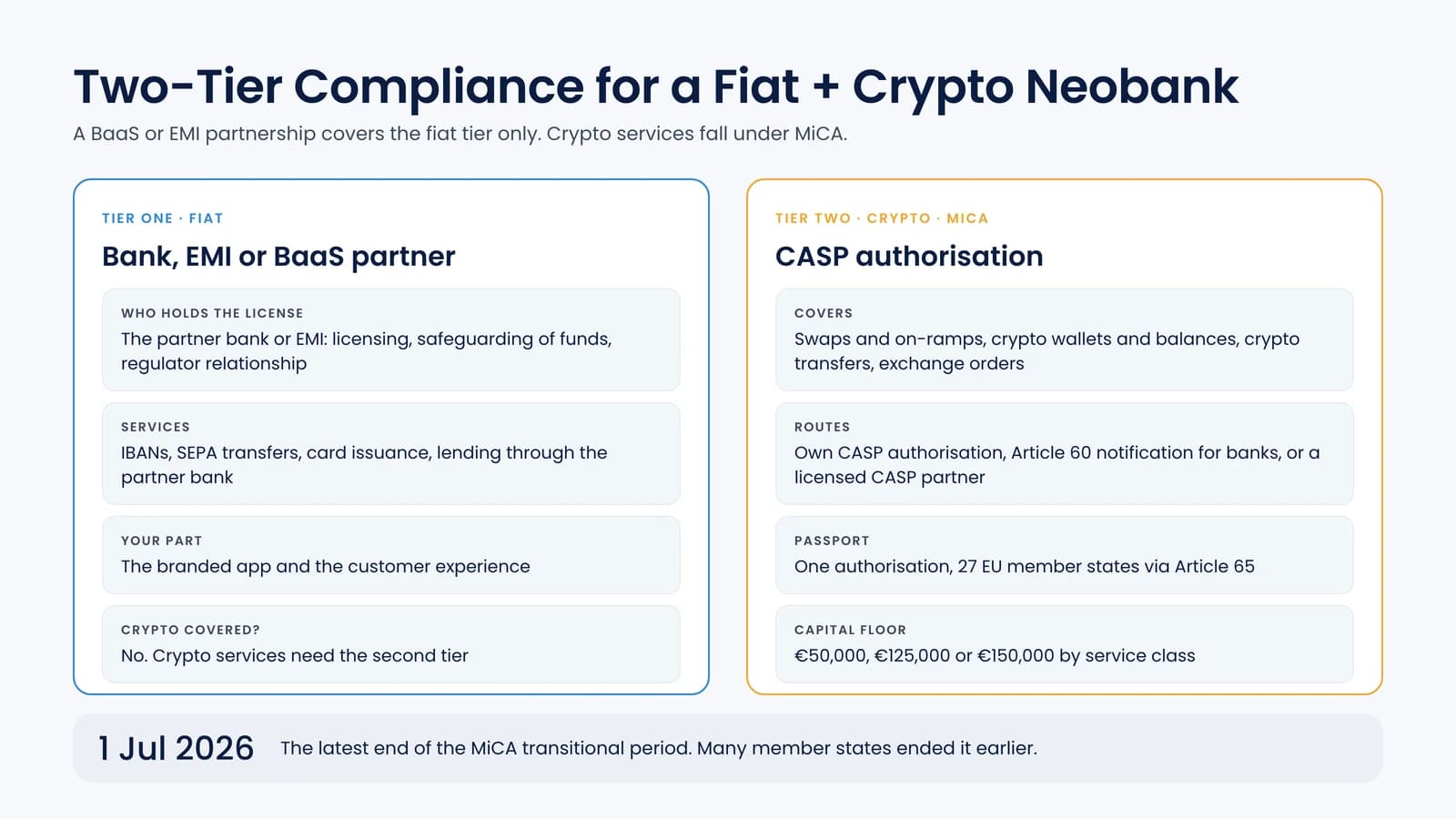
Once a neobank expands its offer with crypto, BaaS no longer covers all of its compliance. So, how do you launch a compliant neobank in the EU? At this point two-tier compliance applies, with MiCA governing swaps and on-ramps, crypto wallets and balances, crypto transfers and the purchase of crypto on exchanges.
Tier One: Fiat
If you pursue the Banking-as-a-Service (BaaS) model, a licensed bank or an electronic money institution (EMI) behind it is responsible for licensing, safeguarding customer funds and the relationship with regulators. The neobank typically supplies a branded app and owns the customer experience. This model works well for the standard service range: IBANs, SEPA transfers, card issuance and lending through the partner bank. If you obtain an EMI license directly, the range stays much the same with one limit: an EMI cannot take deposits, and its lending is restricted to short-term credit linked to payments, so those products still sit with a partner bank.
Tier Two: Crypto
Neobanks that handle crypto enter the scope of MiCA, Regulation (EU) 2023/1114, the EU’s harmonised rulebook for crypto-assets. Its Title V, which has applied since 30 December 2024, requires any firm providing crypto-asset services in the EU to hold a CASP authorisation. Banks, investment firms and a few other licensed financial entities can instead notify their regulator under Article 60. EMIs can use that route only for custody and transfer of the e-money tokens they issue. A CASP authorisation granted in one member state can be passported to all 27 EU member states through a notification under Article 65.
The CASP regime replaced the long-standing approach under which virtual asset service providers (VASPs) could operate after a national AML registration. MiCA introduced a full authorisation with capital, governance and conduct rules, so the VASP to CASP transition has closed the EU market to any VASP that did not obtain a CASP authorisation before its national transitional period ended.
Where to Apply for a CASP License
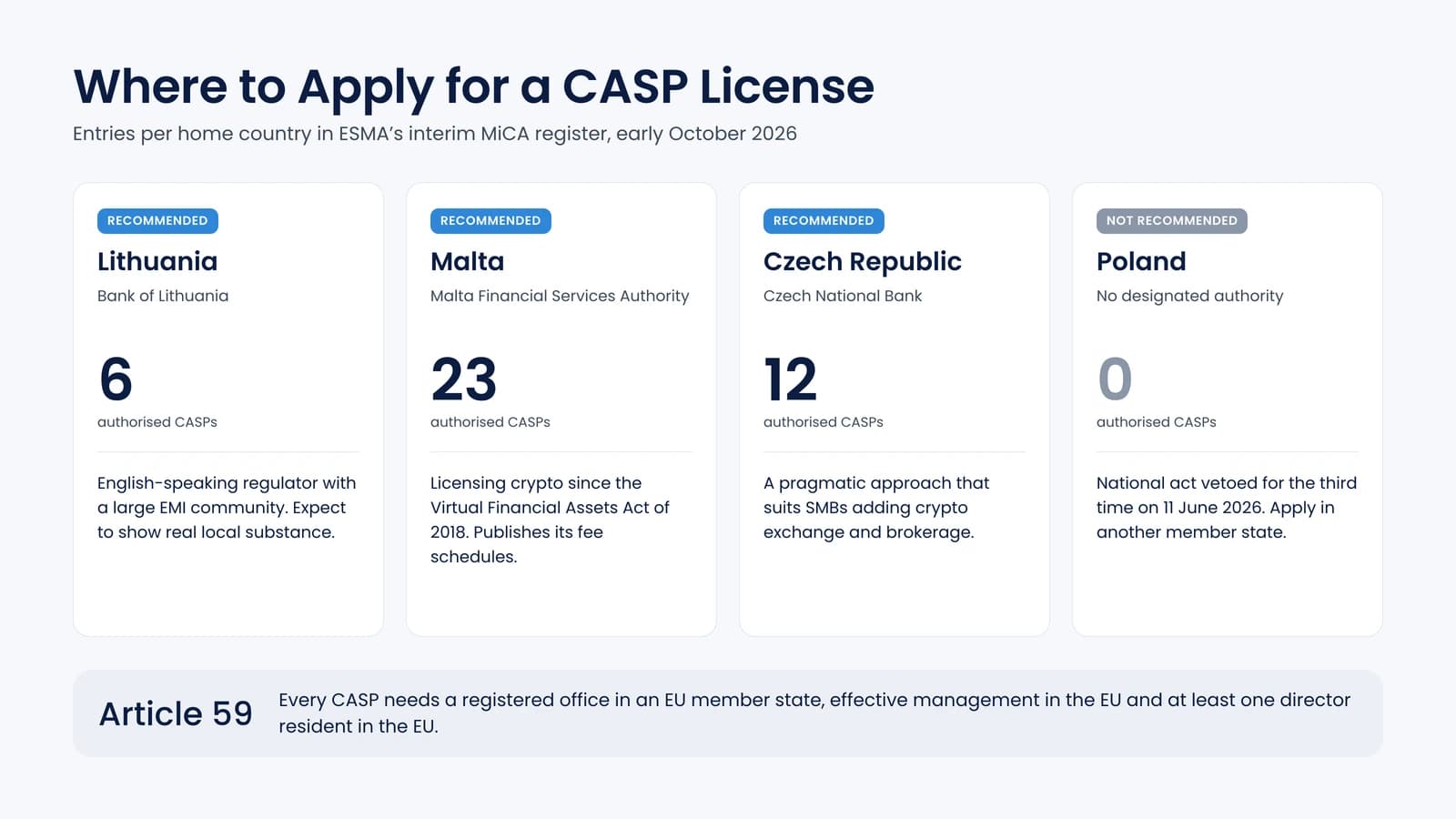
If you plan a crypto-plus-fiat banking model, put the CASP step into your plan early, because the jurisdiction you pick shapes your substance requirements and timeline. At 4IRE, we recommend looking at the following jurisdictions:
- Lithuania. The Bank of Lithuania works in English and supervises one of the EU’s largest EMI communities, which makes it a natural home for EMIs adding crypto to their services. Lithuanian firms hold 6 entries in the ESMA register so far. Expect to show real local substance. MiCA itself requires a registered office in the member state, effective management in the EU and at least one EU-resident director.
- Malta. The MFSA has licensed crypto businesses since its Virtual Financial Assets Act of 2018, one of the longest track records among EU regulators, and publishes its fee schedules openly. Malta-based firms account for 23 entries in the ESMA register.
- Czech Republic. The Czech National Bank has taken a pragmatic approach to CASP licensing, which suits SMBs adding crypto exchange and brokerage to existing operations. Czech firms hold 12 entries in the register.
Poland is not on the list. On 11 June 2026, the Polish president vetoed the national crypto-assets act for the third time, so the country still has no designated authority that can grant a CASP authorisation, and Polish neobanks must apply elsewhere.
Bottom Line
The European neobanking sector now runs a two-tier compliance regime, and your launch roadmap should account for it. Tier one moves fiat and is reachable through a banking license, an EMI license or a BaaS partnership. Tier two covers crypto-assets and needs a CASP authorisation of your own or a licensed CASP partner.
Building a technically and legally compliant neobank can look overwhelming. This is where our NeoBankX product helps, with a pre-built proprietary core that supports fiat and crypto in one tech stack. You also get support from the 4IRE legal team on choosing a licensing jurisdiction and carrying out the licensing strategy, alongside our neobank development team.
Launch a MiCA-Ready Neobank With 4IRE
Our FinTech engineers build the fiat and crypto layers of a digital bank on one core, from BaaS or EMI integration through CASP-ready custody, swaps and reporting. Schedule a free consultation.
FAQ
Licensed banks can use MiCA’s Article 60 notification route, filed at least 40 working days before launch, instead of the full CASP application. EMIs can use the same route only for custody and transfer of the e-money tokens they issue themselves. For every other crypto service, an EMI needs a separate CASP authorisation.
Yes, authorisation is where ongoing obligations begin. A CASP must keep its prudential capital, safeguard client assets, handle complaints and follow MiCA’s conduct rules. Since January 2025, CASPs have also been in scope of DORA, the EU’s digital operational resilience regulation, which requires ICT risk management, incident reporting and regular resilience testing.
Confirm the partner’s authorisation in ESMA’s interim MiCA register and check that it has sent the Article 65 passporting notification for every member state where your customers live. Agree who owns customer onboarding data and who is liable for complaint handling before the partnership starts.