

 Bank

A founder’s gravest mistake is to think about a FinTech superapp in 2026 as a banking app with a “crypto” tab bolted on. Today’s FinTech superapp represents a convergent platform in which processing, trading, swaps, and rewards run smoothly on a single ledger. The market has already absorbed this change, with card volumes at crypto neobanks growing by over 223% over the past year, and a broader trend of super apps and CeDeFi merging into a single system.
The financial component of the shift is also considerable. Stablecoin transactions have exceeded $33 trillion in 2025, which is more than Visa and Mastercard’s transaction volume combined. Even after adjustments for bots and internal transfers, the figure stands at the impressive $10 trillion. The stablecoin market capitalization is also growing, with the latest figures suggesting growth above $300 billion.
Spending follows suit, with over $18 billion processed through stablecoin-linked cards in 2025-2026. The wider neobanking market also enjoys fast growth, expected to grow from almost $149 billion in 2024 to over $4.4 trillion in 2034.
How can dev teams targeting fintech app development 2026 capture that growth? Adding more features will hardly help. The clue is in creating a single foundation on which all features build for a smooth user experience.
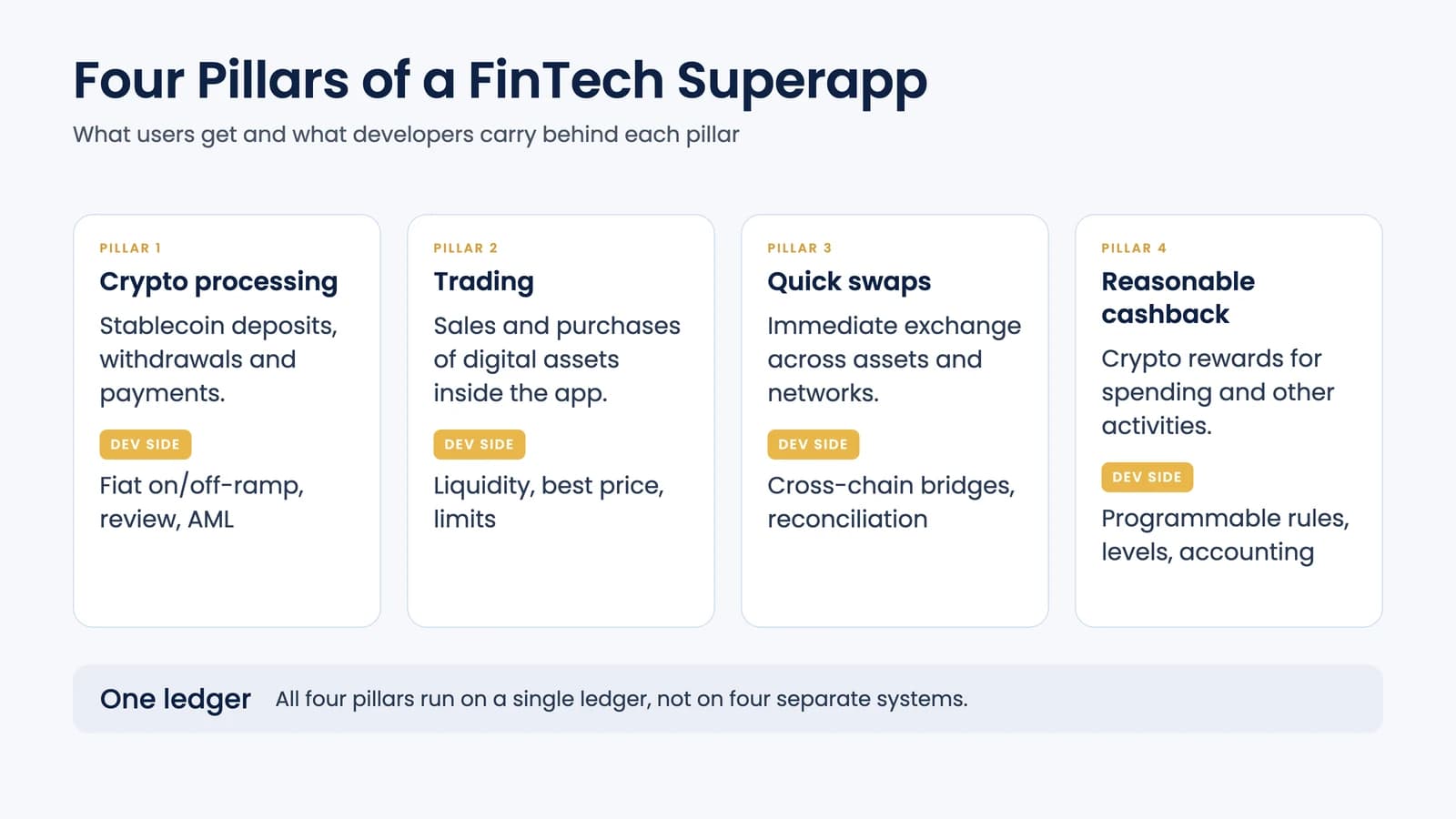
The FinTech SuperApp’s Four Pillars
The uniform ledger on which all superapp functions run is the hardest aspect of modern FinTech development.
Processing
Card and account payments are a vital part of everyday FinTech usage for millions of users. A transfer to crypto payment processing cuts your operational costs by removing intermediary fees.
Trading
The availability of an embedded crypto trading app is always a bonus, as users routinely buy, sell, and hold crypto today. Thus, they want to have it all on the same balance without traveling across apps.
Quick Swaps
An instant cross-chain swap fintech is a true competitive advantage today. The ratio of cross-chain transfer volume to DEX volume rose from 3.4% to over 15% in 2025-2026, suggesting that users prioritize interoperability over other features.
Reasonable Cashback
Crypto cashback rewards work, but not as universally as before. Surveys show that users remain loyal when they receive rewards sustainably and in the assets they want. Many successful projects have embraced this insight: Fold pays 1.5-2% cashback in BTC, while Bleap offers up to 20% rewards in USDC for custodial account activities and up to 6% for its non-custodial products.
| Pillar | User Benefit | Developer-Side Complexity |
|---|---|---|
| Crypto processing | Stablecoin deposits, withdrawals, and payments | Fiat on/off-ramp, review, AML |
| Trading | Sales and purchases of digital assets inside the app | Liquidity, best price, limits |
| Quick swaps | Immediate exchange across assets and networks | Cross-chain bridges, reconciliation |
| Reasonable cashback | Crypto rewards for spending and other activities | Programmable rules, levels, accounting |
A Common Ledger as a Unifying Core
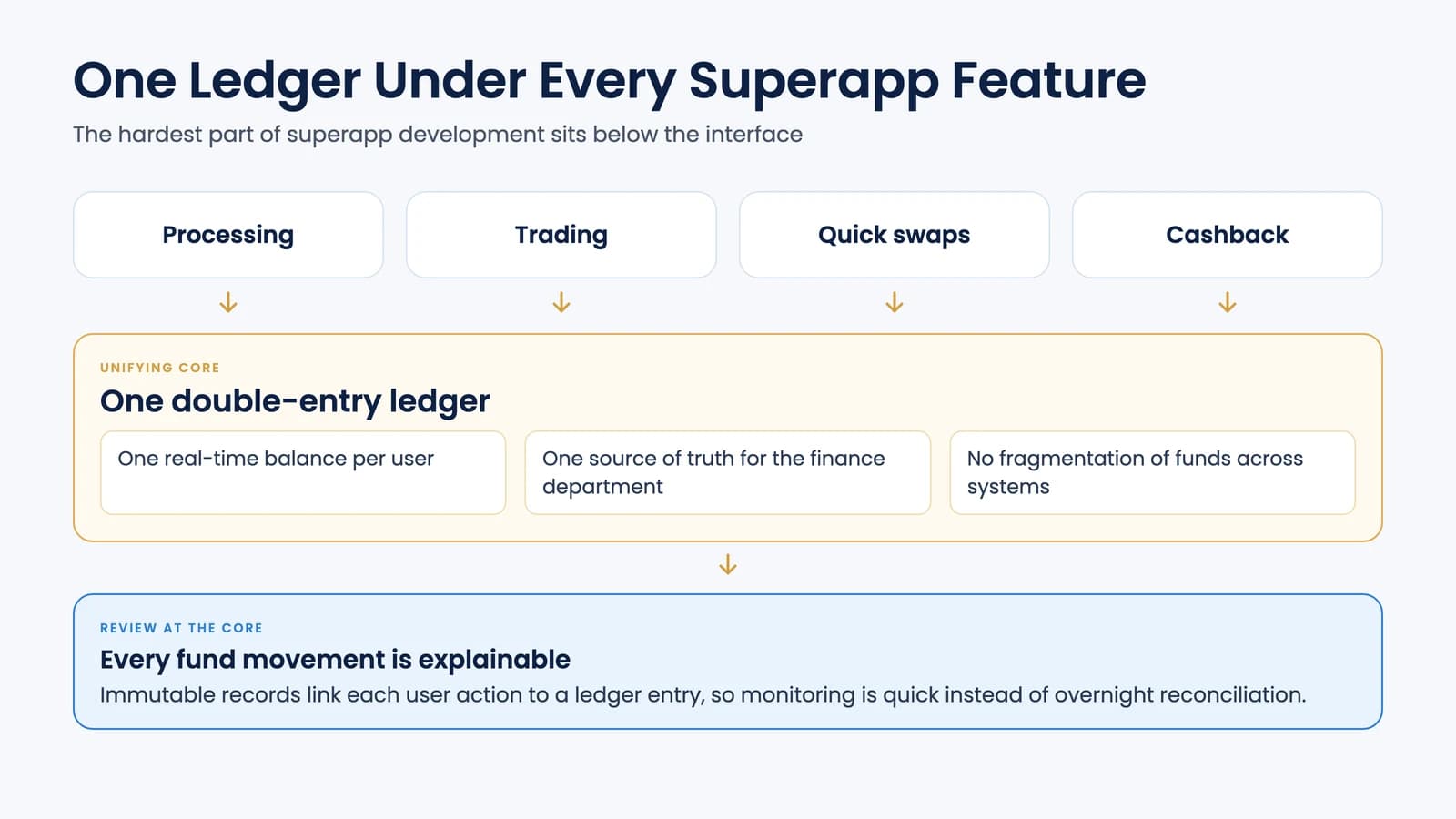
The honest truth about superapps is that the greatest development complexity comes from below – the ledger. A clean swap button is a matter of UI, while the developer’s challenge behind it is the audit trail, compliance checks, and crypto rails that an immediate swap passes through within milliseconds. Here are several tips driving smooth superapp design today.
One Double-Entry Ledger
A convergent superapp includes all card payments, trades, and swaps into a single ledger, giving one real-time balancer per user, one source of truth for the finance department, and no fragmentation of funds across systems.
Review at the Core
All fund moments within the ledger are explainable, with immutable records linking each user’s actions to the ledger entry. This design simplifies transaction monitoring and makes control quick instead of delayed overnight reconciliation.
MiCA and CASP Licensing
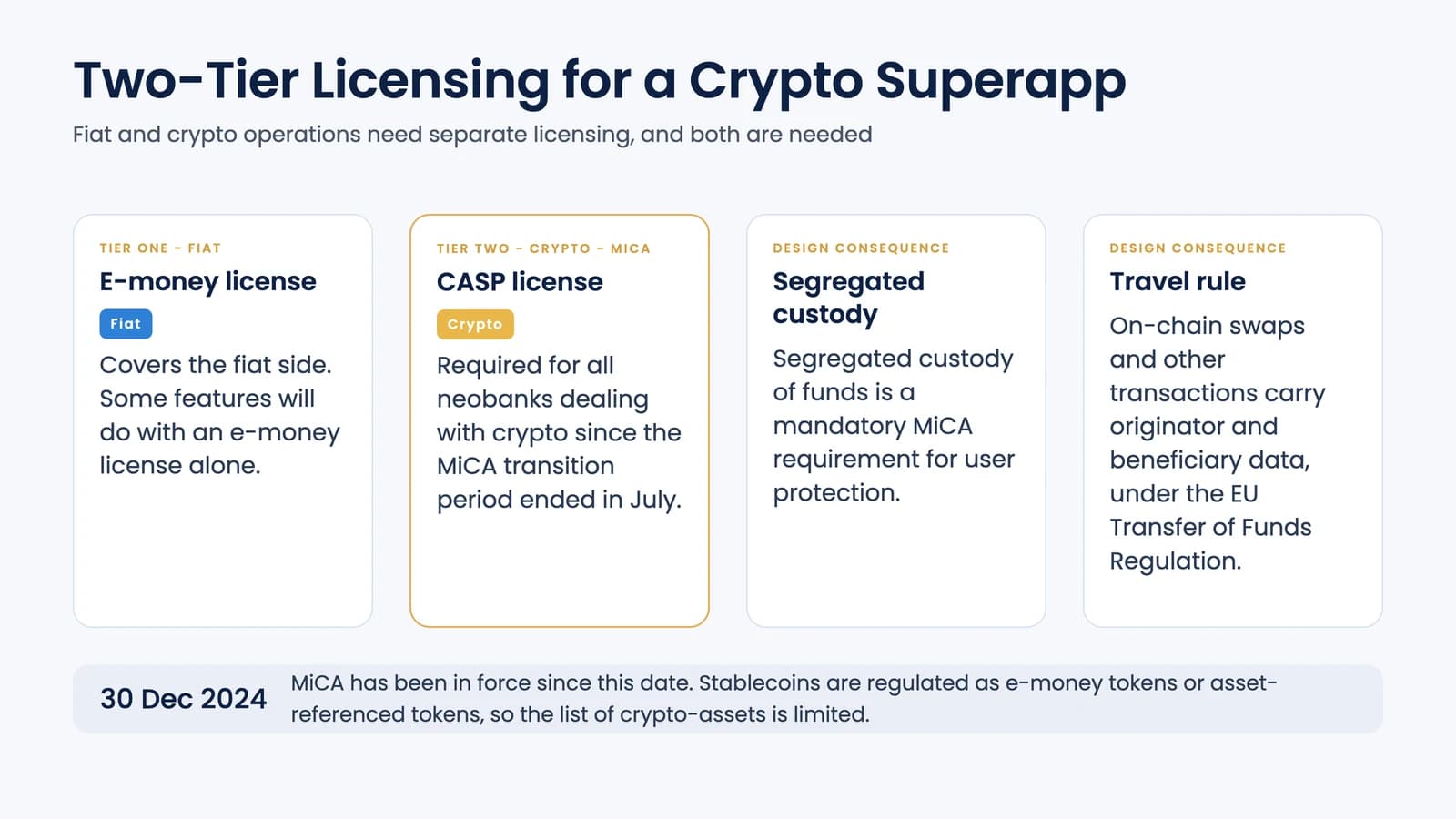
The MiCA regulation in the EU has been in force since 30 December 2024, and the transition period ended this July. It means that all neobanks dealing with crypto should have a crypto-asset service provider (CASP) license. This requirement translates into superapp design solutions like:
- Taking care of segregated custody of funds, which is a mandatory MiCA requirement for user protection.
- Following the travel rule under the EU Transfer of Funds Regulation, with on-chain swaps and other transactions including originator and beneficiary data.
- MiCA regulates stablecoins as e-money tokens or asset-referenced tokens, so neobanks can offer only a limited number of crypto-assets in EU jurisdictions.
- Separate licensing should be sought for fiat and crypto operations: MiCA and e-money licensing cover different assets, and both are needed.
Bottom Line
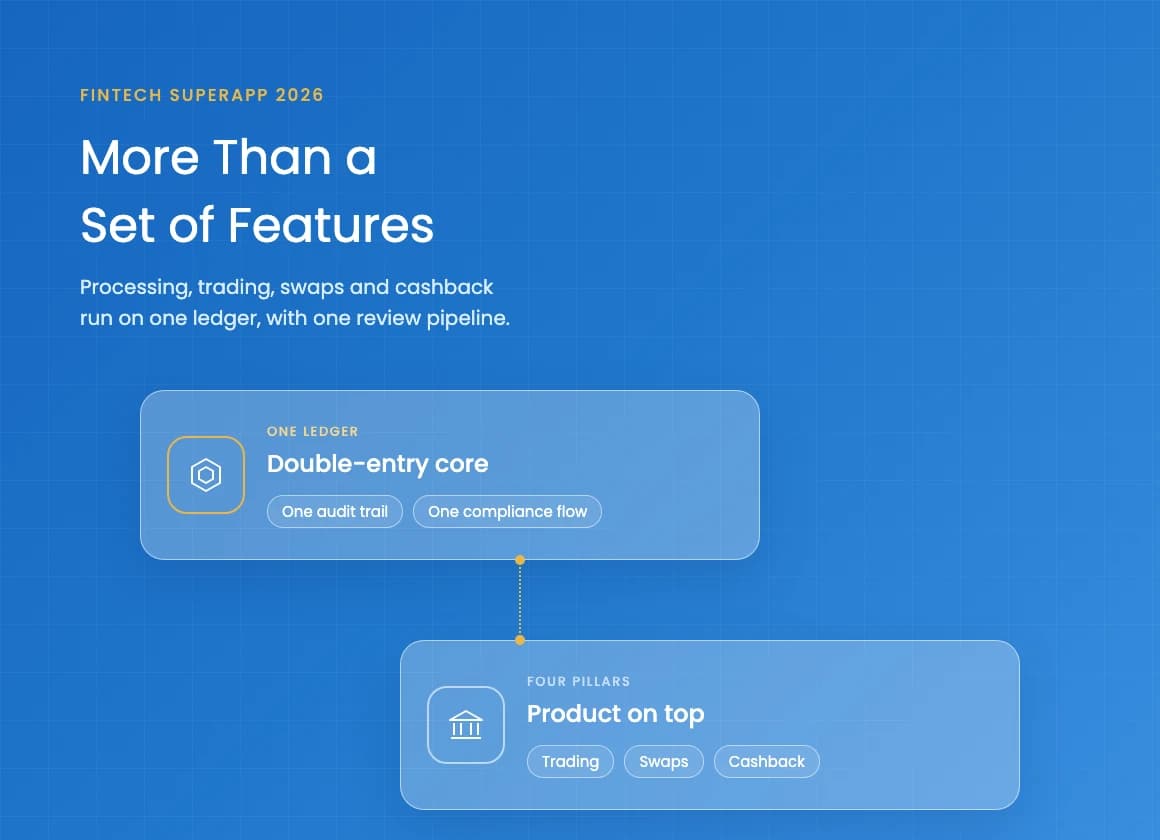
The 2026 FinTech superapp thrives on what regular users don’t see. If the platform is built well, they may perceive processing, trading, swaps, and cashback as a single product. The design is technically beneficial as well, as one ledger presupposes one audit trail and one compliance flow. With these dev innovations in mind, practical takeaways for developers are as follows:
- Ledger-first design. Model your products as entries into one ledger, with stablecoins, fiat, and crypto categorized as first-class assets.
- Review integration into every flow. Embed screening, travel-rule data, and audit records into the transaction instead of bolting it on later.
- License mapping. Determine which features will need CASP and which will do with an e-money license to take care of two-tier compliance in advance.
- Cashback pricing from margin. Fund user rewards from the project’s processing and swap fees so that user loyalty efforts don’t burn your cash.
- UI comes last. Once the ledger holds all features together, the interface is the easiest to produce.
A viable option for neobank founders seeking a superapp design is 4IRE’s NeoBankX product. It supplies a modular core, where processing, trading, swaps, and cashback work on a single ledger with a single review pipeline.
Build a Superapp on One Ledger With 4IRE
Our FinTech engineers build processing, trading, swaps and cashback on a single ledger with one review pipeline. Schedule a free consultation.
FAQ
Most FinTech superapps combine these features, with custodial accounts reserved for making card payments, swaps, and fiat on-ramps. Non-custodial wallets may be available within the platform for users who want to hold their own keys. Yet, the provider explicitly warns clients of limited responsibility for funds lost or stolen from non-custodial wallets, as well as access restoration.
Revenue comes from swap and trading commissions, as well as yield on reserves held by stablecoin issuers and partners. Some projects monetize premium subscription tiers with exclusive features.
No, most apps operate well on existing chains and use widely known stablecoins to generate liquidity and user trust. A native token is useful as a loyalty support and staking tier tool, but its issue heightens regulatory risks.