

 Bank

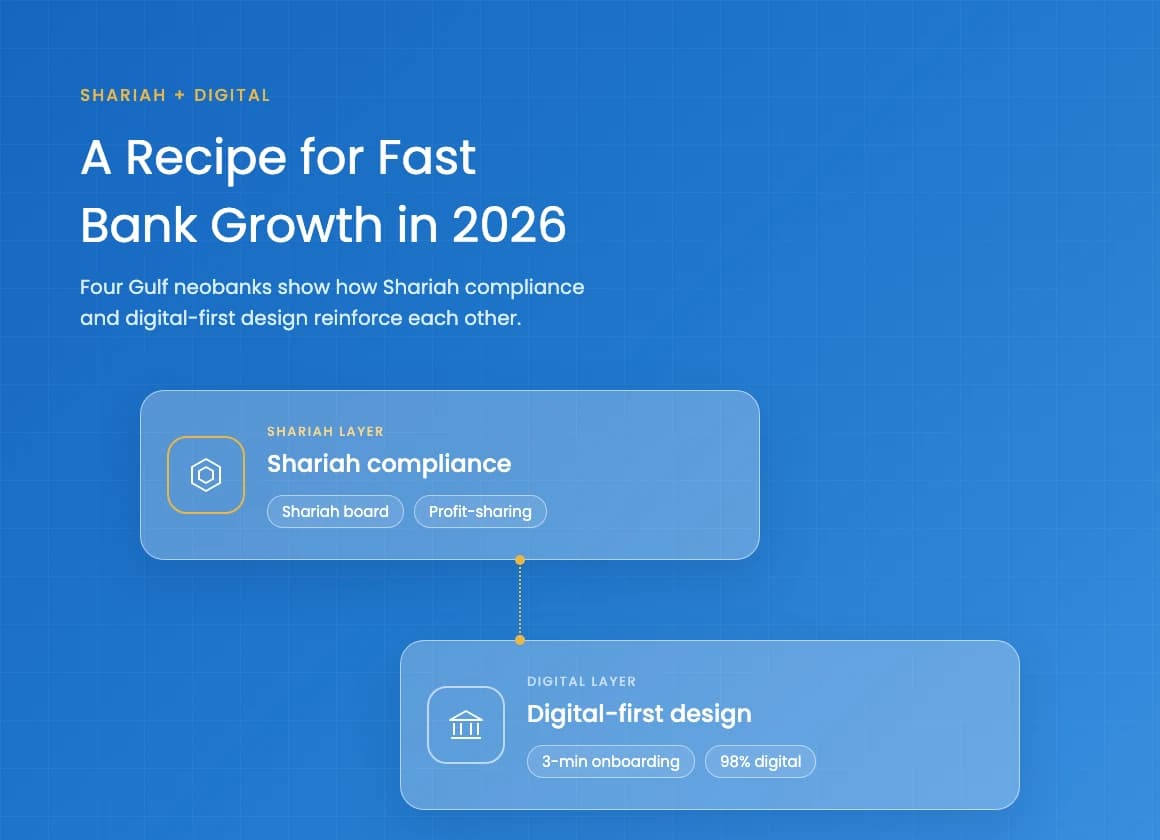
Shariah compliance and digital-first design are internationally recognized as major components of a neobank’s growth formula in 2026. The Islamic digital banking market is booming today, reaching $5.1 trillion this year and projected to exceed $8.46 trillion in five years. These figures translate into a 10.7% CAGR, pointing to healthy growth prospects in the industry.
Islamic fintech growth is twice as fast, with the market exceeding $222 billion in 2026 and predicted to reach $515 billion by 2031, which translates into an 18.27% CAGR. Winners of this trend are all located in the Gulf: Mashreq Al Islami and STC Bank reveal the fastest growth in assets, user numbers, and balance sheets. Here, we dive deeper into the regional market makeup and growth models to derive developer insights for a sure head start in neobanking in 2026 and beyond.
Growth Champions in 2026
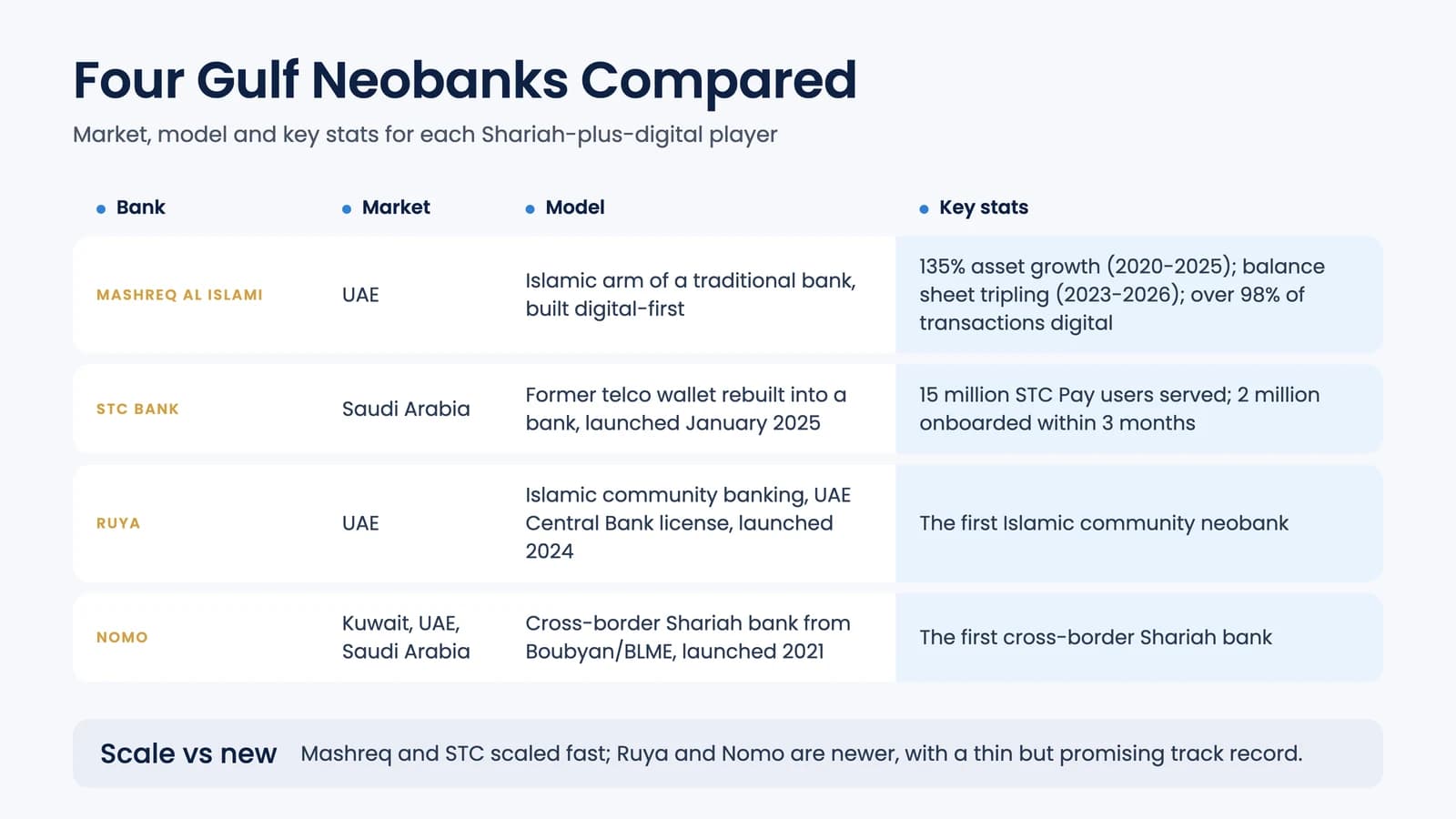
Four Gulf players reveal a strong relevance of the Shariah-plus-digital formula in a neobank’s market entry strategy. The first two are success stories of scaling, while the second two are newer projects with a thin but promising track record.
| Bank | Market | Model | Key Stats |
|---|---|---|---|
| Mashreq Al Islami | UAE | Islamic arm of a traditional bank, created with a digital-first design | 135% growth in assets (2020-2025); balance sheet tripling (2023-2026); over 98% of transactions are done digitally |
| STC Bank | Saudi Arabia | Former Telco wallet, rebuilt into a bank, launched in January 2025 | Servicing of 15 million STC Pay users; 2 million users onboarded within 3 months |
| Ruya | UAE | Islamic community banking with the Central Bank of the UAE’s licensing, launched in 2024 | The first Islamic community neobank |
| Nomo | Kuwait, UAE, Saudi Arabia | Cross-border Shariah bank from Boubyan/BLME, launched in 2021 | The first cross-border Shariah bank |
A couple more facts illustrate why these market players take the lead:
- Mashreq Al Islami was named the world’s best Islamic digital bank in 2026 (Euromoney). Its example shows how incumbent banks may grow deposits and assets without dramatic expenditures by transferring their operations onto digital rails.
- STC Bank exhibits the fastest growth route among Islamic banks in 2026. It received the title of the Best Digital Bank in Saudi Arabia in 2026.
- Ruya and Nomo exemplify two promising growth paths in Islamic banking. Ruya builds its value proposition on community values rather than focusing on specific banking products. Nomo targets international presence and cross-border money movement.
What Do Market Leaders Have in Common?
The most evident feature that surfaces in the analysis of Shariah-compliant digital banks is their focus on Islamic banking as a key product feature. So, what do they teach about how to build a Shariah-compliant bank? This emphasis translates into banking design as follows:
- Quick onboarding. Mashreq Al Islami opens an account in less than 3 minutes using straight-through processing (STP). The latter means that identity checks, KYC, and Shariah-compliant account creation run without manual interference. The faster the onboarding, the higher the conversion.
- Mobile-first design. Contemporary Islamic banks treat their apps as full-scale banks, with offices playing a minimal supportive function. With 98% of transactions going digital, Islamic retail banking thrives on mobile-first design, which enables users to access the full spectrum of services from their smartphones in seconds.
- Internal Shariah board. Islamic banking products benefit from compliance from day one, with Shariah scholars reviewing features and advising on design before you waste time and money on wrong product structures.
- Profit-sharing. Yield-bearing products are structured around profit distribution, with banks revealing their profit strategies transparently in the bank’s interface. This approach attracts users cautious about ethical issues and valuing transparent profit propositions.
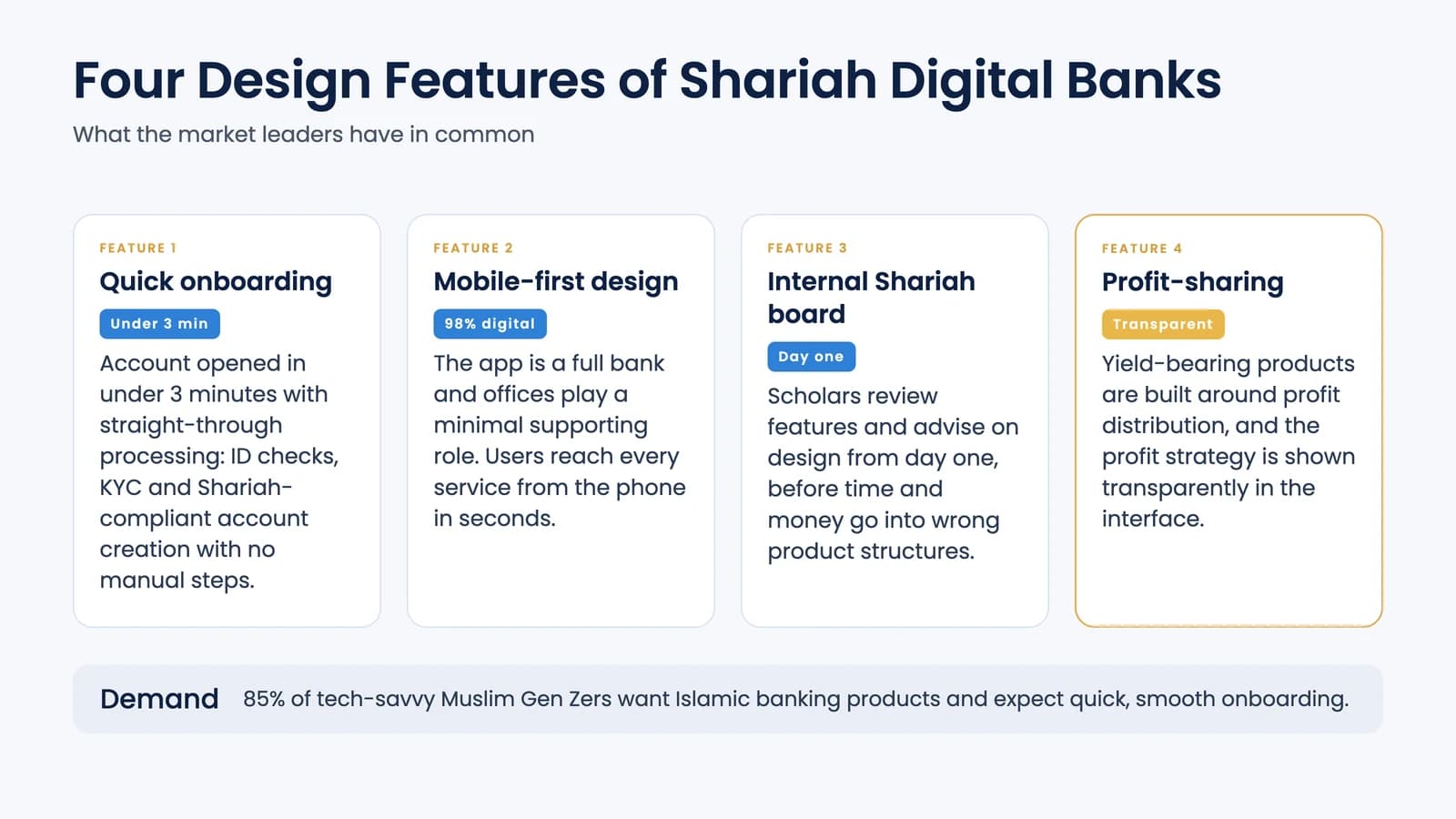
There is healthy demand for all four design features. Market research says that 85% of tech-savvy Muslim Gen Zers are hungry for Islamic banking products. This generation of bank users expects a quick, smooth onboarding process, which the discussed market leaders readily provide.
Development Takeaways for Neobank Projects
The analysis of fastest growing Islamic banks 2026 reveals that Shariah compliance and digital-first design go hand in hand, reinforcing each other. Compliance gives projects access to broader markets, while digital design reduces operational costs and attracts tech-savvy young customers.
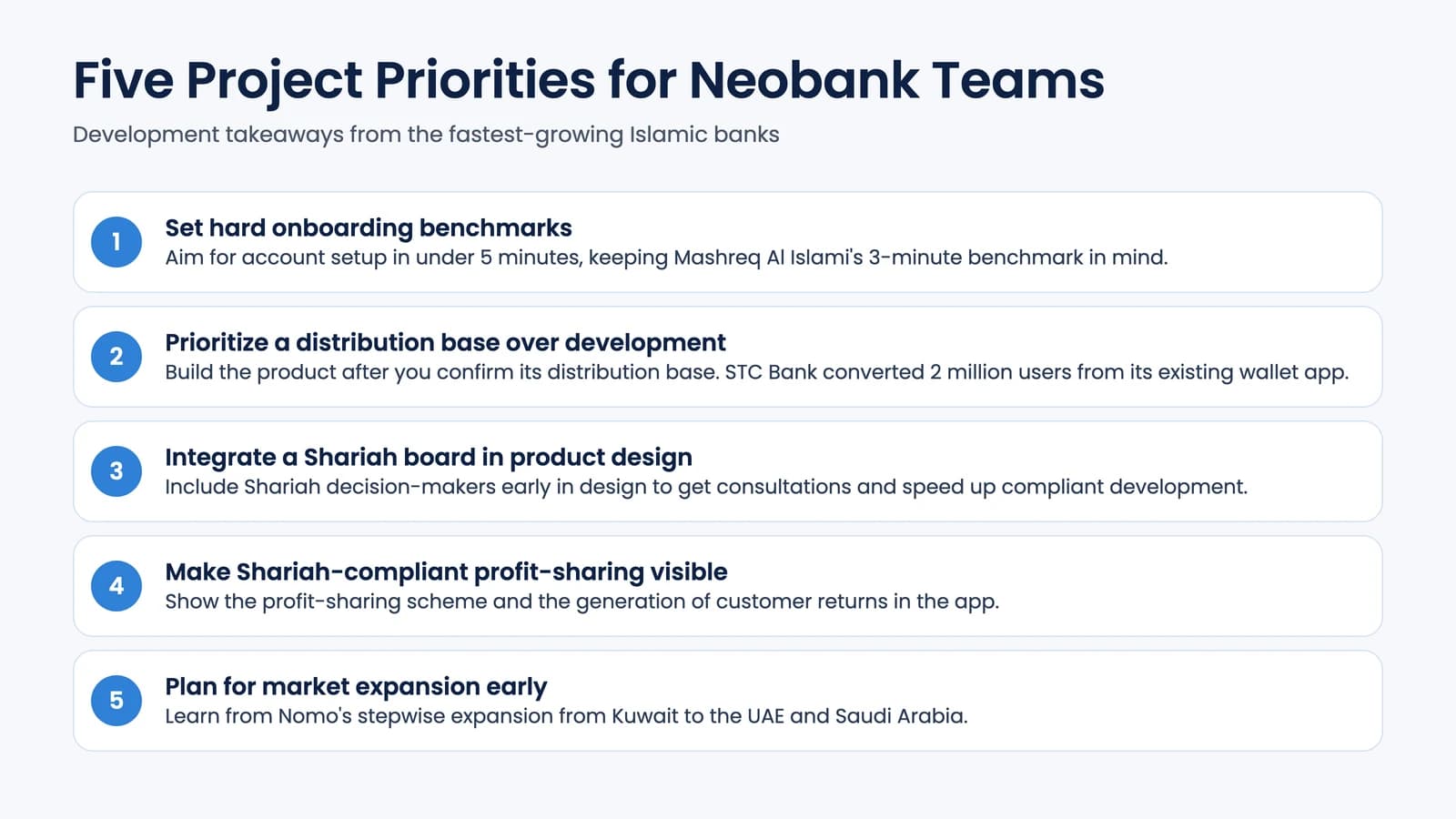
With Islamic FinTech enjoying an impressive growth tempo of 18%+ per year, its appeal to development teams is undeniable. These lessons translate into the following project priorities:
- Set hard onboarding benchmarks. Aim for account setup in under 5 minutes, keeping Mashreq Al Islami’s 3-minute benchmark in mind.
- Prioritize a distribution base over development. Build a product after you confirm the distribution base for it; get inspiration from STC Bank’s 2 million conversions from their existing wallet app.
- Integrate a Shariah board in the product design. Include Shariah decision-makers in the early product design stages to get insightful consultations and speed up compliant development.
- Make Shariah-compliant profit-sharing visible. Show your profit-sharing scheme and generation of customer returns in the app.
- Plan for market expansion early. Learn from Nomo’s stepwise expansion from Kuwait to the UAE and Saudi Arabia to integrate long-term market entry strategies into design.
Bottom Line
Are you considering a Shariah-compliant neobank as your next big project? Make sure to audit your onboarding flow and locate the Shariah review in the project’s roadmap. The 4IRE team can consult you on every step of its design and development, saving you time on costly revisions and later Shariah bolting on existing architectures.
Build a Shariah-Compliant Neobank With 4IRE
Audit your onboarding flow and put the Shariah review on the roadmap from day one. The 4IRE team can consult you on every step of design and development.
FAQ
Yes, Shariah compliance relates only to the bank’s investment and earning strategies but doesn’t exclude anyone from its service eligibility. Many non-Muslim customers choose Islamic banks for their explicit bans on speculative banking products and asset-backed financing.
Shariah-compliant neobanks are subject to two-tier regulatory oversight: licensing from the central bank and audits by an independent Shariah supervisory board.
These banks use profit-sharing and trade-based structures to generate revenue instead of relying on interest. Deposits are eligible for a share of the bank’s profits, while financing is issued to clients in the form of asset leases.