

 Fintech news

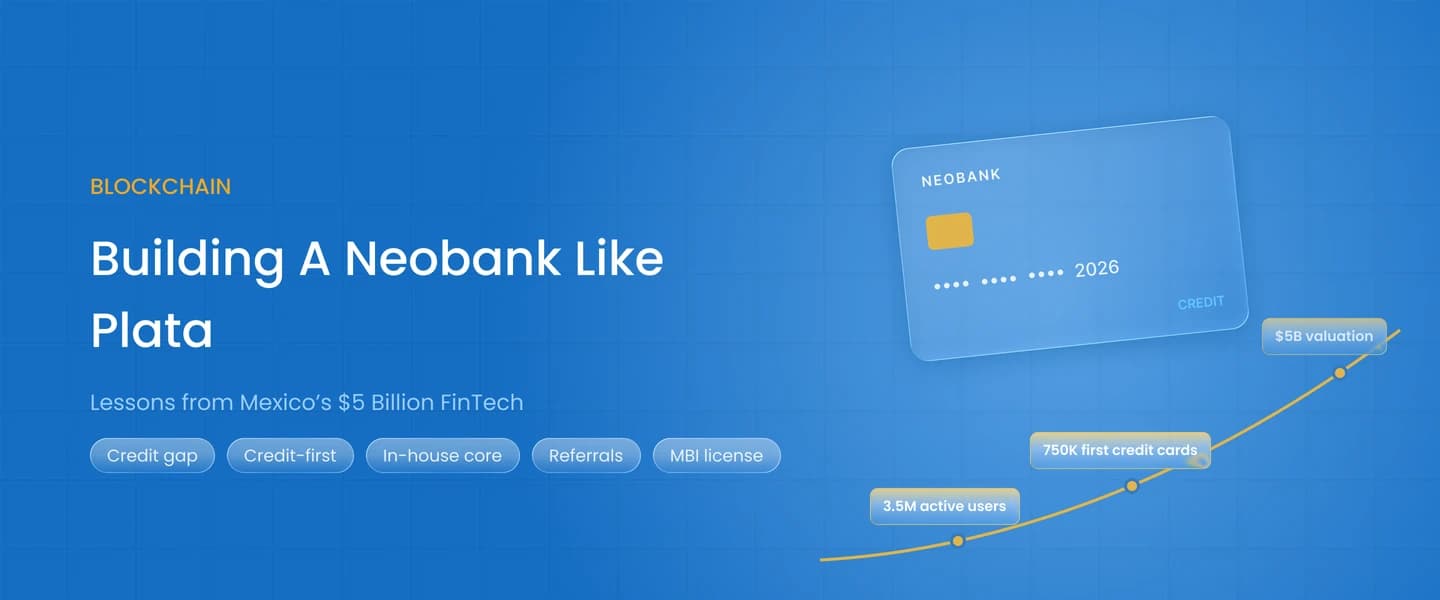
Plata closed a $405 million Series C investment round with an official valuation of $5 billion, making it a FinTech phenomenon of growing interest. The neobank has accumulated a user base of 3.5 million active customers, raising $2 billion in debt and equity within three years. By early 2026, 750,000 Plata customers in Mexico had received their first-ever credit card.
Naturally, every FinTech founder wants to replicate Plata’s success. This guide presents an expert inquiry by the 4IRE team into Plata’s product strategy, growth model, and technical core to show what’s copyable and what’s not. We present a realistic outlook on whether Plata can become a blueprint for how to launch a neobank.
The Market Gap: Mexico’s Credit Services
The secret recipe for success is filling an existing vacuum instead of trying to invent demand. The Mexican market was chosen for the following reasons:
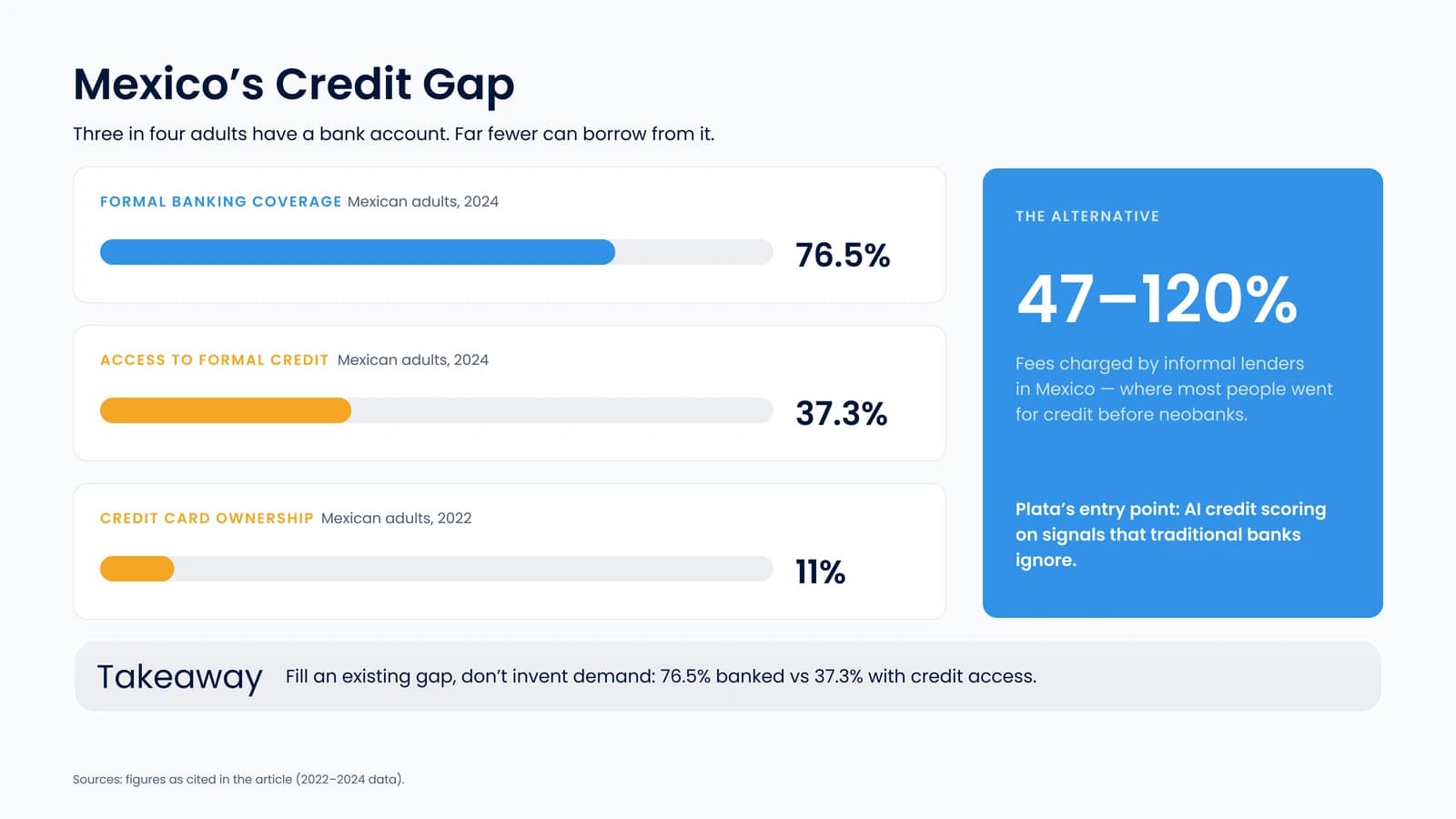
- Only 11% of adult Mexicans owned a credit card in 2022.
- Only 37.3% of Mexicans had access to formal credit in 2024, compared to 76.5% of formal banking service coverage.
- Informal lender fees in Mexico ranged from 47% to 120%.
These figures suggest that while three-quarters of Mexican adults had a bank account, most of them were unable to access credit through their banking providers. Plata’s flexible AI credit scoring algorithms came into play to embrace creditworthiness indicators untapped by formal banking systems, thus balancing the neobank’s risk and people’s need for credit.
Product Strategy: Source of Plata’s Operational Strength
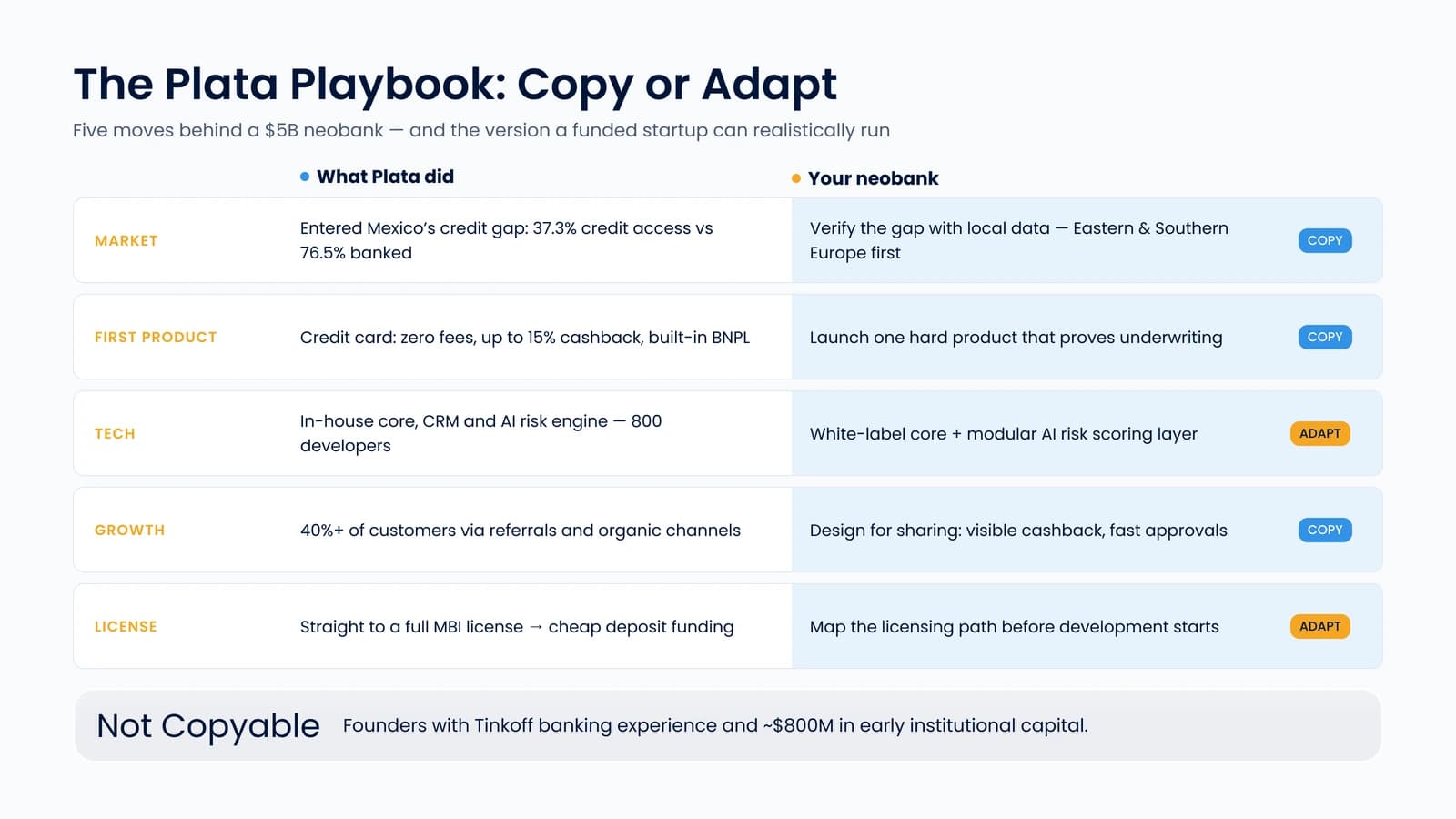
Interestingly, Plata started with credit cards as its frontline banking product. Credit cards are broadly regarded as the toughest product in consumer finance, but the bank’s ability to give loans is a sign of operational strength and a positive user signal. Thus, Plata’s launch of a Mastercard credit card with zero annual fees, cashback of up to 15%, and an in-built BNPL functionality was a huge success.
Tech Stack: Building vs Buying
A vital element of Plata’s viability was the decision to build its technology infrastructure in-house. The technical architecture constituted a proprietary banking core, a CRM, and an AI-powered risk engine. A huge team of 800 FinTech developers worked on core banking system development, with clear vertical integration allowing tech iterations without reliance on third-party release cycles.
This solution requires a side note in terms of replication feasibility. Can a regular FinTech startup afford a team of 800 programmers? Definitely no. Plata enjoyed a scale advantage available only to well-funded institutional players, so a default version recommended for businesses wishing to follow in Plata’s footsteps is a high-quality, secure white-label core and a modular AI risk scoring layer.
Growth Model: Referrals as the Core Channel
The neobank has reported that over 40% of its customers had come through referrals and organic channels. Plata enjoyed a high app rating and attracted users with responsive customer service; besides, its ambassador-driven onboarding model worked exceptionally well.
This user acquisition approach has enabled Plata to bring down the growth budget compared to competitors’ investments in paid digital marketing. Statistics show that referred users showcase better retention rates because they are engaged by the existing network of satisfied customers.
A developer’s implication here is building a neobank with shareability in mind. Features like visible cashback, fast loan and card approvals, and a user-friendly UI build a positive UX at once, contributing to word-of-mouth advertising.
Move towards a Banking License
Plata pursued the most demanding licensing pathway available to a digital bank in Mexico. It moved directly from the credit card issuer status to a FinTech with a full Multiple Banking Institution (MBI) license. The payoff was immediate: the MBI license enabled the launch of the full banking service spectrum and gave Plata strategic access to retail deposit funding. The move was critical at the moment Plata had accumulated substantial loan volumes, representing a more stable source of cheap capital to fund its further development.
Neobank startups can derive a valuable lesson from this algorithm. Instead of treating a banking license as a vanity artefact, include it in the funding-cost strategy. Licensed banks have a greater growth toolkit compared to FinTechs that have to rely on debt-funded lending alone.
What Applies to Europe: Checklist for Neobank Teams
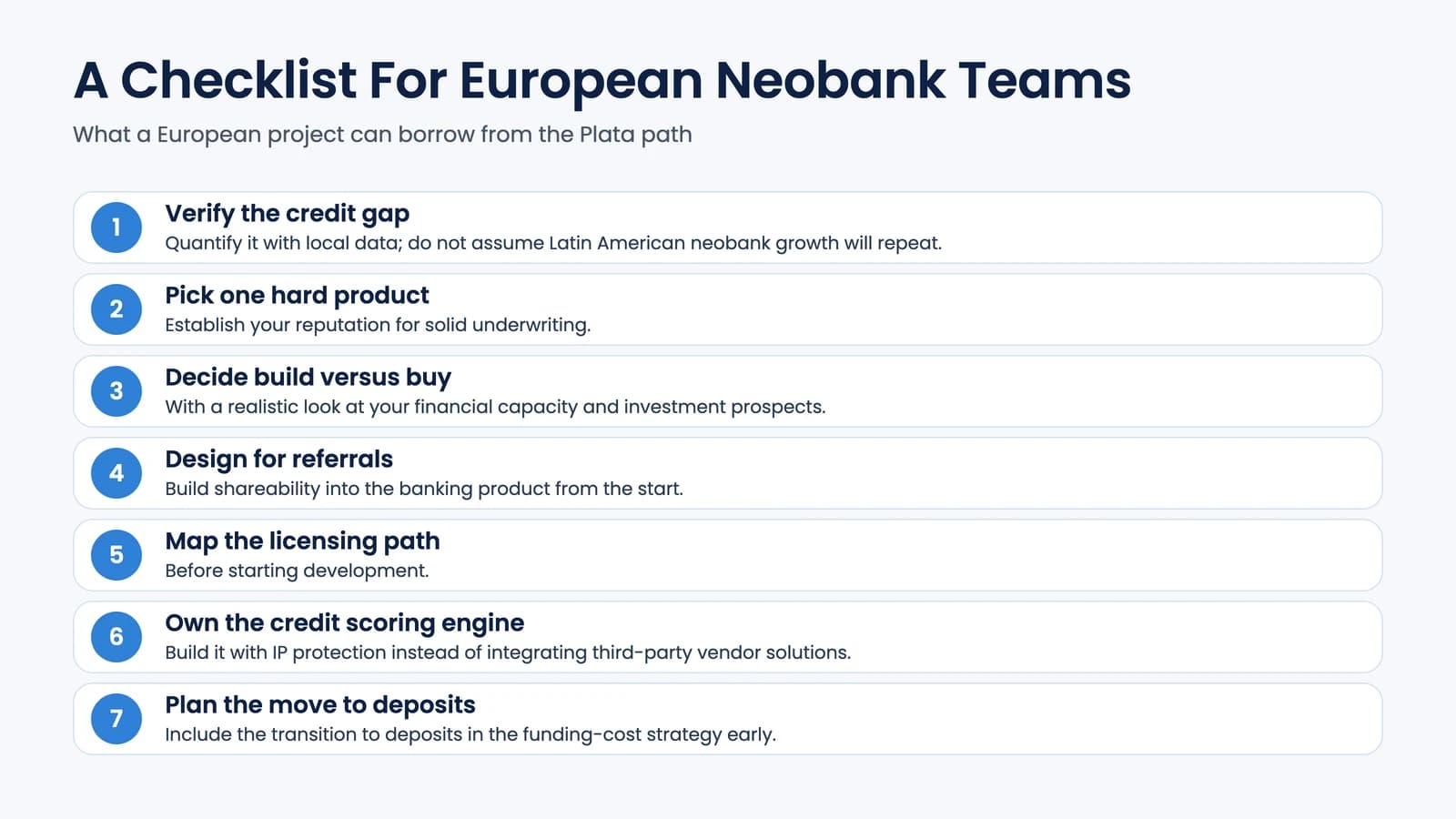
So, what can a contemporary neobank project borrow from the Plata pathway? If we talk about European projects, the credit gap in this jurisdiction is lower, with the majority of underserved populations concentrated in Eastern and Southern Europe. Using this market as your target, check your project against these criteria:
- Quantify and verify the credit gap with local data; don’t assume that your project will replicate Latin American neobank growth by default.
- Pick one hard product to establish your neobank’s reputation as an institution with solid underwriting capability.
- Make the build-versus-buy decision with a realistic look at your financial capacity and investment prospects.
- Design the banking product for referrals from the start.
- Map the licensing path before starting development.
- Create the AI credit scoring engine with IP protection instead of integrating third-party vendor solutions.
- Include the transition to deposits into the funding-cost strategy early.
Bottom Line
The presented evidence on how to build a neobank shows that Plata’s success is not as miraculous as it seems at first glance. First, the founders had in-depth digital banking expertise from Tinkoff, one of the world’s most profitable digital banks. Second, the startup had around $800 million in early institutional capital, enabling the expensive FinTech infrastructure development without revenue accumulation pressure.
Yet, Plata also offers many replicable lessons for FinTech founders. First, market gaps like that in Mexico are still available in many regions of the world. Vast territories with fragmented or non-existing banking systems conceal millions of unbanked and underbanked people. Second, Plata illustrates the benefits of early investment in proprietary risk models instead of relying on subscription-based or ready-made infrastructures. This is where 4IRE’s NeobankX product offers value, offering custom-built neobank functionality with a proprietary core and a full spectrum of digital banking features.
Build Your Neobank With 4IRE
Our FinTech engineers take a digital bank from market and licensing groundwork through a proprietary core, an AI risk scoring layer and the card and deposit products on top of it. Schedule a free consultation.
FAQ
Yes, Plata did not enter the Mexican market in the digital banking vacuum. Its major local competitors include Nubank, Revolut, Stori, and Klar, among others, so the present-day FinTech market can already be regarded as saturated.
There is scarce data on Plata’s net profitability as of 2026. Most records focus on revenue scale and loan portfolio growth, suggesting that Plata is yet to reach a balance between debt funding and deposit influx.
As a rule, digital banks in Mexico start as credit card issuers, further applying for an IFPE license, then contending for a SOFIPO status, and only then targeting the MBI license. Plata skipped the intermediate steps by moving from issuer status straight to the MBI license.
Plata’s seemingly fast-track growth had a solid capital pool that funded that progress. Thus, the biggest execution risk lies in underestimated capital intensity, which means you will unavoidably burn a lot of cash before reaching profitability.