

 Stablecoin news

When a new bank announces putting its assets on-chain, it’s vital to read the fine print. Amid the hype surrounding stablecoins, many banks resort to tokenized deposits as an institutional exchange tool instead of genuine stablecoin development and launch. Those who follow the second path for retail usage and circulation beyond their own networks typically locate it within a subsidiary or joint venture infrastructure for economic, regulatory and balance-sheet reasons.
Here is a snapshot of banks’ stablecoin issuance and tokenization efforts:
- The GENIUS Act is quickly advancing in the U.S. regulatory environment, with the operative date of its entry into force set at January 18, 2027. The law creates a federal regulatory framework for token issuance and circulation by American banks.
- USDT and USDC make up the dominant portion of global stablecoin supply, with over $300 billion in total value.
- SoFi Bank launched sofiUSD on December 18, 2025, making it the first bank-issued stablecoin with FDIC insurance and a national license.
- JPMorgan’s JPM Coin operates on a public ledger and is available for institutional clients, but it is a tokenized deposit rather than a stablecoin.
- The head of Bank of America predicted up to $6 trillion in assets migrating into stablecoins if they officially bear yield.
Regardless of the terminology, the concept of a bank issued stablecoin is quickly gaining traction today. Read this guide to learn more about it, decode the difference between tokenized deposits and stablecoins, see who is advancing this path in the banking sector, and evaluate the regulatory prospects of this undertaking.
What Is a Bank Stablecoin?
In simple words, a bank stablecoin is a token pegged to fiat assets, issued by a regulated bank or a bank-controlled institution. It is backed 1:1 by underlying reserves, making it redeemable at full equivalence. In technical terms, bank stablecoins behave like USDT/USDC, with the only difference in the issuer’s status and regulatory supervision.
Stablecoins vs Tokenized Deposits
While the concept of a stablecoin is more or less common, tokenized deposits (which actually dominate the present-day banking tokenization approach) require more clarification. Here’s how to assess tokenized deposits vs stablecoins.
- Legal claims. Stablecoin holders own a claim on a fraction of the bank’s reserve pool. Deposit token holders own a deposit claim on a specific bank, enjoying identical credit profile, accounting treatment and regulatory status as with other assets in their portfolio.
- Balance sheet. Stablecoins are kept outside the bank’s deposit base; tokenized deposits remain on the bank’s balance sheet and can be used to fund credit.
- Interest. The GENIUS Act bans interest payments for stablecoins. Tokenized deposits can carry interest because they are technically and legally framed as deposits.
- Transferability. Stablecoins are universally transferable on-chain, while tokenized deposits can be moved only within the bank’s infrastructure (i.e., to other registered clients).
- Insurance. Stablecoins come with no insurance, while tokenized deposits qualify for FDIC insurance.
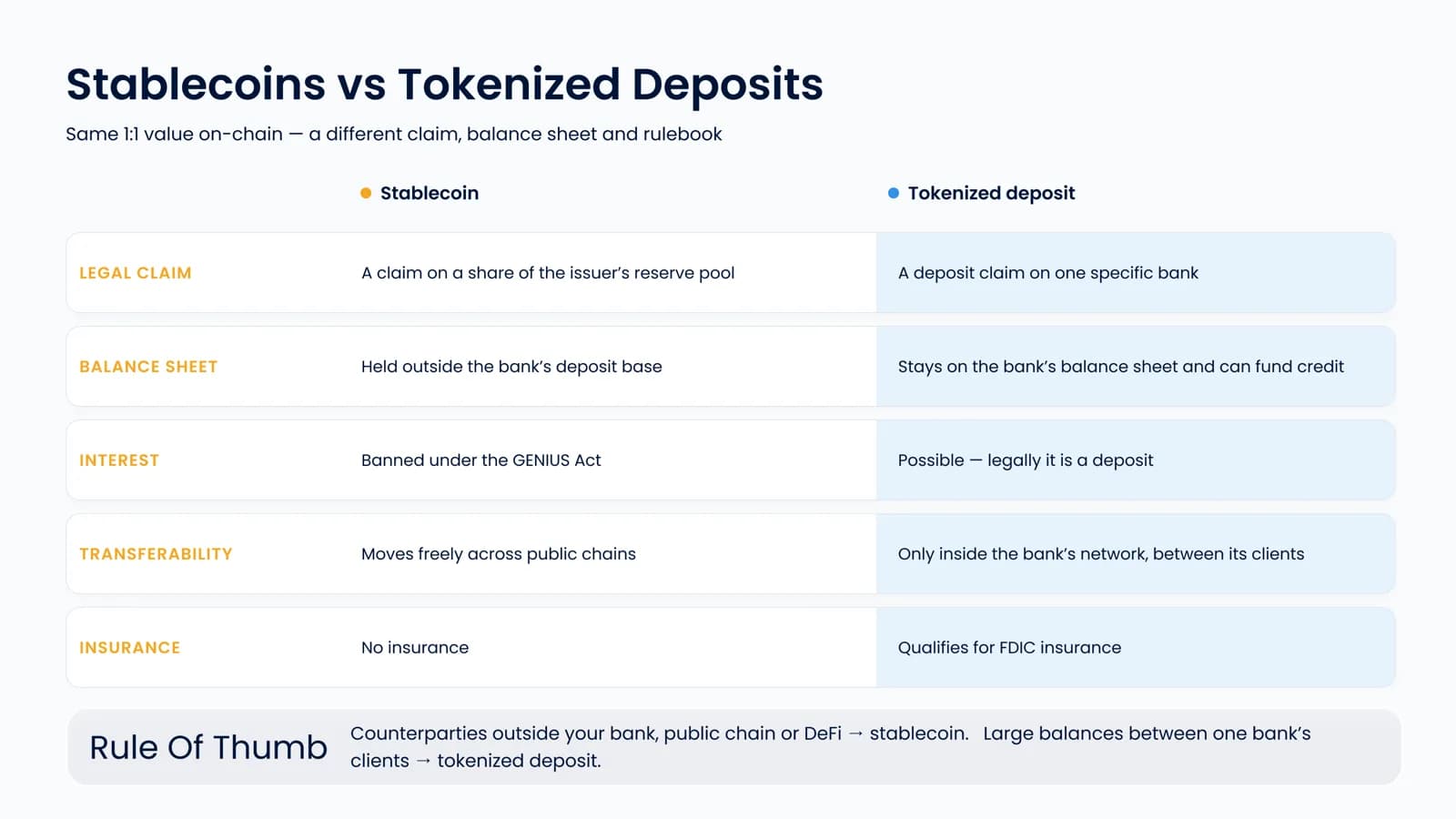
A clearer breakdown of differences is presented below.
| Criterion | Stablecoin (USDC) | Bank stablecoin (sofiUSD) | Tokenized deposit (JPMD) |
|---|---|---|---|
| Issuer | Non-banking company | Licensed bank | Bank |
| Legal status | Segregated reserves | Reserves compliant with GENIUS Act | Claim on a bank deposit |
| Owner’s yield | Banned | Banned | Possible (similar to yield-bearing deposit) |
| Access | No permission required | Public ledger | Only KYC-verified clients |
| Insurance | None | Reserves, not FDIC | Pursuant to the bank’s rules |
Pioneers in the Field
Several banks have already advanced the stablecoin-issuance opportunity to embrace this trend. Notable successful cases include:
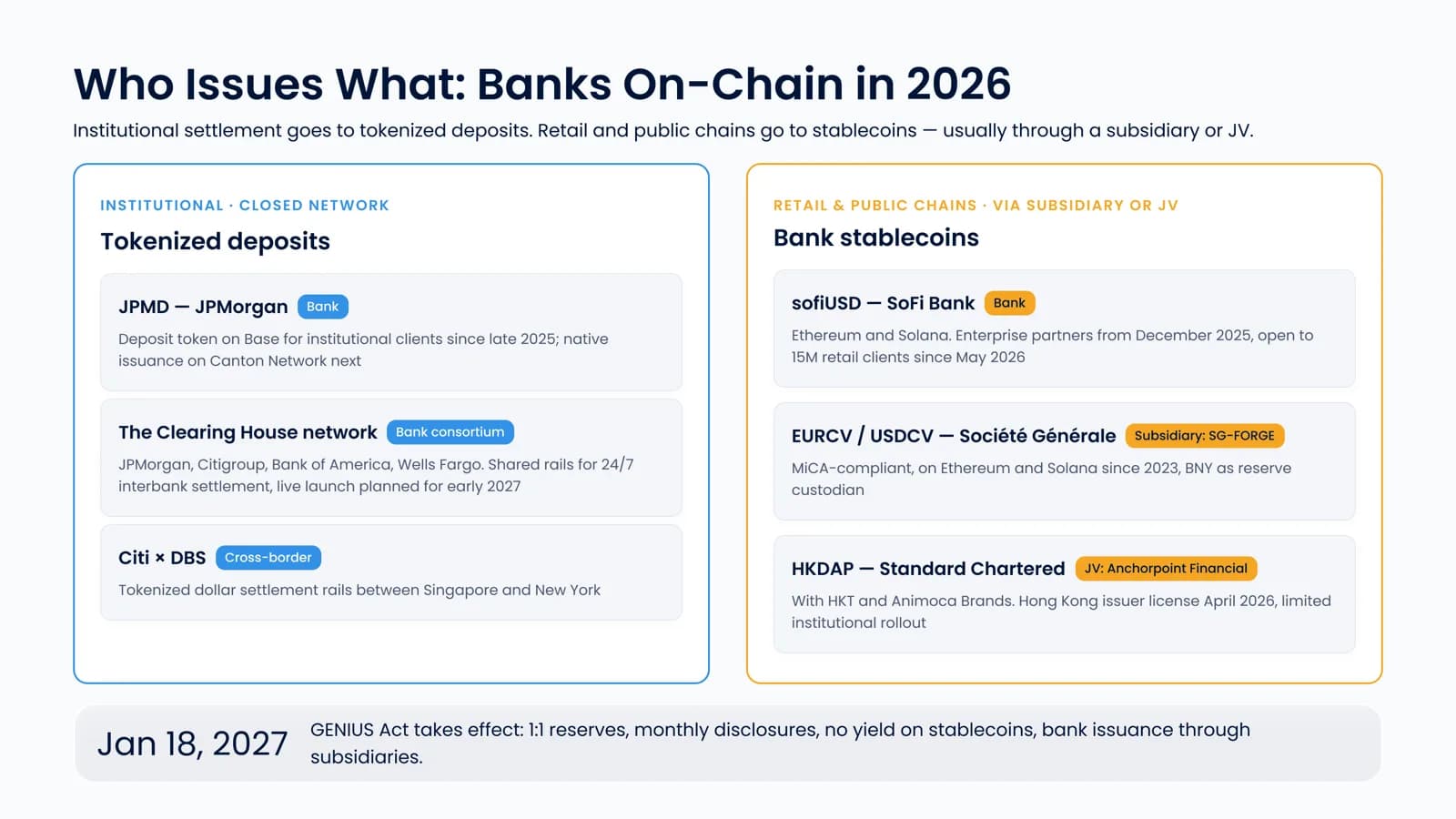
- SoFi Bank’s sofiUSD. The bank’s sofiUSD is a fully reserve-backed stablecoin operating on Ethereum and Solana, launched for enterprise partners in December 2025 and opened for the bank’s 15-million client population in May 2026.
- Société Générale. The bank’s digital arm SG-FORGE issued the EUR Coin Convertible and USD Coin Convertible in 2023. These MiCA-compliant stablecoins operate on Ethereum and Solana, with BNY as a reserve custodian.
- Standard Chartered. The bank’s joint venture with HKT and Animoca Brands, Anchorpoint Financial, received a stablecoin issuer license from a Hong Kong regulator in April 2026. At present, the JV’s HKD-backed stablecoin, HKDAP, is midway through its limited institutional rollout, operated via HashKey and OSL distributors.
- JPMorgan’s JPMD explained. A counterexample is JPMorgan’s JPMD, which is a tokenized deposit running on Base, not a stablecoin. It became available to institutional clients in late 2025, with native issuance on the Canton Network planned soon.
The Regulatory Environment
The GENIUS Act, signed in July 2025, is currently the main regulatory framework for bank stablecoins in the USA. It has created the Permitted Payment Stablecoin Issuer (PPSI) category, which allows every licensed bank to issue digital assets with 1:1 backing with USD, Treasury bills, or other liquid assets. GENIUS Act stablecoin requirements are as follows:
- Issuers are obliged to publish monthly disclosures
- Interest or yield payments on cryptocurrencies are banned
- Banks can launch stablecoins only through subsidiaries
The July 2026 deadline for final rules was missed by the U.S. regulator, so the main reference point to date is the statutory backdrop. However, with the act coming into force next January, financial institutions must already plan their operations accordingly.
Rationale Behind Network-Building
Bank-specific tokenized deposits have no liquidity, as they can’t leave an issuing bank’s balance sheet. To overcome this architectural hurdle, banks are exploring the networking path, making joint treasury pools for tokenized deposits’ transferability. An illustrative example is the Clearing House network, built by JPMorgan, Citigroup, Bank of America, and Wells Fargo, actively expanding to include other U.S. banks. Its live launch is planned for early 2027, with 24/7 interbank settlements and a joint treasury of $6.6 trillion, holding lots of promise for clients.
The main motivation behind networking is the banks’ fear of deposit flight to alternative assets. Though the problem is far from massive in the U.S. banking sector, banks are already accounting for distributional risks, with deposits potentially moving from the banks holding them to financial intermediaries responsible for digital asset custody.
Business Implications of the Trend
A desire to embrace technological changes and new opportunities in banking is clear for individuals and businesses. Understanding how banks issue stablecoins will help you choose wisely. Besides, you need to consider your needs in light of each asset’s pros and cons:
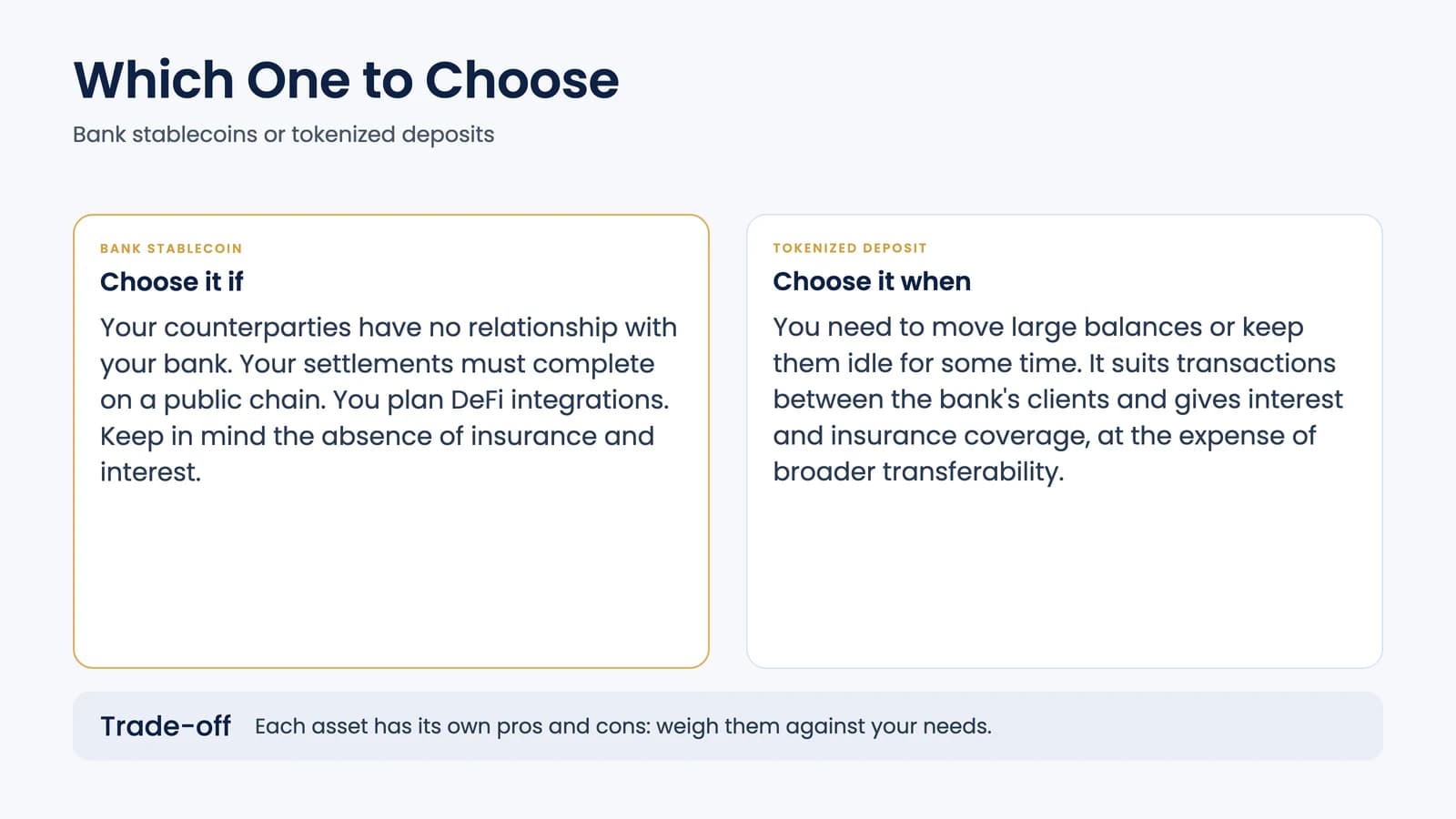
- Choose bank stablecoins if your counterparties have no relationship with your bank, if your financial settlements must be completed on a public chain, or if you plan DeFi integrations. Keep in mind the absence of insurance and interest.
- Choose tokenized deposits when you need to move large balances or keep them idle for some time. The variant suits business transactions between the bank’s clients and rewards you with interest and insurance coverage, though at the expense of broader transferability.
Launch a Bank-Grade Stablecoin With 4IRE
Our blockchain engineers take a bank-issued token from reserve architecture and GENIUS Act-compliant design through smart contracts, custody integrations and audit preparation. Schedule a free consultation.
FAQ
As a rule, the underlying assets are FDIC insured, but tokenized deposits aren’t subjected to separate insurance. No failure has been recorded to date to test the insurance’s validity in legal terms.
The inter-bank movement is complicated because of the reserve requirement. The Clearing House network was built to solve this problem U.S. wide, with several successful cross-border experiments in this area (e.g., the Citi-DBS tokenized dollar settlement rails between Singapore and NYC).
While the asset may be valid, the regulatory regime difference is the main bottleneck. MiCA, the new UAE rules, and the forthcoming GENIUS Act are poorly aligned, meaning limited cross-border compatibility.
All issuers serving American users will need a permitted issuer license or a license from an eligible foreign jurisdiction.