

 Blockchain news

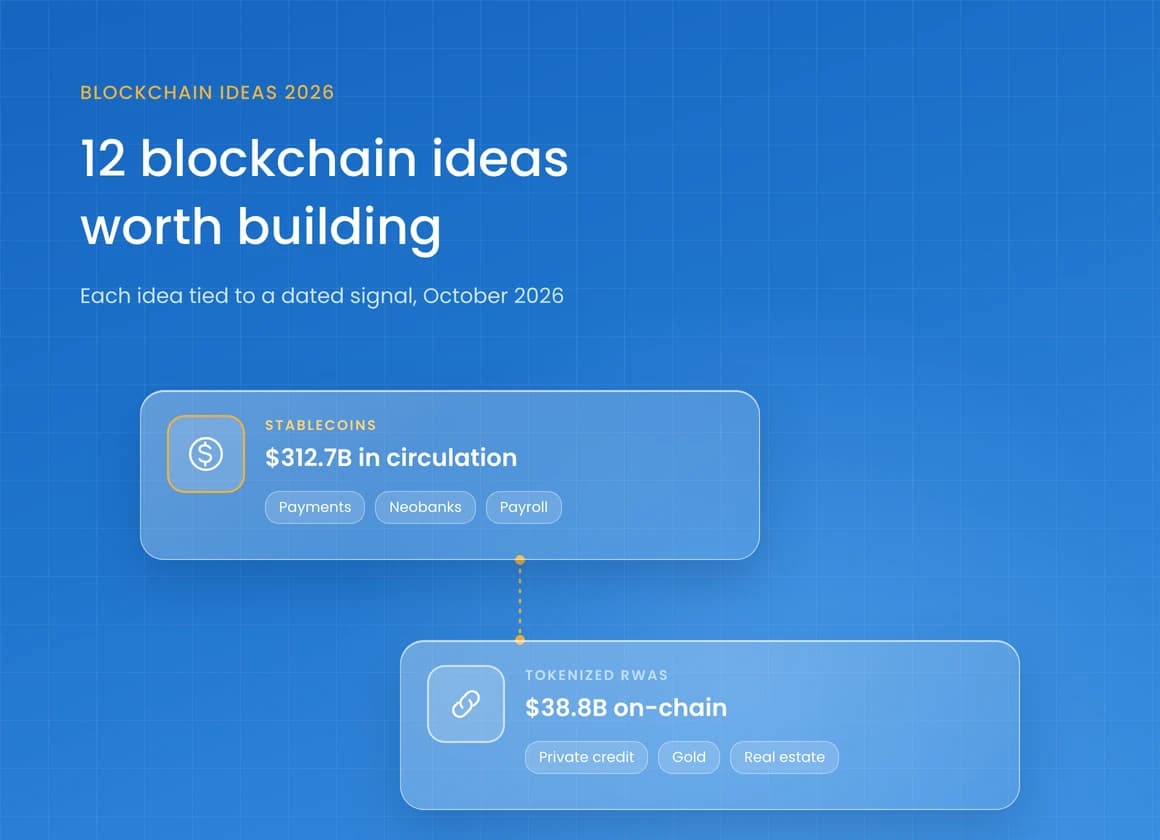
The blockchain business ideas worth building in 2026 sit where money already moves on-chain: tokenized assets, stablecoin payments, regulated prediction markets, payments for AI agents and the compliance tooling every licensed crypto business now needs. This list keeps 12 ideas, and each one is tied to a signal you can check yourself, dated as of 6 October 2026.
We cut this guide down from a 50-idea version. Many of those ideas were variations of each other, and many of the supporting figures could not be traced to a public source, so they are gone.
What changed for blockchain businesses in 2026
- USD-pegged stablecoins in circulation reached $312.7 billion on 6 October 2026, up from $301.1 billion a year earlier, according to DefiLlama.
- Tokenized real-world assets distributed on public chains were worth about $38.8 billion on RWA.xyz on 6 October 2026, with $16.7 billion of that on Ethereum.
- The US GENIUS Act, signed on 18 July 2025, set the first federal framework for payment stablecoins, including one-for-one backing by dollars or comparable low-risk assets.
- In the EU, MiCA has applied in full since 30 December 2024, and the last national transition periods for crypto-asset service providers ended on 1 July 2026.
Regulation used to be the reason founders waited. In the US and the EU it is now a known set of requirements you can design for from the first sprint, and that favours teams who build compliance into the product.
12 blockchain business ideas for 2026
1. RWA tokenization platform for private credit and funds
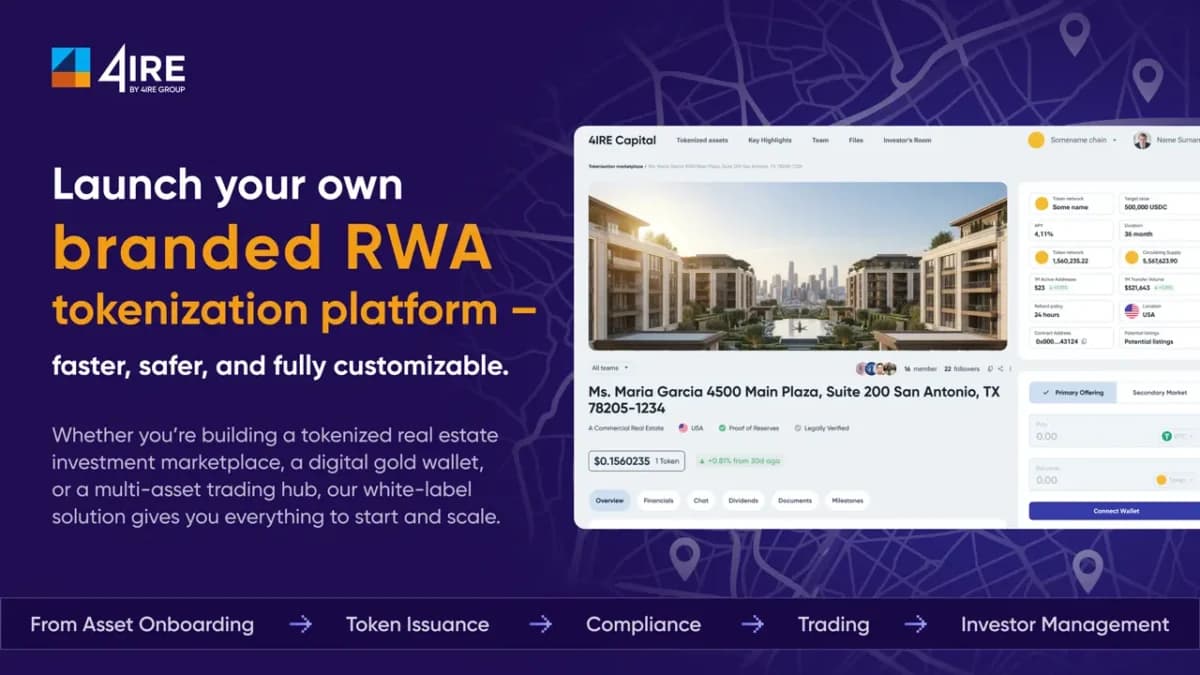
RWA.xyz tracks tokenized US Treasury funds and credit as separate asset classes, which tells you the asset classes are already live, not theoretical. The opening for a new platform is narrower than "tokenize anything": pick one asset class, one investor type and one jurisdiction, then build issuance, investor eligibility checks, cap-table management and distributions around it. Revenue comes from issuance, servicing and secondary-trading fees. 4IRE's RWA tokenization solution is a white-label core for this setup.
2. Tokenized gold and commodities
On 6 October 2026, RWA.xyz listed Tether Gold (XAUT) at $2.9 billion and Paxos Gold (PAXG) at $1.8 billion. Both prove the demand. A new entrant competes on a specific market: a regional custodian, a local-currency on-ramp or a redemption network that the large issuers do not serve. The product needs a vault partner, regular attestations and a clear redemption process.
3. Stablecoin payment gateway for merchants
Stripe closed its $1.1 billion acquisition of Bridge, a stablecoin payments API, on 4 February 2025, its largest acquisition to date. A gateway for a vertical Stripe does not prioritise (B2B invoicing, marketplaces in emerging markets, high-risk categories with a licence) can still win on settlement speed and lower cross-border fees.
4. Stablecoin neobank with multi-currency accounts
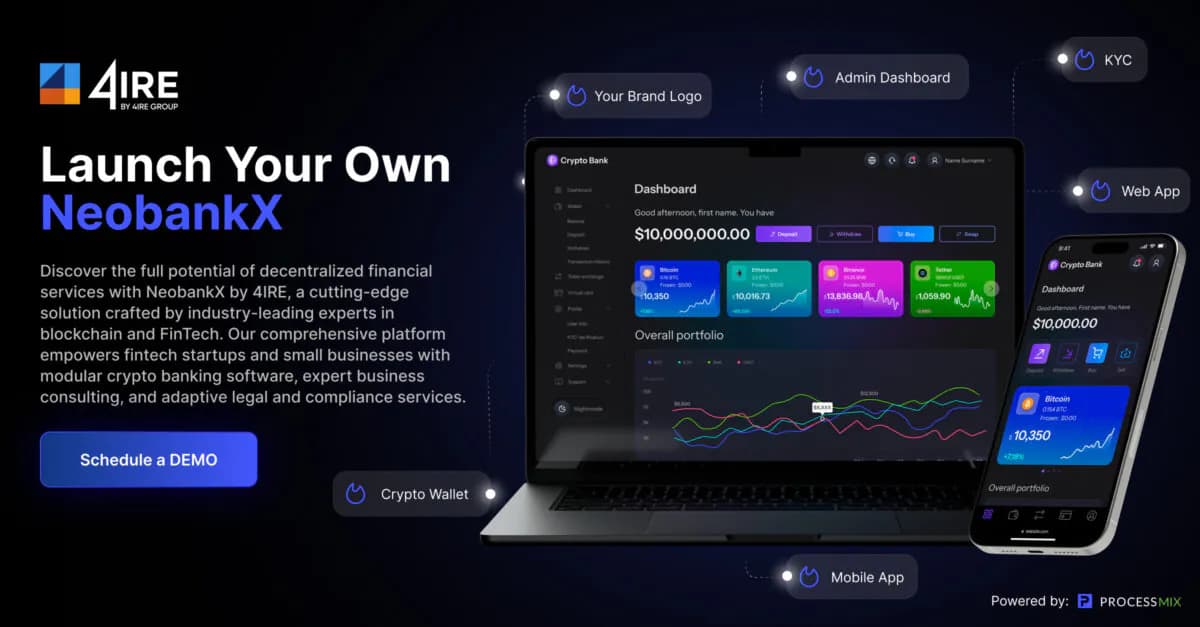
Users want to hold dollars, spend locally and move money abroad from one app. A stablecoin-backed account with cards and fiat on- and off-ramps covers all three. Under the GENIUS Act and MiCA, issuing your own stablecoin is a licensed activity, so most founders partner with a regulated issuer and build the banking layer on top. 4IRE's neobank platform is built for that layer.
5. Cross-border payroll and contractor payouts
Companies with remote contractors pay wire fees and wait days for settlement. A payout tool that funds in fiat, pays out in stablecoins and handles local off-ramps, tax forms and approvals is a business with recurring revenue from day one. Your moat is the off-ramp network and compliance coverage per country.
6. Payment rails for AI agents
Coinbase introduced x402 in May 2025, an open standard that uses the HTTP 402 "Payment Required" status code so software can pay for an API call in stablecoins. In July 2026 the protocol moved to the Linux Foundation's x402 Foundation. On 6 October 2026, x402.org reported 75.41 million transactions and $24.24 million in volume over the previous 30 days: many payments, each very small. Billing, metering and spend controls for agent payments are open products.
7. AI trading and treasury agents with guardrails
Agents that rebalance a treasury or execute a strategy need spending limits, allow-lists, audit logs and a human override. The product is the guardrail layer as much as the model. Our guide to AI agents in crypto covers the architecture.
8. Regulated prediction market for a niche
Kalshi has been a CFTC-designated contract market since 2020. CoinDesk reported on 13 August 2026 that it raised $1 billion at a $22 billion valuation in May 2026 and was in advanced talks to raise at least $750 million at $40 billion, with over 80% of its volume coming from sports contracts. The general market is taken; niches (industry forecasts, local events, B2B hedging) are not. The prediction market build guide walks through the stack.
9. DePIN marketplace for GPU compute
AI teams need GPU time and many owners have idle hardware. A decentralized physical infrastructure network (DePIN) pays providers in tokens or stablecoins and verifies the work on-chain. The hard part is quality of service, not the token. See our explainer on DePIN.
10. Compliance tooling: KYT, Travel Rule and MiCA reporting
Every licensed exchange, wallet and neobank must screen wallets, monitor transactions and pass Travel Rule data between providers. With MiCA's transition window closed on 1 July 2026, EU firms need this running now. A focused tool for one jurisdiction or one customer type can compete with the large analytics vendors. Start with what KYT is and why regulators require it.
11. Carbon credit marketplace
Buyers want proof that a credit exists, has not been sold twice and was retired. A marketplace that links each token to a registry serial number and records retirement on-chain answers all three. 4IRE ships a white-label carbon credit marketplace.
12. Real estate tokenization for one market
Fractional property platforms fail when they try to serve every country at once. Pick one market where the legal wrapper (an SPV, a fund or a REIT-like structure) is settled, sign one property developer and build investor onboarding and rental distributions for that case first.
Blockchain ideas we dropped for 2026
Some ideas from older lists are gone because we found no current, checkable signal that a new entrant can win there:
- Metaverse land and virtual-world platforms.
- Play-to-earn games built around a token economy.
- Generic NFT marketplaces with no specific asset or audience.
- New layer-1 blockchains without a distribution partner.
- Token launches whose only product is the token.
Any of these can still work with a specific audience and a revenue model that does not depend on token price. None of them belongs on a default 2026 list.
How to choose a blockchain business idea
- Check that money already moves in the category, using a public data source such as DefiLlama or RWA.xyz.
- Name the regulator and licence before you name the chain: MiCA in the EU, state and federal rules in the US.
- List your first ten customers by name. If you cannot, the idea is still a hypothesis.
- Decide what to build and what to customize. Wallets, KYC, custody and token standards exist already; your engineering budget belongs in the part customers pay for.
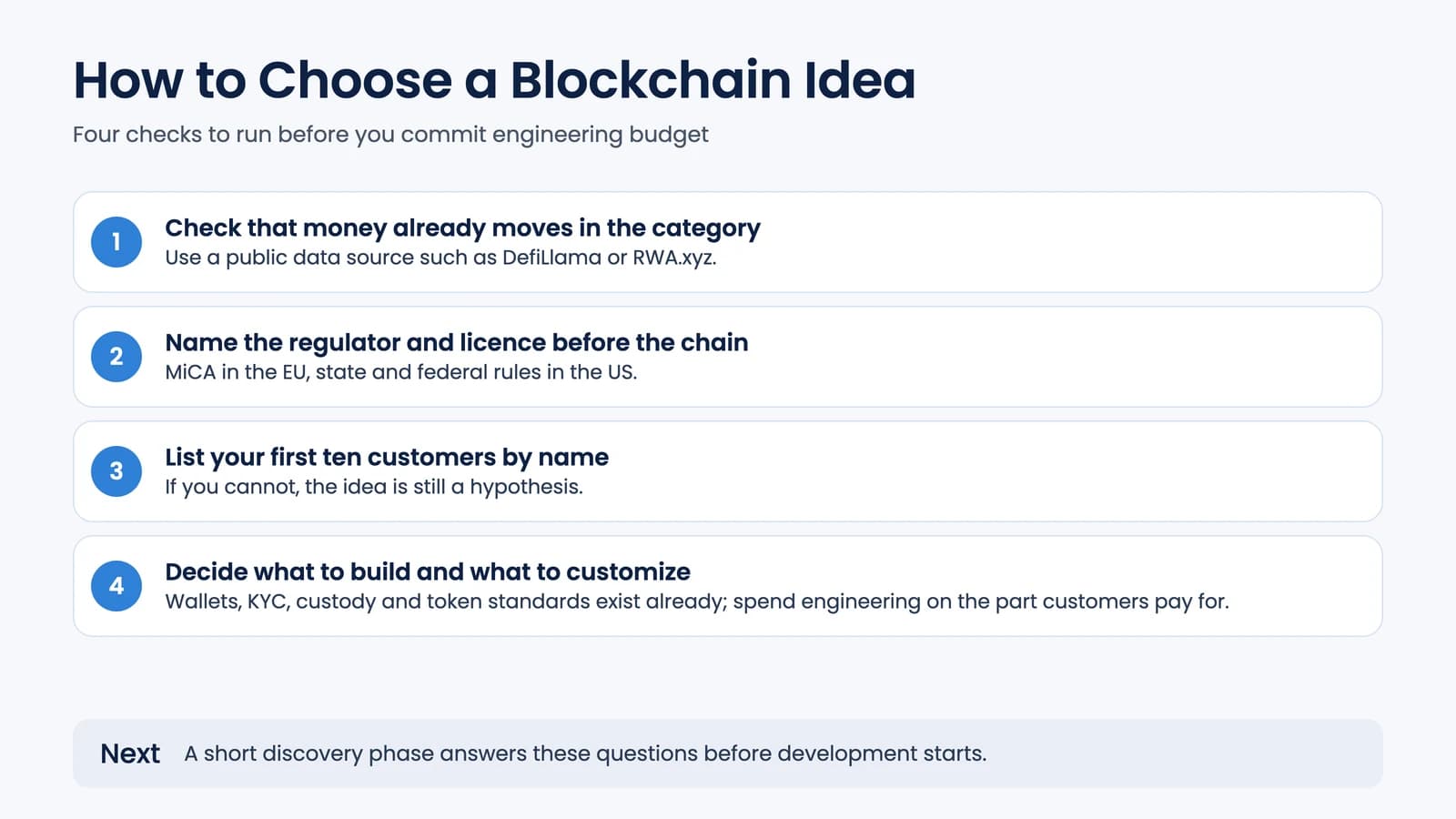
A short discovery phase answers these questions before development starts, and it is where most scope and budget mistakes are cheapest to fix.
FAQ on blockchain business ideas for 2026
No single model is the most profitable. The categories with the most money already on-chain are stablecoins ($312.7 billion in USD-pegged supply on 6 October 2026, per DefiLlama) and tokenized real-world assets (about $38.8 billion distributed, per RWA.xyz), so payment and tokenization businesses have the clearest demand.
It depends on what you do with customer money. Custody, exchange, transfer and stablecoin issuance are licensed activities in the EU under MiCA and in the US under federal and state rules. Software that never touches customer funds usually needs no licence, but your customers will need one.
No. The early speculative phase is over, but regulated categories such as tokenization, stablecoin payments and compliance tooling are still being built out, and clearer rules make it easier for banks and enterprises to buy from new vendors.
Confirm that money already flows in the category, identify the licence you or your customers need, and get commitments from a handful of named customers before you write production code. A discovery phase turns those answers into a scoped, costed plan.