


Most major blockchain foundations run ongoing grant programs to fund the open-source tools, infrastructure and applications that grow their networks. Grants don't dilute your cap table or require giving up tokens, which makes them worth applying to alongside any other funding you're pursuing.
Every program below was checked directly against its own site in early October 2026. Several grant programs that circulated in older versions of this list no longer exist under their original name: EOS Network Foundation's grants disappeared when EOS rebranded to Vaulta in 2025, Coreum's grant program is gone after Coreum merged with Sologenic into the tx platform, and the Celo Foundation's own domain no longer resolves to a foundation site at all, as celofoundation.org now redirects to Celo Core Co, the network's engineering and growth team, whose site carries no grants page, following Celo's 2025 move to an Ethereum layer-2. We dropped those, and a few others we couldn't verify, instead of carrying them forward on trust. See Grants We Dropped From This List below for the full list of what we removed and why.
What to Check Before You Apply
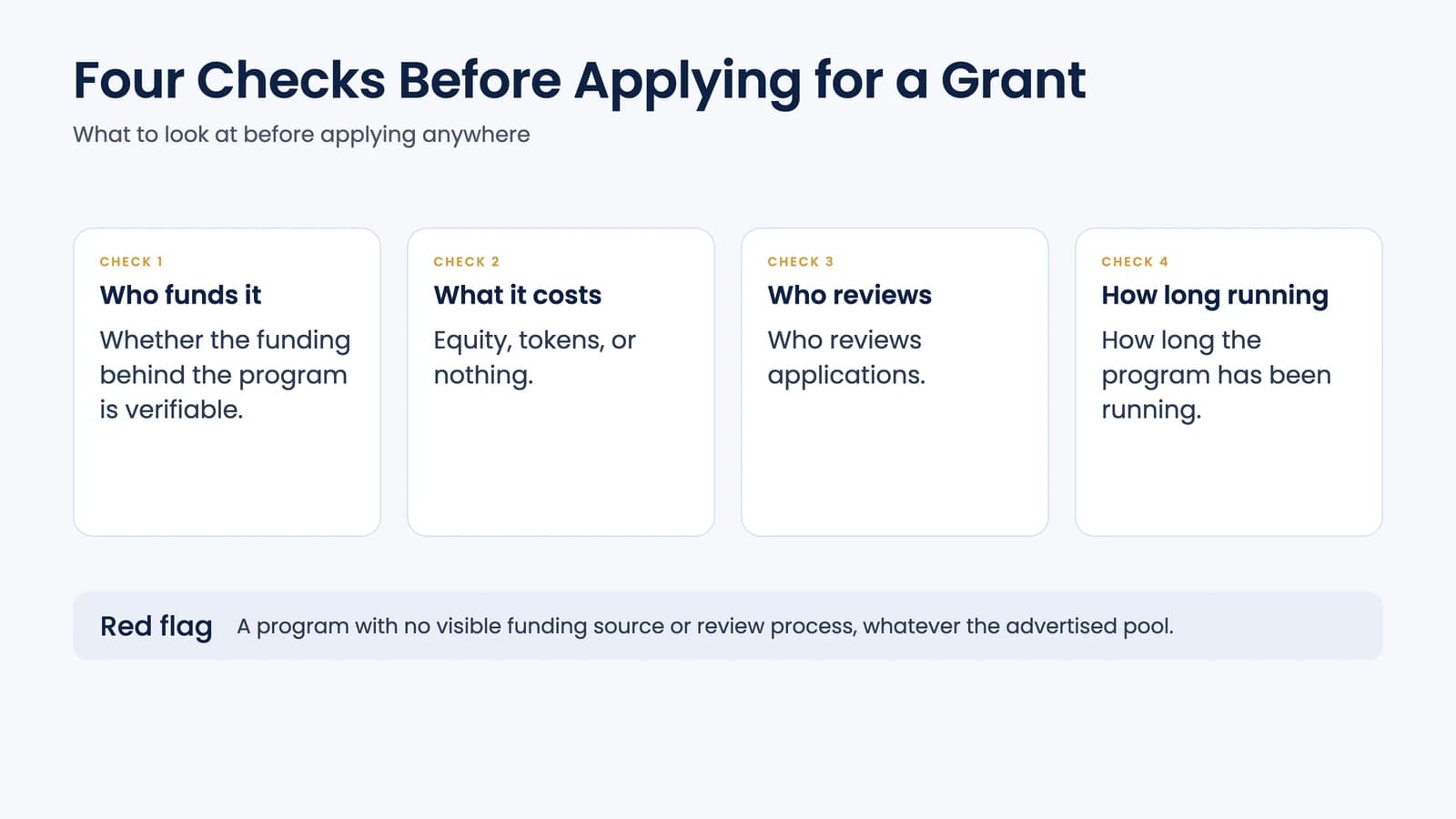
Before applying anywhere, look at four things: who is funding the program and whether that funding is verifiable, what the program actually costs you (equity, tokens, or nothing), who reviews applications, and how long the program has been running. A grant program with no visible funding source or review process is a red flag regardless of how large the advertised pool is.
It also helps to have the basics in place before you apply: a clear statement of the problem your project solves, a chosen blockchain and rough technical plan, and, if funds handle any user money, a completed or planned smart contract audit. Several of the programs below explicitly weight audit status in their review.
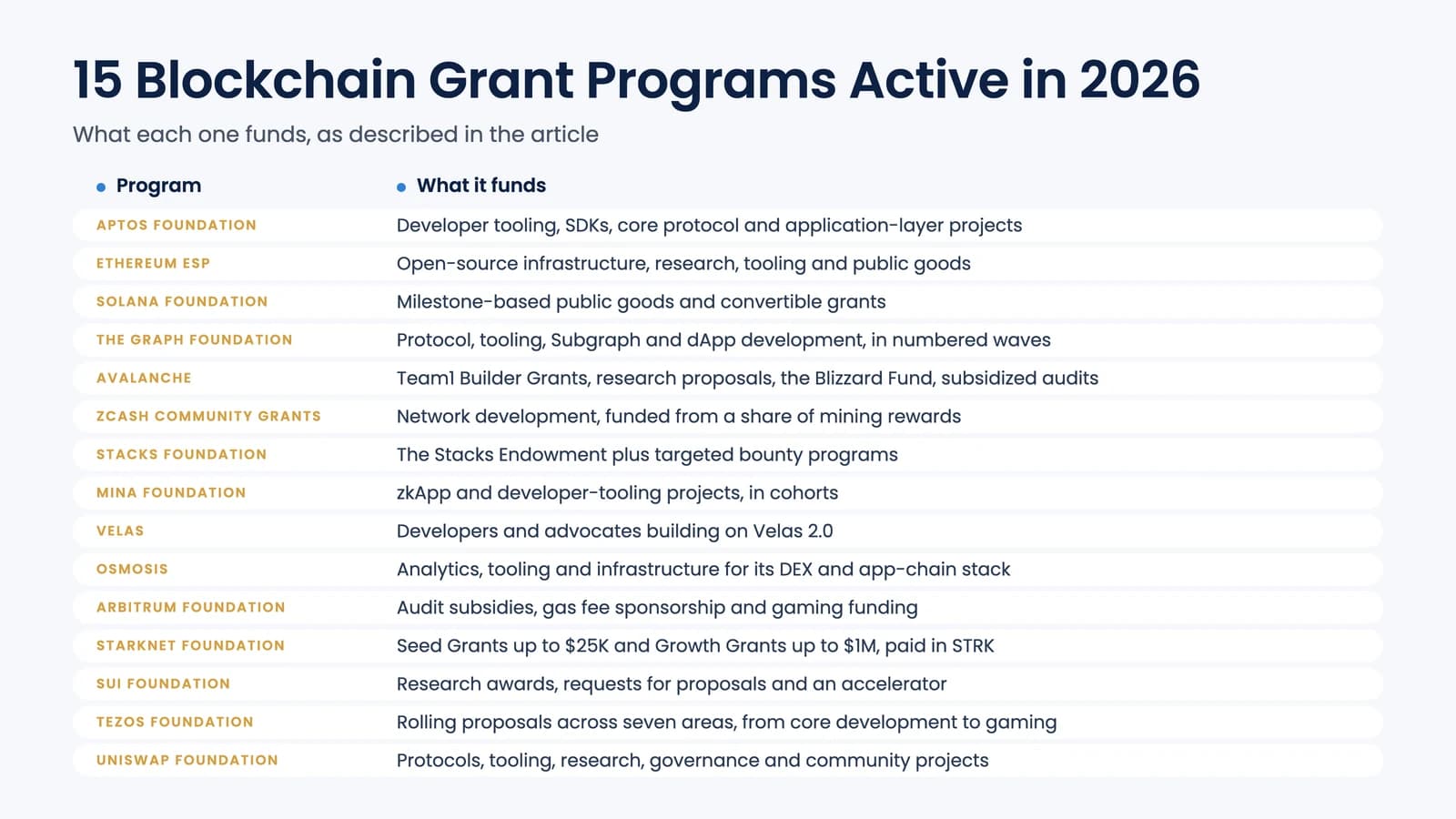
15 Blockchain Grant Programs Active in 2026
#1 Aptos Foundation Grants
The Aptos Foundation funds developer tooling, SDKs, core protocol contributions and application-layer projects (DeFi, NFTs, dApps) on Aptos. Funding amounts are set per project and not published as a fixed figure. aptosfoundation.org/grants.
#2 Ethereum Foundation ESP
The Ethereum Foundation's ESP funds open-source infrastructure, research, tooling and public goods that strengthen Ethereum, through both a rolling Wishlist of curated requests and unsolicited proposals. Historical disclosed funding ranged from roughly $27 million (2021) to over $60 million (2023) across the program's public grant rounds. esp.ethereum.foundation.
#3 Solana Foundation Grants
Solana's grants cover milestone-based public-goods funding and convertible grants for projects with a commercial component, alongside targeted requests for proposals. The Foundation reports having funded 500+ projects with over $100 million distributed across six continents since the program launched. solana.org/grants.
#4 The Graph Foundation Grants
Grants fund protocol, tooling, Subgraph and dApp development plus growth initiatives for The Graph, awarded in numbered waves overseen jointly by the Foundation and The Graph Council. thegraph.com/grants.
#5 Avalanche Foundation Grants
Avalanche's funding is now split across several programs, not one pool: Team1 Builder Grants for fast, focused project funding, a Call for Research Proposals offering up to $50,000 for academic work, the Blizzard Fund (institutional-backed, $200M+) for later-stage projects, and subsidized security audits. build.avax.network/grants.
#6 Zcash Community Grants (ZCG)
ZCG allocates a share of Zcash mining rewards, authorized under ZIPs 1014–1016, to fund network development through the third halving in November 2028; the program dashboard shows roughly 100,000 ZEC (about $11M at the rate cited on the site) available across open RFPs and funded projects. zcashcommunitygrants.org.
#7 Stacks Foundation Grants
The Stacks Foundation funds builders through the Stacks Endowment (covering onboarding-stage to established-builder categories) plus targeted bounty programs run with partner projects, with individual bounties disclosed up to $150,000 for specific integrations. stacks.foundation/grants.
#8 Mina Foundation Builder Grants
Mina funds zkApp and developer-tooling projects that advance its zero-knowledge proof network through a cohort-based builder grants process. The protocol remains actively developed, with a mainnet upgrade shipped in September 2026. minaprotocol.com/grants.
#9 Velas Grants Program
Velas funds developers and community advocates who grow its user base and build on Velas 2.0, its current architecture. Confirm current pool size and terms directly, since Velas has revised its funding structure more than once since the program launched. velas.com.
#10 Osmosis Grants Program
Osmosis funds projects that add value to its DEX and app-chain stack (analytics, tooling, infrastructure and growth) for teams whose funding need exceeds what a standard governance proposal would cover. grants.osmosis.zone.
#11 Arbitrum Foundation Grants
The Arbitrum Foundation's grants page lists several programs open for applications: the Arbitrum Audit Program, which offers $10M in ARB over 12 months to subsidize third-party smart contract audits for early-stage projects, and ArbiFuel, a gas fee sponsorship program for early-stage teams. ArbitrumDAO also funds gaming projects through Arbitrum Gaming Ventures. arbitrum.foundation/grants.
#12 Starknet Foundation Grants
Starknet runs two tiers of non-dilutive funding paid in STRK: Seed Grants of up to $25,000 for early-stage teams with an MVP or proof of concept, and Growth Grants of $25,000 to $1M for later-stage teams with a production-grade product. Growth Grants also cover creator content, Bitcoin builders and a "Next Billion" track. Applications are rolling, with no deadlines stated on the page. starknet.io/grants.
#13 Sui Foundation Funding Programs
The Sui Foundation lists several routes: Academic Research Awards of $25,000 each for blockchain science or security research, with rolling applications; Requests for Proposals that fund specific technical challenges the Foundation wants solved; and the Hydropower Accelerator, which takes no equity up front. sui.io/programs-funding.
#14 Tezos Foundation Grant Program
The Tezos Foundation takes proposals on a rolling basis across seven areas: core development, Tech.Rel, infrastructure and tooling, arts and culture, DeFi, business development and gaming. Its page states an average of four weeks to review a proposal and another four weeks for paperwork, and publishes no fixed grant size. tezos.foundation/grants.
#15 Uniswap Foundation Grants
The Uniswap Foundation funds protocols, tooling, research, governance and community initiatives through a rolling application form. Its documentation notes that deploying on Unichain or Uniswap v4 can strengthen an application, and it does not state grant sizes. Uniswap Foundation grants page.
Grants We Dropped From This List
The 2024 version of this article also listed 15 programs. Five of them no longer check out under their original name or scope, so we removed them instead of carrying stale entries forward: EOS Network Foundation (EOS rebranded to Vaulta in 2025; no grants program under the EOS name), Coreum Development Grants (Coreum merged with Sologenic into the tx platform, which has no listed grants program), Celo Foundation's Grant Kit (celo.org/grants currently returns a 404, and celofoundation.org no longer hosts a foundation site and redirects to Celo Core Co, the network's engineering team, which lists no grants program, following Celo's 2025 move to an Ethereum L2), Chainlink's original grant program (no longer listed on Chainlink's community pages; the closest current equivalent, Chainlink BUILD, is a service-access and token-incentive program for early-stage projects and not a cash or token grant, so we didn't substitute it directly), and Injective's Global Virtual Hackathon (a one-off 2024 event with a since-passed registration deadline, not an ongoing program). Five programs that were not in that version, from Arbitrum, Starknet, Sui, Tezos and Uniswap, now take their place.
What to Expect During Review
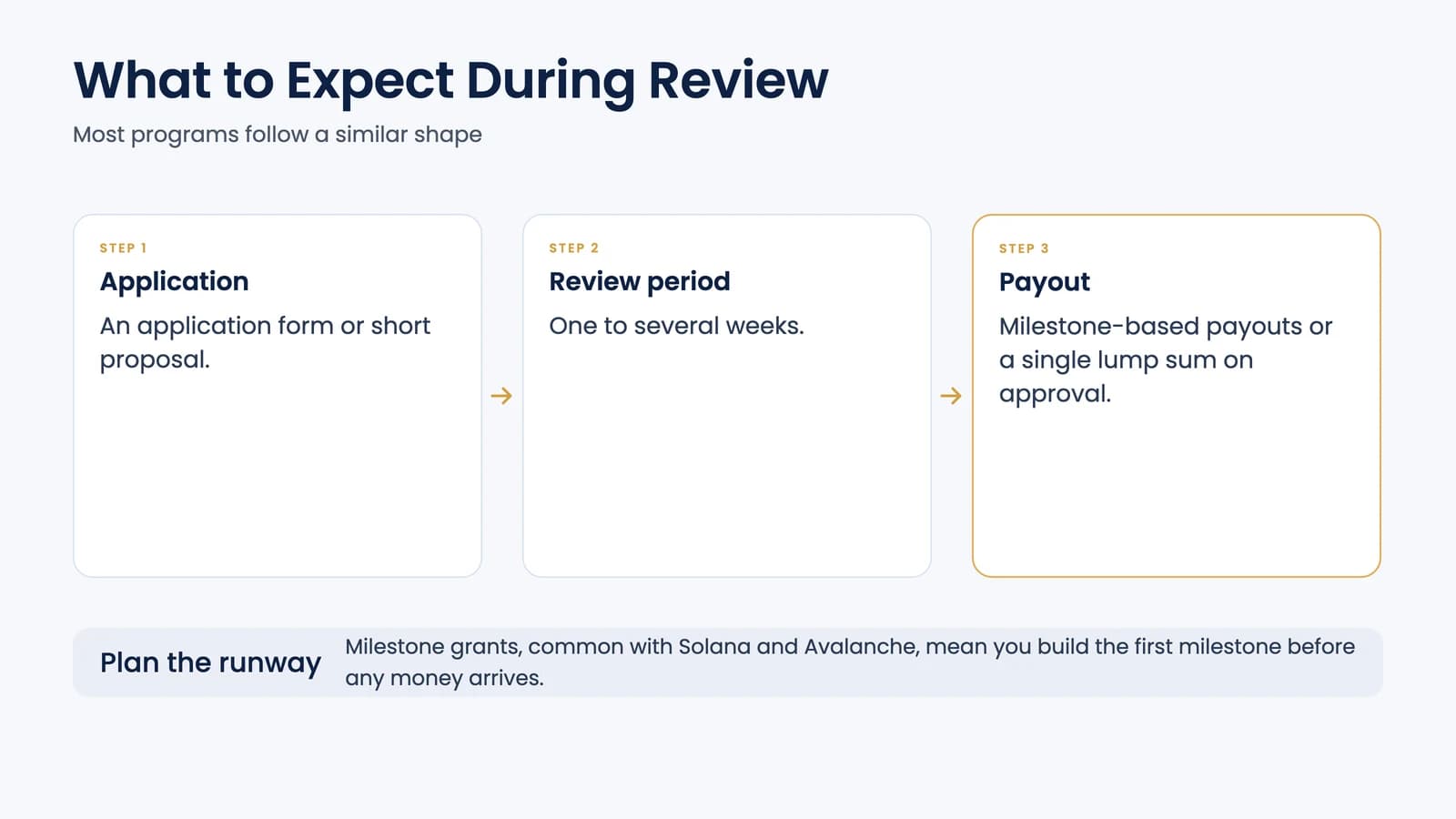
Most of the programs above follow a similar shape: an application form or short proposal, a review period of one to several weeks, and either a milestone-based payout schedule or a single lump-sum grant on approval. Milestone-based grants, common with Solana and Avalanche, release funds as you hit agreed deliverables, which reduces risk for the foundation but means you need enough runway to build the first milestone before any money arrives. Budget for that gap when you're deciding whether a grant alone can carry a project or whether it needs to sit alongside angel or pre-seed funding.
How 4IRE Can Help
If you're applying for a grant, the strongest applications pair a working prototype with sound tokenomics and, where funds touch user money, a completed audit. 4IRE's team can hire on as blockchain developers to get a prototype grant-ready, and help you weigh a grant against other routes covered in our guide to raising funds in crypto.
Conclusion
Grant programs are one of the few genuinely non-dilutive ways to fund early blockchain development, but the field turns over faster than most listicles admit, so check the program's own site before you apply, not a list from a year or two ago, including this one.
Getting a Prototype Grant-Ready?
Talk to our team about building, auditing and shaping the tokenomics of a project before you apply for funding.
FAQ
It varies enormously by program and project scope, from a few thousand dollars for a small tooling contribution to six figures for a significant infrastructure build. Most foundations set amounts per project rather than a fixed figure, so check the specific program's stated ranges before applying.
Most programs strongly prefer it. A working prototype or testnet deployment, even a small one, moves an application ahead of a whitepaper-only pitch, and several programs listed here explicitly ask for evidence of technical progress.
No. Grants typically require no equity and no token allocation in return, which is their main advantage over VC or a token sale. Some programs ask for open-source licensing of the funded work as a condition.
Vague eligibility fit (applying to a program whose stated categories don't match your project) and no verifiable technical progress. Reading the program's specific eligible-categories list before applying screens out most avoidable rejections.