

DePIN: What Is It, Why DePIN Is the Future of Infrastructure and What It Means for Your Business
Infrastructure development and expansion is becoming increasingly challenging and costly.
Centralized systems are finding it difficult to keep up with the issues of 5G rollout costs, rural connection issues, edge latency for AI and IoT, and the increasing need for real-time data.
A novel strategy is provided by Decentralized Physical Infrastructure Networks (DePIN).
DePIN facilitates quicker deployment, reduced financial needs, and increased geographic flexibility by coordinating infrastructure via distributed networks and blockchain—all without depending on conventional ownership paradigms.
DePIN is more than simply a technological advancement for decision-makers in the telecom, energy, IoT, and mobility sectors.
It’s a calculated tool to open up new markets and secure infrastructure for the future.
These community-owned networks disrupt many sectors, from telecom to energy, by offering a next-gen, democratized way to build and manage physical infrastructures with the help of blockchain.
Unlike a centralized system, where a single entity controls everything, DePINs allow individual contributors to unite and provide infrastructure services. Thus, in simple words, DePIN is a community-owned data center, energy grid, or telecom network governed by the people.
This impressive degree of decentralization makes DePINs an embodiment of the democratic promise of blockchain. Thus, the popularity of DePINs is expected to grow together with the increasing adoption of blockchain. In this comprehensive guide, 4IRE’s experts unpack the exposive potential of DePINs for your business, go through the risks, and break down the principles of blockchain ecosystem scaling for you.
What Is DePIN?
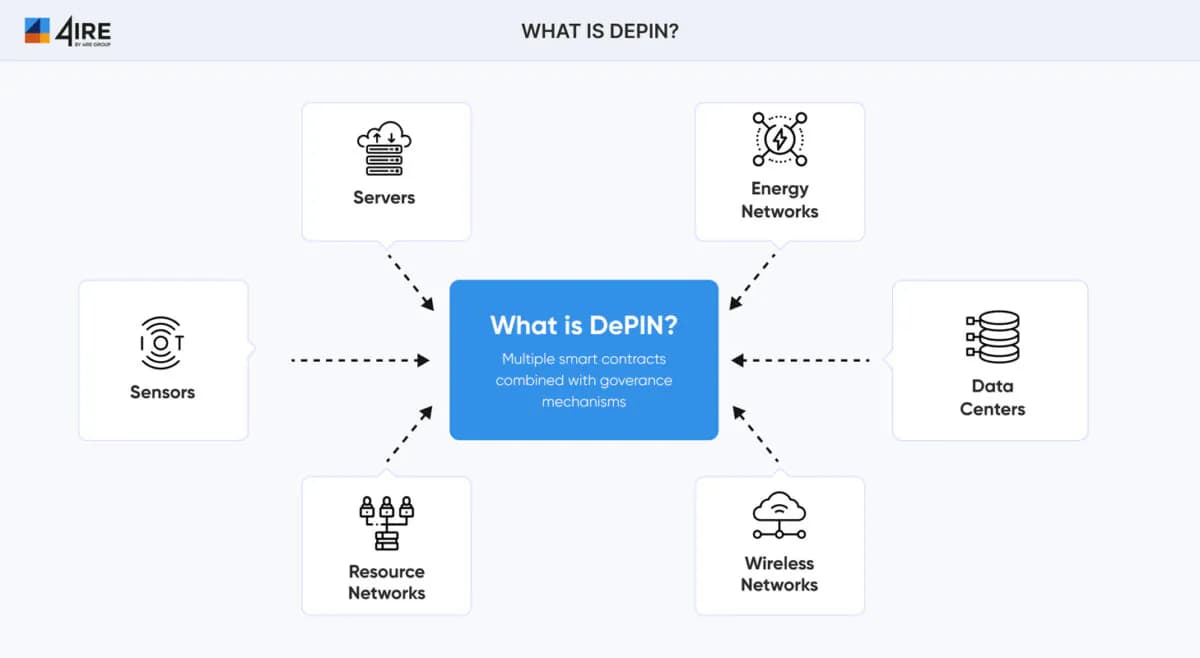
DePIN – is a blockchain-powered network that allows individuals to manage and coordinate physical infrastructure, from hyper-local energy grids to telecom networks and IoT systems, in a decentralized, community-driven manner. People contribute their devices, and the DePIN integrates them with decentralized protocols to deliver specialized network services – decentralized data storage, AI data processing, or connectivity provision. Thus, DePIN members benefit from peer-to-peer infrastructure management, cost reduction, and better network efficiency.
Since the DePIN runs on a blockchain, it possesses the features of transparency, security, automated operations following the smart contract logic, and trustless coordination. Projects like this are powered by flexible and robust blockchains; many use Solana, which has long ago become a synonym for scalability and trust.
Meticulously designed tokenomic and reward systems of DePINs also ensure that every member gets a fair share of rewards relevant to their contribution. So, what is DePIN? An illustrative example of DePIN projects is Grass.io we’ve already mentioned – a model that gives users the ability to monetize their unused Internet bandwidth.
As telecom giants face rising infrastructure costs and slower rural expansion, DePIN models like Helium offer a compelling alternative. This table breaks down how decentralized infrastructure could complement and enhance traditional telecom strategies, unlocking faster growth, lower costs, and broader reach.
| Comparison Criteria | Helium (DePIN) | AT&T/Vodafone (Traditional) |
|---|---|---|
| Deployment Model | Decentralized: Individuals or businesses deploy Hotspots (~$250–$500 each) to provide coverage, coordinated via blockchain. | Centralized: Telecom companies invest in and maintain cell towers ($150,000–$500,000 per tower) and network infrastructure. |
| Cost to Deploy | Low Initial Cost: Hotspot deployment costs $250–$500 per unit. An estimated 1 million Hotspots globally by 2025 (based on Helium’s growth to ~900,000 by 2023). Total deployment cost: ~$250M–$500M for global coverage. - Operational Cost: Minimal, as users maintain Hotspots; no central operator overhead. | High Initial Cost: Building a single 5G tower costs $150,000–$500,000. AT&T spent ~$40B on 5G infrastructure (2020–2023). Global telecom infrastructure market: ~$100B annually. - Operational Cost: High, with maintenance, labor, and energy costs (~$10,000–$20,000 per tower annually). |
| Benefit (Cost) | 80–90% cost reduction for deployment compared to traditional towers. Community-driven model eliminates centralized overhead, making it affordable for startups and SMEs. | Higher costs limit scalability for smaller players. Established infrastructure ensures reliability, but at a premium. |
| Coverage | Global Reach: ~900,000 Hotspots across 190+ countries (as of 2023), covering ~1M square miles for LoRaWAN IoT. Growth: Scales rapidly as anyone can add a Hotspot, with coverage expanding organically. | Extensive but Limited: AT&T’s 5G covers ~290M people in the US (2023). Global telecom networks cover urban areas well but struggle in rural/low-density regions. - Growth: Slower due to regulatory approvals and high costs. |
| Benefit (Coverage) | Faster, broader reach in underserved areas (e.g., rural regions) due to community deployment. Ideal for IoT-specific coverage. | Reliable in urban/high-density areas but less flexible for niche or remote IoT use cases. |
| Scalability | High Scalability: Adding a Hotspot takes days and minimal cost. Helium grew from 10,000 to 900,000 Hotspots in ~3 years (2020–2023). Incentive-Driven: HNT tokens incentivize new deployments, with ~$50M in tokens distributed to Hotspot operators annually (2022 data). | Limited Scalability: New towers require years of planning, permits, and $150K–$500K investment. AT&T added ~10,000 5G sites in 3 years (2020–2023). No Incentives: Expansion driven by corporate budgets, not community participation. |
| Benefit (Scalability) | 10x faster scaling due to low-cost, decentralized deployment. Enables rapid market entry for IoT-focused startups. | Slower, capital-intensive scaling limits agility but ensures consistent quality. |
| Revenue Model | Token-Based: Hotspot operators earn HNT for providing coverage/data transfer. Average earnings: $1–$10/month per Hotspot (varies by location/demand). - User Cost: IoT devices pay ~$0.0001 per data packet (low-cost for low-bandwidth IoT). | Subscription-Based: Enterprises pay $10–$100/month per IoT device for cellular connectivity (e.g., AT&T IoT plans). User Cost: Higher due to centralized infrastructure overhead. |
| Benefit (Revenue) | Low-cost access for IoT users (100–1000x cheaper than cellular). Operators gain passive income, democratizing revenue opportunities. | Higher revenue per user but limited to enterprise clients; no community revenue-sharing model. |
| Speed of Deployment | Rapid: Hotspot setup takes hours (plug-and-play). Global network scaled to 900,000 Hotspots in ~3 years. - Example: A city can gain IoT coverage with 100 Hotspots (~$50,000) in weeks. | Slow: Tower deployment takes 6–18 months due to permits and construction. A new city network costs $10M–$ 50M. - Example: 5G rollout in a city takes 1–2 years. |
| Benefit (Deployment) | Weeks vs. years: DePIN enables rapid deployment, ideal for agile startups and smart city projects. | Slower but ensures robust, standardized infrastructure. |
| Reliability | Variable: Relies on community maintenance; coverage gaps in low-density areas. Blockchain ensures uptime transparency. Uptime: ~95% for well-covered areas (based on Helium user reports). | High: Professional maintenance ensures ~99.9% uptime for 5G networks. - Centralized Risk: Outages can affect large regions (e.g., AT&T outage in 2024 impacted millions). |
| Benefit (Reliability) | The decentralized nature reduces large-scale outages but may lack consistency in sparse areas. | Superior reliability for critical applications, but vulnerable to centralized failures. |
| Sustainability | Eco-Friendly: Hotspots use ~5W (vs. 10–20kW for cell towers). Supports green IoT applications (e.g., environmental monitoring). - Blockchain Impact: Helium uses Solana (a low-energy blockchain), minimizing environmental footprint. | High Energy Use: Cell towers consume 10–20 kW each. The telecom sector accounts for ~2% of global emissions. - Green Efforts: Some providers adopt renewables, but legacy systems remain energy-intensive. |
| Benefit (Sustainability) | 80–90% lower energy use per coverage point, aligning with sustainability goals for smart cities and IoT. | Improving, but lags behind DePIN in energy efficiency for IoT use cases. |
| Market Potential | DePIN Market: $2.14B in 2025, with wireless DePIN (e.g., Helium) estimated at ~$ 500 M. Growing at 35% CAGR due to Web3 adoption. - Helium Users: ~500,000 IoT devices connected (2023), projected to reach 5M by 2025. | Telecom Market: $100B annually for IoT connectivity, growing at 10% CAGR. AT&T’s IoT revenue: ~$1B (2023). - Users: Millions of IoT devices on cellular networks, but higher costs limit growth. |
| Benefit (Market) | High-growth niche: DePIN targets cost-sensitive IoT markets, with faster adoption in emerging regions (e.g., India, Brazil). | Established market but slower growth due to high costs and competition. |
How DePIN Works: A Real-World Example
Now, let’s get down to the practical side of DePIN implementation to give this concept form and shape. In essence, a DePIN represents a combination of hardware and software elements, attracting contributors with economic incentives. The system’s components are:
- Network of contributors – people who share their physical resources and integrate them into the DePIN network.
- Blockchain and smart contracts – the architecture of blockchain makes it possible for the DePIN to record transactions and distribute rewards for the contributors’ input.
- Tokenomics – every DePIN has a clear, consistent economic model that ensures every contributor receives token incentives proportional to their input.
- Verification and QA – contributors have to undergo initial verification so that all service users get a guarantee of resource quality and availability.
Some use cases that illustrate DePIN use in the real world are as follows:
- Energy sector. Energy use, generation, and distribution remain one of the most promising areas for IoT and blockchain applications. DePINs offer a sound way for setting up energy sharing networks, which enables real-time energy supply and demand regulation by feeding extra energy into the grid at peak consumption times or emergencies. An eco-friendly DePIN, PowerLedger, lets households with solar panels share extra generated energy for token rewards.
- Telecom. Projects like Solana-powered Grass.io help users share unused bandwidth with other Internet users and earn Grass Points. The latter are convertible to tokens, offering tangible monetary rewards for the idle bandwidth that would otherwise be wasted.
- IoT. DePINs enable wireless P2P infrastructure networks in which multiple devices communicate directly via the IoT infrastructure. An example of such DePIN is Helium – a community-driven network of hotspots for IoT device connectivity. Projects like this are gaining momentum as cost-effective and flexible solutions for logistics, agriculture, and smart cities blockchain.
- File storage. DePINs also offer a next-gen way to store data on a distributed network of devices, which comes with lower risks to its security and the loss of access. One example is Filecoin – a blockchain-based data storage that breaks user data into multiple pieces and stores it across the network to prevent data interception or theft.
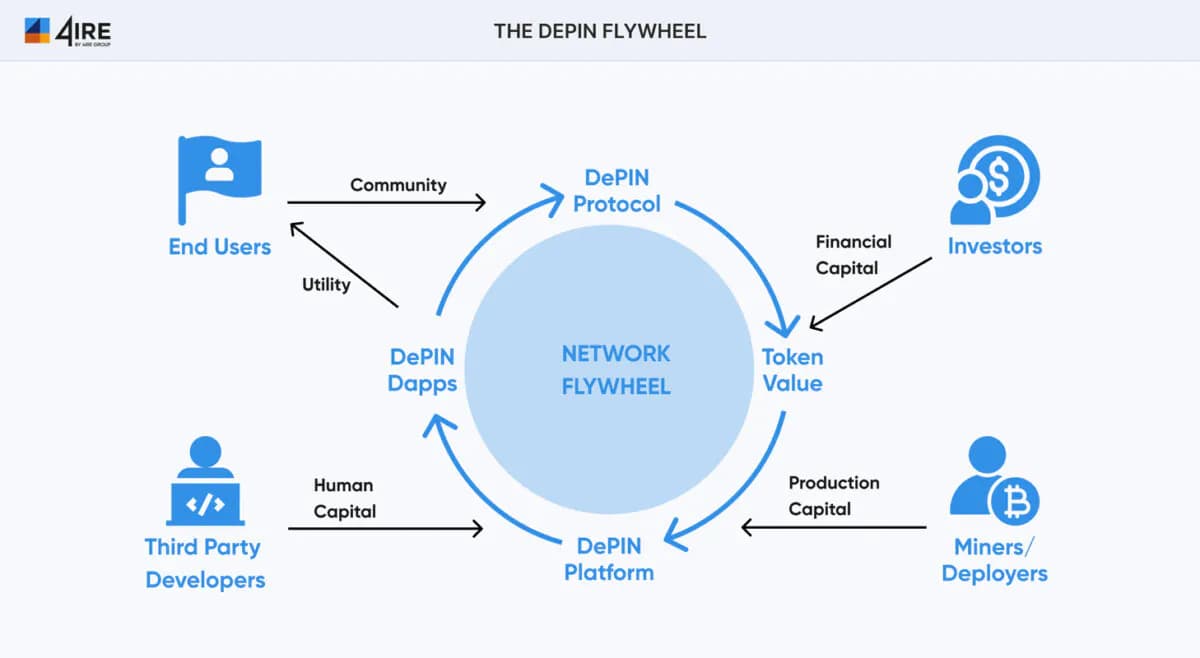
This way, DePINs represent a tech-savvy example of real-world asset tokenization that benefits physical infrastructure use optimization and democratizes access to a variety of resources.
Key Benefits of Launching Your DePIN Project
If you’re still in doubt about turning to a blockchain development services company to create and launch your own DePIN, here are some appealing benefits to consider.
- Cost-effectiveness. Decentralized models of infrastructure design come with lower operational costs and give users more appealing financial terms compared to centralized infrastructure providers.
- Resilience and reliability. Blockchain-powered networks include numerous devices from multiple contributors, so they don’t have a single point of failure.
- Community-driven growth. By incentivizing participants with the project’s internal token rewards, DePINs foster active community participation and expansion.
- Disruption of traditional infrastructure. DePINs are examples of robust Web3 infrastructure that enables quick setup, flexibility, and greater safety.
- Local market synchronization. DePINs can be small in size and highly specialized due to local community participation. Thus, they sync to hyper-local market needs way better than commercial infrastructure projects.
- Permissionless scaling. Due to the permissionless nature of blockchain access, DePINs are scalable across jurisdictions without legal repercussions and hurdles.
- Collective ownership. Blockchain architecture enables decentralized ownership, which makes infrastructure management more democratic.
- Frictionless DeFi integration. Blockchain architecture can smoothly integrate frictionless micropayments and DeFi services, thus creating a functional and feature-rich ecosystem.
With all of these advantages, DePINs represent a new generation of community-driven projects that link physical resources on blockchain and create unprecedented opportunities for community contribution and participation.
Common Challenges and Pitfalls in DePIN
While blockchain physical networks offer a solid alternative or supplement to centralized infrastructural projects, they still come with some potential challenges and pitfalls you should know.
- Technical architecture bottlenecks. Compiling a distributed network of hardware and software and making it work in tandem still represents a technically hard part of blockchain integration.
- Tokenomics and incentives. Attracting and keeping contributors is still among the most pressing issues for all DePIN startups. That’s why it’s vital to develop a clear and appealing tokenomic model and link the project to meaningful community goals and values.
- Regulatory issues. Despite the permissionless nature of public blockchains, regulatory compliance for DePIN still remains a necessity. Thus, DePIN creators still need to navigate the complex patchwork of local and global regulations.
- Scaling problems. It’s often hard to strike the right balance between performance and decentralization in the process of DePIN’s growth.
- Integration challenges. Blockchains are still not universally cross-compatible, and the use of legacy infrastructure can also slow down DePIN setup.
The good news is that a reliable, experienced smart contract development company like 4IRE can help you address all these challenges and create a functional and compliant DePIN for a smooth launch. Your key to success is working with professionals, as both the architectural aspects and legal hurdles can make or break the outcomes of your costly investment.
Why DePIN Is the Future of Infrastructure
There are many reasons to see the future of infrastructure in DePIN solutions. First, DePINs represent community-driven infrastructure, which means these projects are democratic, permissionless, and fair. Second, the transparency of blockchain solutions gives users more trust and confidence in DePINs, thus encouraging their growth and expansion. Third, DePINs are closely aligned with hyper-local needs and community values, which improves their adoption.
DePINs are decentralized IoT networks that allow users to benefit from infrastructure instead of corporations. This arrangement appeals to many, and given the growing demand for data (with the big data market expected to triple by 2027), DePINs become an invaluable source of data from multiple sensors and devices connected within the broader blockchain ecosystem.
Core Infrastructure Elements of a DePIN Project
Let’s also take a closer look at the infrastructural side of the DePIN project. What is needed to set it up? Traditionally, you will need:
- Physical hardware. The devices that make up the infrastructure network include sensors, IoT devices, drones, gateways, etc.
- Connectivity. You will need a network that connects devices into a single system and lets them communicate. It may be WiFi, LoRaWAN, 5G, mesh networks, etc.
- Blockchain. The public ledger records and verifies transactions using one of the popular consensus mechanisms (proof-of-stake, proof-of-coverage, etc.). Smart contracts manage all incentives and interactions on blockchain following the project’s predetermined logic.
- Tokenomics. The project should have an internal token and a clear reward structure to remunerate contributors for the provision of infrastructure and data.
- Data management and analytics. The project should be equipped with compliance data storage and processing tools.
- Governance and security. The DePIN should have a consistent set of rules and frameworks that regulate decision-making, user access, and security.
- User and developer interfaces. The DePIN project should offer an easy, user-friendly app for joining it and developer toolkits for ecosystem expansion.
Top DePIN Projects in 2025
What’s going on in the DePIN niche today? Here is a glimpse of the most successful DePIN projects to give you some inspirational ideas.
| # | Title | Launch Year | Marketcap | Core Use Case / Application | Blockchain Network | Community & Ecosystem Size and activity of the community, notable partnerships, developer activity. |
|---|---|---|---|---|---|---|
| 1 | Bittensor | 2023 | $3.24B | Decentralized AI | Substrate-based (Custom) | Large, active partnerships with AI firms, strong developer activity |
| 2 | Internet Computer | 2021 | $2.72B | Decentralized Internet | ICP | Large, growing, notable partnerships with tech companies, active developers |
| 3 | Render | 2017 | $1.92B | Decentralized rendering | Ethereum | Moderate, growing community, partnerships with gaming, active devs |
| 4 | Filecoin | 2017 | $1.67B | Decentralized storage | Filecoin | Large, established partnerships with enterprises, strong dev activity |
| 5 | Theta Network | 2019 | $750.73M | Decentralized video delivery | Theta | Large, active partnerships with media companies, solid devs |
| 6 | BitTorrent [New] | 2018 | $681.88M | Decentralized file sharing | BitTorrent | Moderate, growing partnerships with P2P networks, active devs |
| 7 | IOTA | 2015 | $684.79M | IoT data transfer | IOTA | Large, established partnerships with industry, strong dev activity |
| 8 | Walrus | 2022 | $677.46M | Decentralized cloud storage | Ethereum | Small, emerging, potential partnerships, growing devs |
| 9 | Helium | 2019 | $530.97M | Decentralized wireless | Helium | Moderate, active partnerships with telecom, solid dev activity |
| 10 | Grass | 2023 | $447.82M | Decentralized computing | Solana | Small, growing, potential partnerships, emerging devs |
How 4IRE Can Help You Use/Develop DePIn
As you move from an idea and start looking for a go-to-market DePIN strategy, it’s time to find a reliable tech partner who can bring your plan to life. 4IRE is a global leader in blockchain engineering, and our 300+ engineers and 14+ years of industry experience (including 8+ years of close work with blockchain) are worthy reasons to rely on us with DePIN implementation.
We are an enterprise blockchain consulting company with a star team of business analysts and engineers. As a trusted partner for enterprises backed by UF Ventures and Polkadot, we can build scalable solutions like Grass.io to give shape to your DePIN project. Thus, by turning to us with a DePIN idea, you get a solid mix of expertise, talent, and business insight – a winning formula for a profitable and sustainable blockchain project.
Conclusion
DePINs have recently emerged as a new model of infrastructure network setup. Their democratic and transparent nature, together with resource ownership and governance decentralization, meet the growing demand for community-driven resource management. Besides, the appeal of DePINs is in the passive income that contributors can generate from sharing unused resources and contributing to green initiatives and their community. By building a DePIN system together with the skilled 4IRE team, you can tap into the world of community-governed projects and blockchain adoption.
FAQ
A DePIN is a decentralized physical infrastructure network operating on blockchain and allowing community members to share their space resources for token rewards.
DePINs offer a transparent, decentralized alternative to corporate infrastructure services. Thus, one may suggest that the trend is sustainable, and demand for PINs is expected to rise further.
DePINs operate based on decentralized governance principles, meaning that every user contributing their physical resources to the network has a word in it and is entitled to a share of the rewards generated by it.
Construction, energy, and logistics industries can benefit from IoT sensor networks created using the DePIN model. This solution is also suitable for decentralized data storage, telecom resource sharing, and the like.
You should perform feasibility assessments for blockchain projects like this. Turn to 4IRE analysts for an in-depth evaluation of your idea’s business potential and technical implementation.
The first steps include the project’s feasibility assessment and a choice of a suitable blockchain that enables building robust DePIN architecture.
The choice of devices and hardware depends on your DePIN’s specialization. In most cases, the list should include sensors, routers, data storage devices, and IoT devices.
The choice depends on your project’s needs and specialization. LoRa is suitable for low-power, long-range applications with small data volumes. 5G possesses high throughput and low latency, which makes it suitable for resource-intensive applications. WiFi is energy-intensive, but it guarantees fast speed over small distances. Mesh networks allow striking the right balance between low power consumption and broader geographical coverage.
A popular choice for DePIN projects is Solana, which combines scalability and reliable, safe architecture.
The tokenomic model of a DePIN project determines the total supply of tokens and the method of contributor remuneration for their input. Smart contracts disburse rewards based on the transactions recorded on the blockchain.
As DePIN projects aim to remunerate users for their contribution, you may face a challenge to fair token distribution or come across regulatory bottlenecks.