

Shariah-Compliant DeFi: Guide to Building Halal Blockchain Products
Shariah-compliant finance at a glance:
- The Islamic (Shariah) finance market is expected to surpass a $6 trillion mark in 2026, with an expected growth target of $8.46 trillion by 2031.
- Islamic FinTech is also on the rise, with a $222.58 billion market cap in 2026 and a growth target of over $515 billion in 2031.
- The volume of sukuk in global circulation has surpassed $1 trillion in Q3 2025.
- Fasset received a preliminary banking license from the Malaysian Labuan regulator, authorizing it to conduct Shariah-compliant digital banking operations using stablecoins and tokenized assets.
- HAQQ-based Islamic Coin has its own Shariah council and integrations with 40+ Islamic banks, including the Abu Dhabi Islamic Bank and the Dubai Islamic Bank.
- Zakat on crypto assets is applied to wealth above nisab, which is around $6,000-$7,000, with an annual 2.5% charitable deduction.
- Leverage trading, margin usage, futures, and perpetual swaps are considered haram in Islamic banking because of their speculative nature and interest generation.
- Islamic FinTech products have already attracted the attention of 85% of tech-savvy Muslim Gen Z users.
These figures point to the massive growth potential of Islamic finance on a global scale, with Islamic FinTech also gaining traction. In this guide, we explain the nuances of building a Sharia compliant DeFi product step by step, from technical architecture to compliance audit.
What Is Shariah Finance?
Islamic financial contracts, such as Murabaha, Mudarabah, and Musharakah, existed long before the advent of modern finance. They have all been executed within the broader field of fiqh al-muamalat, which covers the commercial, financial, and social interactions among people in the Islamic world.
In the modern period, Islamic finance was first introduced into mainstream use by Mit Ghamr Savings Bank in Egypt in 1963, followed by the Nasser Social Bank in 1971 and the Islamic Development Bank in 1975. The first commercial bank, Dubai Islamic Bank, opened in 1975, with most financial developments traced to the 1973-74 oil price shocks in the Arab world.
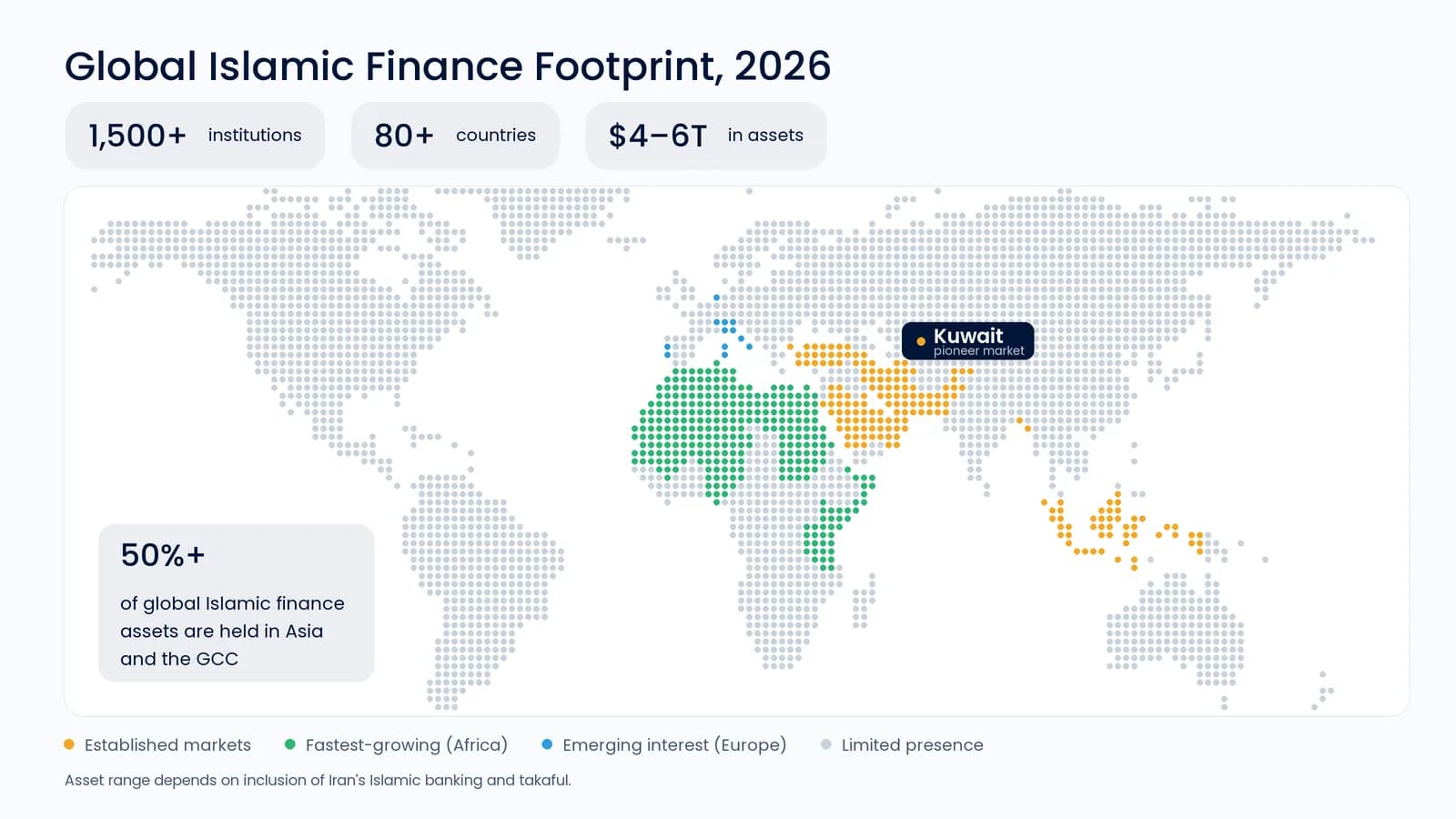
Today, over 1,500 Islamic financial institutions operate across the globe, with an official presence in 80+ countries. Global Islamic assets are currently valued from $4 trillion to $6 trillion, depending on whether Iran’s Islamic banking and takaful are included. Islamic finance dominates in Asia and the GCC, with Kuwait as one of the pioneers, where over 50% of global Islamic finance assets are held. Africa is the fastest-growing market, with several states formally adopting Shariah-compliant banking models in 2026. European countries are also actively exploring Islamic banking, including Italy, the Netherlands, Portugal, and Switzerland as frontrunners.
Structural Prohibitions of Islamic Finance
To enter the fast-growing and potentially profitable Shariah-compliant finance sector, every project developer should understand its structural constraints fully. If the DeFi product fails on any of these parameters, it can’t be regarded as a halal project.
Riba
Literally translated as ‘increase,’ the concept of riba in Islamic finance relates to the profit linked to time rather than risk. Following the Quranic verse 2:275-279, the profit that a lender gets from their assets should be attached to assets and not the loan period. A narrower version of the principle, riba al-fadl, prohibits unequal exchanges of the same commodity. The DeFi product design implication of this ban is that money can’t be rented and yield profit; the riba is avoided only where the return is attached to shared risks, assets, or rendered services.
Haram Assets & Activities
Haram means ‘prohibited’ or ‘sinful’ in Islam, and Islamic finance places an explicit ban on any financial operations related to alcohol, pork, conventional finance, traditional insurance, gambling, tobacco, adult entertainment, and arms trade. Businesses go through sectoral and deeper quantitative screens, with the Accounting and Auditing Organization for Islamic Financial Institutions (AAOIFI) performing in-depth analysis of fund structures and activities of seemingly Shariah-compliant entities. To pass the haram test, the company should have interest-bearing debt under 30%, less than 30% of cash and interest-bearing securities and under 5% of non-permissible income sources in its total revenue.
Gharar
Gharar stands for uncertainty in contractual terms. In practice, it may relate to an undefined delivery date, a vague price statement, contingent outcomes, etc. Licensing authorities distinguish between gharar fahish (excessive, invalidating uncertainty level) and gharar yasir (minimal, tolerable). This is the greatest structural barrier for DeFi projects.
Maysir
Maysir refers specifically to gambling, where the outcome of a contract is zero-sum wagering. In other words, one party stakes a sum of money on an uncertain outcome, and in case their guess is correct, they receive profits, while the other party loses. Islamic finance denies profits based on chance, with financial contracts creating risk and producing no value being qualified as non-halal.
Apart from these bans that all halal FinTech products should include by design, you should also know two enabling principles:
- Al-ghunm bil-ghurm, translated as “gain accompanies liability,” means that the lender’s entitlement to profit requires bearing risk. This condition helps Islamic finance products bypass the riba problem by qualifying the profit not as interest but as a fair payment for the sustained risk.
- Al-kharaj bil-daman, translated as “revenue belongs to those who bear the burden,” meaning that income from the asset accrues to the party holding responsibility for it.
These principles offer a reasonable DeFi framework for builders: the product may be regarded as Shariah-compliant if returns in it are attached to something clients own and can lose (actual ownership is vital).
Why Traditional DeFi Fails Shariah Principles
Most DeFi products are Shariah-incompatible because their revenue streams are linked to a time-based return on money. Composability of certain DeFi projects only aggravates the problem, with some parts of the DeFi architecture failing on riba, while other interest-free aspects collapse under the gharar or maysir test. Thus, equating Shariah compliance to interest-free design is a builder’s grave error. Here is a detailed breakdown of common DeFi mechanisms’ non-compliance with Islamic finance logic.
| DeFi Mechanism | Failure Mode | Reason |
|---|---|---|
| Aave/Compound-model lending pools | Riba | Predetermined, time-based return on a money loan, non-curable with collateral |
| Fixed-APY staking/fixed-rate vaults | Riba | Guaranteed nominal return decoupled from realised protocol revenue |
| Perpetual futures, options | Gharar, Maysir | Sale of non-owned, non-existent assets; funding rate is a time-value payment |
| Margin/leverage | Riba, Gharar | Borrowed capital at interest, compounding uncertainty |
| Liquidation penalties and late fees | Riba | Penalty accruing to lender = increase on debt |
| Rebasing and algorithmic stablecoins | Gharar | Peg mechanics with undefined redemption |
| Yield aggregators routing to lending markets | Riba by passthrough | Composability launders non-compliance |
| Governance tokens of non-compliant protocols | Haram asset | Ownership share in a riba business |
There is still a debate about PoS staking as a halal practice. Platforms seeking compliance validation argue that staking rewards are compensation for validation services, so they don’t fall into the category of interest or profit guarantee. Thus, Islamic auditors are still undecided on whether PoS staking rewards are ujrah, meaning permissible service fees, or returns on locked capital assets.
Liquidity provision in AMMs is also an ambiguous aspect of Shariah compliance determination. On the one hand, LP fees are service income earned from genuine risk-sharing, since the provider is exposed to impermanent loss (halal). On the other hand, the pool itself may contaminate compliance if it contains non-compliant tokens.
Finally, NFTs and airdrops are qualified solely based on the underlying assets. They may be regarded as Shariah-compliant if the underlying utility is halal, and vice versa.
Building a Shariah-Compliant Product: Available Models
Shariah-compliant DeFi, such as a contemporary Neobank, can be built using one of the three financial contract models accepted in Islamic finance.
Murabaha
This one relates to the ‘cost-plus sale’ model of a financial transaction. The financier buys an asset and resells it to the client with an explicitly disclosed markup. The price may be paid in instalments. An important precondition for this arrangement is asset ownership; a financier can’t sell what they don’t own, thus excluding leverage trading and financial derivatives.
Its community modification is Tawarruq, but Islamic scholars are increasingly hostile to this arrangement as dubious, so it’s not recommended for DeFi product design.
Musharakah
This contractual arrangement means a partnership, with both parties contributing capital and sharing risk and profits. The diminishing musharakah model is a good fit for tokenized real assets, with the client’s share increasing with every successive instalment. Yet, the model’s implementation in DeFi faces the oracle problem, as profits must be real, not simulated. Thus, auditable revenue attestation is a vital design element.
Ijarah
An Islamic version of lease, the ijarah model presupposes the asset’s ownership by the financier. The latter promises the asset’s transfer to the borrower after contractual terms are satisfied in full. The financier holds ownership, maintenance responsibilities, and insurance obligations, thus receiving halal profits for these services.
Architecture-Level Shariah Compliance
So, how do you translate these Islamic contracts into DeFi architecture to make your product Shariah-compliant? Use this checklist:
- Asset-backing invariant. Every token should be traceable within the system to its real collateral. There’s no room for purely synthetic assets in Islamic DeFi.
- Permissioned transfer layer. Use ERC-3643 or ERC-1400 with on-chain compliance to whitelist screened counterparties, block transfers to and from non-compliant pools, and enforce jurisdiction-specific rules.
- Screening oracle. Make compliance with AAOIFI ratios visible by encoding interest-bearing debt, non-permissible income, and cash and interest-bearing securities. Trace compliance requirements across licensing bodies and for specific assets to avoid problems.
- Purification functionality. Integrate modules for automated computation and segregation of accidental interest.
- Governance aspects. Build the mechanism of SSB veto directly into the project’s architecture via a multisig or timelock feature.
The Nuances of Zakat Automation
Dealing with Islamic finance automatically creates the need to manage zakat arrangements. Zakat represents 2.5% of the person’s or business entity’s qualifying wealth, once it has been held for a full lunar year (the hawl — 354 days, against the conventional 365-day Gregorian year). Those who want to stick with traditional year-to-year calculations should adjust the zakat percentage accordingly to around 2.577%.
The zakat payment threshold is nisab, which equals 85g of gold or 595g of silver (around $6,000-$7,000). Only wealth exceeding that sum is eligible for zakat deductions. These two figures aren’t equal in practice, with diverging dynamics in gold and silver prices. As a rule, the silver-pegged nisab is lower, but the choice should be given to the payer.
Qualifying assets include cash, precious metals, business inventory, money owed by borrowers, and investments. Household items in regular use and production tools are non-zakatable, including the person’s home, car, and business machinery. Outstanding debts are subtracted before zakat calculation.
There are several nuances of zakat automation crypto businesses should keep in mind when designing Shariah-compliant products:
- Zakat requires niyyah (intention), so any deductions should be made only with explicit user authorization rather than automatically.
- An agreed valuation date should be set for volatile assets in agreement with SSB.
Zakat can be paid to one of eight Quran-approved categories of recipients, including the poor, the destitute, debtors, travelers in need, and those administering zakat collection. Therefore, routing zakat to an arbitrary charity is wrong and doesn’t automatically discharge the Islamic payer’s obligation.
How to Get Your DeFi Product Shariah-Certified
Two overarching authorities handle Shariah compliance in the financial sector – the Bahrain-based AAOIFI, founded in 1991 and setting international standards, and the Kuala Lumpur-based IFSB, responsible for prudential and supervisory standards.
If your DeFi product is jurisdiction-specific, you can seek licenses from these national authorities:
- UAE Higher Shariah Authority (HSA) at CBUAE
- Shariah Advisory Council of Bank Negara Malaysia (or the Securities Commission Malaysia)
- DSN-MUI in Indonesia
- State Bank of Pakistan’s Islamic Banking Department
- CMA/SAMA in Saudi Arabia
As the international interest in Islamic banking and DeFi grows, a number of private advisory firms have emerged to help projects with certification. Some credible names in this area include Amanie Advisors, Shariyah Review Bureau, and Minaret Financial Consultancy, among others.
Regardless of the certification route you will choose, be ready to complete the following steps:
- Pre-engagement, starting with advisor’s appointment and product scoping.
- Structuring review, with careful cashflow mapping per contract.
- Fatwa-Shariah pronouncement, issued by the SSB, with a minimum of three qualified scholars’ confirmation needed.
- Implementation review, with the DeFi product’s code and technical documentation audit for compliance. This is where the Islamic finance blockchain development commitments are closely evaluated, with close scrutiny of smart contract logic.
- Annual Shariah audits. The process of certification is ongoing, with audits, board rotation, and income purification practices under control.
- Purification and reporting. A Shariah-compliant business should issue regular reports on the purification amounts and destinations of zakat channeling.
The documents you will need for certification include a project’s whitepaper in English and Arabic, full contract templates, cashflow diagrams for every product to rule out the possibility of executing riba or gharar smart contracts, smart contract source data and reports, asset custody details, title-transfer evidence, zakat policy, SSB charter, and annual Shariah audit results.
Successful Cases
A couple of examples illustrate that Shariah-compliant DeFi is possible. Use these cases to understand what design approaches work in the field:
- Islamic Coin/HAQQ. This Shariah-compliant, EVM-compatible Layer-1 project is built on the Cosmos SDK. It operates a finite supply of 100 million ISLM, with 10% of the supply allocated to the Evergreen DAO as a zakat modification.
- Fasset. This project received the Malaysian authority’s approval to operate as a stablecoin-powered Islamic digital bank. It serves over a million users across 125 countries and regions, and its annualized transaction volume reached $7 billion in 2025. It currently undergoes ambitious expansion to include SME lending and trade finance products.
- Tokenized sukuk. This sukuk tokenization project is implemented under the auspices of the Khazanah and the Securities Commission. The present-day stage involves an RM100 million pilot test, with crypto-secured digital twins of underlying assets. It enjoys wide institutional adoption, with CGC, KWAP, and OCBC Malaysia as its key investors.
These three are headliner projects, but they do not represent the complete image of Islamic DeFi to date. Other projects to check are:
- REGA-operated Saudi project on real estate tokenization.
- MRHB Network’s self-custodial Sahal Wallet.
- Caizcoin with an Islamic Federated Byzantine Agreement consensus mechanism.
- Goldsand for riba-free ETH and SOL staking.
Market Analysis
Returning to statistics, Islamic finance and banking reveal healthy growth potential, with a 2025 estimate of over $5 trillion in assets and the $6-trillion threshold projected to be crossed by the end of 2026.
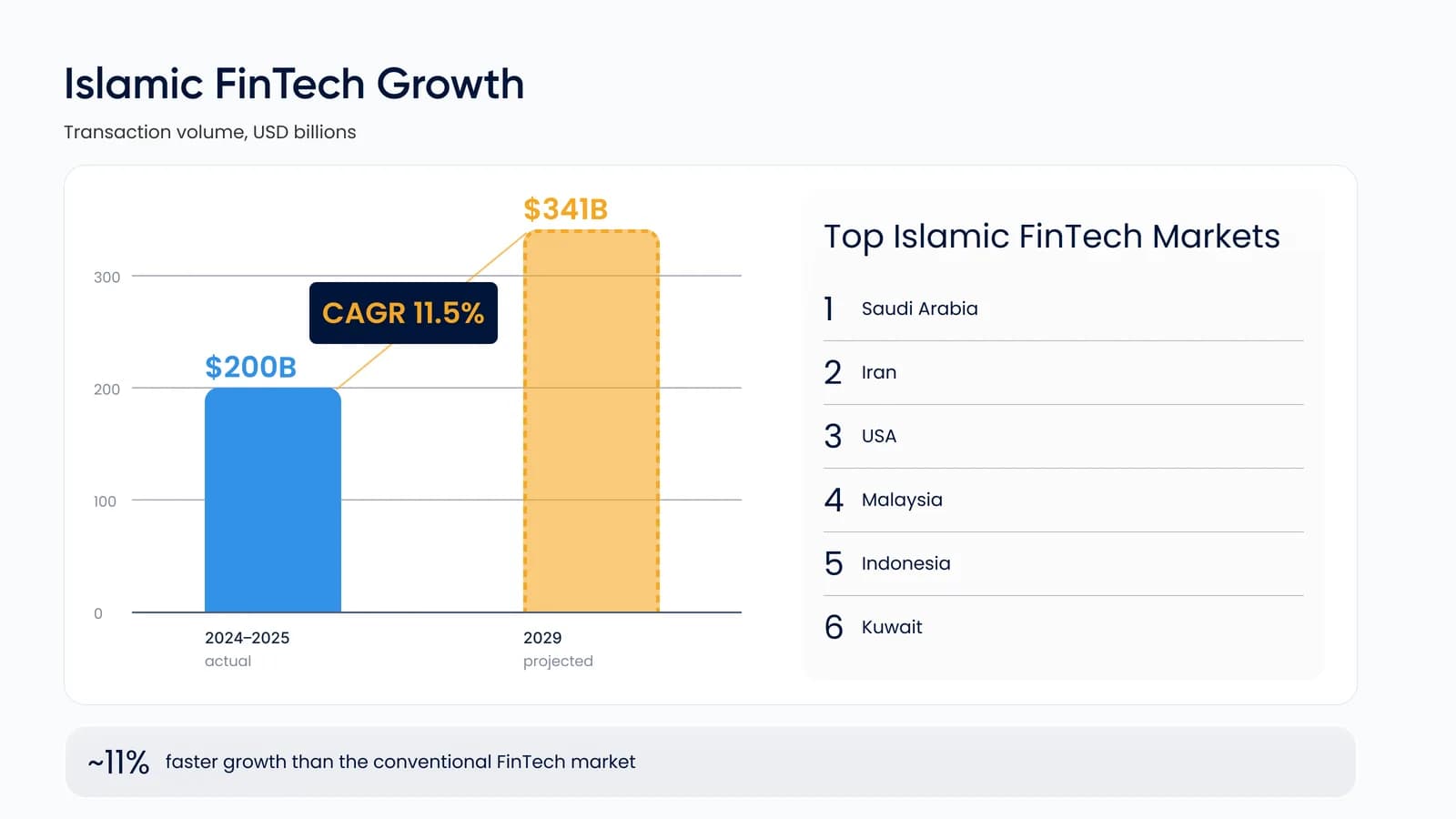
Talking about Islamic FinTech specifically, the almost $200-billion transaction volume registered in 2024-2025 is growing fast, with a $341-billion figure set for 2029 and a CAGR of 11.5%. Its top markets include Saudi Arabia, Iran, the USA, Malaysia, Indonesia, and Kuwait, and the rest of the Islamic and non-Islamic world is adopting the model fast. This fact is supported by Islamic FinTech outpacing usual FinTech market growth by around 11%.
At present, Islamic FinTech is only about 1.5% of the world’s FinTech market. This tiny ratio points to the immense market potential for Shariah-compliant FinTech products amid the rising understanding of this financial model’s benefits.
An influential factor for Islamic FinTech’s explosive growth is the demographic turn, with the young Muslim Gen Z population expected to exceed 2.2 billion by 2030. This population combines religious observance with technology needs, as the gap between intent and actual Islamic FinTech use is still wide. Besides, Islamic finance is a powerful option for targeting the massive segment of unbanked and underbanked population, which has traditionally fallen in the cracks of conventional finance. Therefore, the combination of flexible, decentralized blockchain logic and Shariah compliance gives Islamic DeFi and FinTech unique market benefits worth exploring.
Yet, it’s vital not to ignore objective market challenges and barriers on the way to building and launching genuinely Shariah-compliant FinTech products. Pioneers in this area cite complicated access to capital, the need for extensive consumer education, and regulatory hurdles as their main pain points. Fatwa fragmentation across madhhabs and jurisdictions also adds complexity, while scholarly debates about the status of crypto go on.
FAQ
No, takaful relates to Islamic insurance. Traditional insurance models don’t stand the gharar and riba tests, while takaful represents a mutual risk pool to which participants donate money to cover each other. The pool’s operator earns a wakala fee or receives the Mudarabah share without underwriting profits. If the pool is in surplus, the latter is distributed among participants.
As a rule, Islamic mortgages are structured on the principle of a diminishing musharakah. The bank and the buyer co-own the house, with the buyer purchasing the bank’s share over time while paying rent to the bank for occupying the non-owned share of the property.
There is no consensus on the subject, with BTC advocates treating it as a halal cryptocurrency because it’s mal (property). In this case, Bitcoin’s value is established by convention. Opponents argue that BTC is not halal because of a lack of intrinsic backing and absence of sovereign issuance mechanisms. Besides, BTC’s speculative volatility may be interpreted as gharar.
Gold and silver are treated as ribawi commodities in Islamic finance, meaning they can be exchanged for money hand-to-hand. Deferred or leveraged gold trading is banned, which means that tokenized gold projects seeking Shariah compliance should take proper care of genuine allocated backing and immediate settlement mechanics.
Tainted money should undergo the process of purification, with the sum of generated interest quantified in the Shariah compliance audit and donated to charity without expectation of rewards or tax deductions.
Build Your Shariah-Compliant DeFi Product With 4IRE
Our blockchain engineers build regulated financial products end to end, from contract design and permissioned transfer layers through to the technical documentation your auditors will read. Schedule a free consultation.