


BullX is a web-based memecoin trading terminal. Users sign in through Telegram, fund wallets the platform generates for them, and buy or sell newly launched tokens in one click across several chains. Its business model is simple: BullX's fee documentation lists a 1% platform fee on every buy and every sell.
For a while, that model worked very well. According to DefiLlama, BullX collected about $96 million in fees in 2024 and $106 million in 2025. Then, on 1 June 2026, BullX paused trading in the current version of its app to focus on the next version, keeping wallet functions such as withdrawals available. As of September 2026 it had not announced a restart date, and DefiLlama shows its fees near zero since June.
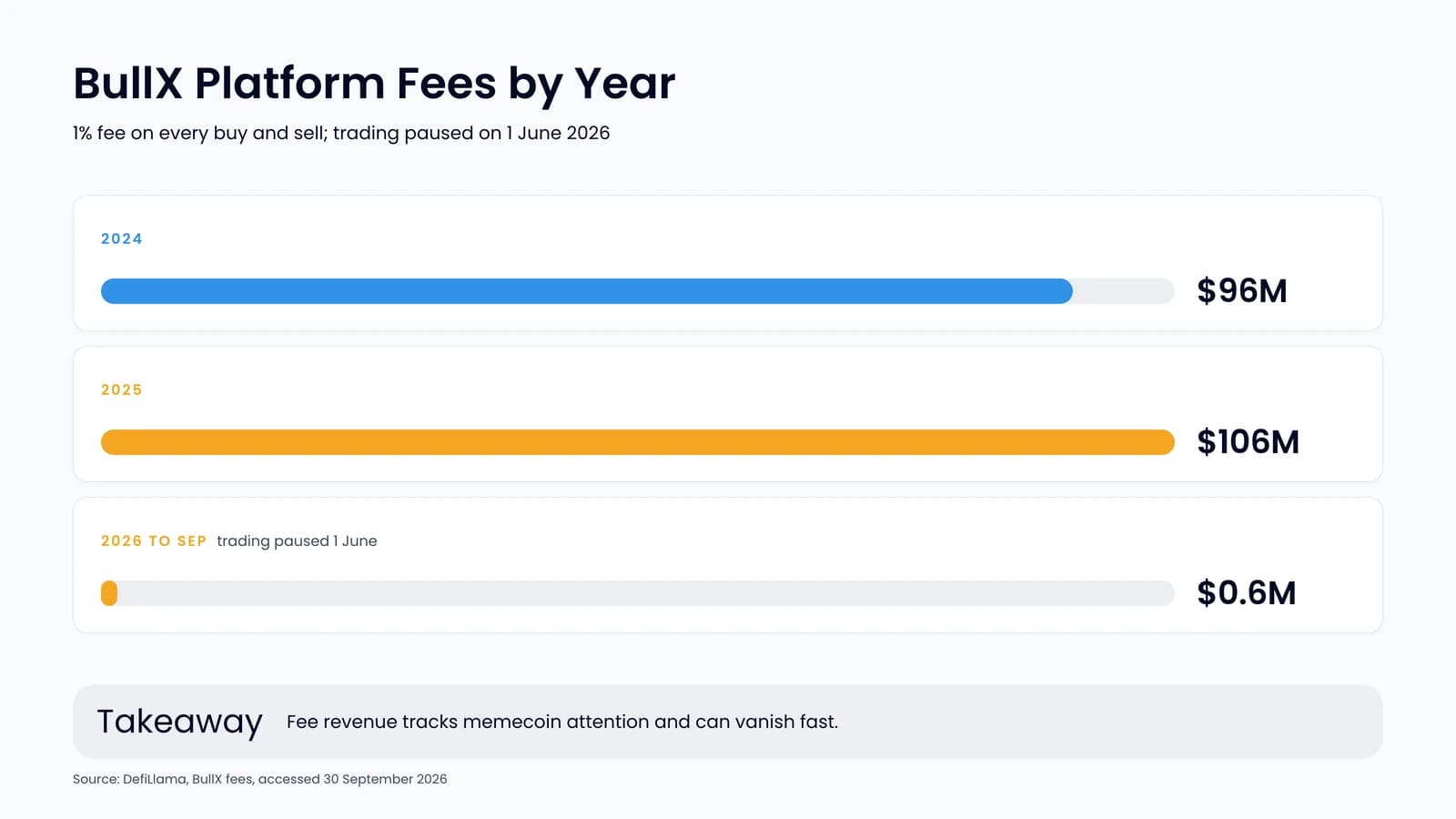
That arc is both the business case and the warning. This guide explains what a BullX-style platform does, how it makes money, what it takes to build one, and what to design differently so your product survives the next shift in the market.
What Is BullX?
BullX NEO is a "hybrid" trading terminal: a web app with the speed of a Telegram bot. Its documentation describes the main building blocks:
- Token discovery: an Explore page and Neo Vision, a dashboard for tokens launched on bonding-curve launchpads such as pump.fun, sorted into new creations, tokens about to "graduate" to a DEX pool, and recently graduated ones.
- One-click trading with presets for priority fees, slippage and MEV protection.
- Automation: Auto Sell strategies that place several take-profit and stop-loss orders on every token bought.
- Wallet tracking, multi-chart views, a wallet manager for several wallets, and a portfolio view.
- Generated wallets: the platform creates wallets for users and shows their private keys once, recommending that users import them into a standard wallet.
None of this requires BullX to run its own exchange. It routes trades to existing launchpads and DEX pools, which is why a terminal like this is cheaper to build than a DEX protocol.
How a Memecoin Trading Platform Makes Money
Revenue is a percentage of trading volume. BullX takes 1% on each buy and each sell, on top of network fees, priority fees and any MEV protection fees the user chooses. Other common revenue lines are referral programmes that share fees with promoters, premium analytics tiers and sponsored placements.
The weakness is just as clear: revenue tracks memecoin attention, and users switch terminals quickly. DefiLlama's data shows how fast leadership changes. In the 30 days to 28 September 2026, Axiom, a newer terminal, generated about $37.5 million in fees, while Photon, a leader in 2024, generated about $0.4 million. A business plan should assume sharp cycles and competitors a click away.
Why Build One Now, and What to Do Differently
Demand has not disappeared. The meme segment was still worth about $34.9 billion on 30 September 2026, according to CoinGecko, and terminals such as Axiom still earn tens of millions of dollars a month in fees. What has changed is what it takes to stay in the market:
- Resilience: multi-chain support and a modular architecture, so one chain's slowdown or one launchpad's change does not stop the business.
- Security: a wallet model users can trust, with clear key ownership.
- Protection by default: risk flags on every token, not only speed.
- A product beyond one niche: many teams extend a terminal into perpetuals, prediction markets or copy trading once they have an audience.
Knowing how tokens are created helps too. Our guide to launching a meme coin explains the contract and liquidity red flags your risk engine should detect.
Core Features of a BullX-Style Platform
- Real-time token discovery: indexing of new pools and launchpad tokens, with filters for liquidity, holders, age and volume.
- Fast execution: routing through DEX pools or a DeFi aggregator, priority-fee control, slippage settings and MEV protection.
- Automated orders: limit, take-profit and stop-loss orders executed by the platform, built on the same patterns as a crypto trading bot.
- Risk data: holder concentration, retained mint or freeze authority, liquidity lock status and developer wallet activity shown before every buy.
- Wallet management: several wallets per user, deposits, withdrawals and key export.
- Social tools: wallet tracking, alerts and shareable PnL cards.
- Account security: two-factor authentication and withdrawal address allowlists.
Technical Architecture
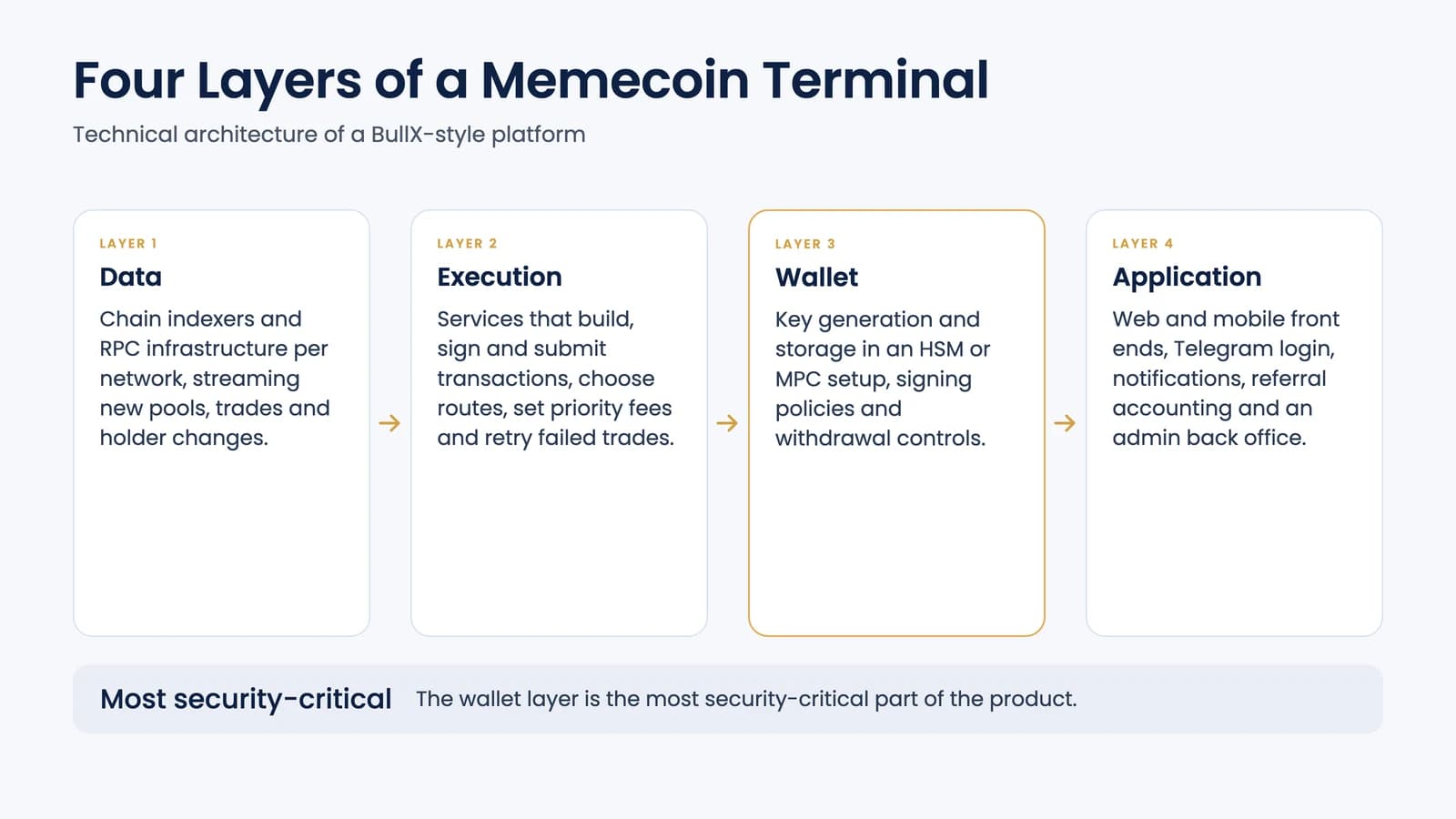
A terminal like BullX has four main layers:
- Data layer: chain indexers and RPC infrastructure per network that stream new pools, trades and holder changes with minimal delay. On a fast chain such as Solana, latency here decides whether the product feels fast; our Solana development team works with this layer daily.
- Execution layer: services that build, sign and submit transactions, choose routes, set priority fees and retry failed trades.
- Wallet layer: key generation and storage in an HSM or MPC setup, signing policies and withdrawal controls. This is the most security-critical part of the product; see our crypto wallet development services for the main custody models.
- Application layer: web and mobile front ends, Telegram login, notifications, referral accounting and an admin back office.
Step-by-Step Development Process
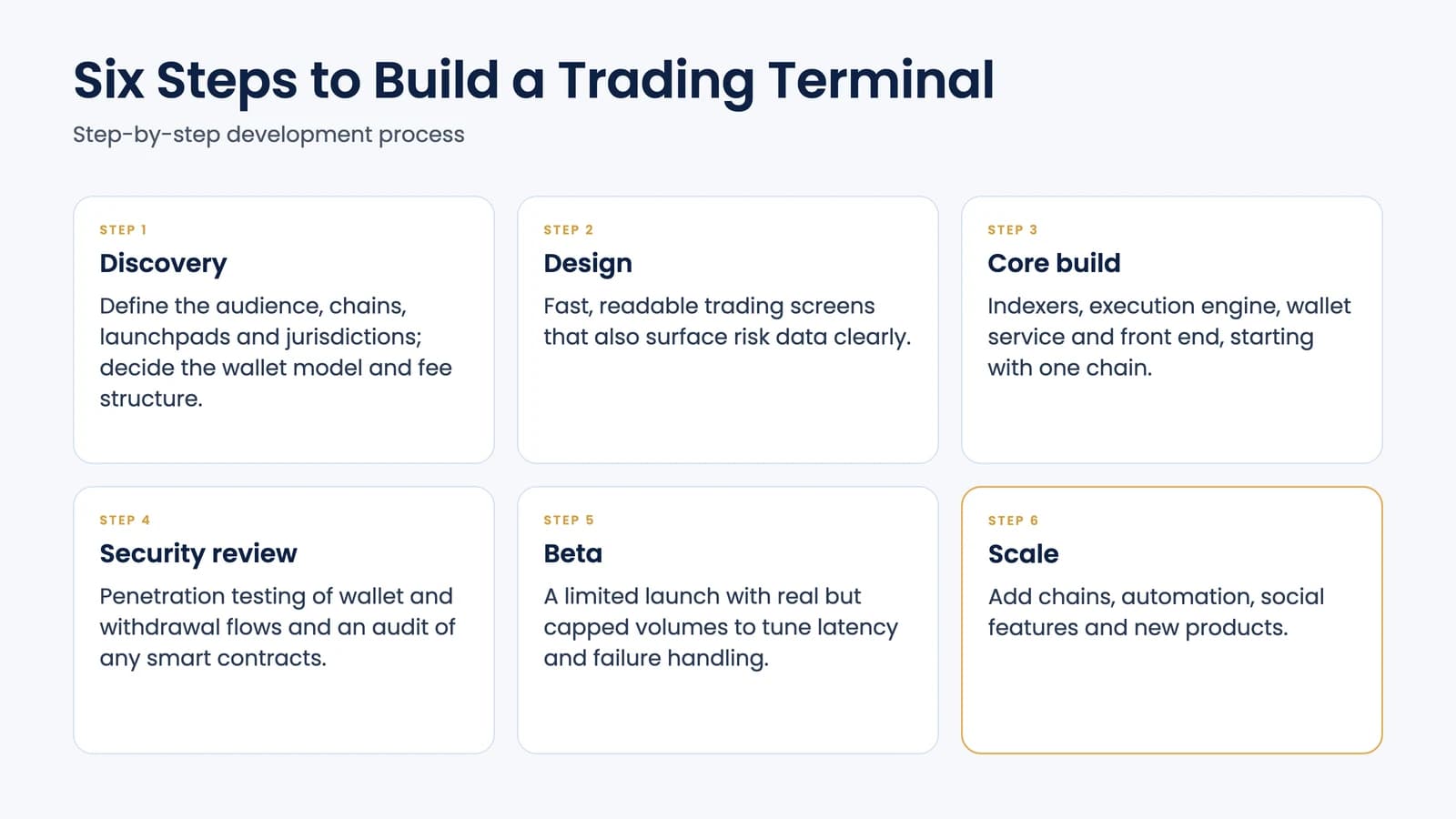
- Discovery: define the audience, chains, launchpads and jurisdictions; decide the wallet model and fee structure.
- Design: fast, readable trading screens that also surface risk data clearly.
- Core build: indexers, execution engine, wallet service and front end, starting with one chain.
- Security review: penetration testing of the wallet and withdrawal flows and an audit of any smart contracts.
- Beta: a limited launch with real but capped volumes to tune latency and failure handling.
- Scale: add chains, automation, social features and new products.
Custody and Compliance
The wallet model decides much of your regulatory exposure. If the platform generates and controls keys on users' behalf, it is likely to be treated as a custodian in many jurisdictions. In the EU, that is a crypto-asset service under MiCA, which requires authorisation now that the transitional period ended on 1 July 2026. A model where users hold their own keys and sign trades carries a lighter load but still leaves questions about brokerage, marketing and sanctions screening. Our overview of fintech and crypto licences covers the main regimes; get legal advice for each market before launch.
How Much Does It Cost?
By 4IRE's estimate, a basic memecoin trading platform with a standard feature set costs roughly $100,000–$150,000. An advanced multi-chain platform with automation, social features and gamification costs $200,000–$300,000 or more. The final figure depends on the number of chains, the wallet model and the latency targets. A terminal does not need its own AMM; if you also want to run your own exchange protocol, see our decentralized exchange development services.
How 4IRE Can Help
4IRE has built trading products for the memecoin audience, including Together.fun, a provably fair memecoin PvP game on Solana with live alpha feeds, community chat and one-screen execution. We can help you scope, build and secure a trading terminal designed to last beyond a single market cycle.
Learn more from us
 Blockchain news28 Sept 2026
Real Estate Tokenization in 2026: A Guide to Fractional Ownership
How real estate tokenization works: SPVs, token standards, fractional ownership, current market data, Deloitte's 2035 forecast, rules and real projects.
Olena Petrashchuk
 Bank08 Oct 2026
What Are Crypto Banks? Everything You Need to Know
What crypto banks are, how they work, the main types, how they differ from traditional banks, and how they are regulated in 2026.
Olena Petrashchuk
 Cryptocurrency28 Sept 2026
How to Build a Cryptocurrency Exchange Platform in 2026
How to build a cryptocurrency exchange platform: choose CEX, DEX or hybrid, white-label or custom, plan features, then build, license and launch.
Yaroslav Tumanov
FAQ
BullX paused trading in the current version of its app on 1 June 2026 to focus on its next version, keeping wallet functions such as withdrawals available. As of September 2026, it had not announced a restart date.
Mostly through a fee on each trade. BullX's documentation lists a 1% platform fee on every buy and sell. Referral programmes, premium analytics and sponsored placements are common additional revenue lines.
Start with the chain where your audience trades, for example Solana, where launchpads such as pump.fun operate, then add EVM chains such as Base, BNB Chain and Ethereum. A modular architecture lets you add chains without rebuilding the core.
It depends on the wallet model and the markets you serve. A platform that controls users' keys is likely to be treated as a custodian, and in the EU that requires MiCA authorisation. Get legal advice for each market before launch.
By 4IRE's estimate, roughly $100,000–$150,000 for a basic platform and $200,000–$300,000 or more for an advanced multi-chain platform with automation and social features.