

 Stablecoin news

USD1 is a US dollar stablecoin sold under the World Liberty Financial brand, a crypto company co-founded by members of President Donald Trump's family. When we first wrote about it in April 2025, it had just launched on Ethereum and BNB Chain. By October 2026 the picture is far more concrete: about $4.4 billion of USD1 circulates across several blockchains, the tokens are issued by a federally chartered trust bank, KPMG examines the reserves every month, and World Liberty has conditional approval for a trust bank of its own. This update covers how the USD1 stablecoin works, what backs it, who is behind World Liberty Financial and why the project draws political scrutiny.
What is USD1 and who issues it?
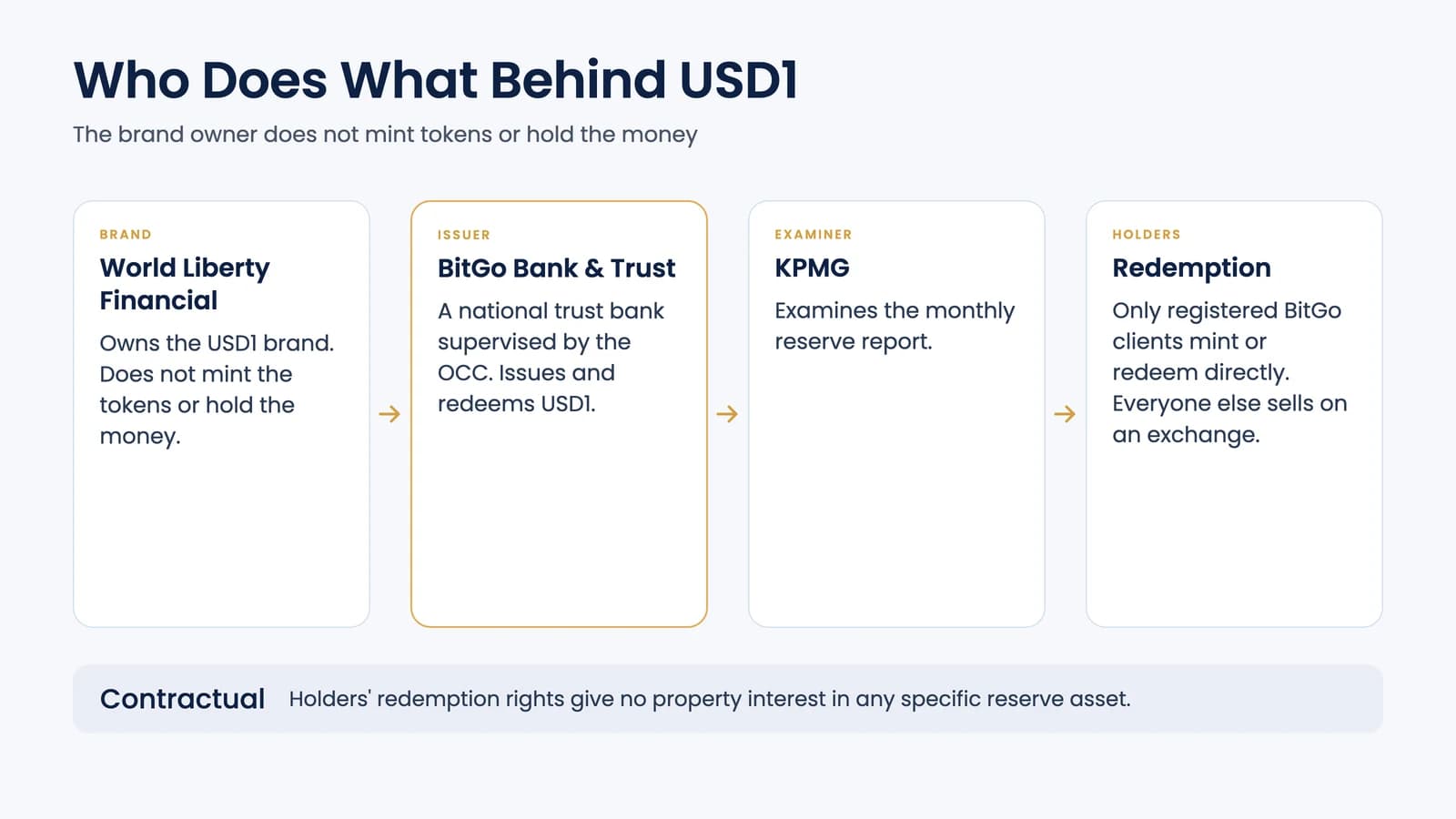
USD1 is a dollar-pegged stablecoin: each token is meant to be redeemable for one US dollar. World Liberty Financial owns the brand, but it does not mint the tokens or hold the money. According to the August 2026 reserve report, USD1 is issued and redeemed by BitGo Bank & Trust, N.A., a national trust bank chartered and supervised by the Office of the Comptroller of the Currency (OCC). The USD1 brand and related trademarks belong to World Liberty Financial, Inc. and SC Financial Technologies, LLC.
Redemption is narrower than many guides suggest. Only registered BitGo clients in good standing, who have passed its identity, anti-money-laundering and sanctions checks, can mint or redeem USD1 directly. Everyone else can hold and transfer the token, but gets dollars back by selling it on an exchange or another platform. The same report says holders' redemption rights are contractual and give no property interest in any specific reserve asset.
What backs USD1?
World Liberty's documentation says USD1 is backed by cash, US government money market funds and other cash equivalents, all held or maintained by BitGo. The monthly reports show what that means in practice. KPMG examined BitGo's report for August 2026, signed on September 24, 2026, and found management's assertion fairly stated. At 11:59 p.m. UTC on August 31, 2026, the report listed:
- 4,195,303,689 USD1 tokens outstanding, all of them redeemable;
- $1,129,357,410 in cash held in demand deposit accounts at US commercial banks;
- $3,066,358,657 in a government money market fund;
- $4,195,716,067 in total redemption assets, a surplus of $412,378 over tokens outstanding.
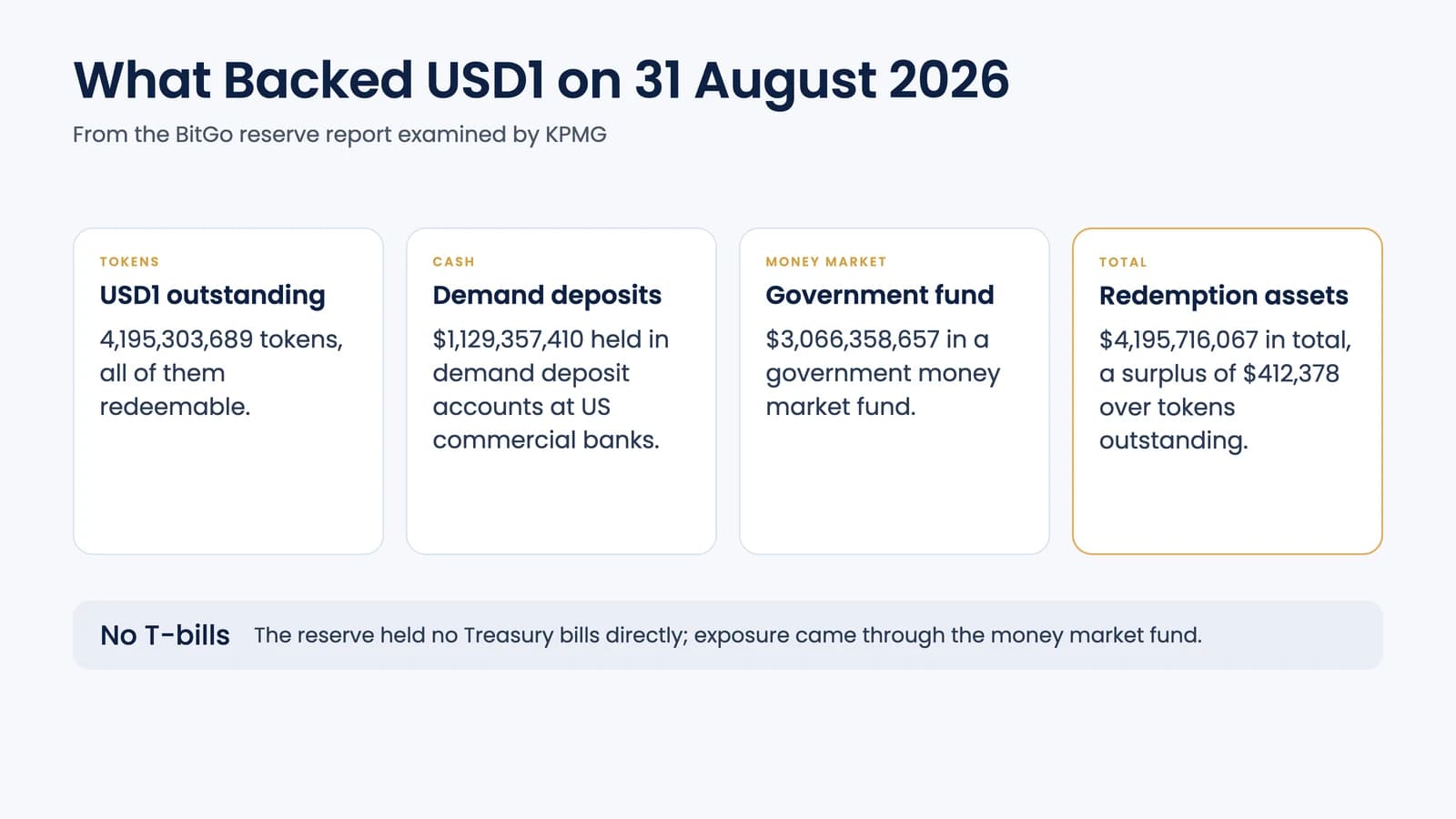
Two details matter when you compare USD1 with older stablecoins. On that date the reserve held no Treasury bills directly; Treasury exposure came through the money market fund. And the report itself discloses that bank balances can exceed the FDIC's $250,000 insurance limit. Monthly reports going back to April 2025 are linked from World Liberty's attestation page.
How big is USD1 in October 2026?
DefiLlama tracked about $4.44 billion of USD1 in circulation on October 6, 2026, the sixth-largest US dollar stablecoin on its list after USDT, USDC, USDS, USDe and DAI. That is roughly 1.4% of the $312.7 billion in US dollar stablecoins DefiLlama tracked the same day; USDT alone accounted for about $184 billion.
BitGo's August report lists USD1 contracts on Ethereum, BNB Smart Chain, Solana, Tron, Aptos, Tempo and the Canton Network, and DefiLlama also counts supply on Monad, Plume and AB Core. Ethereum and BNB Chain still carried most of it at the end of August, about 1.57 billion and 1.40 billion tokens respectively. Growth has been steady: CoinDesk put supply above $3.4 billion on January 12, 2026, the day World Liberty launched World Liberty Markets, a lending app built on Dolomite with USD1 as its main asset.
Who is behind World Liberty Financial?
Banking Dive describes World Liberty Financial as founded by Zach Witkoff, its CEO and chairman, together with Eric Trump, Donald Trump Jr. and Barron Trump, and notes that President Trump was listed as co-founder emeritus when the company applied for a bank charter in January 2026. CoinDesk identifies Zak Folkman as co-founder and chief operating officer.
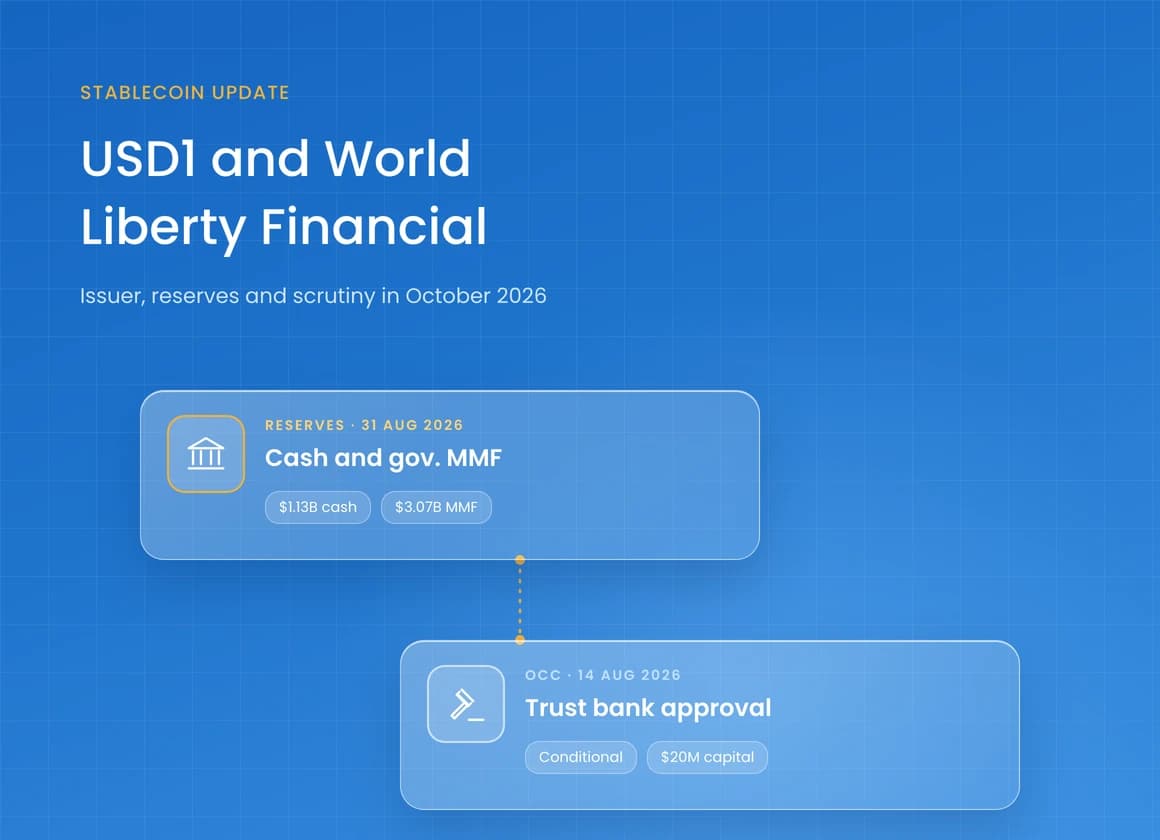
On August 14, 2026, the OCC granted conditional approval to World Liberty Trust Company, N.A., which plans to issue and redeem USD1, hold its reserves and offer digital asset custody to institutions. The approval carries conditions, including a minimum of $20 million in tier 1 capital, and the bank cannot open until the OCC grants final approval after its pre-opening requirements are met. If the trust company opens, World Liberty could issue USD1 itself; as of the August 2026 report, BitGo is still the issuer.
Why does USD1 draw conflict-of-interest scrutiny?
The criticism centres on a company partly owned by the president's family operating in a market regulated by federal agencies. Three reported facts drive most of it:
- The MGX deal. On May 1, 2025, World Liberty announced on stage at the Token2049 conference in Dubai, with Eric Trump and Zach Witkoff present, that Abu Dhabi's MGX would use USD1 to close its $2 billion investment in Binance, as Reuters and CoinDesk reported.
- The bank's ownership. The Wall Street Journal reported in August 2026, as relayed by The Block and Quartz, that StringZ Holding RSC, backed by Sheikh Tahnoon bin Zayed Al Nahyan, the UAE's national security adviser, holds 49% of WLTC Holdings, the trust bank's holding company, while an entity affiliated with the Trump family holds 38%.
- Lawmakers' objections. Senator Elizabeth Warren urged the OCC to reject the charter application, and Americans for Financial Reform said the charter "creates insurmountable conflicts of interest", according to Banking Dive.
The White House rejects the charge: principal deputy press secretary Anna Kelly said the president "only acts in the best interests of the American public", as reported by The Block on August 27, 2026. We report the allegations and responses as published and take no position on them.
Is USD1 compliant with the GENIUS Act?
The GENIUS Act, signed on July 18, 2025, is the first US federal law for payment stablecoins, and World Liberty's documentation says USD1 is designed to align with its standards. The core rules for issuers are:
- reserves of at least 1:1 in cash, bank deposits, Treasury bills of 93 days or less, overnight repos or government money market funds that hold only those assets;
- monthly public disclosure of reserve composition;
- a monthly examination of that report by a registered public accounting firm, plus a certification by the CEO and CFO;
- no interest or yield paid to holders simply for holding the stablecoin.
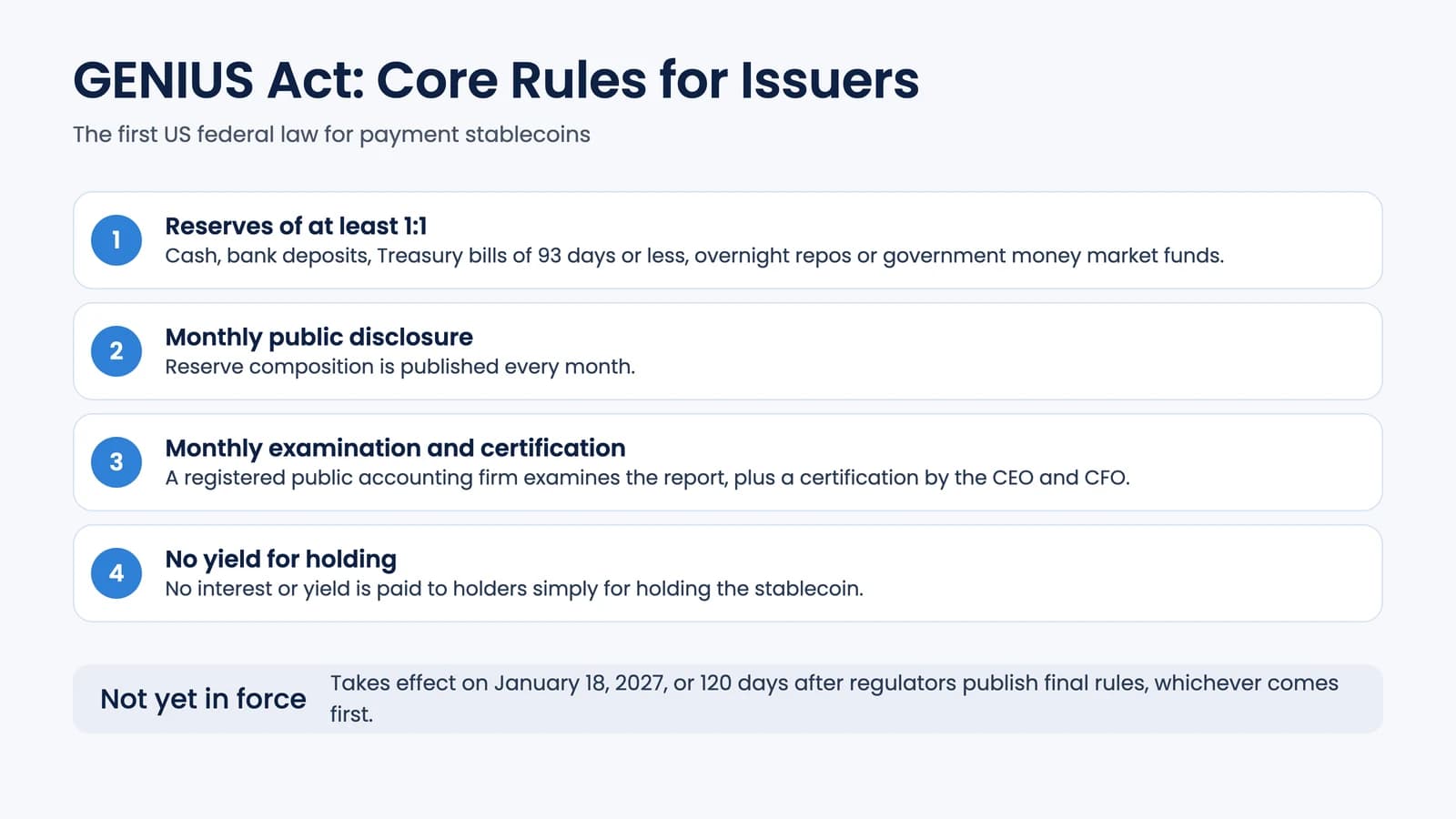
The Act is not yet in force. It takes effect on January 18, 2027, or 120 days after regulators publish final rules, whichever comes first, and the OCC proposed its implementing rules on February 25, 2026. On the evidence of the August report, USD1's reserve mix and monthly examined reporting already follow the shape the law requires.
What does USD1 teach teams building a stablecoin?
USD1 is a useful case study because its documents show exactly which parts are contracted out: a brand owner works with a regulated issuer and custodian, an outside auditor and several blockchains. Anyone planning a dollar token faces the same decisions:
- Issuer of record. Partnering with a chartered trust bank got USD1 to market quickly; World Liberty is now pursuing its own charter as well.
- Who can redeem. Limiting direct redemption to verified clients simplifies compliance, but it makes exchange liquidity part of how the peg holds.
- Reserve and reporting. Decide what the reserve holds and who examines it each month, before launch, not after.
- Chains and reconciliation. Every extra chain adds a contract to secure and supply to reconcile; see our guide to stablecoin issuance and redemption infrastructure.
- Contract security. Token contracts, minting roles and bridges need a smart contract audit before real money flows through them.
For how established issuers handle the same trade-offs, compare Circle and Paxos, and for the build itself, see how to launch a stablecoin on Ethereum. 4IRE works on stablecoin development and on the architecture and regulatory planning that comes before it.
FAQ on USD1 and World Liberty Financial
BitGo Bank & Trust, N.A., an OCC-chartered national trust bank, issues and redeems USD1, according to its August 2026 reserve report. World Liberty Financial and SC Financial Technologies own the USD1 brand. World Liberty Trust Company received conditional OCC approval on August 14, 2026 and could take over issuance if it opens.
Cash and US government money market fund shares held by BitGo for USD1 holders. On August 31, 2026, the KPMG-examined report showed about $1.13 billion in bank deposits and $3.07 billion in a government money market fund against 4.195 billion tokens outstanding.
Its issuer is a federally chartered trust bank supervised by the OCC, and World Liberty says USD1 is designed to align with the GENIUS Act. The Act itself takes effect no later than January 18, 2027. Only BitGo clients who pass its compliance checks can redeem directly with the issuer.
About $4.44 billion on October 6, 2026, according to DefiLlama, which made it the sixth-largest US dollar stablecoin it tracked. The August 2026 attestation counted 4,195,303,689 tokens on August 31.