

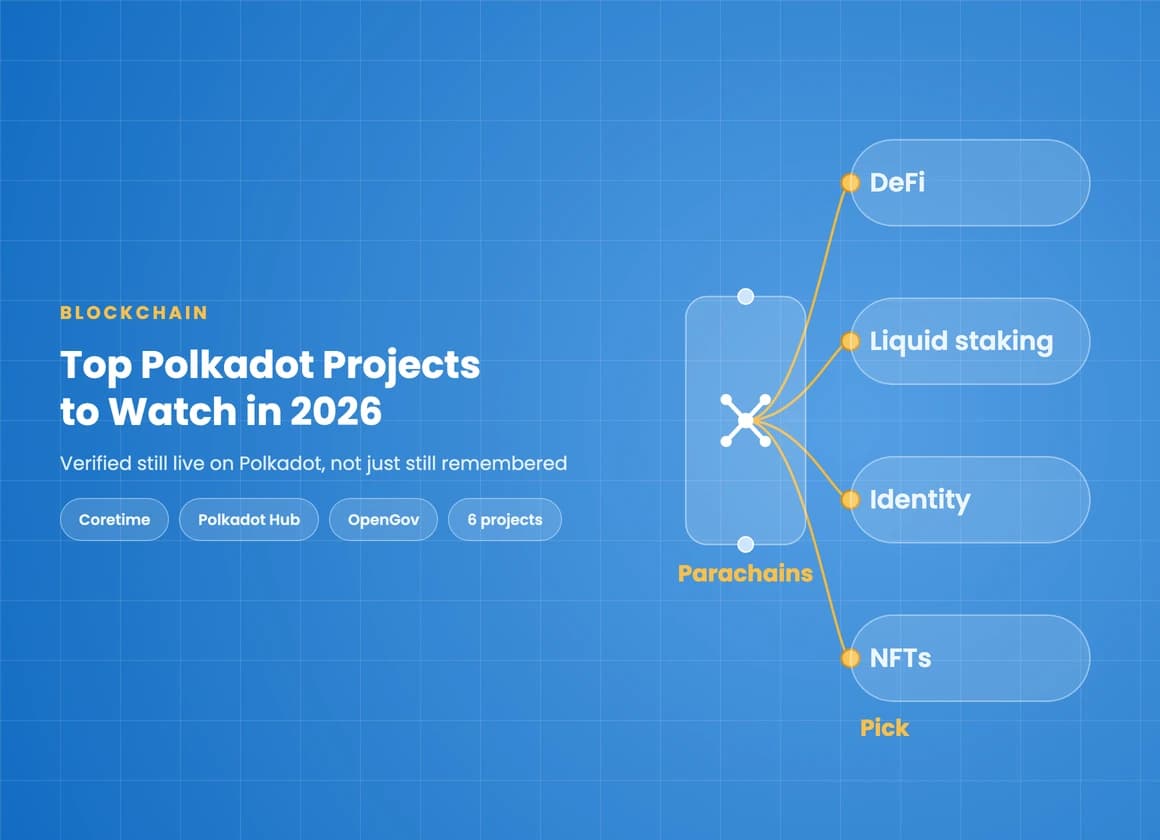

A "top Polkadot projects" list written in 2021 is now mostly a list of defunct chains: parachain-slot winners that never shipped a product, or tokens whose ambitions ran ahead of their teams. A list written carelessly in 2026 has a newer version of the same problem, because several genuinely large Polkadot projects have since left the network for other chains. This guide only includes projects we could confirm are still running on Polkadot as of October 2026, each with a dated signal of current activity.
How Polkadot's Project Roster Changed Since 2021
The way projects access Polkadot's shared security changed first. Parachain slot auctions, which used to lock up DOT for years at a time, ended on 19 September 2024 and were replaced by Agile Coretime, where a chain buys validation capacity in 28-day bulk periods, on demand per block, or splits one core's capacity across several chains through elastic scaling. That is a materially lower commitment than the old multi-year DOT lease, which is part of why several smaller or struggling projects could afford to leave for another chain when their lease came up: the lock-in that used to keep a chain on Polkadot regardless of its health is largely gone. In November 2025, balances, staking and governance moved from the relay chain to Polkadot Hub, which also runs Solidity smart contracts. Our full explainer on what Polkadot is covers that architecture in detail.
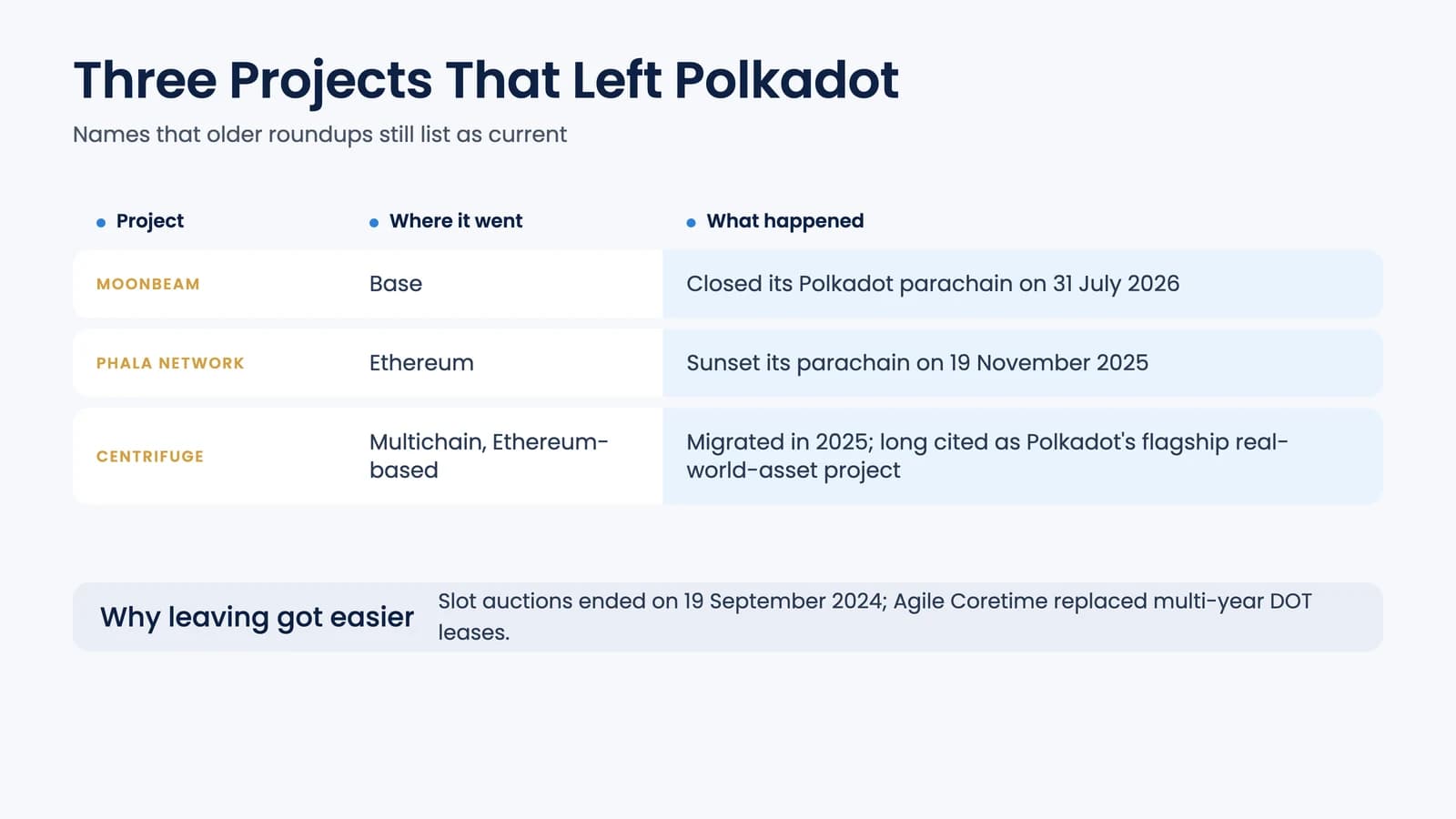
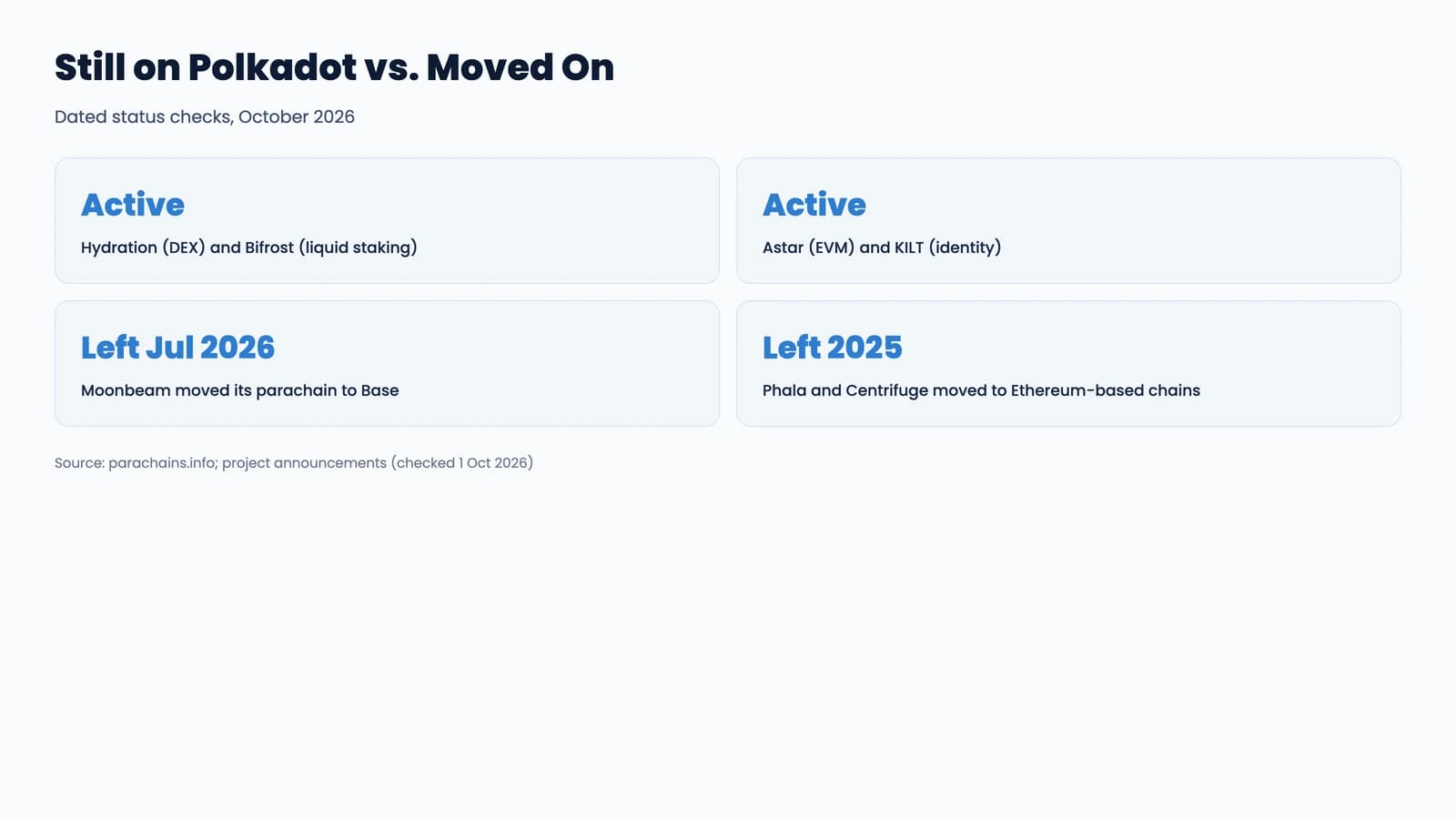
The project roster changed too. Three names that regularly show up in older "top Polkadot" roundups have left the network outright: Moonbeam closed its Polkadot parachain on 31 July 2026 and moved to Base; Phala Network sunset its parachain on 19 November 2025 and moved to Ethereum; and Centrifuge, long cited as Polkadot's flagship real-world-asset project, migrated to a multichain Ethereum-based architecture in 2025. None of these are failures of Polkadot itself, but a listicle that still names them as current Polkadot picks is working from an outdated snapshot.
Top Polkadot Projects in 2026
Hydration
Hydration, rebranded from HydraDX, is Polkadot's main decentralized exchange. Its Omnipool design pools liquidity for many assets into one shared trading venue, not split across separate pairs, and it issues HOLLAR, a Polkadot-native stablecoin. Like every parachain, it renews its access to block space periodically under Agile Coretime rather than through a multi-year lease, which is routine and not a sign of instability.
Bifrost
Bifrost is Polkadot's largest liquid staking project, though its reported value locked has fallen to roughly $14 million as of October 2026 (CoinGecko), well short of the "$100 million+" figure the project's own materials cite. In March 2026 it launched Loopstake, a leveraged staking tool, and its parachain has continued shipping runtime upgrades through 2026.
Acala
Acala runs Polkadot's longest-standing DeFi hub parachain, offering lending, liquidity and its aUSD stablecoin. aUSD suffered a widely reported depeg in 2022 after a configuration error, and its trading volume has not returned to pre-incident levels since; anyone building on it should treat that history as relevant due diligence, not a solved problem.
Astar Network
Astar has long run smart contracts in both the Ethereum Virtual Machine and Wasm through ink!, but that dual-stack pitch is ending: Runtime-2207 (June 2026) froze new WASM/ink! deployments on Astar and Shiden after ink!'s maintainers discontinued it, existing WASM contracts keep running for now, and the Astar Foundation's published plan removes the pallet-contracts module from the runtime entirely later in 2026. In March 2026, Astar launched a Fast Finality Layer with AltLayer and EigenLayer, and the project has increasingly positioned itself as an EVM-first multichain hub, not a Polkadot-only, dual-VM chain.
KILT Protocol
KILT issues and verifies decentralized identity credentials, and it is one of the few Polkadot projects with a named enterprise customer: Deloitte uses KILT-based credentials for parts of its KYC and KYB processes. That kind of adoption is a more durable signal than trading volume for an identity-infrastructure project.
Unique Network
Unique Network is a Polkadot parachain built specifically for NFTs, with sponsored transactions, re-fungible tokens and cross-chain transfers between its own chain and Polkadot's Asset Hub. It remains one of the few parachains with an NFT-specific focus still active on the network.
How to Check Whether a Polkadot Project Is Still Live
A project's own homepage is not always enough to tell. As of October 2026, neither Moonbeam's nor Phala's site prominently flags that it has left Polkadot; both describe their current positioning, not an archived history. A faster check: parachains.info lists every chain holding Agile Coretime, and as of 1 October 2026 it shows 27 active chains on Polkadot's relay chain, each with its own coretime status. If a project is not on that list, or its most recent blog post or social account mentions "migrating," "sunsetting" or "transitioning" a parachain, treat that as the current answer over an older roundup, including this one a year or two from now.
For governance specifically, every live and historical OpenGov referendum is visible directly on-chain through Polkadot Hub; a project with no referendum activity in the past year is a weaker signal than one still regularly proposing runtime upgrades, a treasury spend or a parameter change.
When to Build Your Own Chain Instead
Not every product should pick an existing parachain at all. The Polkadot SDK, built around the Substrate framework plus FRAME and Cumulus, lets a team build a purpose-specific chain with its own fee model, governance and runtime logic, then plug it into Polkadot's shared validator set through coretime, without bootstrapping an independent set of stakers. That trade-off, more control over the runtime against the engineering cost of running your own chain, is the same one Astar and Hydration made years ago; it only makes sense when a smart contract on an existing chain genuinely cannot express what the product needs. 4IRE's Substrate development team scopes that decision against building on an existing parachain or Polkadot Hub directly.
Real-World Assets: Why We Did Not List a Single Winner
Real-world asset tokenization is one of the categories Polkadot is most often associated with, largely because of Centrifuge's early work there before it left for a multichain Ethereum setup. What remains on Polkadot itself is less a single flagship project and more infrastructure: Polkadot Hub's Asset Hub is designed to let tokenized assets move between chains with shared settlement. If your product needs real-world-asset tokenization specifically, it is worth comparing a Polkadot-based build against other chains case by case; our RWA tokenization team can help with that comparison directly.
Which Polkadot Project Should You Watch?
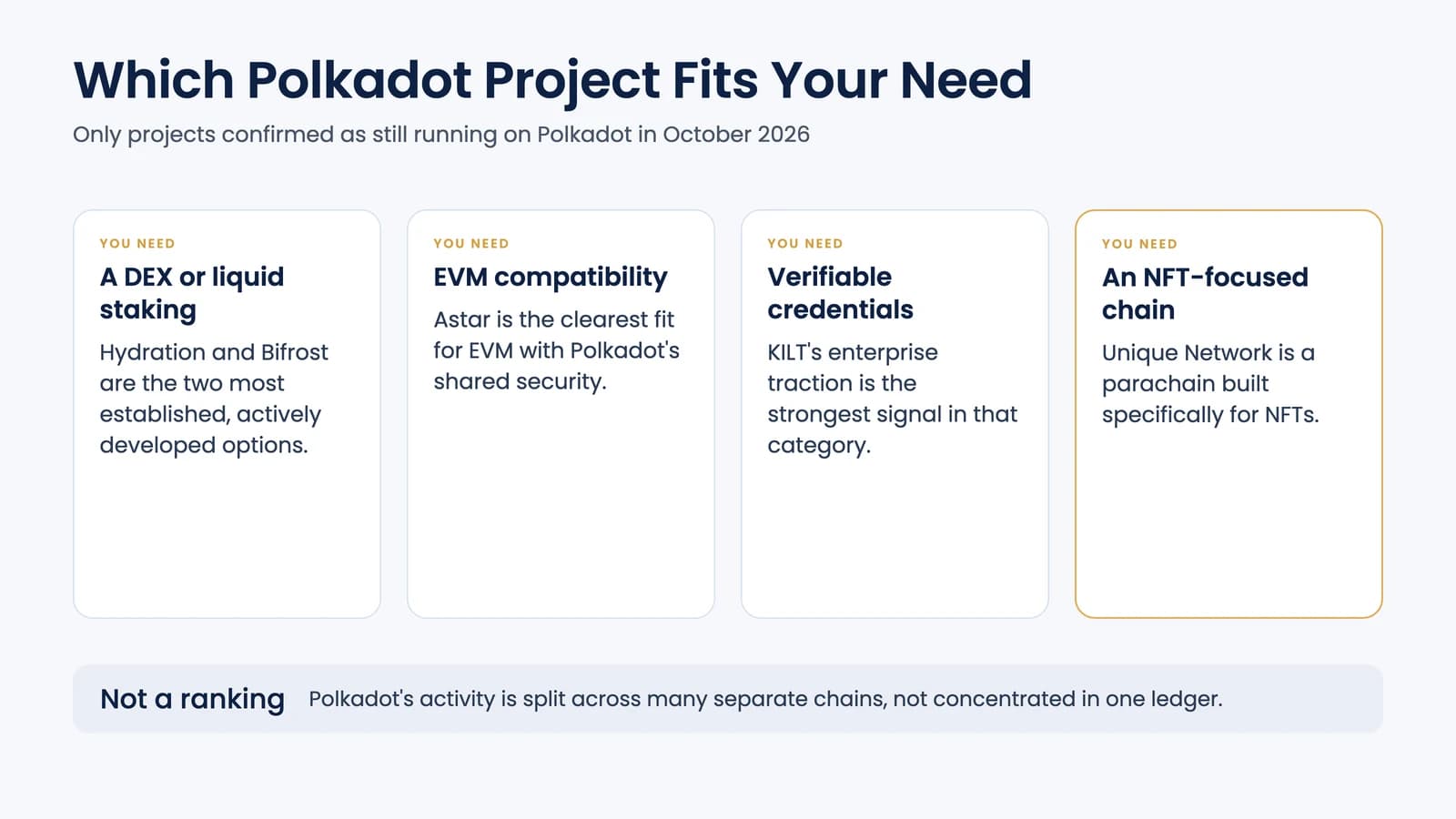
If you need a DEX or liquid staking, Hydration and Bifrost are the two most established, actively developed options. If you need EVM compatibility with Polkadot's shared security, Astar is the clearest fit. If your product needs verifiable credentials and not DeFi, KILT's enterprise traction is the strongest signal in that category. None of this is a ranking of total value, since Polkadot's activity is split across many separate chains rather than concentrated in one ledger the way it is on Cardano or NEAR; see our Cardano vs Polkadot comparison for that contrast directly.
Conclusion
The most useful filter for a Polkadot project list in 2026 is not popularity, it is whether the project is still actually on Polkadot. Several names that defined the network's early reputation have since moved elsewhere, and the projects still building here, Hydration, Bifrost, Astar, KILT and Unique Network, are a smaller but more verifiable list.
If you are evaluating a Polkadot parachain, Polkadot Hub smart contracts, or a Substrate-based chain of your own for a new product, 4IRE's Polkadot and Substrate development team can walk through the current architecture with you.
Building on Polkadot?
4IRE's Polkadot and Substrate team can walk through the current architecture for your product.
Frequently asked questions
No. Moonbeam closed its Polkadot parachain on 31 July 2026 and migrated GLMR to Base, an Ethereum layer-2 network.
Centrifuge, previously cited as Polkadot's main real-world-asset project, migrated to a multichain Ethereum-based architecture in 2025 and consolidated its CFG token into a single Ethereum ERC-20.
Bifrost, Polkadot's liquid staking leader, and Hydration, Polkadot's main decentralized exchange, are the two most established DeFi parachains still active in 2026. Bifrost's own materials cite more than $100 million in value locked, but third-party trackers like CoinGecko put it closer to $14 million as of October 2026.
No. Parachain slot auctions ended on 19 September 2024. Projects now buy Agile Coretime in short bulk periods or on demand instead of locking DOT for a multi-year lease.